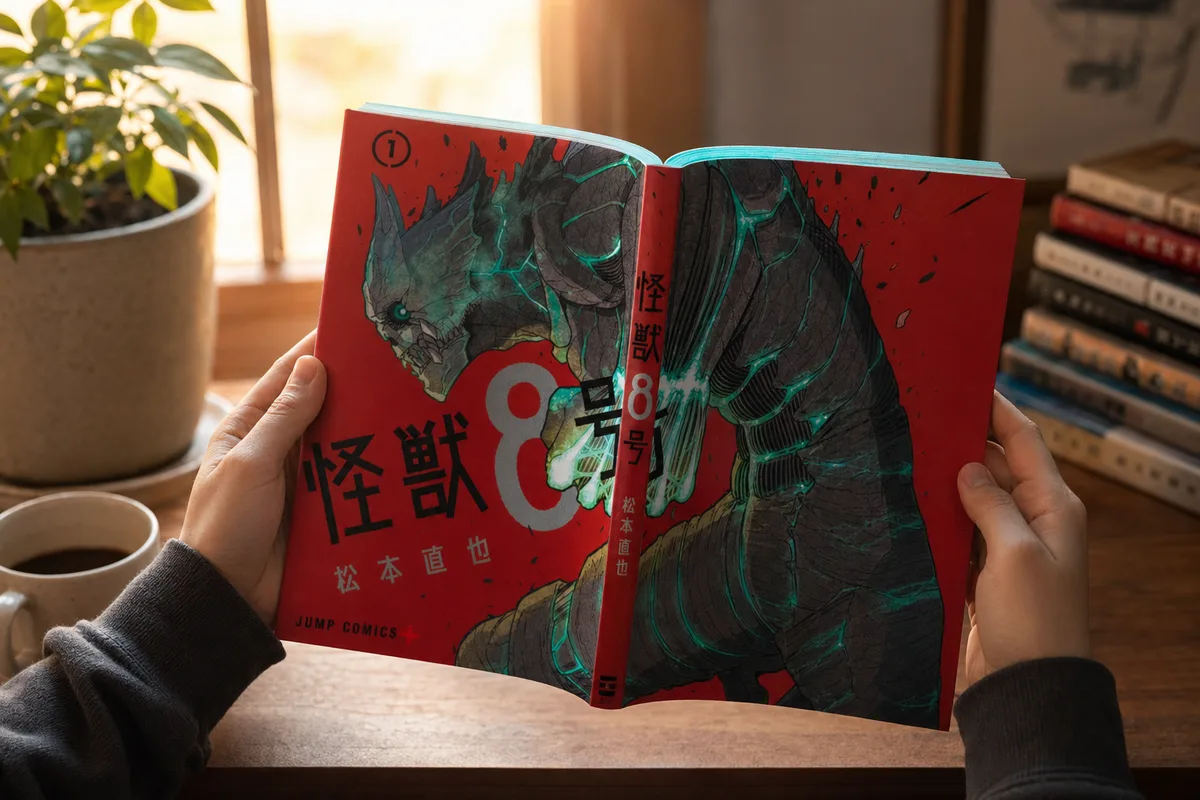
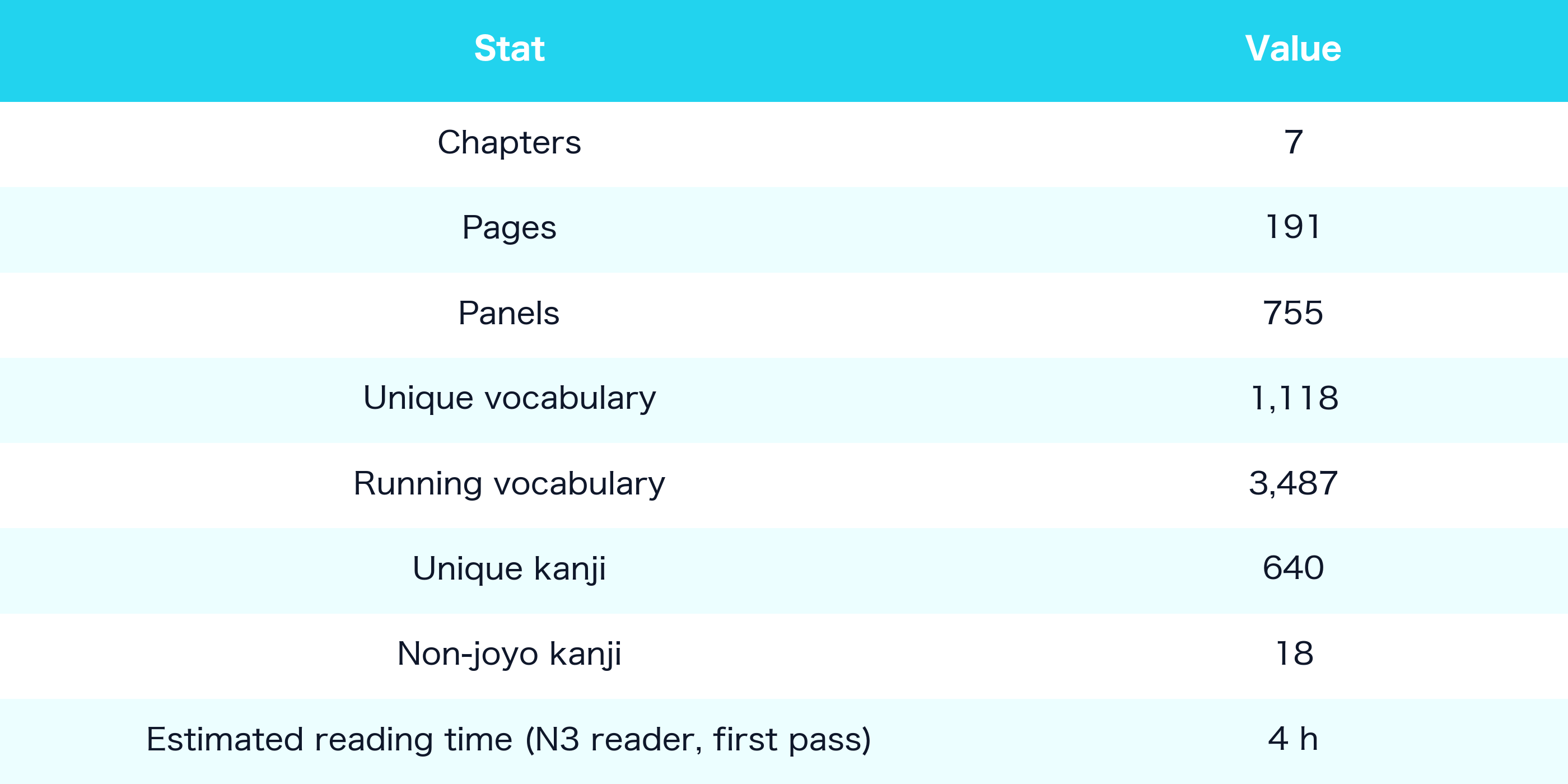
Volume 1 of Kaiju No. 8 (怪獣8号) contains 1,118 unique vocabulary items across 7 chapters, 191 pages, 755 panels, and 3,743 textboxes. The script uses 640 unique kanji on the page, of which only 18 are non-joyo. The hardest single thing in this book is not the kanji and not the grammar. It is the volume of profession-specific vocabulary the manga assumes you understand from page one: kaiju extermination jargon, defense-force chain-of-command speech, and the bureaucratic register of dismantling cleanup contracts.
That is the whole problem with KN8 volume 1 in one paragraph. Here is exactly what is in this book, and exactly what you need to read it.
Every number in this article comes from Ashiba's production corpus, measured against the official N5 to N1 JLPT vocabulary lists and the 2,136-character joyo kanji set. Last measured 2026-04-27.
Is Kaiju No. 8 volume 1 hard to read in Japanese?
Advanced. Not because the grammar is difficult. Because Kaiju No. 8 does not print furigana on most kanji. Where Jujutsu Kaisen and Blue Lock spoon-feed the reading on every kanji, KN8 prints furigana only on proper nouns and the occasional rare reading. Without furigana, kanji you cannot read becomes a wall, not a speed bump. If you do not already know how to read 損傷, 筋繊維, 解体, 廃棄, and 討伐 on sight, you will spend the volume in a dictionary.
People mis-rate this book in both directions. Here is the actual shape.
What makes it easier than you think
The base register is unusually approachable for an action shonen. KN8 spends most of its panels in two modes: workplace banter between adults on a dismantling crew, and recruit-to-officer speech inside the defense force. Both lean on patterns you already know from beginner Japanese. Roughly 40% of the running tokens are N5 or N4, and another 20% are N3. Add it up and roughly 60% of the words on the page are textbook vocabulary. The grammar is modern, the registers are recognisable, and the sentence rhythm is short.
The kanji set is also small for a shonen action title. Volume 1 uses 640 unique kanji, and 622 of them (97.2%) are joyo. The 18 non-joyo characters are a small, manageable set, almost all of them old-style spellings of common everyday words (此奴 for こいつ, 筈 for はず, 喋る for しゃべる, 噛む for かむ). If you can read joyo, you can read this book without looking up a kanji-form, even if you still have to look up the meaning.
What makes it harder than it looks
Out of 1,118 unique vocabulary items, 750 (67%) appear exactly once. That long tail is the real difficulty: most words you look up will not appear again in the same volume. Lookups are not difficulty in disguise. They are volume of unknowns.
Vocabulary acquisition is iterative. A word does not stick the first time. Each word takes multiple painful encounters before recognition becomes automatic, and every encounter breaks the story flow. You stop, you look up, you re-read the sentence, you re-set the panel in your head, you keep going. The tipping point where the manga starts reading easily is further out than most learners expect, and KN8's tipping point gets pushed further by the unlisted bucket. 184 unique words (16.5%) sit outside the JLPT N5 to N1 framework entirely after Gemini-classification. Almost all of it is series-specific: 怪獣 (kaiju), 防衛隊 (defense force), 討伐 (subjugation), 隊員 (force member), 解体 (dismantling), 識別怪獣 (identified kaiju), 本獣 (main beast). At an N3 reader's pace, that is 7 lookups per page on first pass, and most of them are workplace nouns you will not find in any general dictionary. The fix is to pre-study them. Same words, different context. The story stays intact.
You don't need permission. Just go for it.
The real question is not whether this book is at your level. The real question is whether the pain is tolerable for the reward. If you actually want this story, the level mismatch is just a tax on time, not a wall. You pay it in lookups and re-reads and slow chapters until the cost goes down. Always read above your level. Attack the stories that motivate you. Permission is something other people give themselves and then complain about. Just go for it.
What the data says about volume 1
Every number below was calculated from the approved vocabulary set for Kaiju No. 8 volume 1 in Ashiba's production database. JLPT level was assigned by matching against the official N5 to N1 vocabulary lists. Words not on any list were classified by Gemini 3 Pro against context. 184 unique words remained outside the N5 to N1 framework and are marked "unlisted" (proper nouns, defense-force jargon, manga-specific compounds, slang, onomatopoeia).
A note on terminology. Running vocabulary means every word token as it occurs in the text, counting every repeat. If 怪獣 appears 41 times, that is 41 running tokens from 1 unique word. Unique vocabulary means the distinct words themselves, counted once each.
Volume 1 at a glance
| Stat | Value |
|---|---|
| Chapters | 7 |
| Pages | 191 |
| Panels | 755 |
| Textboxes (speech, thought, narration) | 3,743 |
| Unique vocabulary | 1,118 |
| Running vocabulary | 3,487 |
| Unique kanji | 640 |
| Non-joyo kanji | 18 |
| Estimated reading time (N3 reader, first pass) | 6 to 8 hours |
JLPT coverage
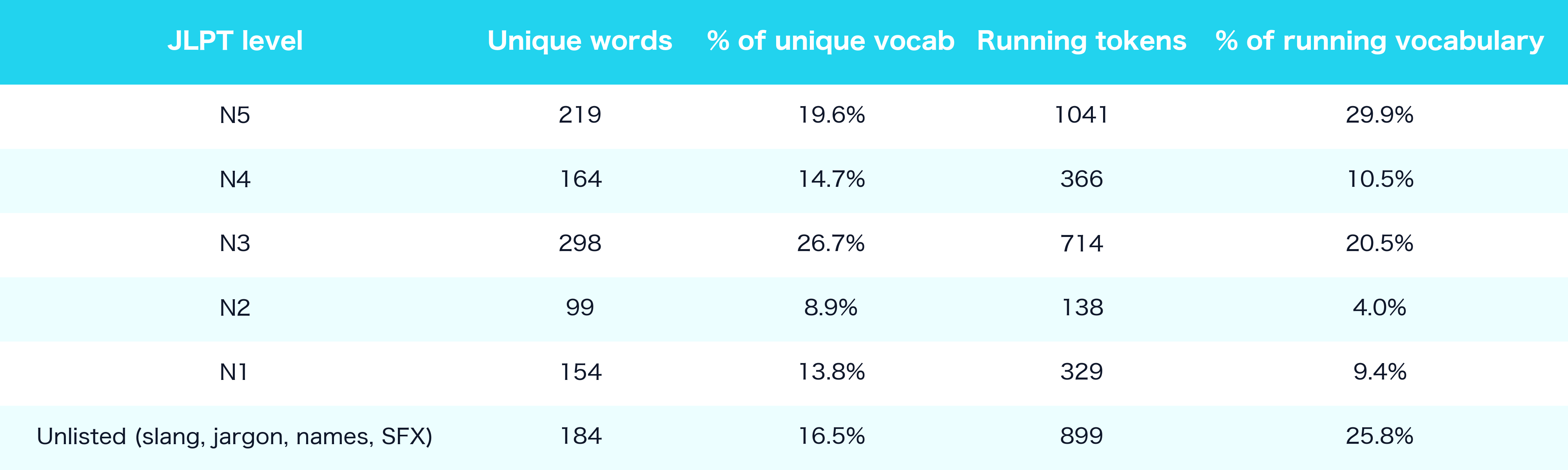
The 1,118 unique vocabulary items in volume 1 break down like this:
| JLPT level | Unique words | % of unique vocab | Running tokens | % of running vocabulary |
|---|---|---|---|---|
| N5 | 219 | 19.6% | 1,041 | 29.9% |
| N4 | 164 | 14.7% | 366 | 10.5% |
| N3 | 298 | 26.7% | 714 | 20.5% |
| N2 | 99 | 8.9% | 138 | 4.0% |
| N1 | 154 | 13.8% | 329 | 9.4% |
| Unlisted (slang, jargon, names, SFX) | 184 | 16.5% | 899 | 25.8% |
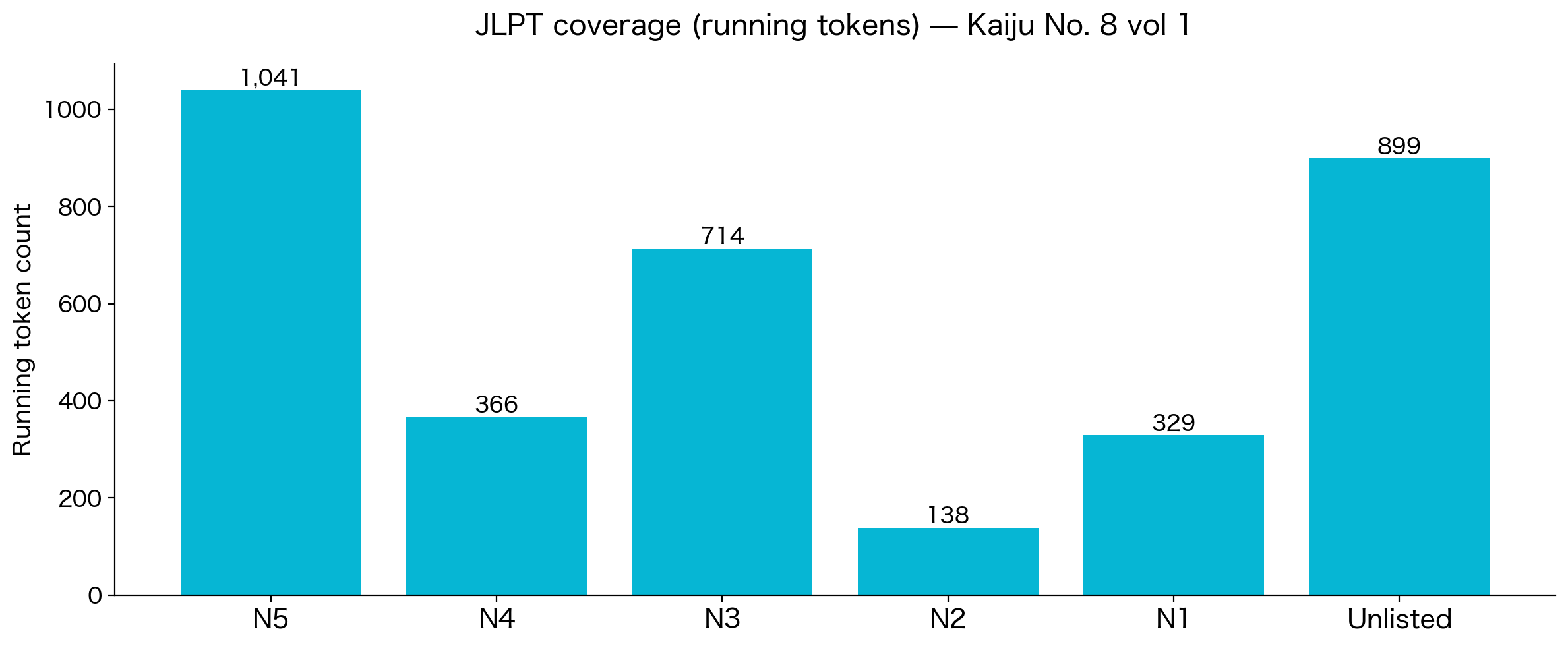
Read the last column. 40% of the running vocabulary is N5 or N4. Add N3 and you are at 61% of running vocabulary. The hard stuff (N2 and N1 combined) is 13% of what you actually read, because the hardest words appear rarely. The unlisted bucket sits at 26% of running tokens. KN8's vocabulary weight lives outside the JLPT framework, and that is because the JLPT does not test defense-force jargon.
Reader guidance by level
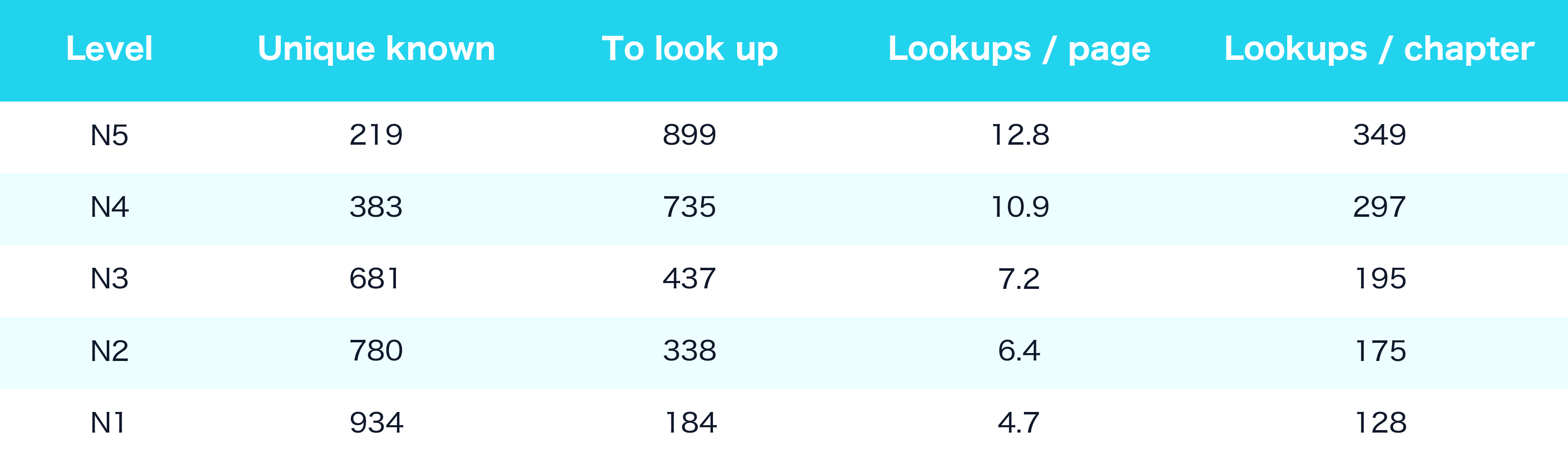
| Level | Unique words known | Unique words to look up | Lookups per page (first pass) | Lookups per chapter (first pass) |
|---|---|---|---|---|
| N5 | 219 | 899 | 12.8 | 349 |
| N4 | 383 | 735 | 10.9 | 297 |
| N3 | 681 | 437 | 7.2 | 195 |
| N2 | 780 | 338 | 6.4 | 175 |
| N1 | 934 | 184 | 4.7 | 128 |
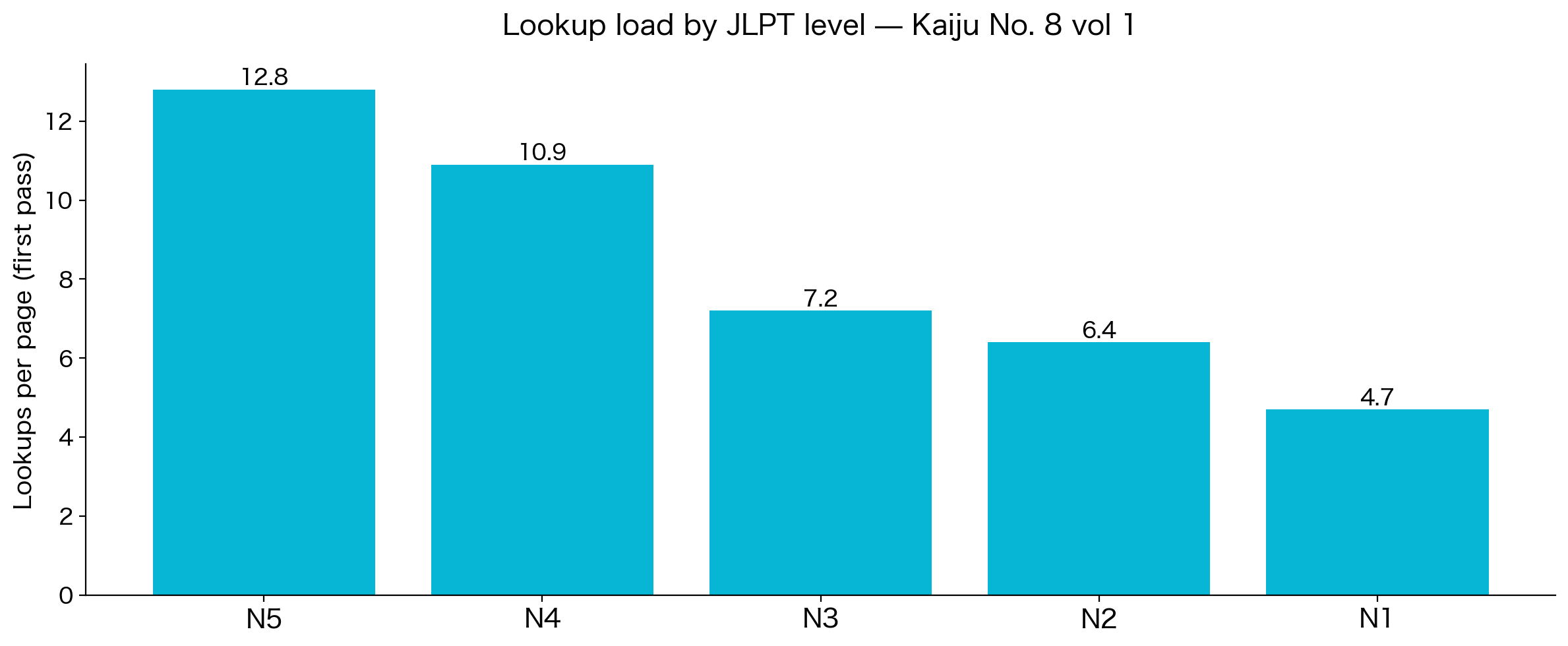
Lookups are unavoidable and painful, but you can lower the pain by completing the grammar foundation guide first. If you do not have kana yet, start there. That is table stakes.
N1 ≠ mastery
N1 means you passed a test. Real Japanese is not the test. Even N1 readers reading KN8 for the first time will look things up. An N1 reader still has 184 unique unlisted words in this volume alone, plus first-encounter recognition on vocabulary they know from study but have never seen embedded in defense-force shoptalk. Even at N1, expect 4.7 lookups per page on first pass. The best way to learn real Japanese is to read real Japanese. Then you can pass any test.
Kanji
Kaiju No. 8 volume 1 has 640 unique kanji on the page (counted from the actual surface forms, not lemma headwords; words written in pure hiragana do not count). 622 are joyo. 18 are non-joyo. That non-joyo count is the lowest of any title we have measured so far, lower than JJK (41), FMA (22), or Apothecary (51). Furigana is printed on every one.
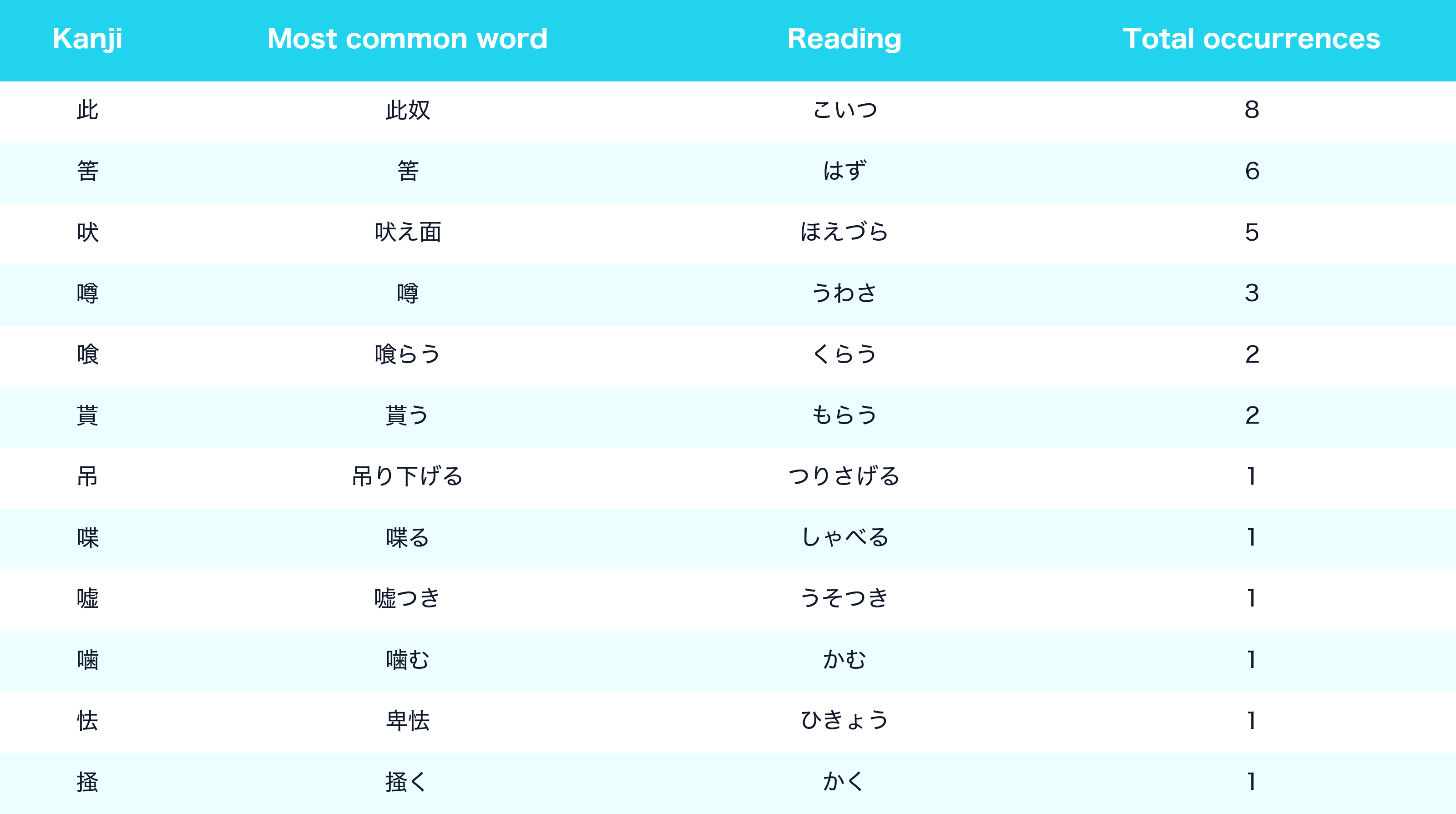
| Kanji | Most common word | Reading | Total occurrences |
|---|---|---|---|
| 此 | 此奴 | こいつ | 8 |
| 筈 | 筈 | はず | 6 |
| 吠 | 吠え面 | ほえづら | 5 |
| 噂 | 噂 | うわさ | 3 |
| 喰 | 喰らう | くらう | 2 |
| 貰 | 貰う | もらう | 2 |
| 吊 | 吊り下げる | つりさげる | 1 |
| 喋 | 喋る | しゃべる | 1 |
| 嘘 | 嘘つき | うそつき | 1 |
| 噛 | 噛む | かむ | 1 |
| 怯 | 卑怯 | ひきょう | 1 |
| 掻 | 掻く | かく | 1 |
Where the kanji weight actually lives is in joyo characters combining into series-domain compounds. 怪獣 (かいじゅう, kaiju) is built from 怪 (suspicious, mysterious) and 獣 (beast). Both joyo. Together they make the genre-defining noun the entire series turns on. Same story with 防衛隊 (ぼうえいたい, defense force, from 防 + 衛 + 隊), 討伐 (とうばつ, subjugation, from 討 + 伐), and 隊員 (たいいん, force member, from 隊 + 員). Every character in those compounds is on the joyo list, but the compound itself is workplace vocabulary you will not see outside this genre. The bottleneck is the word, not the kanji. Stop worrying about the character list. Start worrying about the compounds.
Frequency
Vocabulary appears in a long-tail distribution. 750 of 1,118 unique words (67%) appear exactly once; only 10 words appear 26 times or more. The small head of the curve is where the leverage lives.
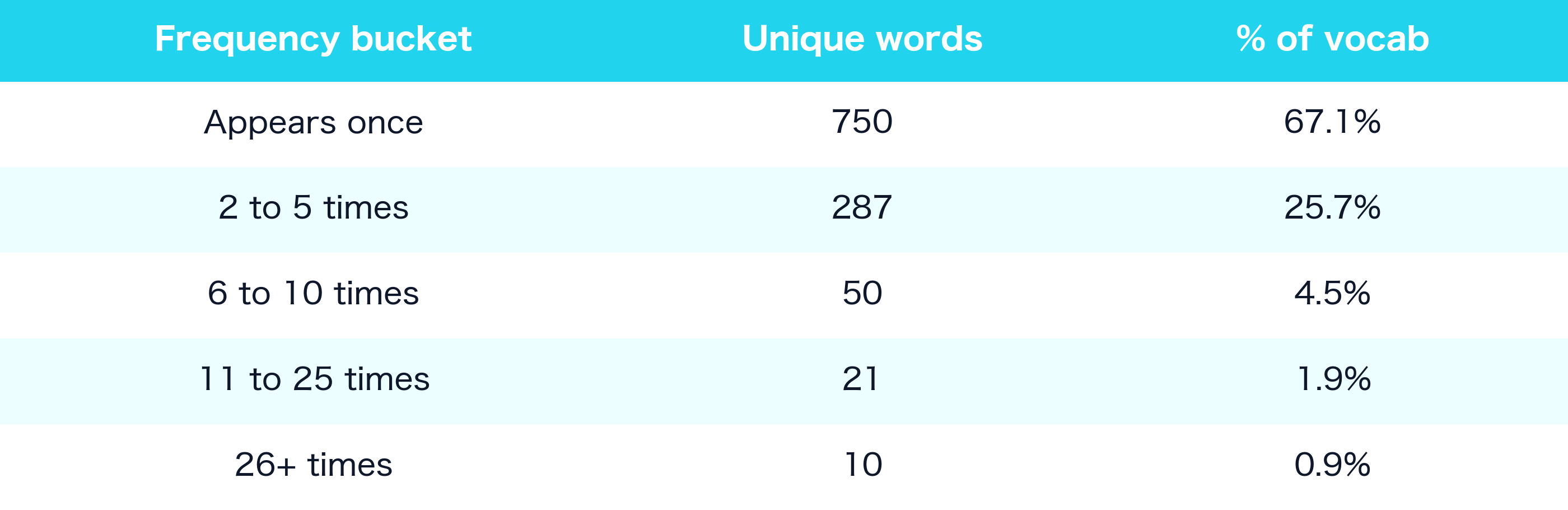
| Frequency bucket | Unique words | % of vocab |
|---|---|---|
| Appears once | 750 | 67.1% |
| 2 to 5 times | 287 | 25.7% |
| 6 to 10 times | 50 | 4.5% |
| 11 to 25 times | 21 | 1.9% |
| 26+ times | 10 | 0.9% |
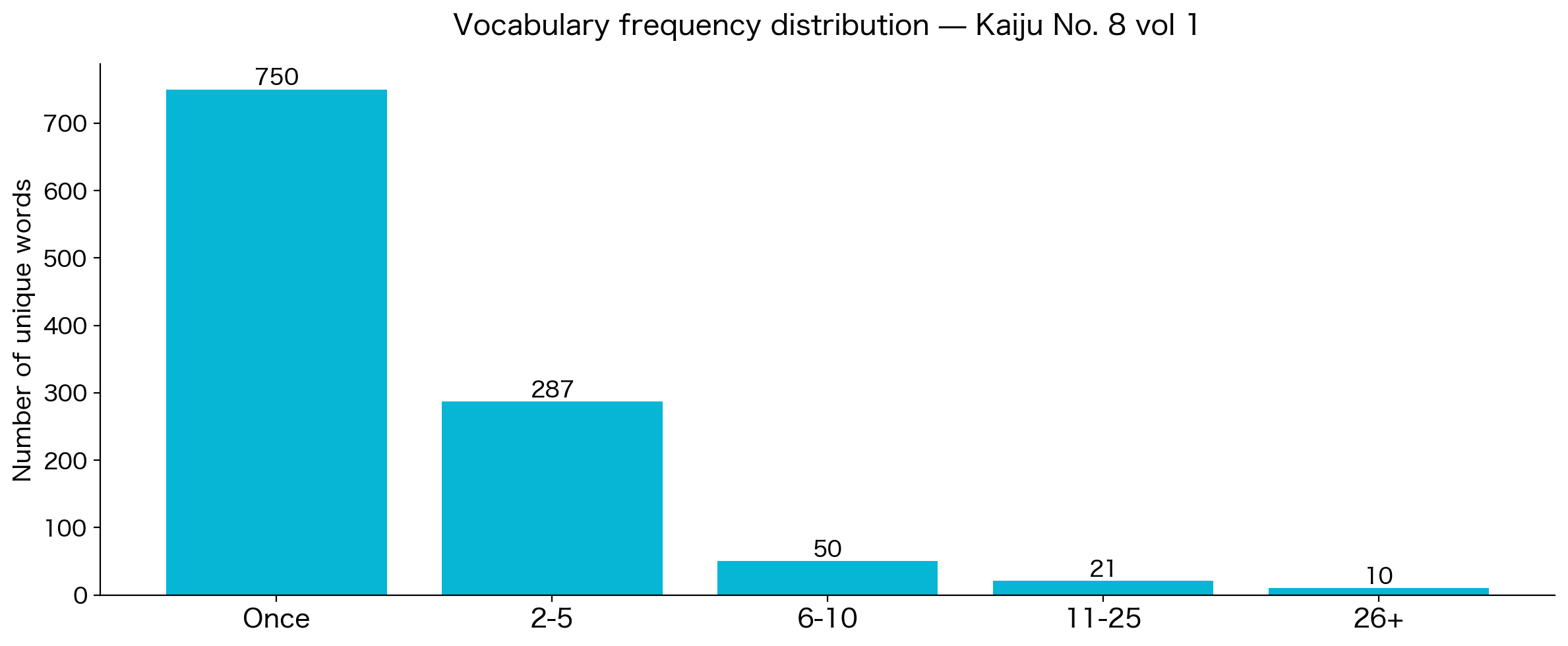
Do not read "appears once" as "not worth learning." These words recur across the series. Later volumes pick them up and use them again. The 81 words that appear six times or more are the real spine of volume 1 specifically.
The 20 most frequent content words
Pre-study these 20 and you have learned the most common content words on almost every page. By the time you finish volume 1, all 20 are locked into your memory just from how often they appear.
Particles, auxiliary verbs, pronouns, conjunctions, proper nouns, and adnominals are excluded so the list surfaces meaningful content words.
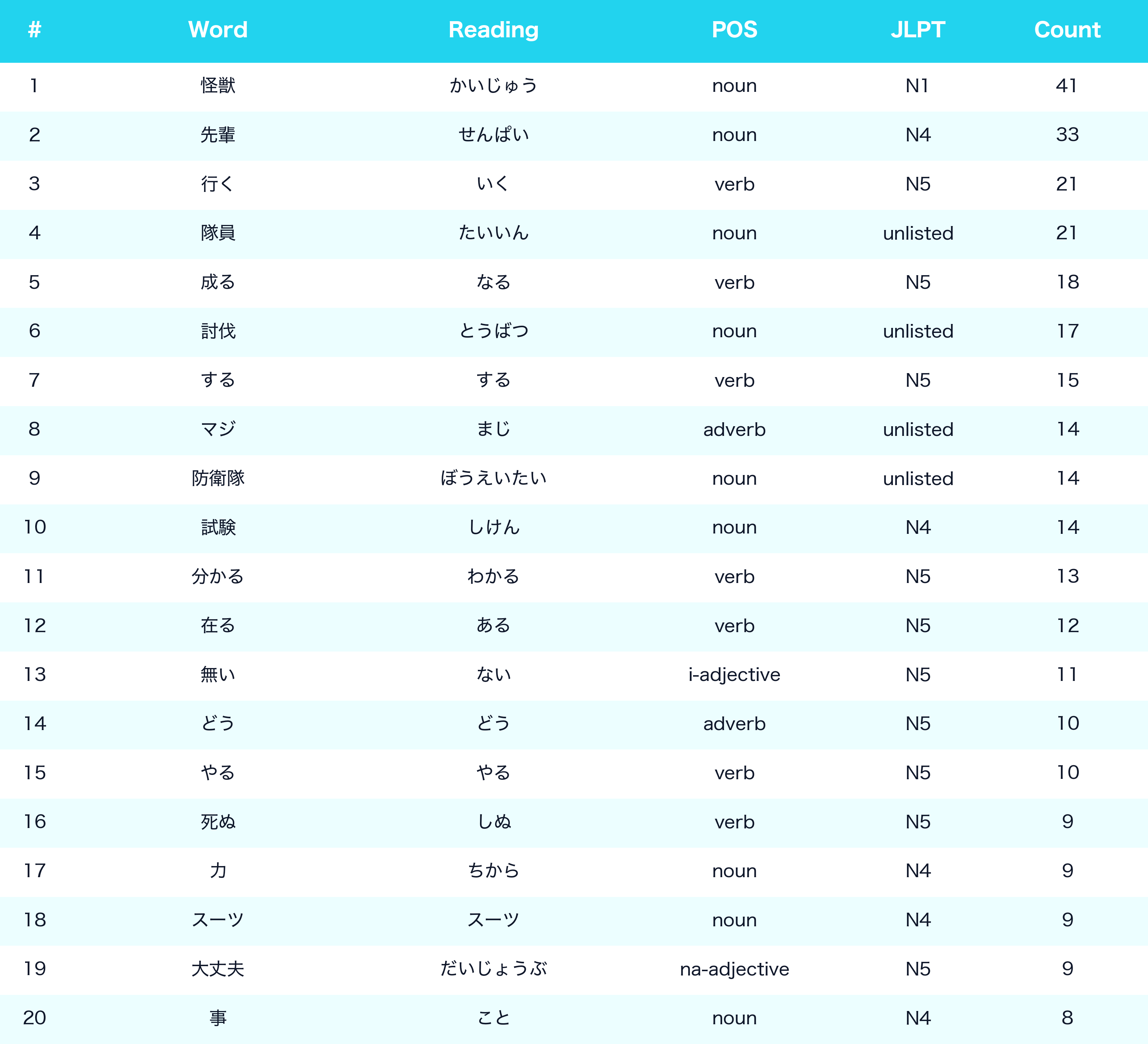
| # | Word | Reading | POS | JLPT | Count |
|---|---|---|---|---|---|
| 1 | 怪獣 | かいじゅう | noun | N1 | 41 |
| 2 | 先輩 | せんぱい | noun | N4 | 33 |
| 3 | 行く | いく | verb | N5 | 21 |
| 4 | 隊員 | たいいん | noun | unlisted | 21 |
| 5 | 成る | なる | verb | N5 | 18 |
| 6 | 討伐 | とうばつ | noun | unlisted | 17 |
| 7 | する | する | verb | N5 | 15 |
| 8 | マジ | まじ | adverb | unlisted | 14 |
| 9 | 防衛隊 | ぼうえいたい | noun | unlisted | 14 |
| 10 | 試験 | しけん | noun | N4 | 14 |
| 11 | 分かる | わかる | verb | N5 | 13 |
| 12 | 在る | ある | verb | N5 | 12 |
| 13 | 無い | ない | i-adjective | N5 | 11 |
| 14 | どう | どう | adverb | N5 | 10 |
| 15 | やる | やる | verb | N5 | 10 |
| 16 | 死ぬ | しぬ | verb | N5 | 9 |
| 17 | 力 | ちから | noun | N4 | 9 |
| 18 | スーツ | スーツ | noun | N4 | 9 |
| 19 | 大丈夫 | だいじょうぶ | na-adjective | N5 | 9 |
| 20 | 事 | こと | noun | N4 | 8 |
Two of these are worth calling out. 怪獣 (かいじゅう, kaiju) is the genre-defining noun the entire series is built on, and it appears 41 times in volume 1 alone. If you only learn one word before opening this manga, learn this one. It will carry you through every page.
防衛隊 (ぼうえいたい, defense force) is the institution everything else in the volume revolves around: the recruits, the captains, the entrance exam, the chain-of-command speech. It appears 14 times directly and far more often via its components (隊員 21 times, 部隊 in unit names). Pre-study this compound and the institutional vocabulary that follows it slots into place chapter by chapter.
How each main character speaks
日比野カフカ (Hibino Kafka)
Thirty-two years old, working a kaiju-cleanup job that pays the bills, watching every recruit half his age pass him on the way to the defense force he failed to enter. Kafka uses 俺 (おれ) for "I." His speech is blue-collar Tokyo: contracted endings (じゃねえ for じゃない, 〜てる for 〜ている), sentence-final よ and ぞ, and self-deprecating jokes that flip into earnestness without warning. He is the easiest main character to read once you stop expecting politeness, and he is the entry point into the dismantling-job vocabulary that defines chapter 1.
市川レノ (Ichikawa Reno)
Eighteen, recruit-track, the foil to Kafka's burnt-out salaryman energy. Reno speaks with the polite-but-direct register of someone who has not been in the workforce long enough to corrode it: 〜です/〜ます endings stay intact, 僕 (ぼく) for "I," clipped sentences when he is focused. His lines are the cleanest grammar in the volume. When he switches to plain form around Kafka it reads as a small character beat rather than a register collapse.
亜白ミナ (Ashiro Mina)
Captain of the defense force's 3rd division, Kafka's childhood friend, and the person whose career trajectory mirrors and shames Kafka's. Her panels are command register: short, declarative, almost completely free of sentence-final particles. She gives orders in plain-form imperatives and clinical defense-force jargon. Her speech is easier to parse word-by-word than Kafka's but harder to read fast, because every sentence is loaded with the unlisted bucket of military terms.
古橋伊春 (Furuhashi Iharu)
Recruit, brash, talks first thinks second. 俺 for "I," sentence-final だ and ぞ, a steady drip of マジで (literally, "seriously") and other young-male slang. He is the character who shows you the spoken edge of recruit culture, and the reason マジ ranks 8th in the top-20 content words despite not appearing on any JLPT list.
Expressions with depth
These are volume 1 expressions where the dictionary entry will mislead you. Surface meaning is one thing. What the phrase actually does in a panel is another.
怪獣 (かいじゅう, kaiju)
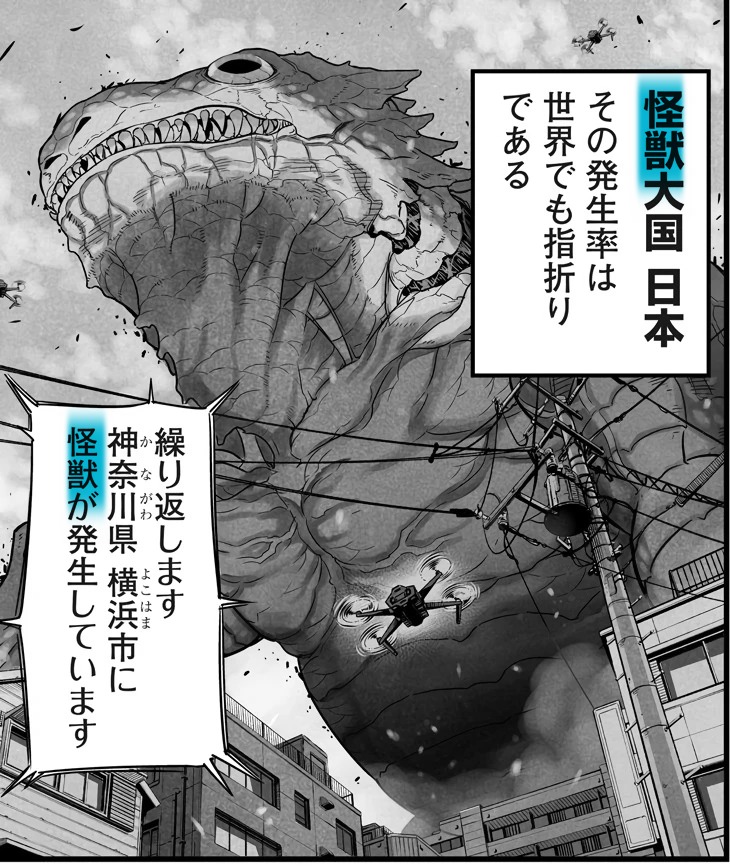
Dictionary: "monster" or "strange beast." The texture: 怪獣 is not a generic monster. It is a Japanese genre. The word is loaded with seventy years of cultural baggage from Godzilla through Ultraman through Pacific Rim, and KN8 leans on every gram of it. When the chapter-1 narration says 怪獣大国日本 ("monster-superpower Japan") and notes the country's kaiju-occurrence rate is among the highest in the world, it is doing genre-work, not world-building. The reader is supposed to read that line and immediately understand that the rules of this world are the rules of Japanese kaiju cinema. Translate it as "monster" and you lose all of that.
討伐 (とうばつ, subjugation)
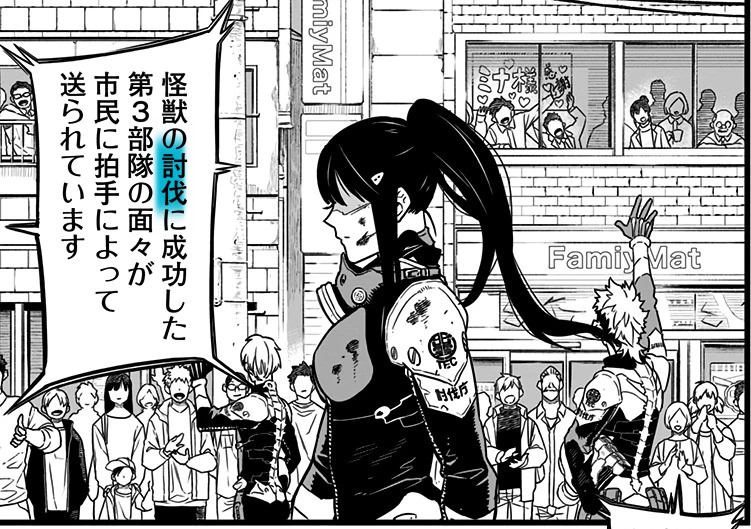
Dictionary: "subjugation" or "suppression of an enemy." The texture: this is a classical-feudal verb, the kind of word a chronicle uses for a general putting down a rebellion. KN8 grafts it onto a modern bureaucratic process. When the manga says the 3rd division has 怪獣の討伐に成功した ("successfully completed kaiju subjugation") and the citizens applaud them through the streets, the word choice is telling you the defense force occupies the cultural slot of returning samurai, not the slot of returning soldiers. Translate it as "defeat" and the formality leaks out.
解体 (かいたい, dismantling)
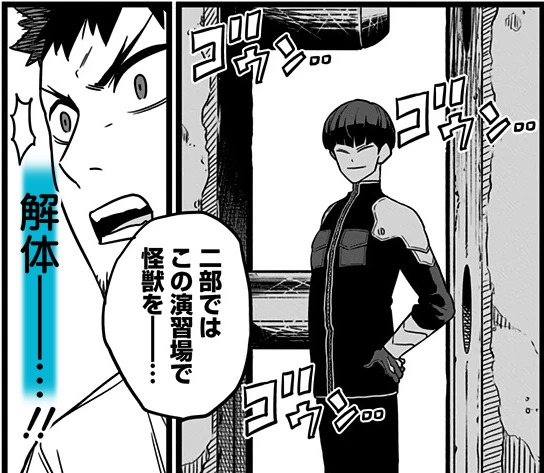
Dictionary: "dismantling" or "demolition." The texture: this is a construction-and-demolition word in everyday Japanese (used for tearing down buildings or stripping cars for parts) and KN8 reuses it almost untouched as the verb for processing a kaiju corpse. Chapter 4's second-division exam panel literally says the recruits will この演習場で怪獣を解体 ("dismantle the kaiju in this training ground"), and every dismantling-job panel in chapter 1 runs on the same word. The translation choice is deliberate: kaiju cleanup is not heroism, it is industrial demolition with paperwork. The word makes that subtext text.
防衛隊 (ぼうえいたい, defense force)
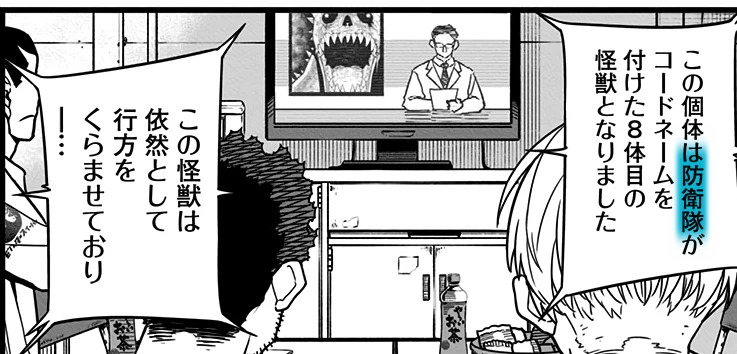
Dictionary: "defense force." The texture: in modern Japanese this is the word for the country's self-defense forces (自衛隊, JSDF), and the cultural connotation is domestic-disaster response, not foreign-war military. KN8 builds its institution on exactly that template. When chapter 3 introduces the 防衛隊 with the line この個体は防衛隊 がコードネームを付けた ("this individual was given a codename by the defense force"), the manga is signalling that kaiju response is run like an earthquake or typhoon protocol: institutional, procedural, public-trust-driven. Read "defense force" with "disaster response" in your head, not "army."
試験 (しけん, exam)
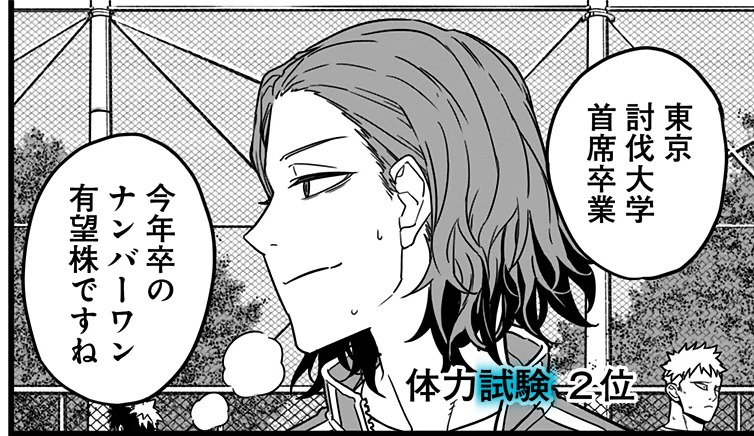
Dictionary: "exam" or "test." The texture: in Japan, 試験 is the register of the entrance exam, an institution every reader has lived through. Chapter 4 spends most of its run on the defense-force entrance exam, complete with score rankings (体力試験2位, "physical-fitness exam, rank 2") and graduation-school flexes (東京討伐大学首席卒業, "Tokyo Subjugation University top graduate"). The joke and the worldbuilding are the same thing: monster-killing has been absorbed into the Japanese exam-and-rank ecosystem like every other career. The word does that work.
Pop culture and context in volume 1
怪獣 as a Japanese genre. Kaiju is not a synonym for monster. It is a category of Japanese popular culture that runs from Godzilla (1954) through Ultraman (1966) through every kid's rubber-suited TV show across seven decades. KN8 is in constant dialogue with that lineage. The genre conventions (kaiju attack, defense institution responds, kaiju is defeated, public reacts, repeat) are baked into the manga's structure, and Japanese readers register every familiar beat. Watching one Godzilla movie before reading does more for comprehension than memorising twenty extra vocabulary words.
防衛隊 modeled on the JSDF disaster-response posture, not the military. The 自衛隊 (Japan Self-Defense Forces) operates under constitutional restrictions that make their public identity closer to fire department or coast guard than to a foreign army. They show up after earthquakes. They show up after typhoons. They are saluted in the street the way KN8's 3rd division is saluted in chapter 1. The manga's defense force is built on this template, and the bureaucratic register (codename assignments, kill-count rankings, division numbers) reads to a Japanese reader as a pastiche of real-world disaster-response protocol with kaiju swapped in.
高専 (kōsen, technical college). Chapter 4 mentions 八王子討伐高専 (Hachioji Subjugation Technical College). 高専 is a real category of Japanese institution, a five-year combined high-school-and-junior-college that trains specialists (engineers, marine officers, mechanical technicians) outside the regular university track. KN8 uses the term to signal that monster-killing is a vocational specialism, not a heroic calling. Reading it as "monster-killing trade school" is closer to the right register than "monster-killing academy."
Discipline plus bureaucracy as register. Most of volume 1 is spent in workplaces (a dismantling crew, a recruit barracks, an exam hall, a press-briefing scene), and the language reflects it. Contract names, division numbers, salvage rights, codename assignments. The cultural joke and the cultural anchor are the same: kaiju cleanup is a job in this world. People go home from it. People file paperwork about it. That register is what makes the action panels hit when they finally come.
Inside the app: one panel, fully broken down
Reading manga in Japanese is, at the bottom of it, a vocabulary-acquisition problem. Let me get you one panel: chapter 1, page 21, the dismantling-shift assignment panel. All the context around it is broken down here the same way The Ashiba App provides it, so you finish this section actually understanding the workplace vocabulary that defines volume 1, not just having seen it.
Chapter 1, page 21: the dismantling shift assignment
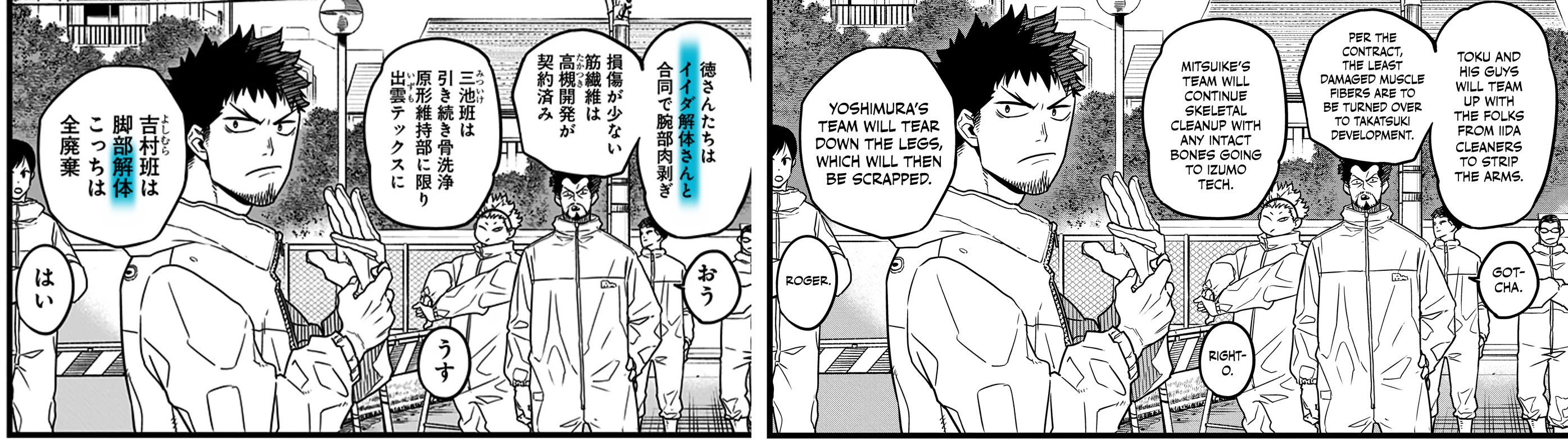
Scroll the image sideways to read the Japanese in full size.
Summary. A foreman on Kafka's dismantling crew runs the morning shift assignment. Three subcontractors, three crews, three different parts of the kaiju corpse, three different downstream buyers. This is the panel that establishes the workplace KN8 lives inside.
Textbox 1
JP: 徳さんたちはイイダ解体さんと合同で腕部肉剥ぎ
EN: Toku and the others are working with Iida Demolition on the arm muscle stripping.
Overview: First crew, joint contract, specific body part. Reads like any construction-site morning briefing.
Breakdown:
- 徳さん (とくさん): Toku-san, a coworker on the crew
- たち: pluralizer suffix, "and the others"
- イイダ解体 (イイダかいたい): Iida Demolition, a subcontracting company
- 合同 (ごうどう): joint, combined; N1-N2 noun
- 腕部 (わんぶ): arm part; technical jargon, not in standard dictionaries
- 肉剥ぎ (にくはぎ): muscle stripping; compound coined for the dismantling-trade context
Textbox 2
JP: 損傷が少ない筋繊維は高槻開発が契約済み
EN: Lightly damaged muscle fibers are already contracted to Takatsuki Development.
Overview: Salvage rights, by quality grade, by buyer. The corpse has a supply chain.
Breakdown:
- 損傷 (そんしょう): damage; N1-N2 noun
- 少ない (すくない): few, little; N5 i-adjective
- 筋繊維 (きんせんい): muscle fiber; technical jargon
- 高槻開発 (たかつきかいはつ): Takatsuki Development, a buyer company
- 契約済み (けいやくずみ): already contracted; 〜済み marks completed status
Textbox 3
JP: 三池班は引き続き骨洗浄原形維持部に限り出雲テックスに
EN: Mike's crew keeps doing bone-washing; the section that preserves original shape only goes to Izumo Techs.
Overview: Same crew, continuing assignment, but with a quality-control caveat baked into the contract.
Breakdown:
- 三池班 (みいけはん): Mike's crew (lit. the Miike squad)
- 引き続き (ひきつづき): continuously; N2 adverb
- 骨 (ほね): bone; N5 noun
- 洗浄 (せんじょう): cleaning, washing; N1 noun
- 原形 (げんけい): original form; N1 noun
- 維持 (いじ): maintenance, preservation; N2 noun
- 限り (かぎり): limit; here functioning as "limited to"
- 出雲テックス (いずもテックス): Izumo Techs, a buyer company
Textbox 4
JP: 吉村班は脚部解体こっちは全廃棄
EN: Yoshimura's crew handles leg dismantling; this side is full disposal.
Overview: Last crew, last body part, no buyer attached, contents go to the incinerator.
Breakdown:
- 吉村班 (よしむらはん): Yoshimura's crew
- 脚部 (きゃくぶ): leg part; technical jargon, paired with 腕部 from textbox 1
- 解体 (かいたい): dismantling; N2 noun, the volume's defining workplace verb
- 全 (ぜん): all, total; prefix
- 廃棄 (はいき): disposal; N1 noun
Key points
- The register is shift-briefing speech: short noun-phrases, no sentence-ending verbs, declarative tone. Read it like a foreman writing on a whiteboard, not like prose.
- Body parts use the suffix 〜部 (腕部, 脚部) the way a butcher uses cuts of meat. Specific, professional, slightly clinical. Once you see the pattern, the next dozen kaiju-anatomy panels parse instantly.
- Every company name plus 班 (crew) plus 〜済み (already done) is the bureaucratic spine of the volume. Pre-study these patterns and chapter 1's dismantling sequences read at half the lookup rate.
How to actually read volume 1
- Get a foundation. How much you need depends on how much discomfort you can sit with. Genki I and II is the polished path. At a minimum, lock in N5. Nothing else moves until kana and basic grammar are automatic.
- Start with chapter 1. Take your time. Not a week. Not a day. This is the first chapter of manga you have ever read in Japanese. Set a timer for 15 minutes. Early on, you crack one to three sentences in that window. Later, you crack a full chapter. Consistency compounds. Rack up the reps.
- When you get stuck, reference the translation. Looking things up is not failure. It is learning. The fastest way to get unstuck is to see the answer and understand why the sentence means what it means. Goal: parse the sentence. Match the English to the Japanese, identify the word or grammar that blocked you, and move on. You will hurdle (probably in chapter 1 when the dismantling-job exposition lands, in chapter 4 when the defense-force entrance-exam procedure runs at full speed, or in chapter 7 when the volume's big reveal stacks setup vocabulary onto setup vocabulary). Those panels are dense. The answer is not to grind harder. The answer is what I wrote about in Why You Will Quit Learning Japanese: put the book down and come back tomorrow.
If you want the deeper version of this reading strategy, the fastest way to learn Japanese article has the volume-control framework in full.
The Takeaway
The main reason reading manga in Japanese is hard is the sheer amount of vocabulary you do not know.
Most readers never get past this. The pain is too great. The effort-to-reward ratio collapses, and the book gets shelved.
The easiest way out is to pre-study the words you do not know that will appear in the chapter you are about to read. The Ashiba App does this for every chapter of every series I cover. It surfaces the vocabulary, shows readings and POS, and includes grammar breakdowns so you see how each word is being used. Nothing is studied in isolation. Every flashcard carries its full panel context. You see the word in the sentence in the panel where it lives.
You can get started today.
Frequently asked questions
Should I watch the anime before reading Kaiju No. 8 in Japanese?
Yes. The Kaiju No. 8 anime aired in 2024 with a second season in 2025, and the early episodes track volume 1 closely. Watch episodes 1 through 3 before you open the manga. The anime gives you the visual context for the dismantling crew, the defense-force uniforms, and the kaiju-attack tempo, so the manga reads with familiar pictures already loaded. Watch the same episodes again after you finish volume 1 and you will feel exactly how much more you picked up by reading.
Does Kaiju No. 8 have furigana?
Mostly no. KN8 prints furigana on proper nouns and a handful of unusual readings, but leaves the bulk of the kanji bare. This is unusual for a Shonen Jump+ title and is the single biggest difficulty signal in this volume. If you cannot read joyo kanji on sight, you cannot read this manga.
Do I need to know all 640 kanji before I start?
Effectively yes. Without furigana to bail you out, you need to recognise the kanji to access the word. The good news: 622 of the 640 are joyo, so a solid joyo foundation unlocks the volume. The bad news: there is no shortcut. If kanji is your weak point, this is not the manga to start on.
How long will volume 1 take to read?
For an N3 reader on a first pass at the lookup rate above (about 7 lookups per page), plan for 6 to 8 hours of focused reading time spread across multiple sessions. An N1 reader will finish it in 4 to 5 hours but will still pause on the unlisted defense-force vocabulary. Reread for fluency afterward.
Should I start with volume 1 or jump in further?
Follow the fun. If a different volume is pulling you harder, start there. The reasons to pick volume 1 anyway: the workplace vocabulary (解体, 防衛隊, 隊員, 討伐, 試験) is introduced here and used unchanged in every later volume. Skip it and you spend volume 2 looking up volume 1 words.
Where can I buy Kaiju No. 8 volume 1 in Japanese?
Free Japanese preview: Shonen Jump+ chapter 1. Free English preview: VIZ Media volume 1 product page. Buy the full Japanese volume on Amazon Japan or BookWalker (Kindle or paperback).