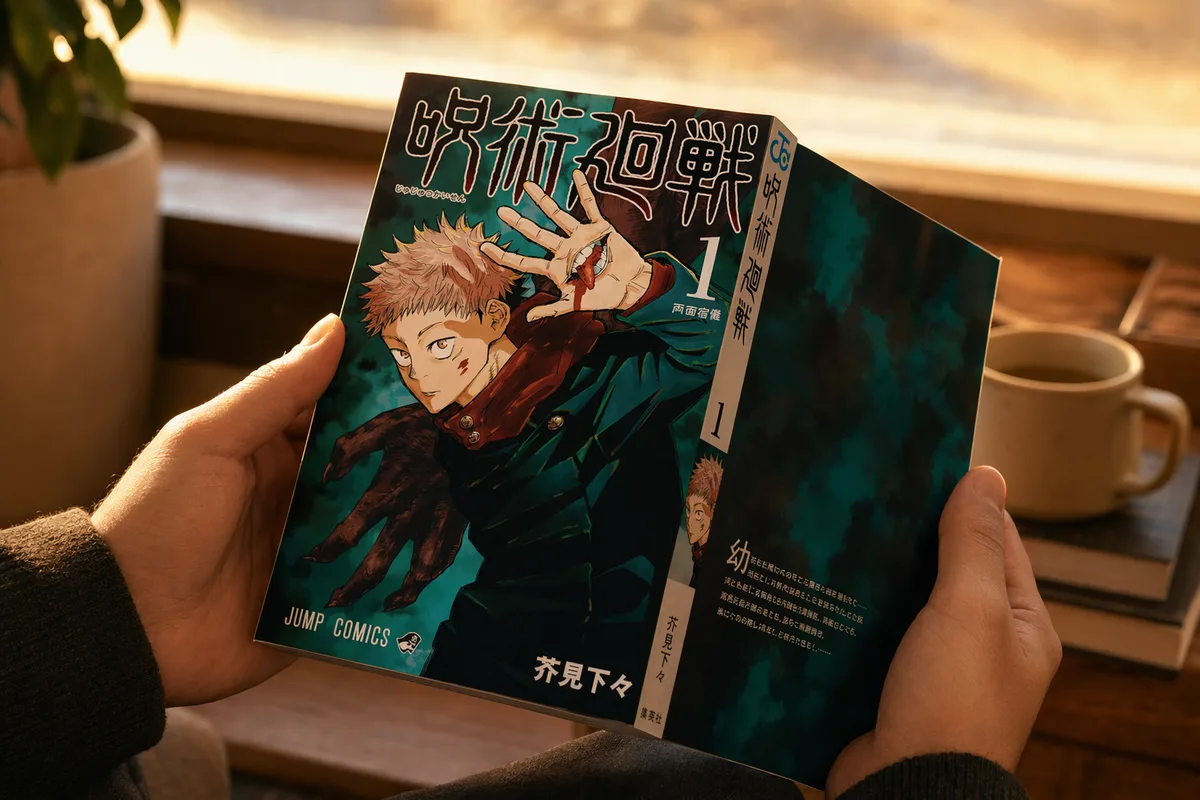
Volume 1 of Jujutsu Kaisen contains 1,414 unique vocabulary items across 7 chapters, 182 pages, 901 panels, and 1,323 textboxes. If you have finished Genki II, you already know about 472 of those words outright. You have roughly 942 more to learn, and 229 of them are not on any JLPT list because they are slang, character names, or the sorcery vocabulary Gege Akutami invented for this world.
That is the whole problem with JJK volume 1 in one paragraph. Here is exactly what is in this book, and exactly what you need to read it.
Every number in this article comes from Ashiba's production corpus, measured against the official N5 to N1 JLPT vocabulary lists and the 2,136-character joyo kanji set. Last measured 2026-04-22.
Is Jujutsu Kaisen volume 1 hard to read in Japanese?
Upper-intermediate. Not beginner. Not advanced. If you can read a Genki II dialogue without stopping every line, you will finish volume 1. It will take you longer than you think, and you will look up more words than you want to. You will also finish.
People mis-rate this book in both directions. Here is the actual shape.
What makes it easier than you think
Kanji is not a blocker. Furigana, the small phonetic companion written above every kanji, is provided everywhere in this manga: every kanji, every appearance, every chapter. Volume 1 uses 797 unique kanji, and 756 of them (94.9%) are joyo. Even when they are not, the manga shows the reading anyway.
The 41 non-joyo kanji split into two groups. The first is common-but-old words an artist chose to print in kanji for the look. 此奴 (こいつ, this guy) and 爺ちゃん (じいちゃん, gramps) are written in kanji 5 and 9 times respectively in volume 1, with the reading sitting right above. The second is series-invented technique terms (more in the kanji section below). Those also have furigana.
Stop worrying about the kanji list. The book hands you the readings.
What makes it harder than it looks
The long tail. 937 unique words appear exactly once in the entire volume. That is 66% of the unique vocabulary. This is the single biggest difficulty in volume 1, not kanji, not grammar. Most words you encounter do not repeat enough times within volume 1 to give you the in-volume spaced-repetition benefit. They will recur across the series. They will not recur much in this book.
Vocabulary acquisition is iterative. A word does not stick the first time. Each word takes multiple painful encounters before recognition becomes automatic, and every encounter breaks the story flow. You stop, you look up, you re-read the sentence, you re-set the panel in your head, you keep going. The tipping point where the manga starts reading easily is further out than most learners expect. The only path through is volume.
There is one way to lower the pain without lowering the reps. Pre-study the chapter vocabulary before you open the chapter. That moves the lookups out of the story and into focused study time. Same words, different context. The story stays intact.
The fights are easy. The exposition is not. 225 unique words sit at JLPT N1 and another 142 sit at N2. They cluster around curse terminology, the bureaucratic language of Jujutsu High, and military jargon (Gojo explaining curse grades in terms of tanks and shotguns).
Gojo is the second problem. He does not speak politely. He is your character's teacher and he talks like a bored friend. If you learned desu-masu first and nothing else, Gojo's lines will feel like a violation of the rules you memorized. Good. That is how real Japanese sounds.
You don't need permission. Just go for it.
The real question is not whether this book is at your level. The real question is whether the pain is tolerable for the reward. If you actually want this story, the level mismatch is just a tax on time, not a wall. You pay it in lookups and re-reads and slow chapters until the cost goes down. Always read above your level. Attack the stories that motivate you. Permission is something other people give themselves and then complain about. Just go for it.
What the data says about volume 1
Every number below was calculated from the approved vocabulary set for Jujutsu Kaisen volume 1 in Ashiba's production database. JLPT level was assigned by matching against the official N5 to N1 lists. Words not on any list were classified by Gemini 3 Pro against context. 229 remained outside the N5 to N1 framework and are marked "unlisted" (proper nouns, manga-specific jargon, slang, onomatopoeia).
A note on terminology. Running vocabulary means every word token as it occurs in the text, counting every repeat. If 呪い appears 65 times, that is 65 running tokens from 1 unique word. Unique vocabulary means the distinct words themselves, counted once each.
Volume 1 at a glance
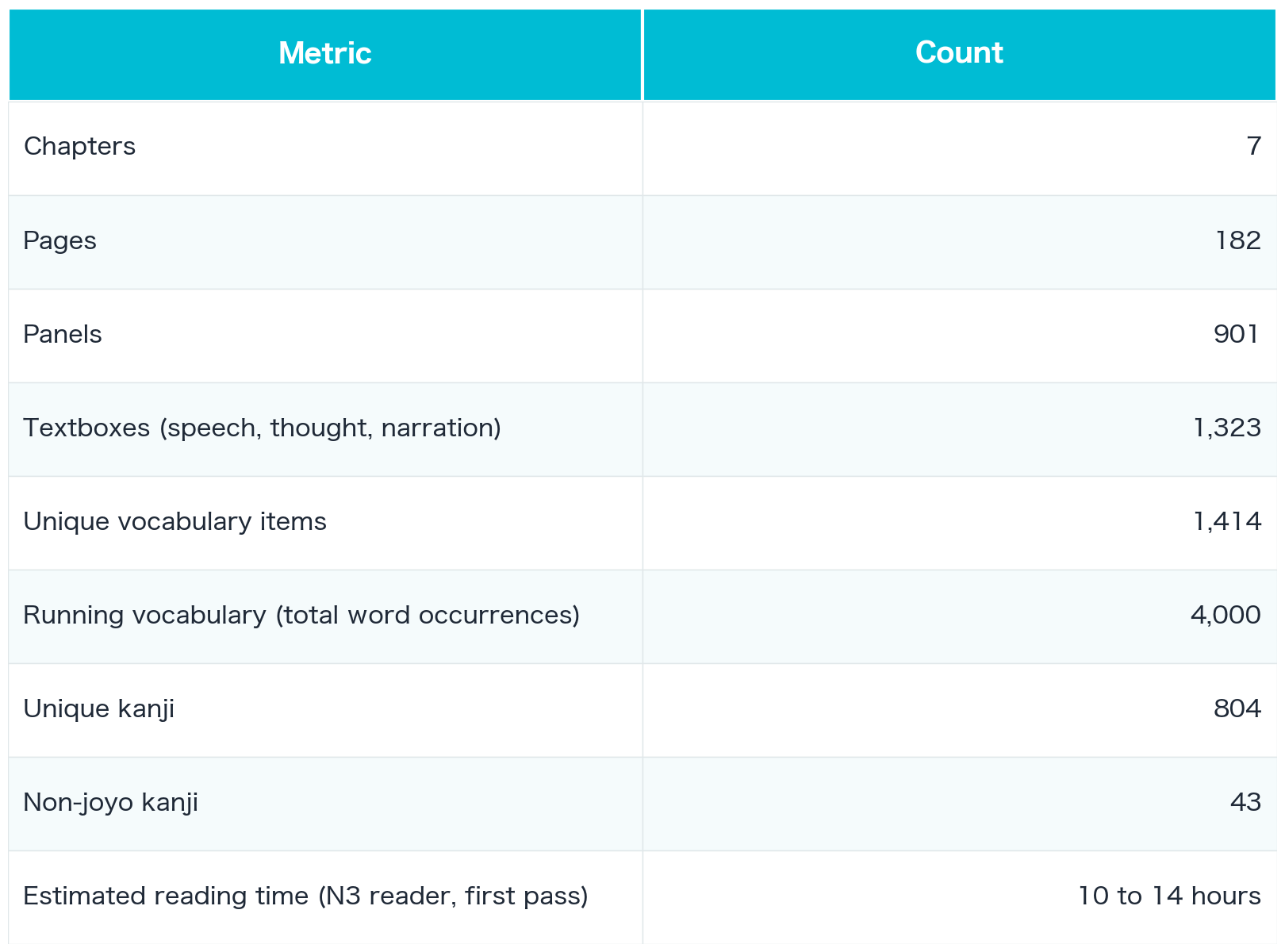
| Metric | Count |
|---|---|
| Chapters | 7 |
| Pages | 182 |
| Panels | 901 |
| Textboxes (speech, thought, narration) | 1,323 |
| Unique vocabulary items | 1,414 |
| Running vocabulary (total word occurrences) | 4,000 |
| Unique kanji | 804 |
| Non-joyo kanji | 41 |
| Estimated reading time (N3 reader, first pass) | 10 to 14 hours |
JLPT coverage
The 1,414 unique vocabulary items in volume 1 break down like this:
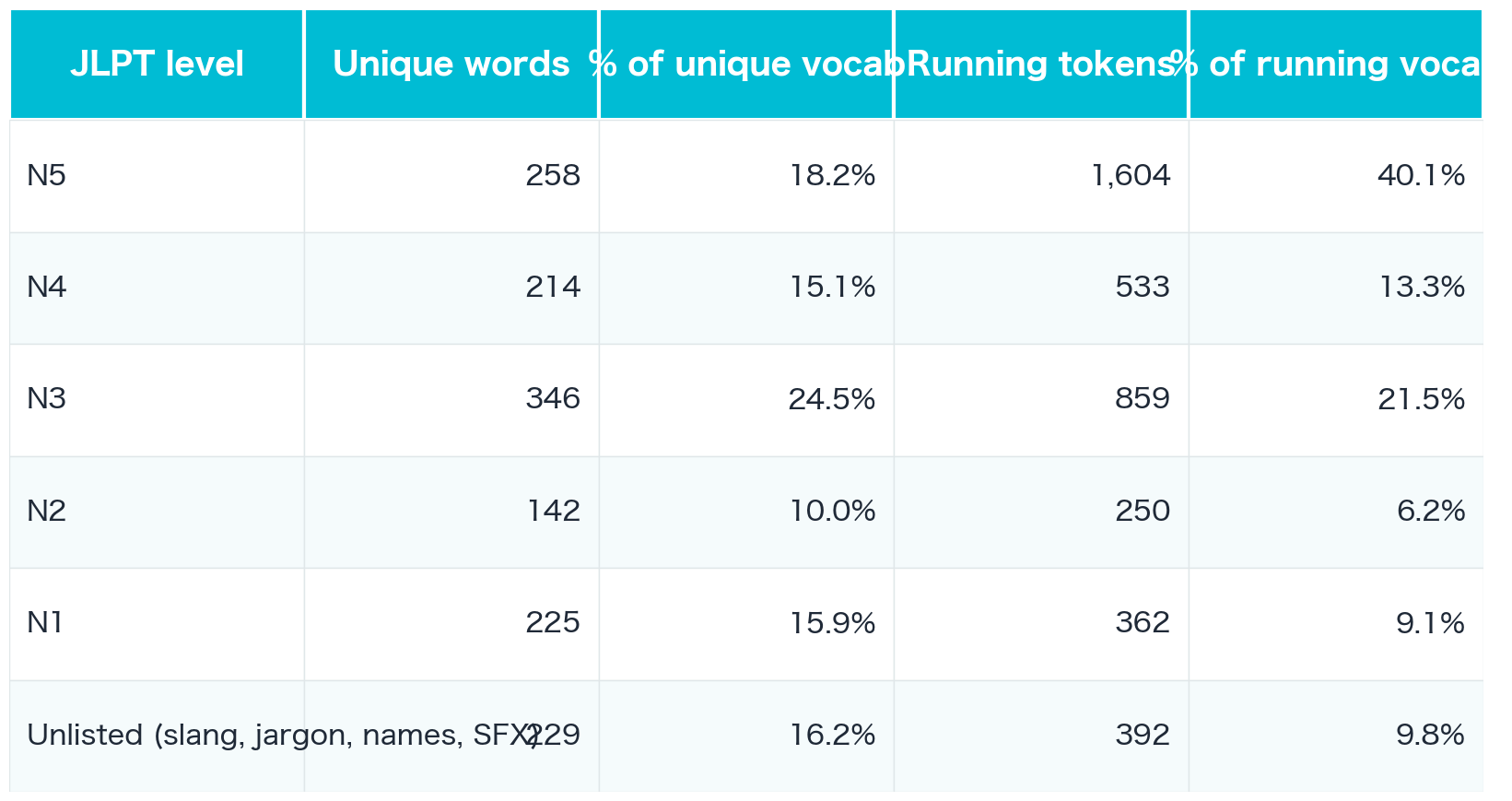
| JLPT level | Unique words | % of unique vocab | Running tokens | % of running vocabulary |
|---|---|---|---|---|
| N5 | 258 | 18.2% | 1,604 | 40.1% |
| N4 | 214 | 15.1% | 533 | 13.3% |
| N3 | 346 | 24.5% | 859 | 21.5% |
| N2 | 142 | 10.0% | 250 | 6.2% |
| N1 | 225 | 15.9% | 362 | 9.1% |
| Unlisted (slang, jargon, names, SFX) | 229 | 16.2% | 392 | 9.8% |
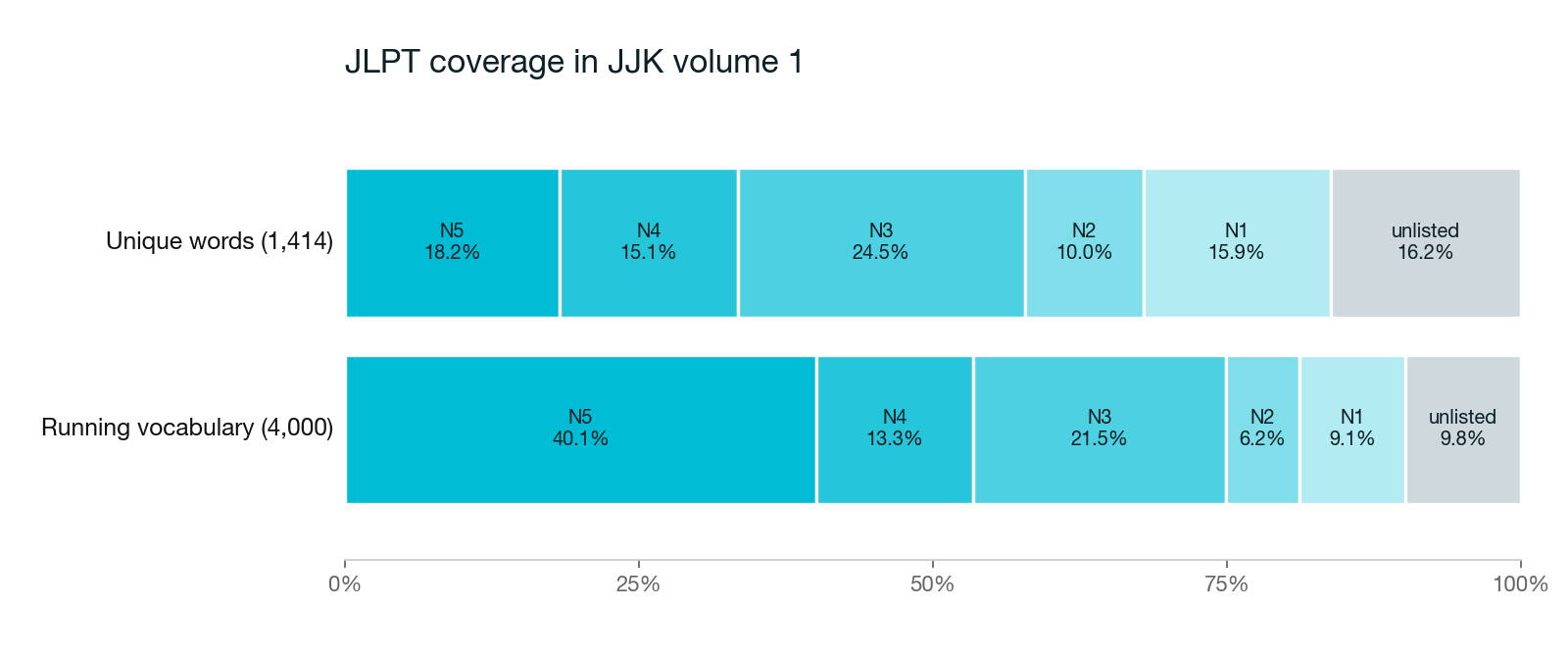
Read the last column. 53.4% of the running vocabulary is N5 or N4. Add N3 and you are at 74.9% of running vocabulary. The hard stuff (N2 and N1 combined) is 15.3% of what you actually read, because the hardest words appear rarely.
Reader guidance by level
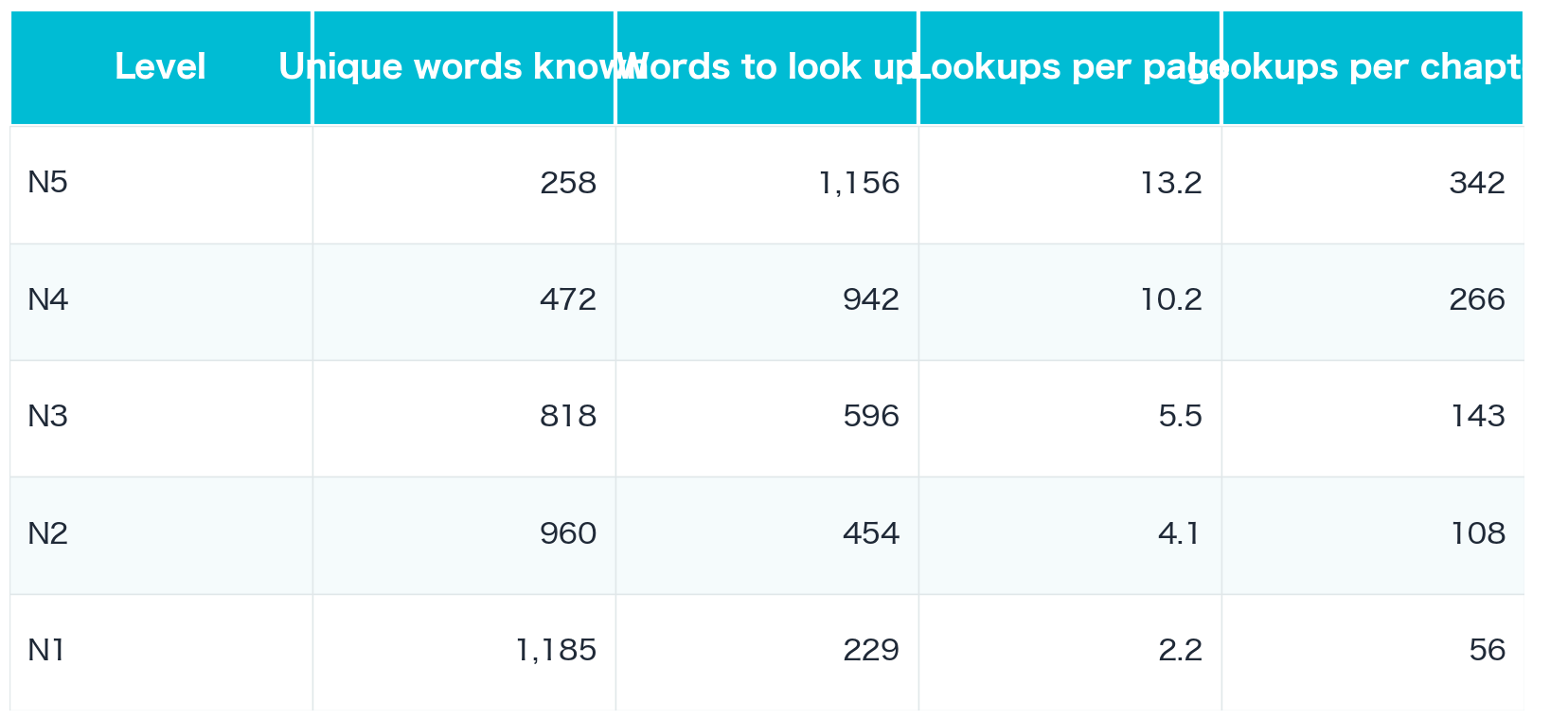
| Level | Unique words known | Unique words to look up | Lookups per page (first pass) | Lookups per chapter (first pass) |
|---|---|---|---|---|
| N5 | 258 | 1,156 | 13.2 | 342 |
| N4 | 472 | 942 | 10.2 | 266 |
| N3 | 818 | 596 | 5.5 | 143 |
| N2 | 960 | 454 | 4.1 | 108 |
| N1 | 1,185 | 229 | 2.2 | 56 |
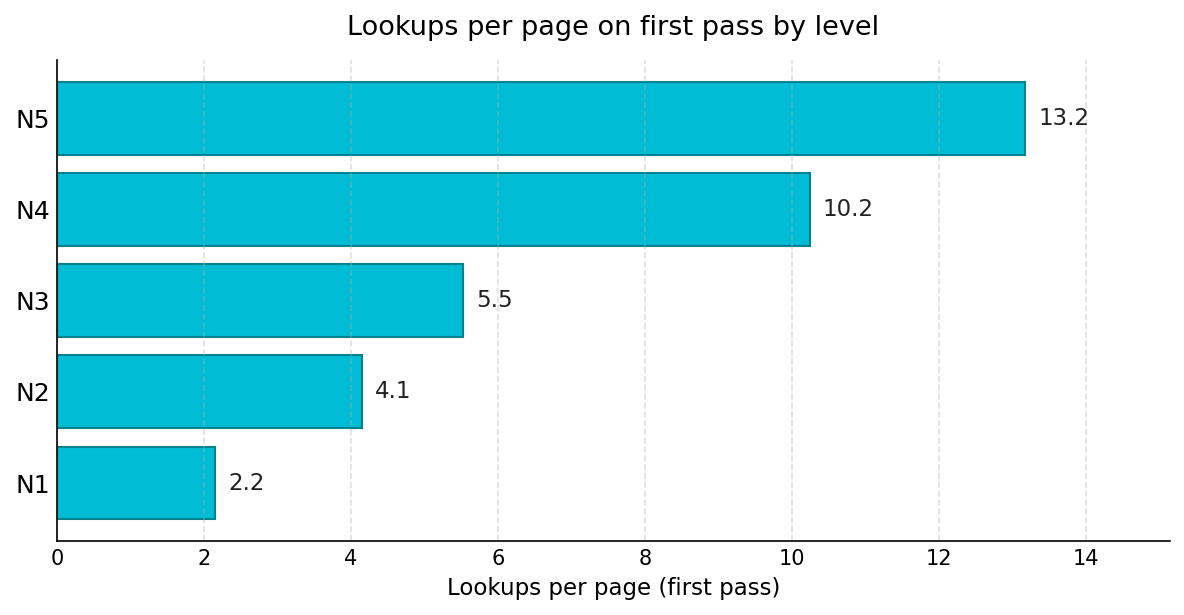
Lookups are unavoidable and painful, but you can lower the pain by completing the grammar foundation guide first. If you do not have kana yet, start there. That is table stakes.
N1 ≠ mastery
N1 means you passed a test. Real Japanese is not the test. Even N1 readers reading manga for the first time will look things up. The best way to learn real Japanese is to read real Japanese. Then you can pass any test.
An N1 reader still has 229 unique unlisted words to learn from this volume alone, plus first-encounter recognition on vocabulary they know from study but have never seen in flowing prose. Even at N1, expect 1 to 2 lookups per page on first pass.
Kanji
797 unique kanji on the page, counted from the actual surface forms. 756 are joyo. 41 are non-joyo. The non-joyo set splits into two camps: archaic-style kanji for common modern words, and series-specific or technique vocabulary Akutami built for the world. Furigana is printed on every one.
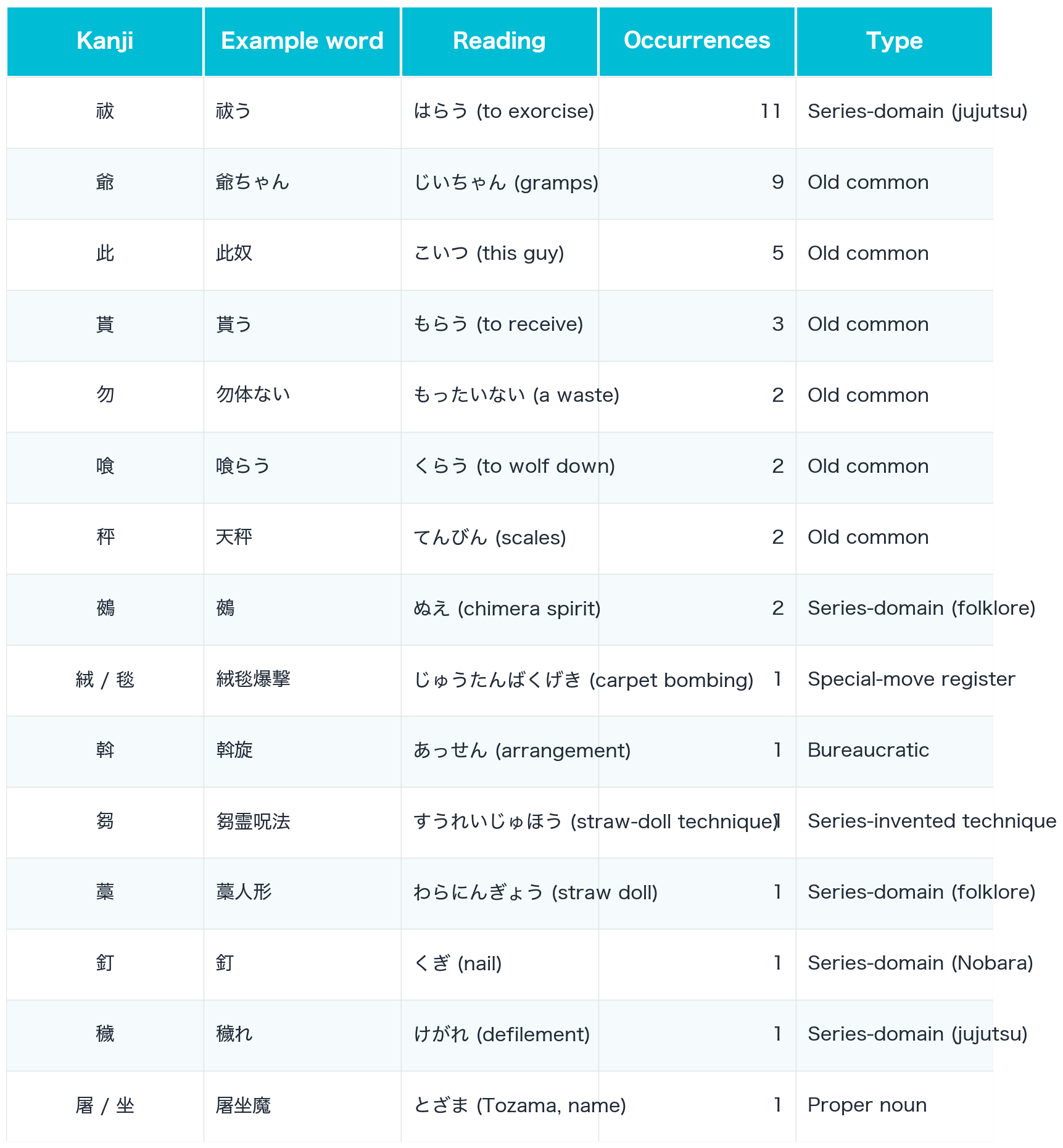
| Kanji | Example word | Reading | Occurrences | Type |
|---|---|---|---|---|
| 祓 | 祓う | はらう (to exorcise) | 11 | Series-domain (jujutsu) |
| 爺 | 爺ちゃん | じいちゃん (gramps) | 9 | Old common |
| 勿 | 勿体ない | もったいない (a waste) | 3 | Old common |
| 鵺 | 「鵺」 | ぬえ (chimera spirit) | 2 | Series-domain (folklore) |
| 穢 | 残穢 | ざんえ (lingering defilement) | 2 | Series-domain (jujutsu) |
| 秤 | 天秤 | てんびん (scales) | 2 | Old common |
| 篭 | 篭もっている | こもる (to be holed up) | 2 | Old common |
| 芻 | 反芻する | はんすう (to ruminate) | 2 | Old common |
| 喰 | 喰ってん | くらう (to wolf down) | 2 | Old common |
| 猾 | 「狡猾さ」 | こうかつさ (cunning) | 1 | Old common |
| 舐 | 舐めて | なめる (to mock or lick) | 1 | Old common |
| 嘘 | 嘘つきーー | うそつき (liar) | 1 | Old common |
| 藁 | 藁人形 | わらにんぎょう (straw doll) | 1 | Series-domain (folklore) |
The bottleneck is vocabulary, not kanji recognition. Stop worrying about the kanji list. Start worrying about the words.
Frequency
Word frequency in volume 1 is heavily concentrated at the top:
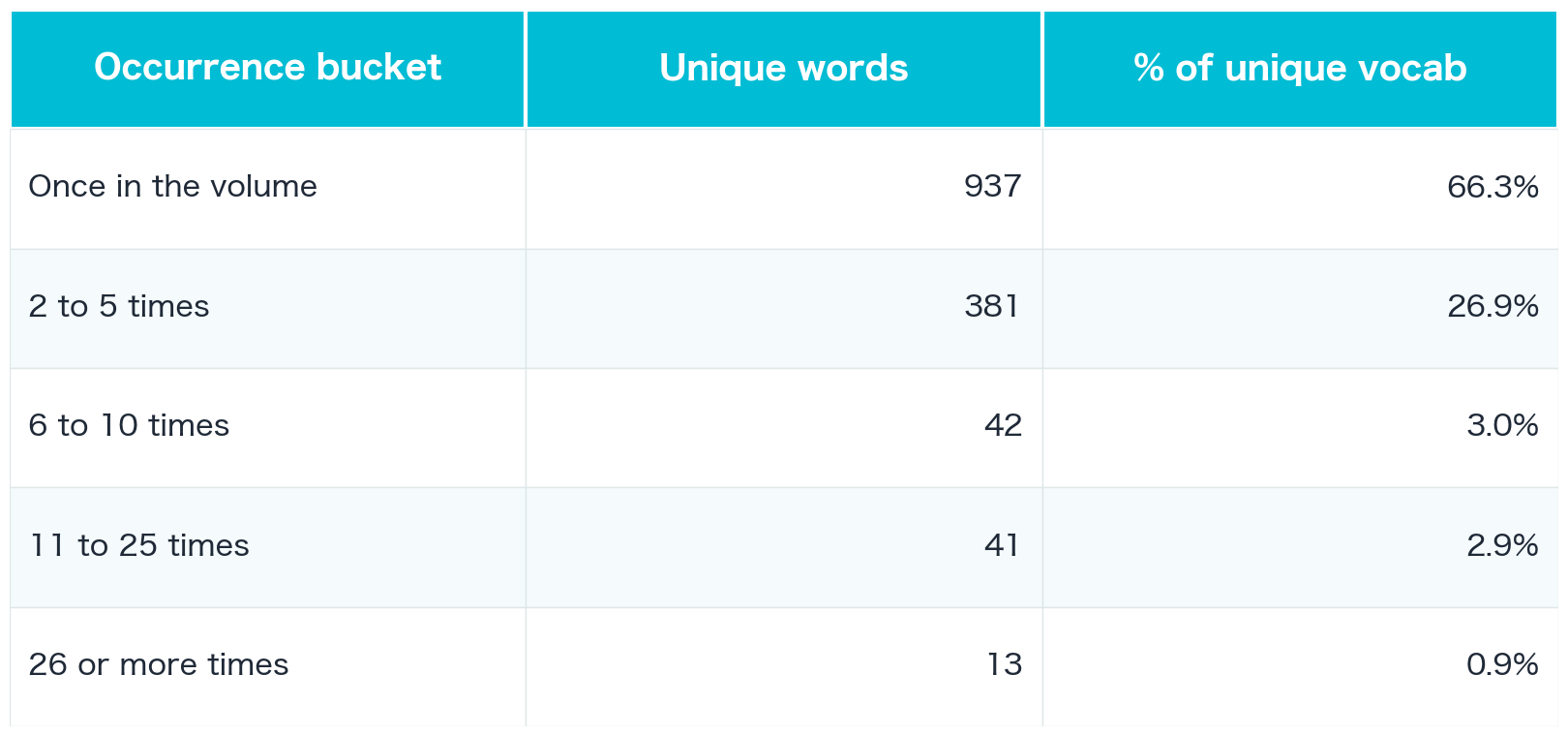
| Occurrence bucket | Unique words | % of unique vocab |
|---|---|---|
| Once in the volume | 937 | 66.3% |
| 2 to 5 times | 381 | 26.9% |
| 6 to 10 times | 42 | 3.0% |
| 11 to 25 times | 41 | 2.9% |
| 26 or more times | 13 | 0.9% |
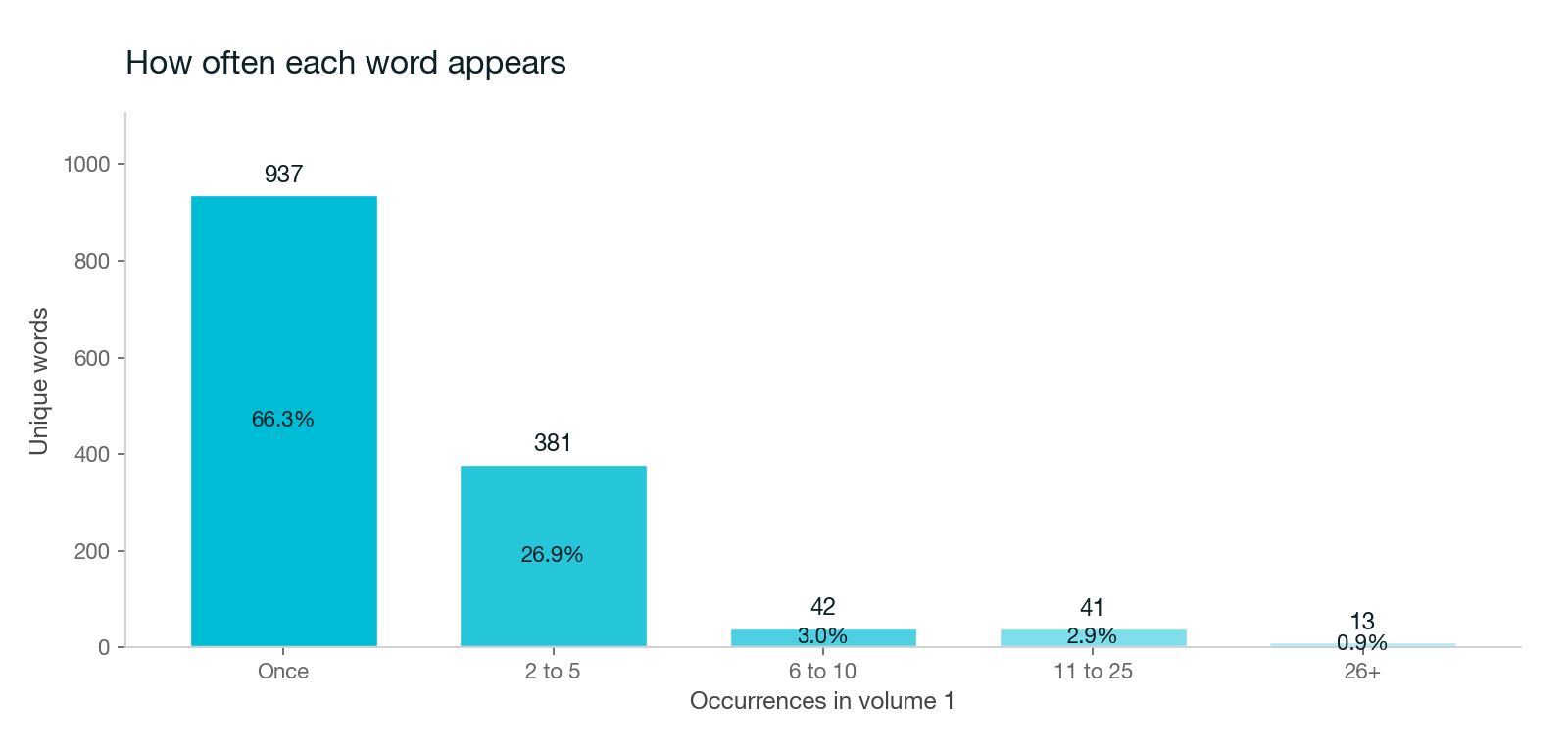
66% of the volume's unique vocabulary appears exactly once. Do not read "appears once" as "not worth learning." These words recur across the series. Later volumes pick them up and use them again. The 96 words that appear six times or more are the real spine of volume 1 specifically.
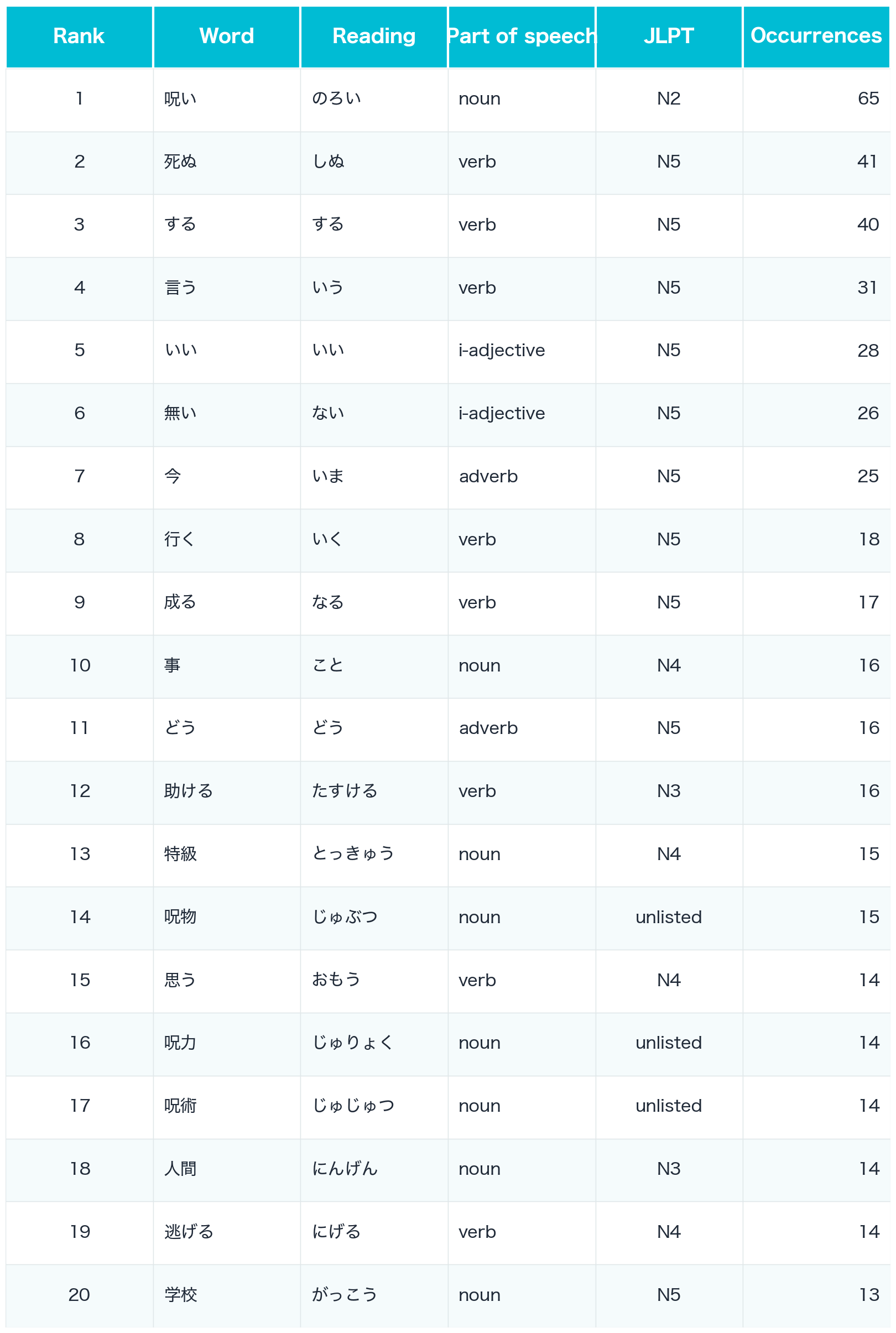
The 20 most frequent content words
Pre-study these 20 and you have learned the most common content words on almost every page. By the time you finish volume 1, all 20 are locked into your memory just from how often they appear.
Particles, auxiliary verbs, pronouns, conjunctions, proper nouns, and adnominals are excluded so the list surfaces meaningful content words.
| Rank | Word | Reading | Part of speech | JLPT | Occurrences |
|---|---|---|---|---|---|
| 1 | 呪い | のろい | noun | N2 | 65 |
| 2 | 死ぬ | しぬ | verb | N5 | 41 |
| 3 | する | する | verb | N5 | 40 |
| 4 | 言う | いう | verb | N5 | 31 |
| 5 | いい | いい | i-adjective | N5 | 28 |
| 6 | 無い | ない | i-adjective | N5 | 26 |
| 7 | 今 | いま | adverb | N5 | 25 |
| 8 | 行く | いく | verb | N5 | 18 |
| 9 | 成る | なる | verb | N5 | 17 |
| 10 | 事 | こと | noun | N4 | 16 |
| 11 | どう | どう | adverb | N5 | 16 |
| 12 | 助ける | たすける | verb | N3 | 16 |
| 13 | 特級 | とっきゅう | noun | N4 | 15 |
| 14 | 呪物 | じゅぶつ | noun | unlisted | 15 |
| 15 | 思う | おもう | verb | N4 | 14 |
| 16 | 呪力 | じゅりょく | noun | unlisted | 14 |
| 17 | 呪術 | じゅじゅつ | noun | unlisted | 14 |
| 18 | 人間 | にんげん | noun | N3 | 14 |
| 19 | 逃げる | にげる | verb | N4 | 14 |
| 20 | 学校 | がっこう | noun | N5 | 13 |
Two of these are worth calling out. 呪い (のろい, curse) is the noun the whole series is built on, and it appears 65 times in volume 1 alone. You will also see the same kanji read as じゅ in compounds like 呪術 (じゅじゅつ, sorcery), 呪力 (じゅりょく, cursed energy), 呪物 (じゅぶつ, cursed object), and 呪霊 (じゅれい, curse spirit). Same character, four readings, all central to the plot. Learning this one word helps you decode the entire curse vocabulary immediately.
特級 (とっきゅう, special-grade) is the curse-rating vocabulary you will hit in chapter 5 and chapter 6. Learning it once helps you decode every threat-level panel in the rest of the volume.
How each main character speaks
虎杖 悠仁 (Itadori Yuji)
Casual Tokyo teen. Uses 俺 (おれ) for "I." Sentence-final よ, ぞ, おい. Drops い from the negative adjective ending (わかんない instead of わからない). Runs loud. The easiest main character to read once you stop expecting politeness.
伏黒 恵 (Fushiguro Megumi)
Terse, blunt, minimal. Drops particles. Drops subjects. Answers in two or three words when possible. His lines are short and rarely confusing. When he does speak at length, it is usually exposition about 式神 (しきがみ, shikigami) or his clan, and that is when the N1 nouns land hardest.
釘崎 野薔薇 (Kugisaki Nobara)
Assertive, self-assured, the most confident speaker in the main trio. Uses あたし for "I." Rhetorical sentence enders (ってば, じゃない, わ). Her introduction in chapter 4 is the clearest speech register in the volume.
五条 悟 (Gojo Satoru)
The laziest speaker in the book. He is a teacher and he uses zero keigo with students. Long sentences, frequent register breaks, playful sarcasm, and the occasional 俺 (おれ). Gojo is also the character who delivers the grade-system exposition, which means his hardest lines are vocabulary bricks dressed up as jokes.
Expressions with depth
These are volume 1 expressions where the dictionary entry will mislead you. Surface meaning is one thing. What the phrase actually does in a panel is another.
のみならず (not only)
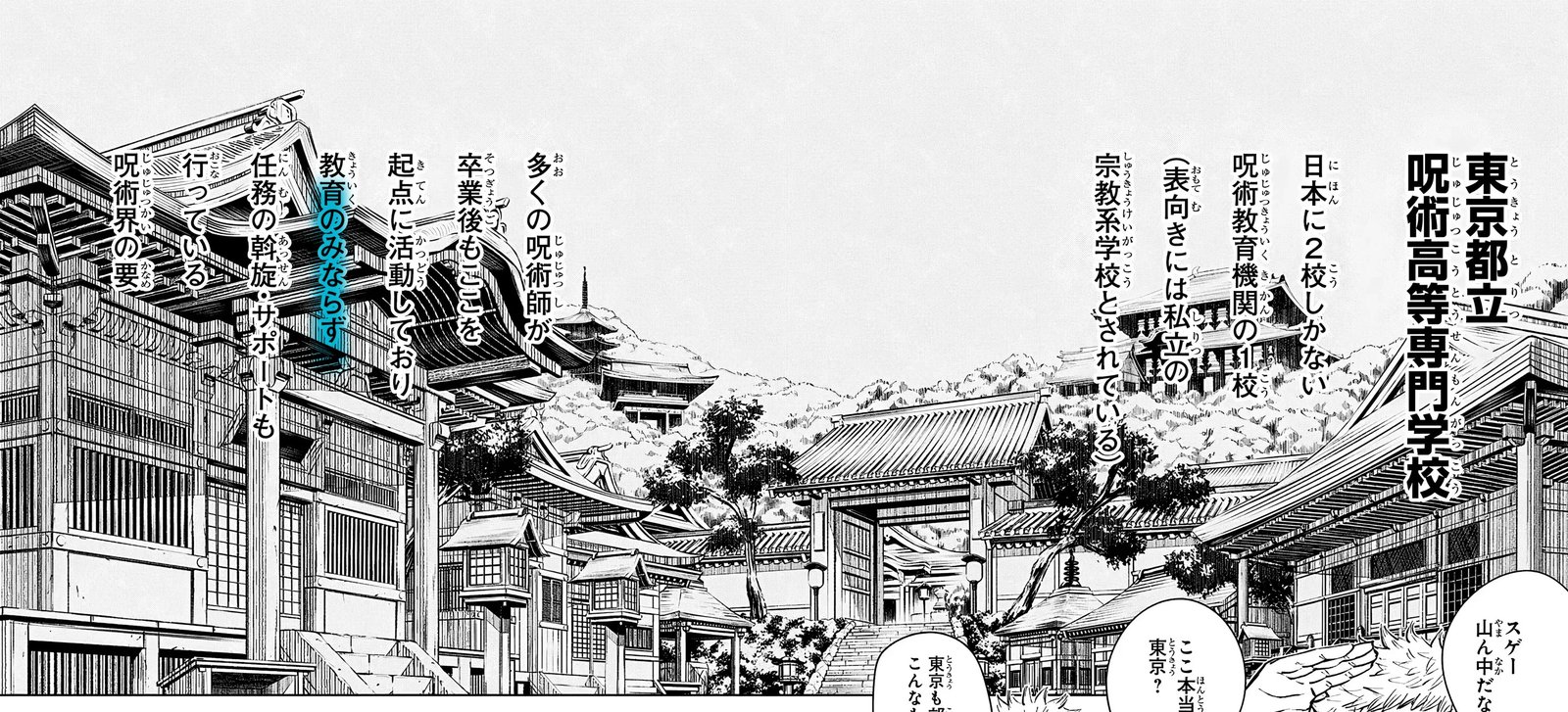
Dictionary: "not only." Textbook-neutral. The truth: this is a written-register phrase that signals the speaker is elevating their register on purpose. When Jujutsu High is introduced with 教育のみならず任務の斡旋 ("not only education but also mission arrangement"), the narrator is speaking in an institutional voice. Notice how quickly it disappears once Gojo opens his mouth.
とは言え (that said)
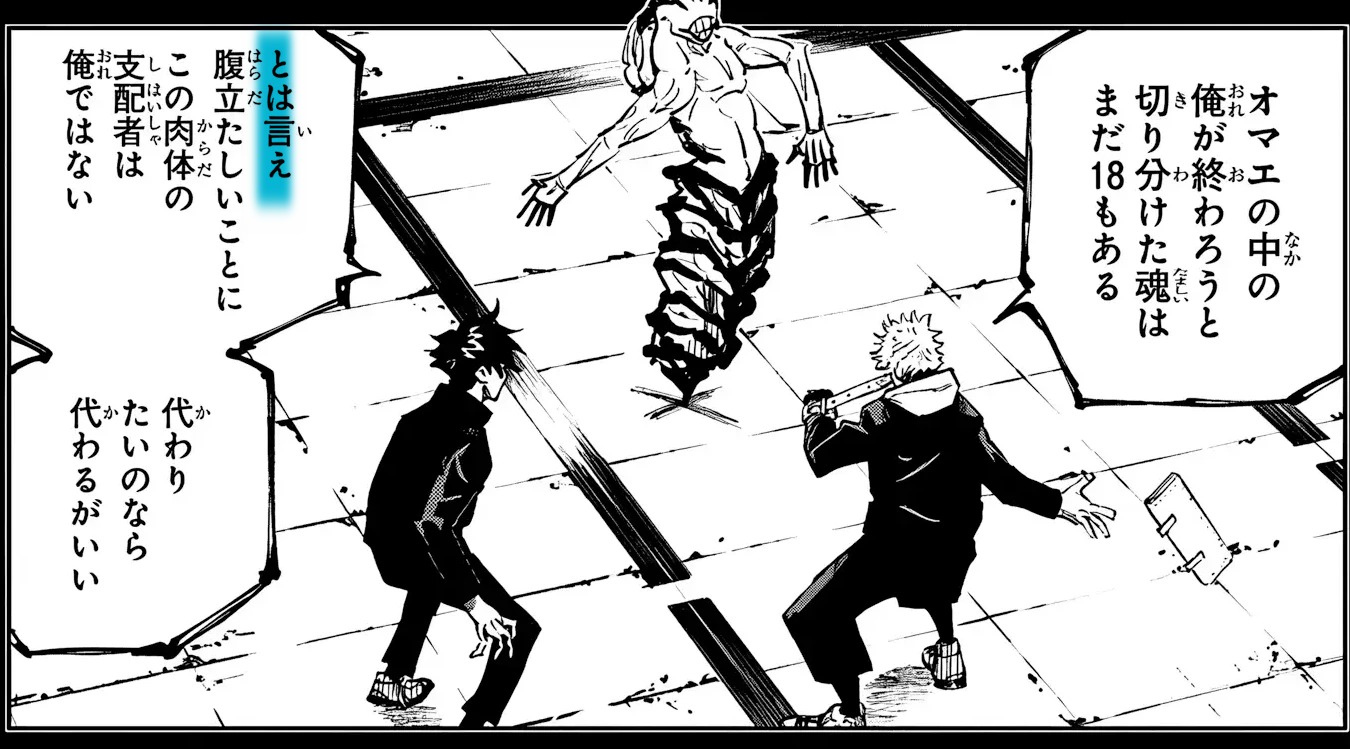
Dictionary: "having said that." What it actually does: signals the speaker is about to contradict themselves or complicate the picture. Sukuna uses it in chapter 7 for exactly this move. Watch for it. It is the Japanese rhetorical pivot you will see for the rest of your reading life.
ことに (particularly, to my...)
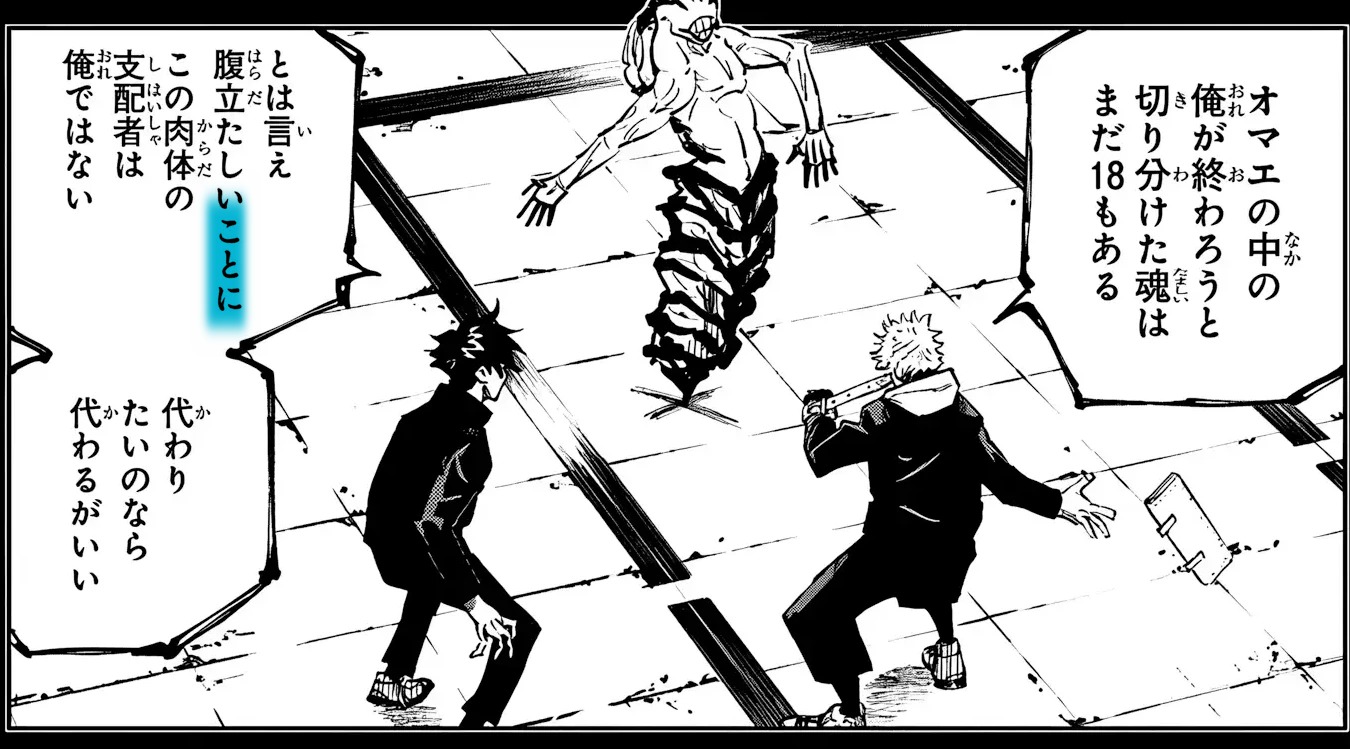
Dictionary: "especially" or "to one's X." The trick: 腹立たしいことに does not mean "the thing that is annoying." It means "to my annoyance," and it is how a character tells you how they feel about what they are about to say, before they say it. Sukuna uses this construction to preload contempt into his next clause.
現に (in reality)
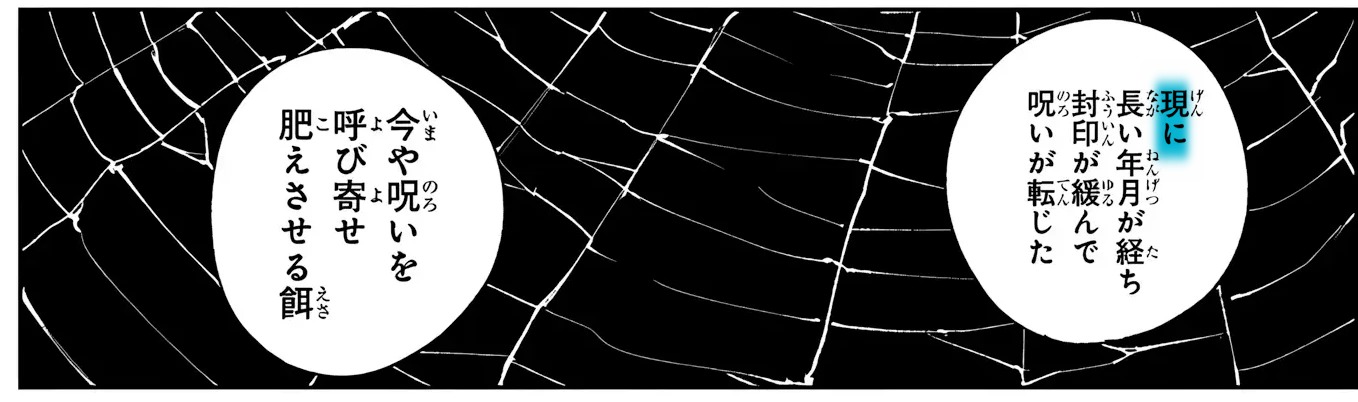
Dictionary: "actually, in fact." The texture: this is a word for pointing at a physical demonstration. When the narrator says 現に長い年月が経ち封印が緩んで in chapter 1 ("in reality, as the years passed, the seal loosened"), the word is telling you the fiction inside the panel is now the claim being defended. Rhetorical weight, not a filler word.
心細い (lonely-feeling, uneasy)
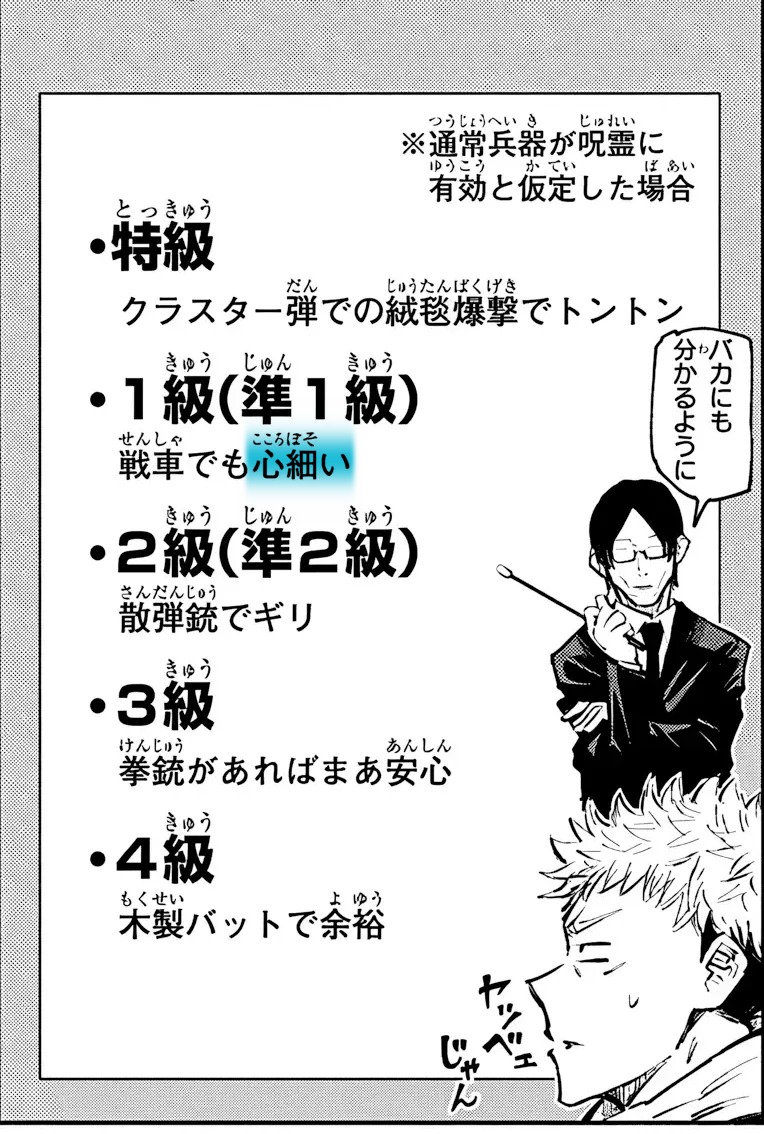
Dictionary: "forlorn" or "uneasy." The texture: the kanji is literally "thin heart." It is the specific anxiety of feeling alone and underequipped. Gojo uses it in chapter 6 to describe a tank's prospects against a grade-1 curse. The joke is in the word choice. A tank feels lonely. That is how dangerous grade-1 curses are.
Pop culture and context in volume 1
Four references a dictionary will not explain.
百葉箱 (ひゃくようばこ). Louvered weather-instrument shelter. Every Japanese elementary school has one in the yard for science class. In the opening pages, Itadori's club finds a cursed object inside one. The cultural weight: this is the most boring, most familiar, most harmless object on any school campus, which is exactly why something evil being sealed inside it reads as a violation of normalcy to a Japanese reader.
絨毯爆撃 (じゅうたんばくげき). Carpet bombing, literally "carpet bomb attack." Appears in Gojo's chapter 6 explanation of curse grades. The grim comedy: World War II military terminology applied to a teenager audience, and the reader is supposed to laugh at the register crash.
呪術高等専門学校 (じゅじゅつこうとうせんもんがっこう). Jujutsu High is a "technical college" (高専), a real Japanese institutional category that sits between high school and university and specializes in vocational training. The word choice is satirical. A school where the "vocation" is exorcism.
両面宿儺 (りょうめん すくな). The title of chapter 1 and the name of the antagonist. Sukuna is a real figure from the Nihon Shoki, an 8th-century chronicle, described as a two-faced, four-armed demon from Hida province. Akutami did not invent the character. The manga is leaning on folklore readers may remember from school.
芻霊呪法 (すうれいじゅほう). Nobara's "straw doll" technique uses the character 芻 (fodder, hay), which is non-joyo and rare. The furigana saves you. The cultural note: straw doll cursing (藁人形, わらにんぎょう) is a real piece of Japanese folk magic, and Nobara using hammer-and-nail straw dolls is both a fight style and a reference to that tradition.
Inside the app: one panel, fully broken down
Reading manga in Japanese is, at the bottom of it, a vocabulary-acquisition problem. Let me get you one word: 忌々しい. All the context around it is broken down here the same way The Ashiba App provides it, so you finish this section actually understanding the word, not just having seen it.
Chapter 7, page 18: Sukuna's contempt
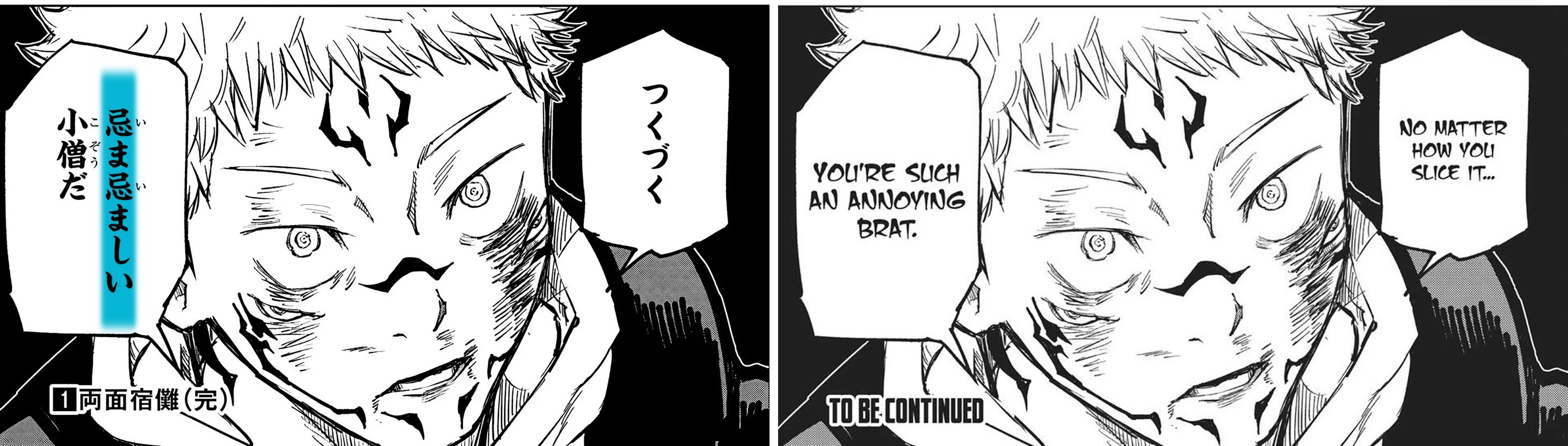
Summary. Sukuna has manifested and is expressing his profound disgust for Yuji Itadori, the "brat" who usually suppresses him. The tone is one of seething, ancient malice.
Textbox 1
JP: つくづく
EN: Truly...
Overview: Sukuna uses this adverb to emphasize the depth and certainty of his annoyance.
Breakdown:
- つくづく: an adverb meaning "thoroughly," "deeply," or "utterly." It indicates that the speaker has reached a firm, heartfelt conclusion.
Textbox 2
JP: 忌ま忌ましい小僧だ
EN: What a detestable brat.
Overview: Sukuna insults Yuji with a strong, archaic-sounding adjective, declaring his hatred plainly.
Breakdown:
- 忌ま忌ましい (いまいましい): detestable, abominable, or cursed. A very strong adjective used to express intense loathing.
- 小僧 (こぞう): "brat" or "youngster." Sukuna's standard derogatory way of referring to Yuji.
- だ: the casual copula, used here for a blunt and definitive statement.
Key points
- つくづく: an adverb used to express a deep, heartfelt feeling or a firm realization. Often translates to "really," "deeply," or "utterly."
- 忌ま忌ましい (いまいましい): a strong adjective meaning "detestable" or "abominable." It carries a nuance of being "cursed" or "unpleasant to even think about," fitting for an ancient curse like Sukuna.
- 小僧 (こぞう): a derogatory term for a young male, often translated as "brat" or "kid." It reflects Sukuna's arrogant, ancient perspective compared to Yuji.
How to actually read volume 1
- Get a foundation. How much you need depends on how much discomfort you can sit with. Genki I + II is the polished path. At a minimum, lock in N5. Nothing else moves until kana and basic grammar are automatic.
- Start with chapter 1. Take your time. Not a week. Not a day. This is the first chapter of manga you have ever read in Japanese. Set a timer for 15 minutes. Early on, you crack one to three sentences in that window. Later, you crack a full chapter. Consistency compounds. Rack up the reps.
- When you get stuck, reference the translation. Looking things up is not failure. It is learning. The fastest way to get unstuck is to see the answer and understand why the sentence means what it means. Goal: parse the sentence. Match the English to the Japanese, identify the word or grammar that blocked you, and move on. You will hurdle (probably in chapter 1 when Sukuna first emerges, or chapter 6 when Gojo introduces curse grades, or chapter 7 when the Eishu detention center fight peaks). Those panels are dense. The answer is not to grind harder. The answer is what I wrote about in Why You Will Quit Learning Japanese: put the book down and come back tomorrow.
If you want the deeper version of this reading strategy, the fastest way to learn Japanese article has the volume-control framework in full.
The Takeaway
The main reason reading manga in Japanese is hard is the sheer amount of vocabulary you do not know.
Most readers never get past this. The pain is too great. The effort-to-reward ratio collapses, and the book gets shelved.
The easiest way out is to pre-study the words you do not know that will appear in the chapter you are about to read. The Ashiba App does this for every chapter of every series I cover. It surfaces the vocabulary, shows readings and POS, and includes grammar breakdowns so you see how each word is being used. Nothing is studied in isolation. Every flashcard carries its full panel context. You see the word in the sentence in the panel where it lives.
Frequently asked questions
Should I watch the anime before reading Jujutsu Kaisen in Japanese?
Yes. Watch at least episode 1 before you start the manga. Knowing the beats kills comprehension FOMO: you are not anxious about missing the story, because you already know the story. The early-arc JJK anime is near 1-to-1 with the manga dialogue, so your brain has the voice work and the pacing loaded before you open the book. Watch the anime a second time after you finish volume 1 and you will feel exactly how much more you picked up by reading.
Do I need to know all the kanji before starting?
No. Furigana is provided everywhere, every kanji, every appearance. You need to know hiragana and katakana. That is the hard prerequisite. Kanji you pick up as you read. If you have not finished kana yet, start with how to learn hiragana and katakana.
How long does it take to read JJK volume 1 in Japanese?
A solid N3 reader, first pass, cracking every unknown word: 10 to 14 hours across the full volume. An N2 reader who knows most curse terminology: 4 to 6 hours. A native speaker: 45 minutes. You are not the native speaker. Respect the pace.
Do I need to read volume 1 first or can I start anywhere?
Follow the fun. If a different volume or series pulls you harder, start there. The reasons to pick volume 1 anyway: the early-arc language is the easiest in the series, and it builds the curse-vocabulary base that carries through every later arc.
Where can I buy Jujutsu Kaisen volume 1 in Japanese?
Free preview: read chapter 1 in Japanese on Shonen Jump Plus. For the English translation to compare against, Viz Media has the same chapter online. Digital recommendation: the Shonen Jump app is the cleanest reading experience on mobile or web. Physical or Kindle: Amazon Japan or BookWalker.