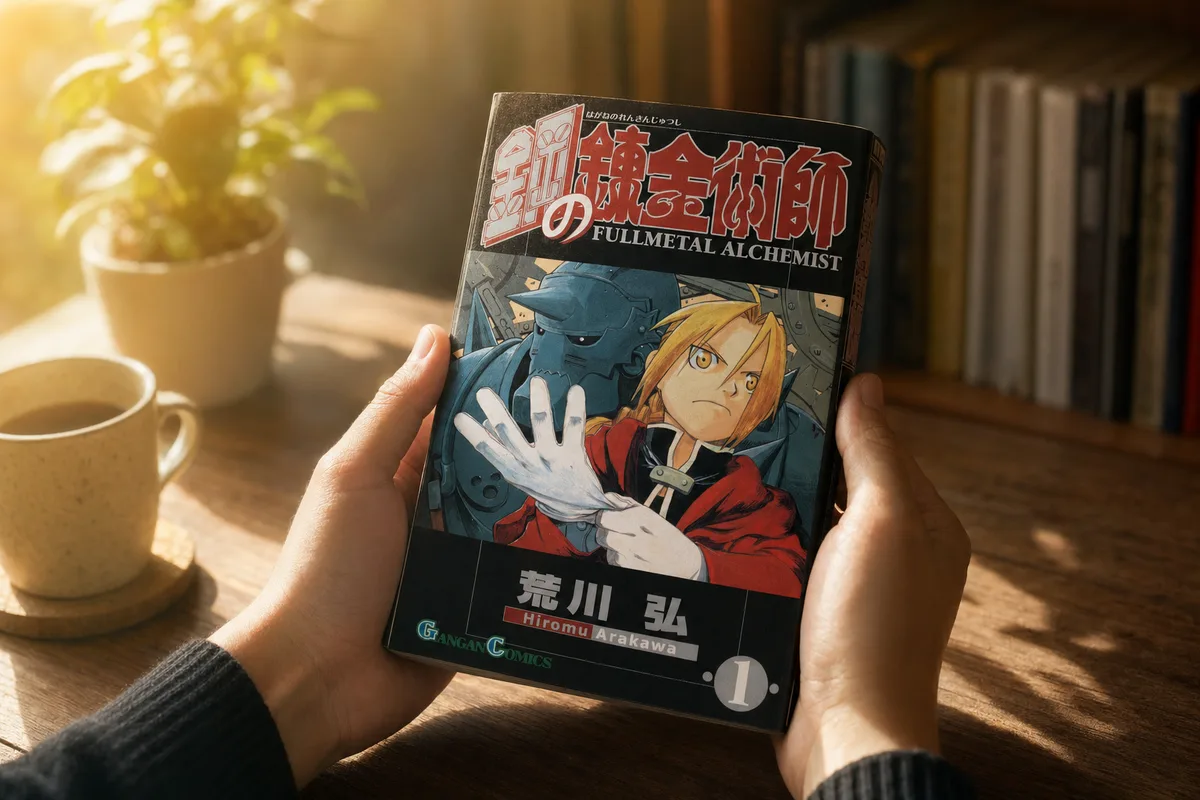
Volume 1 of Fullmetal Alchemist contains 1,409 unique vocabulary items across 4 chapters, 174 pages, 790 panels, and 1,065 textboxes. The script uses 689 unique kanji on the page, of which only 22 are non-joyo. If you have finished Genki II, you already know roughly half of those words outright. The other half is a mix of military rank vocabulary, alchemy terminology Hiromu Arakawa repurposes from chemistry and German philosophy, and the regional slang of a desert religion arc.
That is the whole problem with FMA volume 1 in one paragraph. Here is exactly what is in this book, and exactly what you need to read it.
Every number in this article comes from Ashiba's production corpus, measured against the official N5 to N1 JLPT vocabulary lists and the 2,136-character joyo kanji set. Last measured 2026-04-25.
Is Fullmetal Alchemist volume 1 hard to read in Japanese?
Upper-intermediate. Not beginner. Not advanced. If you can read a Genki II dialogue without stopping every line, you will finish volume 1. It will take you longer than you think, and you will look up more words than you want to. You will also finish.
People mis-rate this book in both directions. Here is the actual shape.
What makes it easier than you think
Kanji is not a blocker. Furigana, the small phonetic companion written above every kanji, is provided everywhere in this manga: every kanji, every appearance, every chapter. Across the actual surface forms in volume 1 the manga uses 689 unique kanji, and 667 of them (96.8%) are joyo. Even the 22 non-joyo kanji come with the reading sitting right above the character.
The alchemy vocabulary is not the problem either. 錬金術 (alchemy), 錬成 (transmutation), and 錬金術師 (alchemist) sound exotic but every character in those compounds is joyo. 錬, 金, 術, 師, 成 are all on the standard list. Series-specific does not mean unfamiliar characters. It means familiar characters reused for invented domain vocabulary.
Most of the actual non-joyo kanji in volume 1 are old literary words. 鎧 (よろい, armor) appears 10 times, 汝 (なんじ, archaic "you") 4 times, 噂 (うわさ, rumor) 3 times. Then a long tail of one-off appearances: 焰 (alternate kanji for flame), 甦 (to revive), 噛 (to bite), 咎 (fault), 嬉 (glad), 莫 (vast, in 莫大な). These come from the religion arc's sermon register and the narrator's elevated military exposition. You build a dictionary entry once, then you are done.
Stop worrying about the kanji list. The book hands you the readings.
What makes it harder than it looks
The long tail. 941 unique words appear exactly once in the entire volume. That is 67% of the unique vocabulary. This is the single biggest difficulty in volume 1, not kanji, not grammar. Most words you encounter do not repeat enough times within volume 1 to give you the in-volume spaced-repetition benefit. They will recur across the series. They will not recur much in this book.
Vocabulary acquisition is iterative. A word does not stick the first time. Each word takes multiple painful encounters before recognition becomes automatic, and every encounter breaks the story flow. You stop, you look up, you re-read the sentence, you re-set the panel in your head, you keep going. The tipping point where the manga starts reading easily is further out than most learners expect. The only path through is volume.
There is one way to lower the pain without lowering the reps. Pre-study the chapter vocabulary before you open the chapter. That moves the lookups out of the story and into focused study time. Same words, different context. The story stays intact.
The fights are easy. The exposition is not. Vol 1 has three distinct vocabulary domains layered on top of one another: alchemy theory (錬金術, 等価交換, 法則, 錬成), military chain-of-command (中尉, 大佐, 国家錬金術師), and the religion arc's sermon vocabulary (神, 奇跡, 信じる, 教主). When a chapter switches between them, your dictionary goes with it.
Edward's voice adds a register layer too. He is fifteen, he is a State Alchemist, and he switches between casual youth speech and technical alchemy-prodigy explanation in the same page. If you learned desu-masu first and nothing else, Ed's lines will feel like a violation of the rules you memorized. Good. That is how real Japanese sounds.
You don't need permission. Just go for it.
The real question is not whether this book is at your level. The real question is whether the pain is tolerable for the reward. If you actually want this story, the level mismatch is just a tax on time, not a wall. You pay it in lookups and re-reads and slow chapters until the cost goes down. Always read above your level. Attack the stories that motivate you. Permission is something other people give themselves and then complain about. Just go for it.
What the data says about volume 1
Every number below was calculated from the approved vocabulary set for Fullmetal Alchemist volume 1 in Ashiba's production database. JLPT level was assigned by matching against the official N5 to N1 lists. Words not on any list were classified by Gemini 3 Pro against context. The remainder are marked "unlisted" (proper nouns, manga-specific jargon, slang, onomatopoeia).
A note on terminology. Running vocabulary means every word token as it occurs in the text, counting every repeat. If 錬金術 appears 16 times, that is 16 running tokens from 1 unique word. Unique vocabulary means the distinct words themselves, counted once each.
Volume 1 at a glance
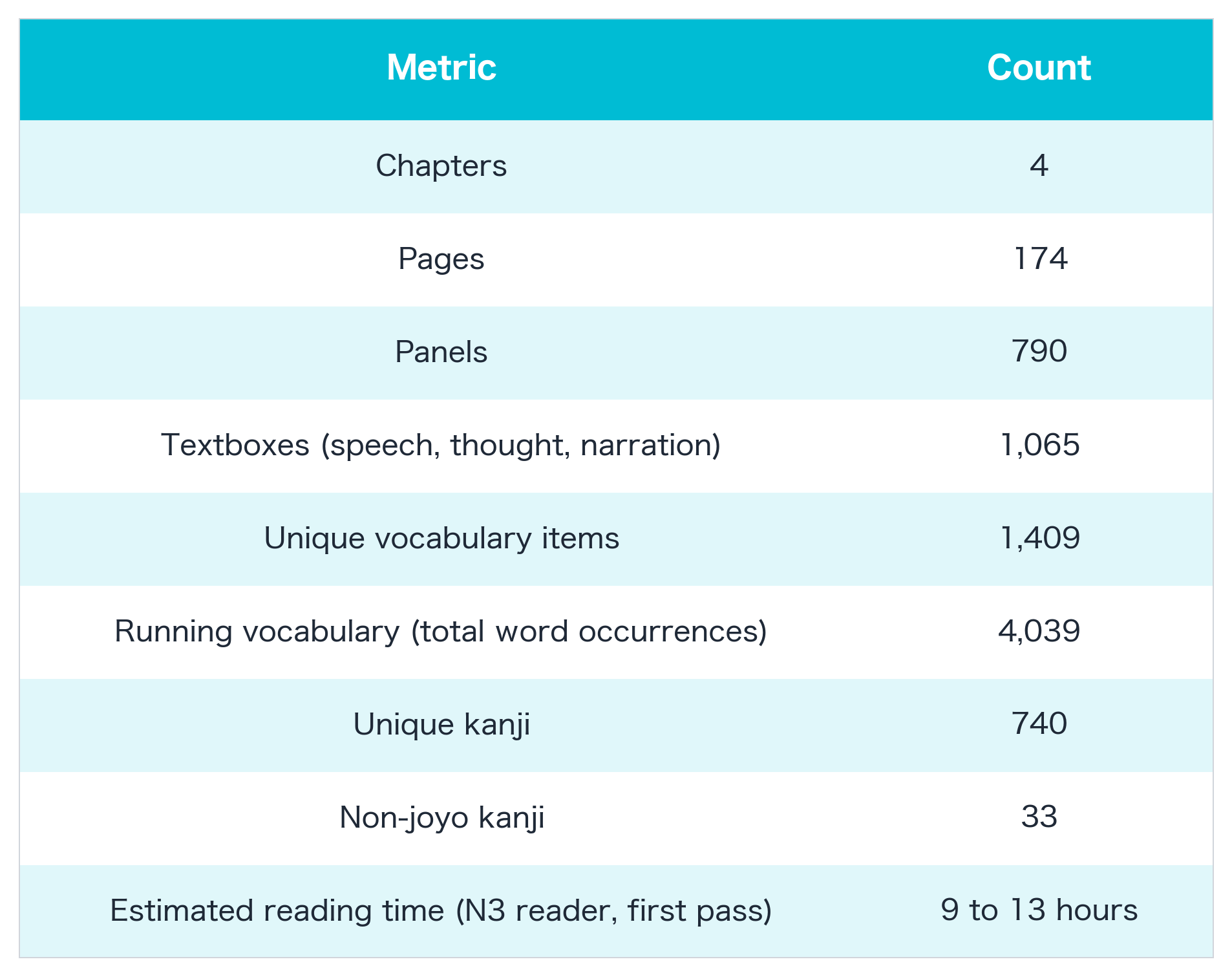
| Metric | Count |
|---|---|
| Chapters | 4 |
| Pages | 174 |
| Panels | 790 |
| Textboxes (speech, thought, narration) | 1,065 |
| Unique vocabulary items | 1,409 |
| Running vocabulary (total word occurrences) | 4,039 |
| Unique kanji | 689 |
| Non-joyo kanji | 22 |
| Estimated reading time (N3 reader, first pass) | 9 to 13 hours |
JLPT coverage
The 1,409 unique vocabulary items in volume 1 break down like this:
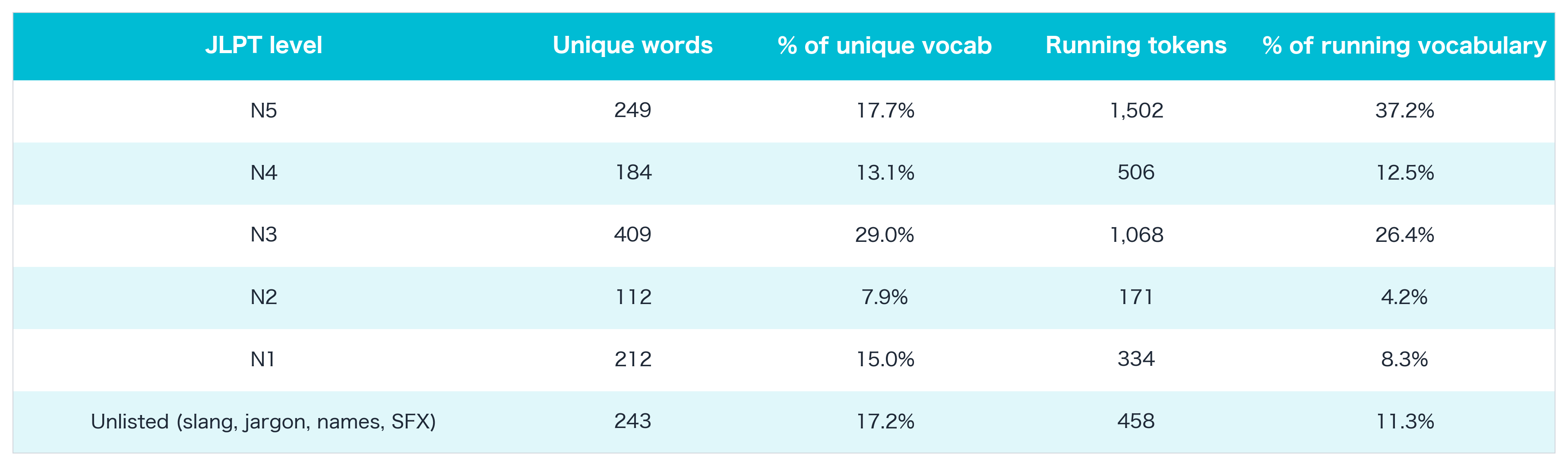
| JLPT level | Unique words | % of unique vocab | Running tokens | % of running vocabulary |
|---|---|---|---|---|
| N5 | 249 | 17.7% | 1,502 | 37.2% |
| N4 | 184 | 13.1% | 506 | 12.5% |
| N3 | 409 | 29.0% | 1,068 | 26.4% |
| N2 | 112 | 7.9% | 171 | 4.2% |
| N1 | 212 | 15.0% | 334 | 8.3% |
| Unlisted (slang, jargon, names, SFX) | 243 | 17.2% | 458 | 11.3% |
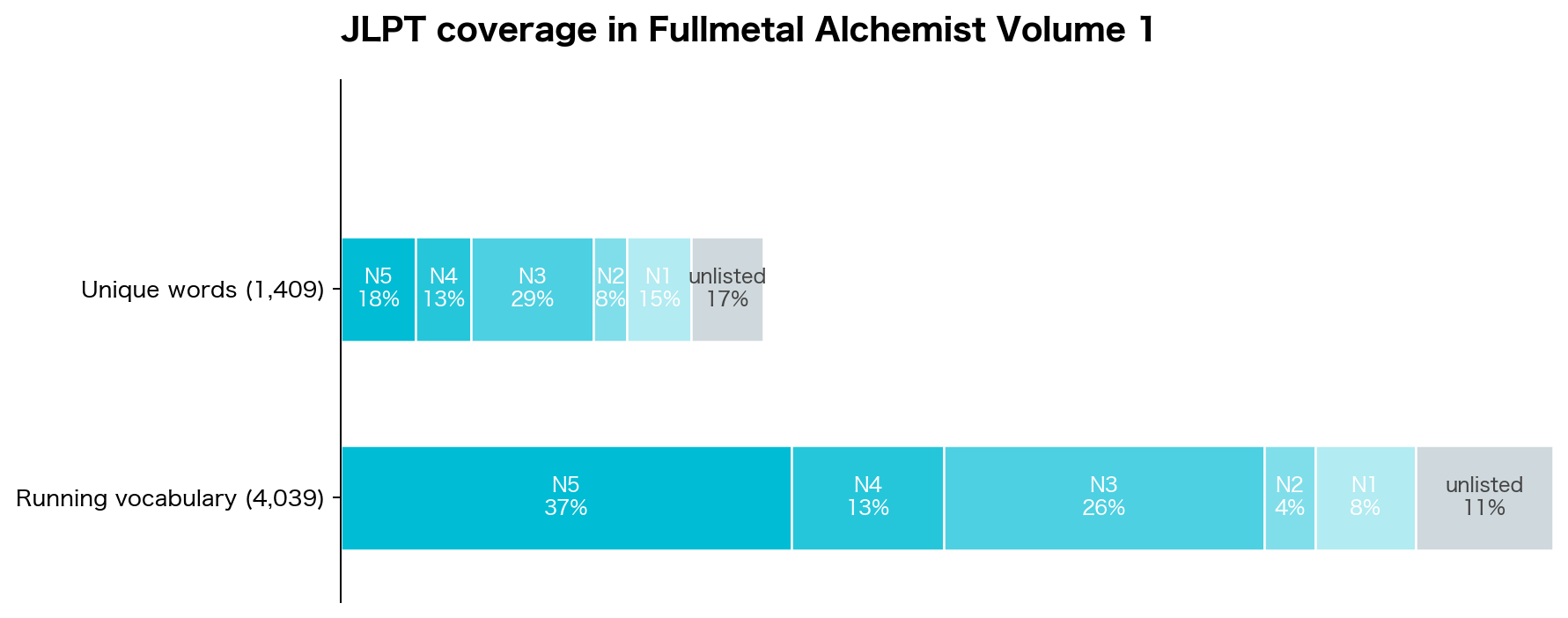
Even at N5+N4 you already know around half of the running vocabulary. Add N3 and you push past three quarters. The hard stuff (N2 and N1) is small in volume but heavy in importance: these are the alchemy and religion-arc terms that carry the story. The unlisted bucket holds the series-coined words like 錬成 and 等価交換, which live nowhere on a JLPT list but show up constantly.
Reader guidance by level
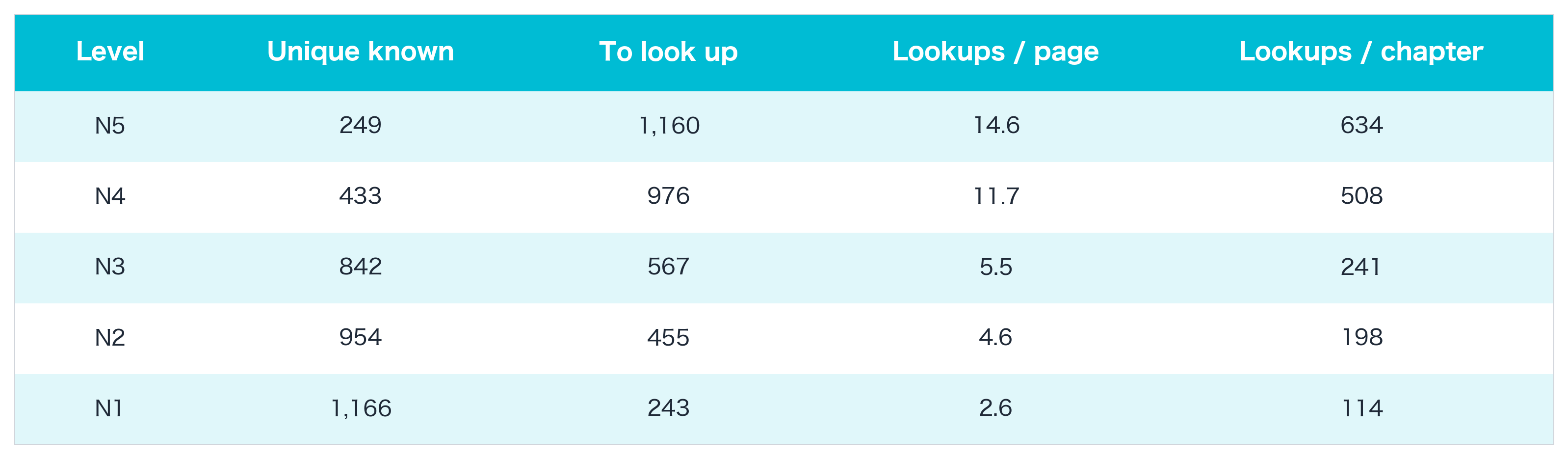
| Level | Unique known | To look up | Lookups per page | Lookups per chapter |
|---|---|---|---|---|
| N5 | 249 | 1,160 | 14.6 | 635 |
| N4 | 433 | 976 | 11.6 | 508 |
| N3 | 842 | 567 | 5.5 | 241 |
| N2 | 954 | 455 | 4.5 | 198 |
| N1 | 1,166 | 243 | 2.6 | 115 |
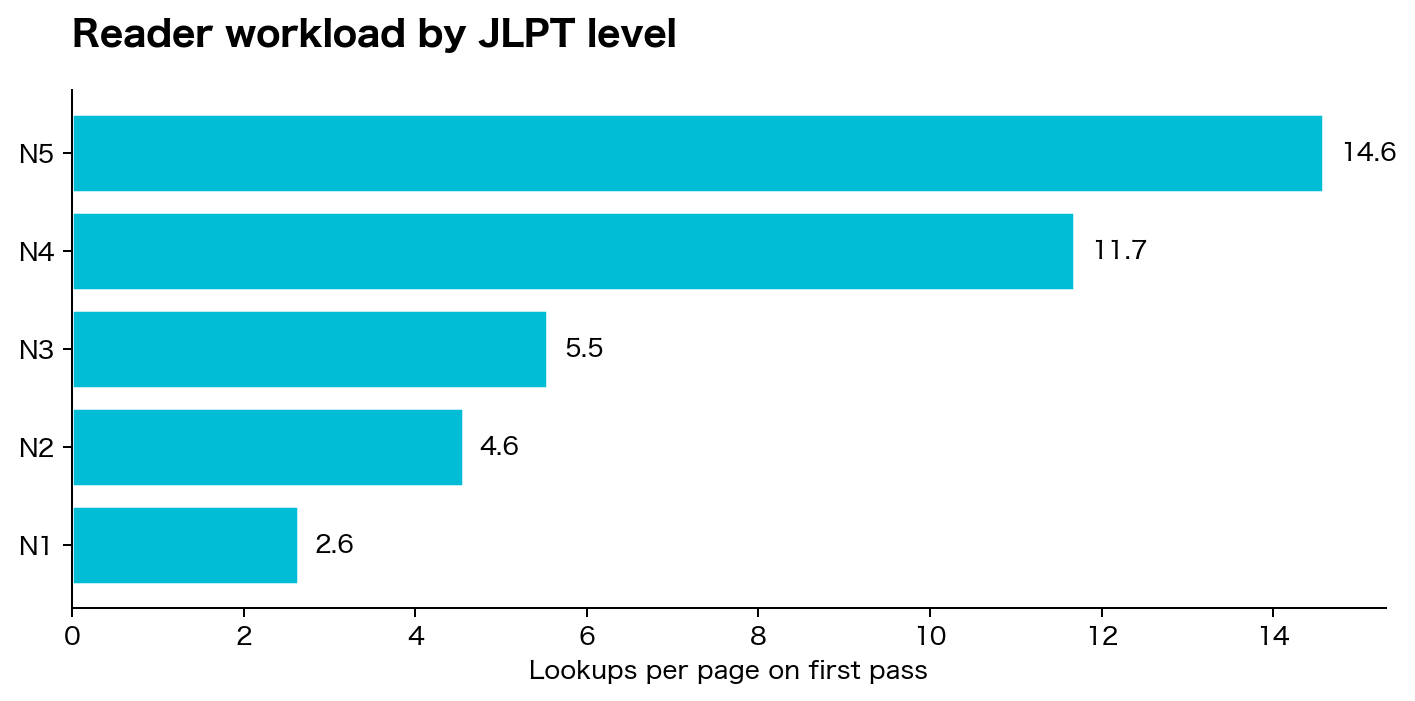
It is all grammar and vocabulary. It is all things to look up. The variable is how much pain and frustration you are willing to sit with. If you love this story, you can do this. If you do not love it, pick a different one. Either way, you can lower the pain by completing the grammar foundation guide first. If you do not have kana yet, start there. That is table stakes.
N1 ≠ mastery
N1 means you passed a test. Real Japanese is not the test. Even N1 readers reading manga for the first time will look things up. The unlisted bucket alone holds words you will not have seen before, plus first-encounter recognition for vocabulary you know from study but have not seen in flowing prose. Expect to look up roughly one to two words per page on a first pass through volume 1, even with N1 grammar locked in. The best way to learn real Japanese is to read real Japanese. Then you can pass any test.
Kanji
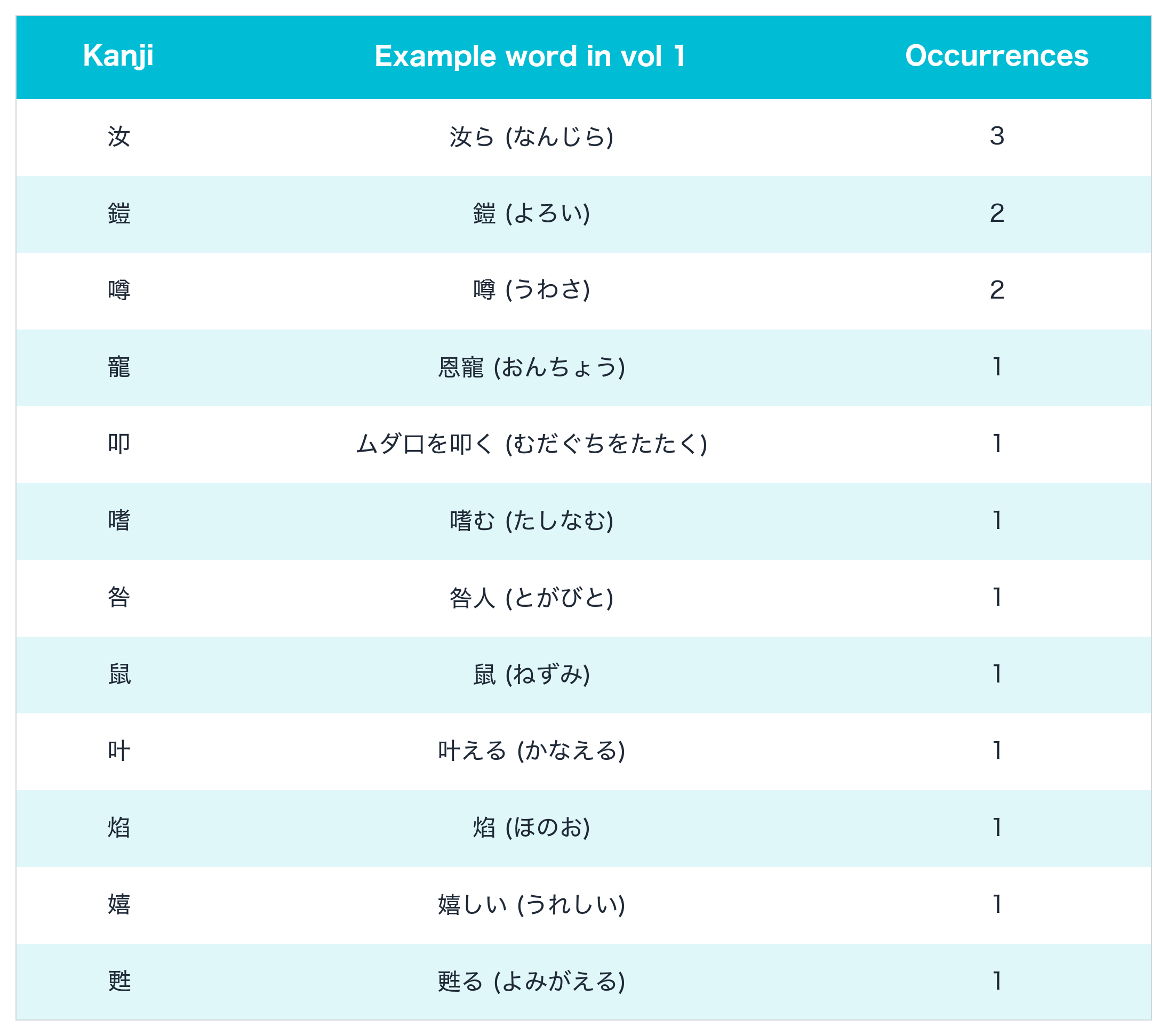
FMA volume 1 has 689 unique kanji on the page (counted from actual surface forms, not lemma headwords; words written in pure hiragana do not count). 667 are joyo. 22 are not. The non-joyo set is small and skewed toward archaic / literary register: words an older Japanese reader would have seen in pre-war texts but a modern student might not. The narrator's military exposition and the religion arc's sermon dialogue pull from this register on purpose.
| Kanji | Example surface form in vol 1 | Occurrences |
|---|---|---|
| 鎧 | 鎧 (よろい, armor) | 10 |
| 汝 | 汝ら (なんじら, archaic "you") | 4 |
| 噂 | 噂 (うわさ, rumor) | 3 |
| 焰 | 焰 (ほのお, alternate kanji for flame) | 1 |
| 甦 | 甦らせる (よみがえる, to revive) | 1 |
| 噛 | 噛み殺せ (かみころす, to bite to death) | 1 |
| 翡 | 翡翠 (ひすい, jadeite) | 1 |
| 咎 | 咎人 (とがびと, criminal) | 1 |
| 嬉 | 嬉しい (うれしい, glad) | 1 |
| 伊 | 伊達 (だて, in proper name) | 1 |
| 莫 | 莫大な (ばくだいな, vast) | 1 |
| 瀆 | 冒瀆 (ぼうとく, blasphemy) | 1 |
The alchemy vocabulary itself sits inside joyo. 錬金術, 錬成, 等価交換, 法則, 機関 are all joyo compounds. Once you have learned 錬, you have learned half the alchemy vocabulary, and you already knew 金, 術, 成, 価, 交, 換 from school-grade Japanese.
Frequency
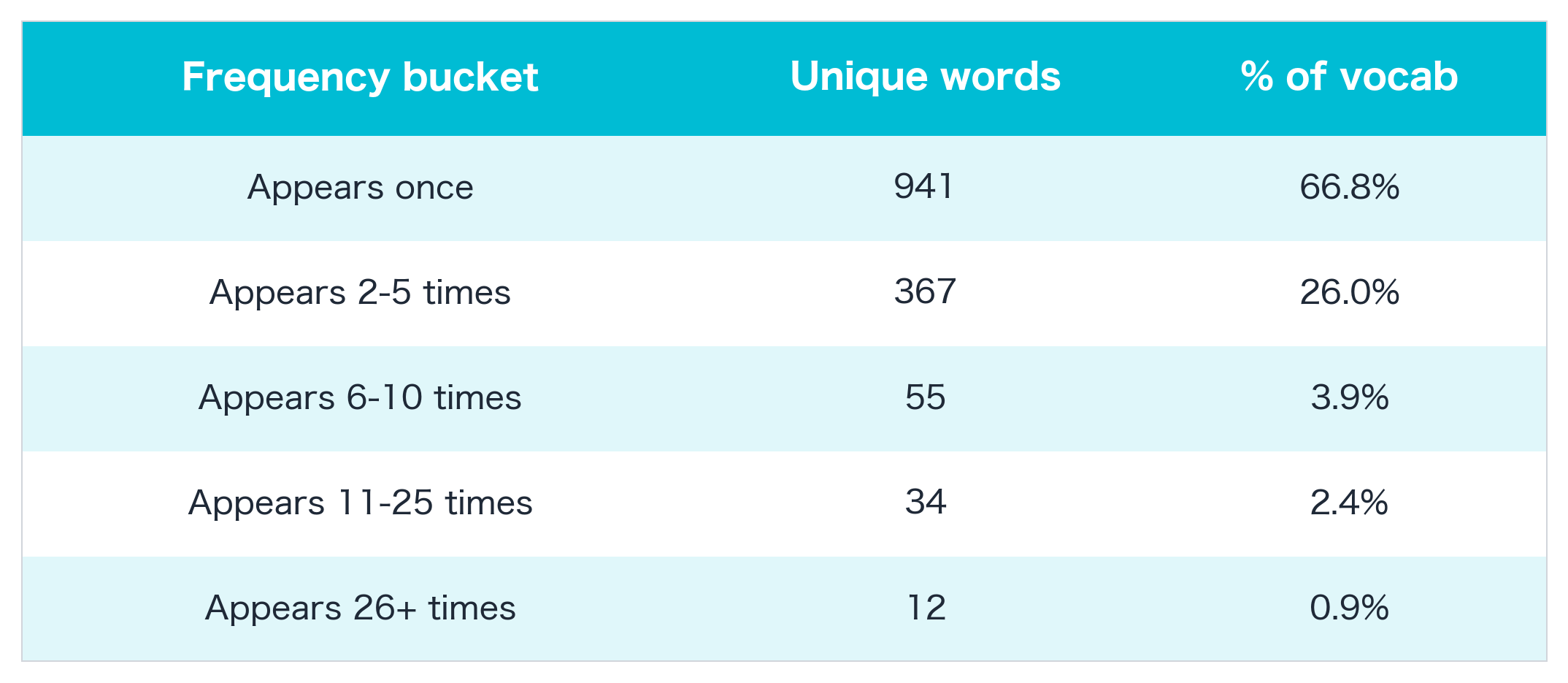
| Frequency bucket | Unique words | % of vocab |
|---|---|---|
| Appears once | 941 | 66.8% |
| Appears 2-5 times | 367 | 26.0% |
| Appears 6-10 times | 55 | 3.9% |
| Appears 11-25 times | 34 | 2.4% |
| Appears 26+ times | 12 | 0.9% |
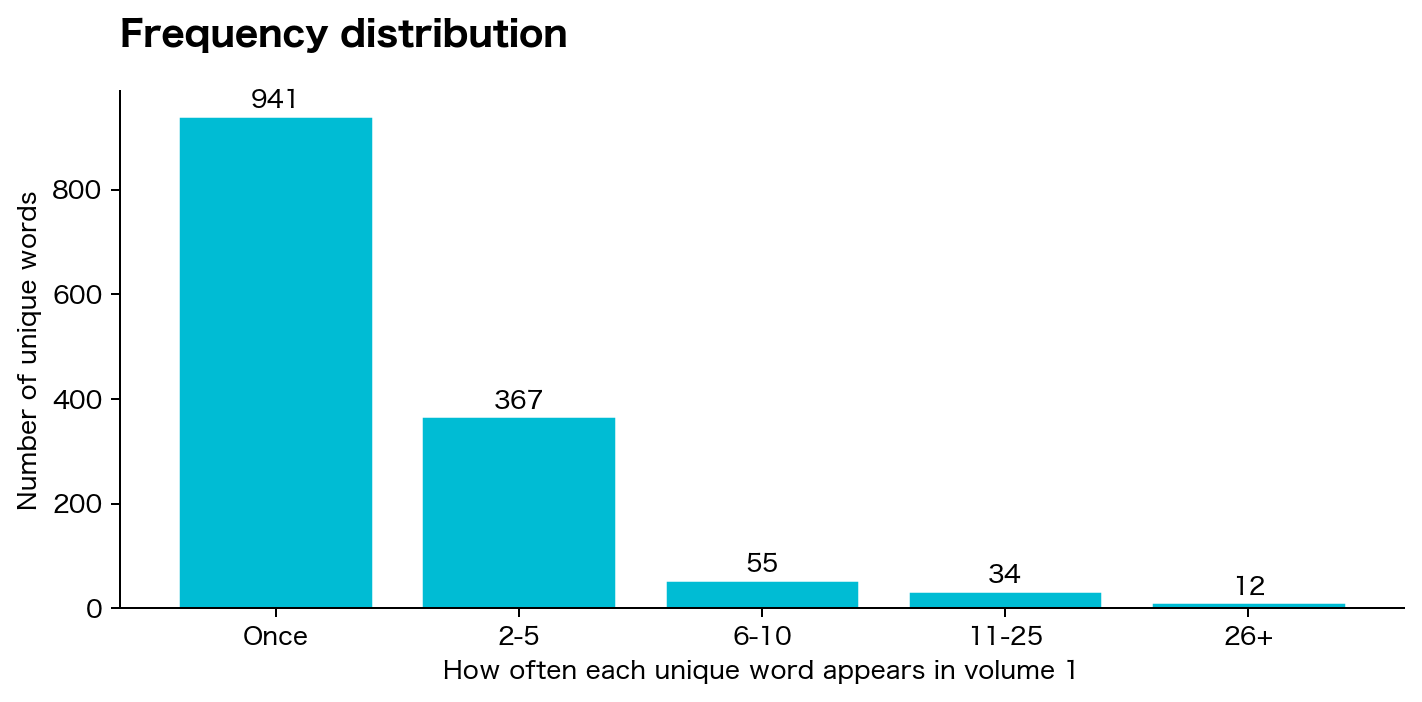
67% of the unique vocabulary appears exactly once. That is 941 words you will see and never meet again in this book. Long tail does not mean not worth learning. Many of these recur across the series, and the payoff is collected the next time you open a volume. It just means volume 1 alone will not give you the spaced-repetition benefit on those words. The small head of the curve is where the leverage lives. The 12 words at the top of the distribution carry the panels.
The 20 most frequent content words
Pre-study these 20 and you have learned the most common content words on almost every page. By the time you finish volume 1, all 20 are locked into your memory just from how often they appear, if they were not already.
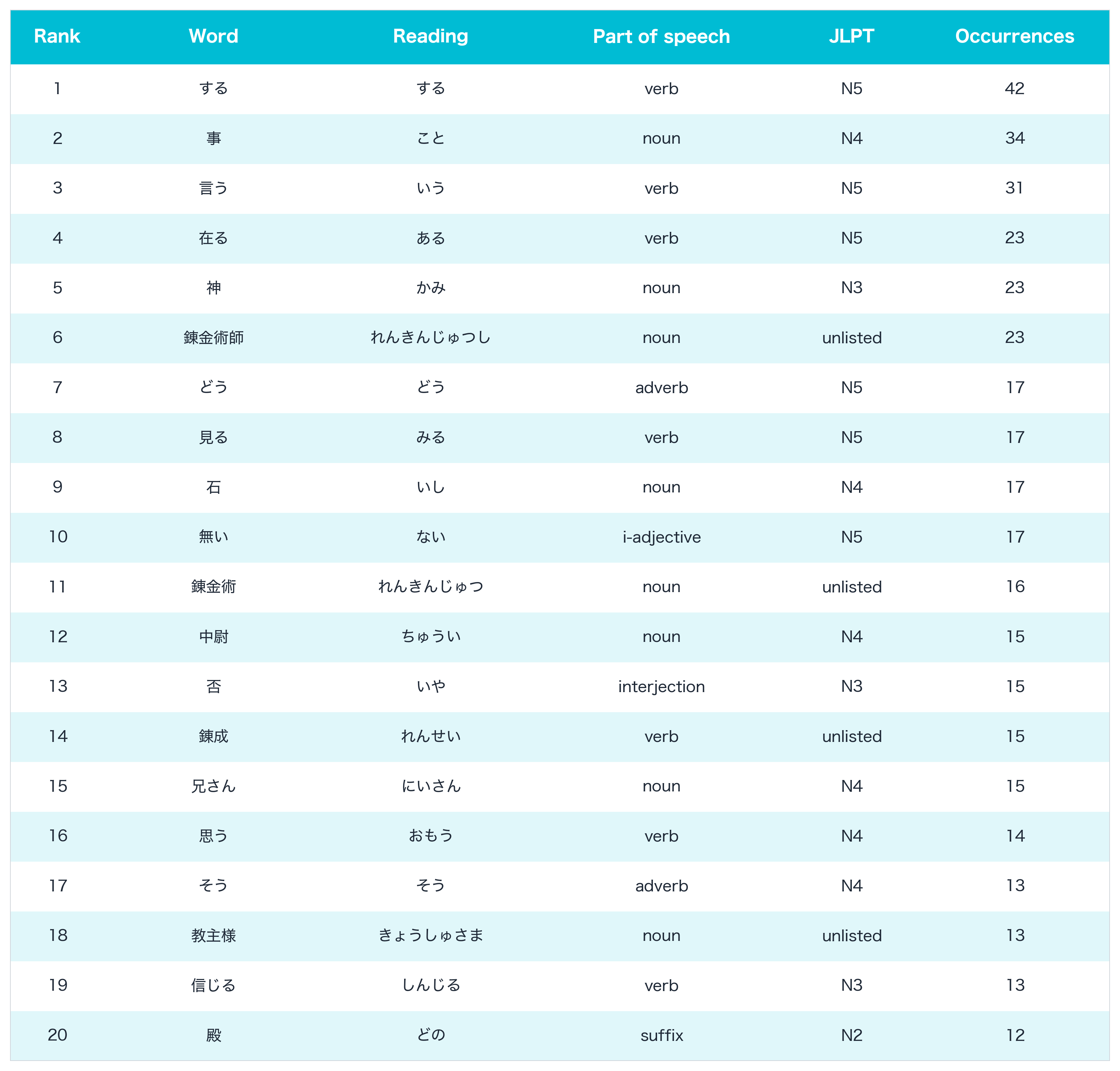
| Rank | Word | Reading | Part of speech | JLPT | Occurrences |
|---|---|---|---|---|---|
| 1 | する | する | verb | N5 | 42 |
| 2 | 事 | こと | noun | N4 | 34 |
| 3 | 言う | いう | verb | N5 | 31 |
| 4 | 在る | ある | verb | N5 | 23 |
| 5 | 神 | かみ | noun | N3 | 23 |
| 6 | 錬金術師 | れんきんじゅつし | noun | unlisted | 23 |
| 7 | どう | どう | adverb | N5 | 17 |
| 8 | 見る | みる | verb | N5 | 17 |
| 9 | 石 | いし | noun | N4 | 17 |
| 10 | 無い | ない | i-adjective | N5 | 17 |
| 11 | 錬金術 | れんきんじゅつ | noun | unlisted | 16 |
| 12 | 中尉 | ちゅうい | noun | N4 | 15 |
| 13 | 否 | いや | interjection | N3 | 15 |
| 14 | 錬成 | れんせい | verb | unlisted | 15 |
| 15 | 兄さん | にいさん | noun | N4 | 15 |
| 16 | 思う | おもう | verb | N4 | 14 |
| 17 | そう | そう | adverb | N4 | 13 |
| 18 | 教主様 | きょうしゅさま | noun | unlisted | 13 |
| 19 | 信じる | しんじる | verb | N3 | 13 |
| 20 | 殿 | どの | suffix | N2 | 12 |
Particles, auxiliary verbs, pronouns, conjunctions, proper nouns, and adnominals are excluded so the list surfaces meaningful content words.
Two are worth calling out. 錬金術 (れんきんじゅつ, alchemy) appears 16 times and is the noun the series is built on. The same root surfaces as 錬金術師 (alchemist, 23 times) and 錬成 (transmutation, 15 times). Learning the kanji 錬 once unlocks every alchemy compound in the book. 中尉 (ちゅうい, lieutenant) shows up 15 times because chapter 3 introduces the military hierarchy, and the entire arc hinges on rank vocabulary.
How each main character speaks
Edward Elric (エドワード・エルリック)
Twelve years old, a State Alchemist prodigy, and the older Elric brother. Ed switches registers constantly. With his brother and townspeople he is casual, often rude, ends sentences in だ and ぜ. With superiors he code-switches to clipped polite forms. When he explains alchemy he sounds like a textbook because he is one. Watch for short bursts of technical exposition followed by youth slang and you have his voice.
Alphonse Elric (アルフォンス・エルリック)
Ed's younger brother, soul-bonded to a suit of armor. Speech is gentler than Ed's, often softer-mannered, with です・ます forms more present. He calls Ed 兄さん (にいさん) 15 times in volume 1. The contrast between his polite speech and his giant armor body is most of his characterization in vol 1.
Roy Mustang (ロイ・マスタング)
Flame Alchemist and military officer. Mustang appears in chapters 3 and 4 with formal military Japanese, sharp and clipped. He uses 中尉 (ちゅうい) to address Hawkeye and 准将 (じゅんしょう) phrasing for chain of command. His casual register only emerges briefly. If you learn the formal-military patterns from his lines, the rest of FMA's military arc becomes easier.
The town priest, Father Cornello (コーネロ)
The chapter 1-2 antagonist. Speaks in sermon register: drawn-out vowels, religious vocabulary (神, 信じる, 奇跡, 教主), and elevated formal forms used for charisma rather than respect. His voice is what religious con men sound like in any language. Useful contrast with Ed's flat skepticism.
Expressions with depth
錬成 (れんせい, transmutation)
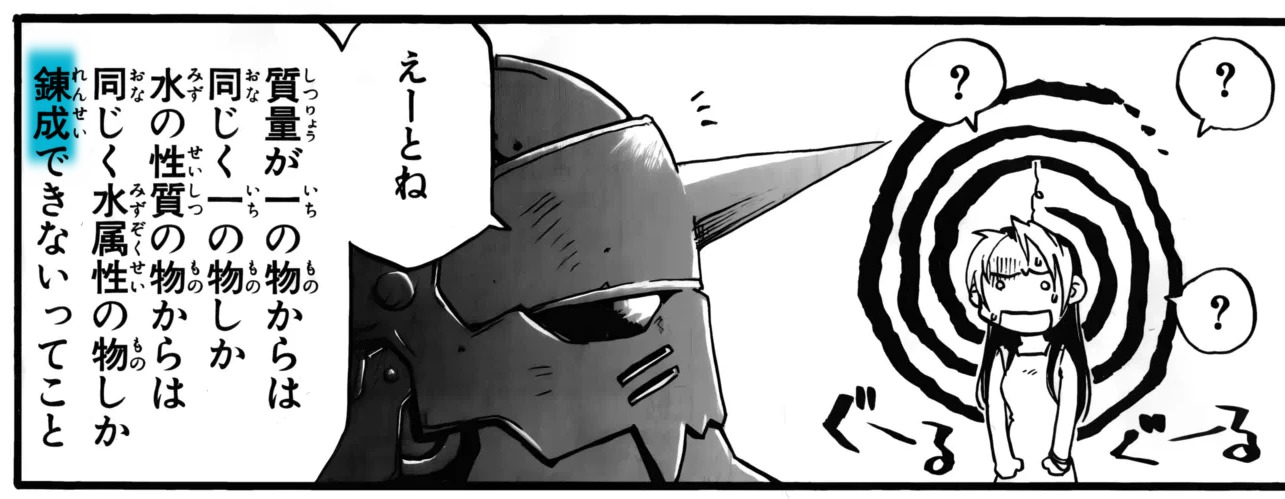
Series-coined verb formed by combining 錬 (refine, forge) and 成 (become, accomplish). Outside FMA you will see 錬成 occasionally in metallurgy or video-game contexts; inside FMA it is the verb for the central act of alchemy. Arakawa uses the noun, the suru-verb, and the gerund forms throughout. Learn it once, recognize it everywhere.
法則 (ほうそく, law)
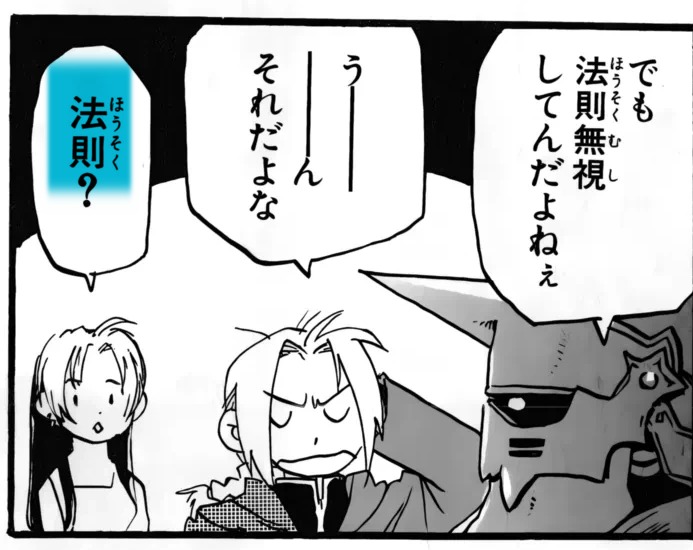
Translates as "law" in the scientific sense (Newton's laws, the laws of physics). In FMA it is the law of equivalent exchange and the law of natural-order alchemy cannot violate. Distinct from 法律 (statutory law) and 規則 (rule). When Edward says 法則 he is referring to a fundamental constraint of reality, not a regulation.
奇跡 (きせき, miracle)
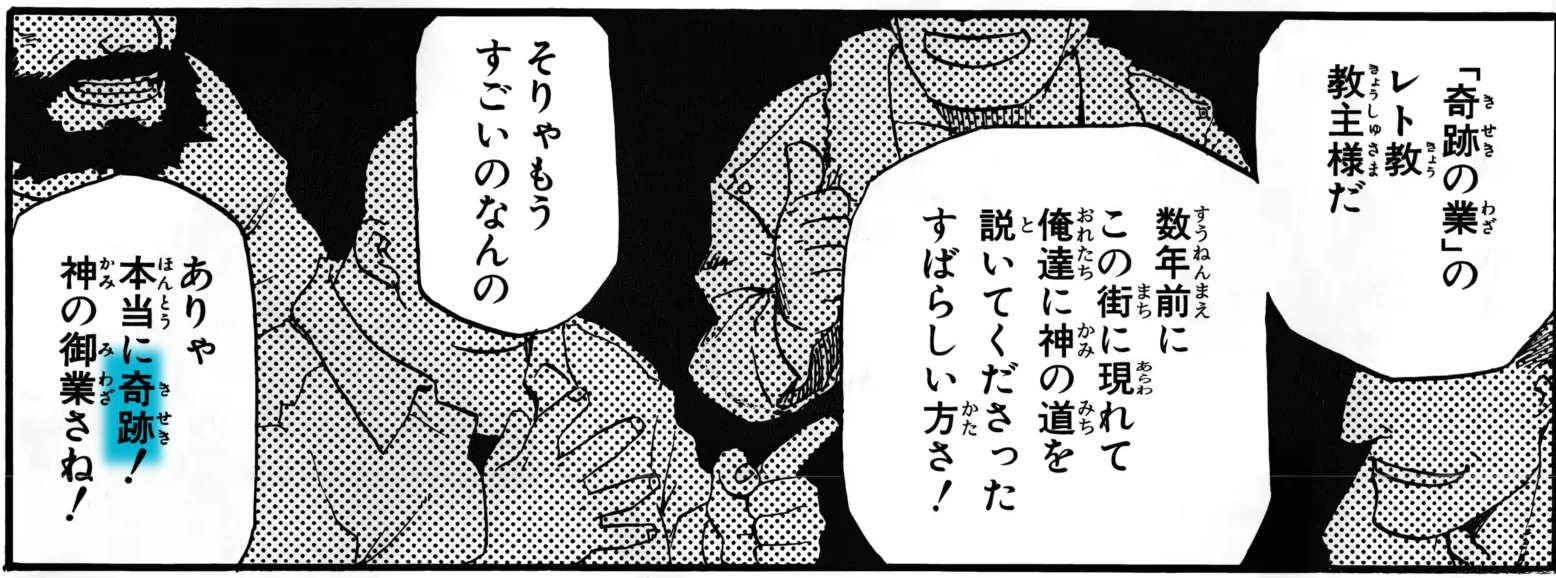
The chapter 1-2 religious arc hinges on the difference between 奇跡 (a miracle, an event that breaks natural law) and 錬金術 (a discipline that obeys natural law). The priest sells miracles. Edward shows the townspeople a chemical reaction. The whole arc is a vocabulary argument before it is a fight scene.
兄さん (にいさん, big brother)
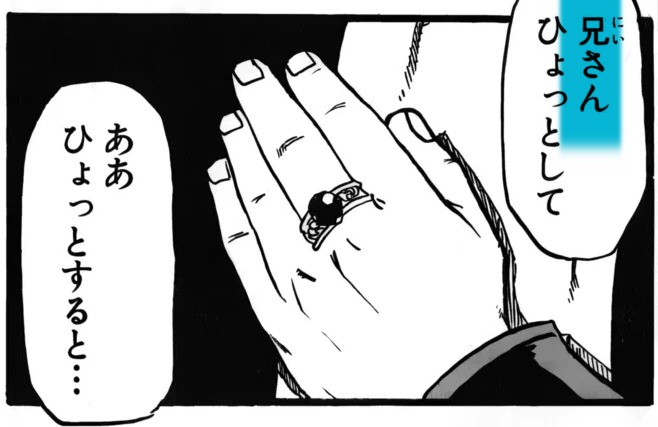
The standard respectful address from younger to older brother. Al uses it for Ed in every chapter. The choice is small but important. Al is the gentler, more emotionally open sibling, and 兄さん keeps the brotherly relationship visible in every line of dialogue. If Al ever drops the honorific in later volumes, that will be a story moment. For now, listen for the cadence.
信じる (しんじる, to believe)
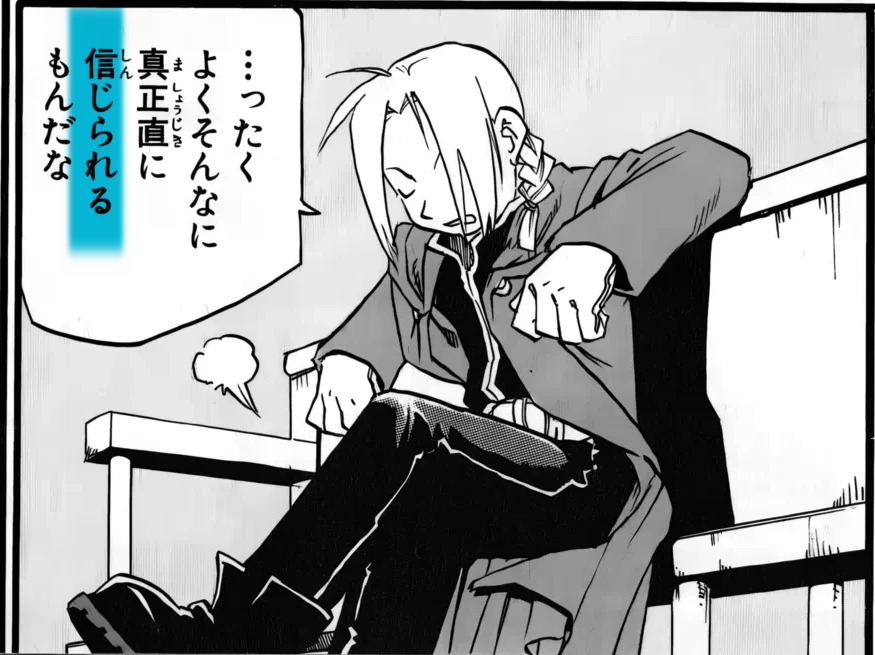
A common N5 verb that does extra work in FMA volume 1. The religion-arc dialogue piles meaning onto it: belief in the priest, belief in miracles, belief in alchemy, belief in your brother. Ed challenges every form of 信じる the priest invokes. This is one of those words where the textbook gloss ("to believe") is correct but the manga teaches you how the word actually feels when used.
Pop culture and context in volume 1
Equivalent exchange (等価交換). Arakawa borrowed the phrase from German idealist philosophy by way of the Japanese translation tradition. It functions in FMA both as a physical conservation law and as a moral one: nothing can be created without something of equal value being lost. The series' entire moral framework hangs on this single compound noun.
State Alchemist titles. Each State Alchemist is given a public name (e.g. Mustang as the Flame Alchemist, 焔の錬金術師). These titles use 焔, 鋼, etc. with の plus 錬金術師. The pattern itself is worth recognizing: it appears in news coverage and military introductions throughout the series.
Military rank vocabulary. 中尉 (lieutenant), 大佐 (colonel), 准将 (brigadier general). Arakawa uses real Imperial Japanese Army rank names, which makes the military arc's vocabulary close to historical sources. If you have read any war manga or seen any war film set in WWII Japan, you have a head start.
Religion-arc rhetoric. The chapter 1-2 priest uses the cadence and word choice of an actual sermon. 教主, 信仰, 奇跡, 神様 stack up in his lines. This is one of the few places in vol 1 where the Japanese is doing genre work. If you have not heard a Japanese sermon, the patterns will feel new.
Inside the app: one panel, fully broken down
What follows is the actual panel-breakdown data The Ashiba App provides for every vocab panel in every chapter of every series. Below is one panel from volume 1, with the most-advanced studyable target highlighted on the JP side. The English from the official Viz translation runs alongside.
Chapter 1, page 24: equivalent exchange
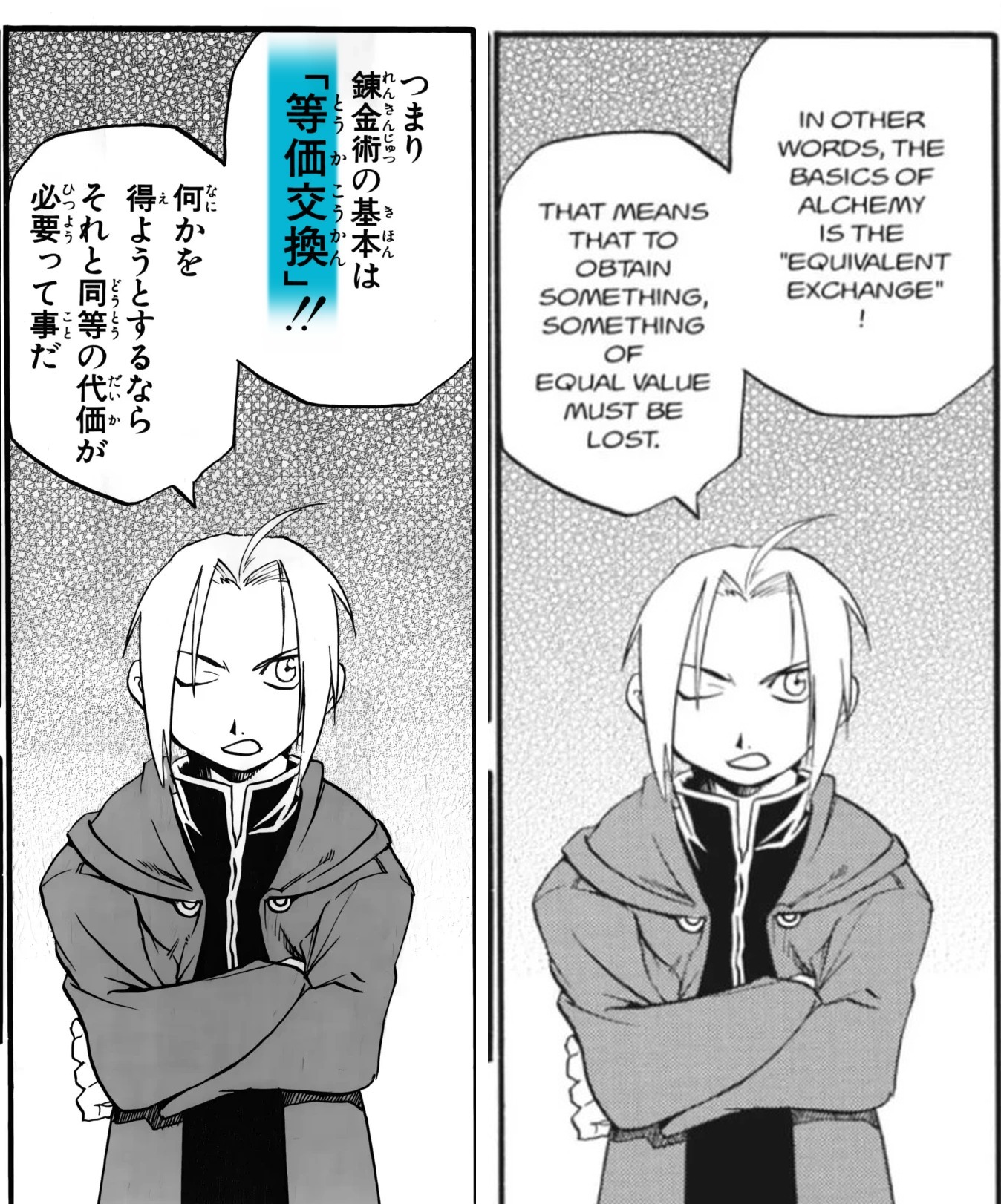
Scroll the image sideways to read the Japanese in full size.
Summary. Edward Elric explains the fundamental law of 錬金術 (れんきんじゅつ, alchemy), 等価交換 (とうかこうかん, Equivalent Exchange), stating that one must give something of equal value to gain something. This panel contains the core moral premise of the entire series.
Textbox 1
JP: つまり錬金術の基本は「等価交換」!!
EN: In other words, the basis of alchemy is "Equivalent Exchange"!!
Overview: Edward summarizes the core principle of his craft in a definitive, educational tone.
Breakdown:
- つまり: in other words; basically
- 錬金術 (れんきんじゅつ): alchemy
- 基本 (きほん): basis; foundation
- 等価交換 (とうかこうかん): equivalent exchange; the central law of alchemy in this series
Textbox 2
JP: 何かを得ようとするならそれと同等の代価が必要って事だ
EN: If you want to obtain something, it means you need a price of equal value.
Overview: Edward elaborates on what 等価交換 actually entails in practice.
Breakdown:
- 何か (なにか): something
- 得ようとする (えようとする): to try to obtain; volitional form of 得る (える, to obtain) plus とする (to try / attempt)
- なら: if; conditional particle
- 同等 (どうとう): equivalent; equal level
- 代価 (だいか): price; cost; compensation
- 必要 (ひつよう): necessary; needed
- って事だ: casual contraction of という事だ, used to summarize a point ("it means that")
Key points
- 等価交換 (とうかこうかん): the defining concept of Fullmetal Alchemist. You cannot create something from nothing; you must provide an equal sacrifice.
- 〜ようとする: a grammar pattern for an attempt or intention to do something. Volitional verb plus とする.
- 〜って事だ: a common way to end an explanation in spoken Japanese, contracted from という事だ.
How to actually read volume 1
- Get a foundation. How much you need depends on how much discomfort you can sit with. Genki I and II is the polished path. At a minimum, lock in N5. Nothing else moves until kana and basic grammar are automatic.
- Start with chapter 1. Take your time. Not a week. Not a day. This is the first chapter of manga you have ever read in Japanese. Set a timer for 15 minutes. Early on, you crack one to three sentences in that window. Later, you crack a full chapter. Consistency compounds. Rack up the reps.
- When you get stuck, reference the translation. Looking things up is not failure. It is learning. The fastest way to get unstuck is to see the answer and understand why the sentence means what it means. Goal: parse the sentence. Match the English to the Japanese, identify the word or grammar that blocked you, and move on. You will hurdle (probably in chapter 1 when Father Cornello starts a sermon, or chapter 3 when the military hierarchy is introduced, or chapter 4 when the train arc moves through tactical vocabulary). Those panels are dense. The answer is not to grind harder. The answer is what I wrote about in Why You Will Quit Learning Japanese: put the book down and come back tomorrow.
The Takeaway
The main reason reading manga in Japanese is hard is the sheer amount of vocabulary you do not know.
Most readers never get past this. The pain is too great. The effort-to-reward ratio collapses, and the book gets shelved.
The easiest way out is to pre-study the words you do not know that will appear in the chapter you are about to read. The Ashiba App does this for every chapter of every series I cover. It surfaces the vocabulary, shows readings and POS, and includes grammar breakdowns so you see how each word is being used. Nothing is studied in isolation. Every flashcard carries its full panel context. You see the word in the sentence in the panel where it lives.
Frequently asked questions
Should I watch the anime before reading Fullmetal Alchemist in Japanese?
Yes. Familiarity kills comprehension FOMO and lets you focus on the language. Both Brotherhood (2009) and the original 2003 anime cover volume 1 closely. Watch at least the first arc, then come back to the manga and read again. You will pick up grammar you missed and recognize how a sentence builds toward its English translation. After you read, watch one more time to see how much you absorbed.
Does Fullmetal Alchemist have furigana?
Yes. Furigana is provided for every kanji on every page. You do not need to know any kanji in advance to start reading. You will pick them up by repetition.
Do I need to know all the kanji before starting?
No. You need kana. That is the hard prerequisite. Kanji you pick up as you read because the manga gives you the reading every time. If you have not finished kana yet, start there.
How long does it take to read FMA volume 1 in Japanese?
For an N3 reader on a first pass, plan for 9 to 13 hours of focused reading time spread across a few weeks. An N4 reader will spend more time in the dictionary; double the estimate. An N1 reader will read it in 4 to 6 hours but still pause on alchemy terminology.
Do I need to read volume 1 first or can I start anywhere?
Follow the fun. If a different volume or series is pulling you harder, start there. The reasons to pick volume 1 anyway: the early-arc language is the easiest in the series, and it builds the alchemy vocabulary base that carries through every later arc.
Where can I buy Fullmetal Alchemist volume 1 in Japanese?
Free preview: read chapter 1 in Japanese on Gangan Online, Square Enix's official reader. Digital recommendation: the Kindle store on Amazon Japan has the full series, and BookWalker has it too. Physical copies via Amazon Japan or BookWalker if you want the paper edition. For an English reference, Viz Media's 3-in-1 omnibus volume 1 covers chapters 1 through about 12 in their official translation. No official free preview of the English version is available at the moment.