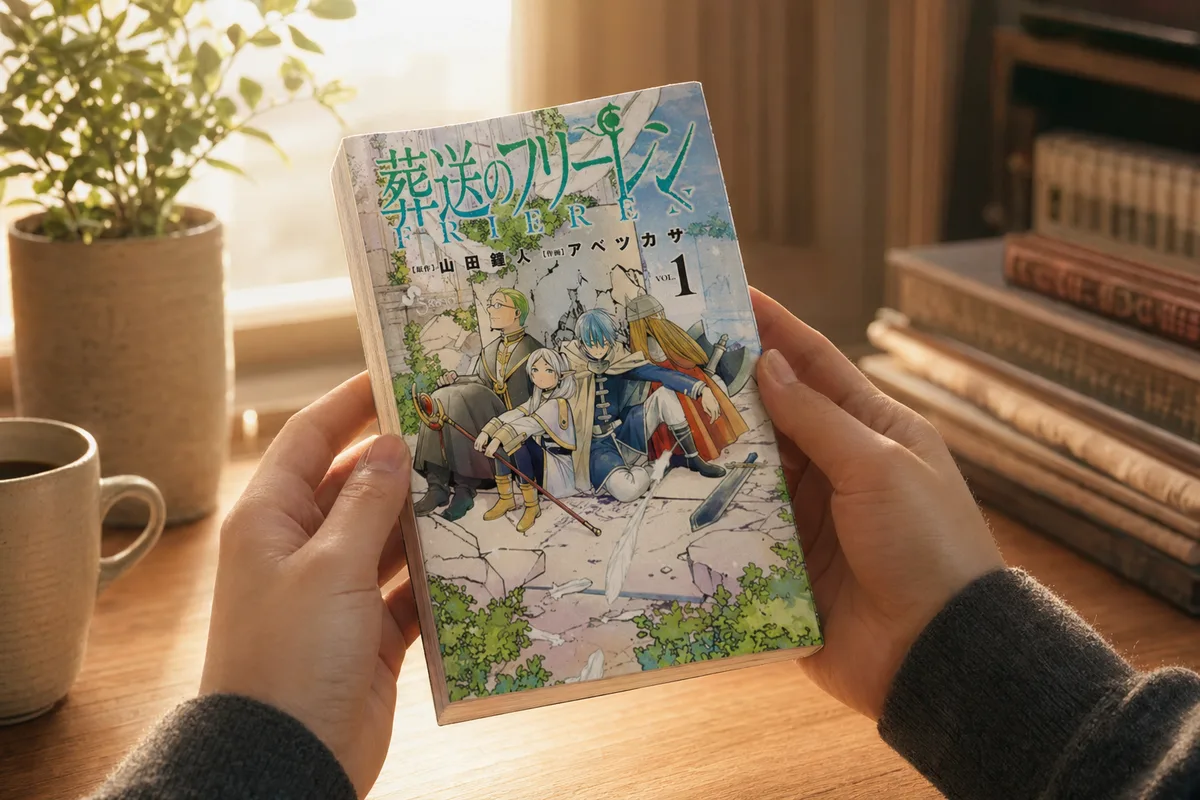
Volume 1 of Frieren: Beyond Journey’s End (葬送のフリーレン, Sousou no Frieren) contains 1,106 unique vocabulary items across 7 chapters, 187 pages, 951 panels, and 4,913 textboxes. The script uses 706 unique kanji on the page, of which only 29 are non-joyo.
The number to lead with is on the JLPT side. Only 8% of the unique vocabulary in this volume is unlisted. That is the lowest unlisted share of any title in our corpus so far. JJK volume 1 sits at 16%. Apothecary at 15%. Frieren’s vocabulary is generic-fantasy plus standard Japanese, not series-specific jargon.
And then there is the second number. The running unlisted share is 28%, not 8%, because a small set of fantasy-specific words repeats constantly. 魔法 (magic) alone appears 62 times in volume 1, more than any other word. 勇者 (hero), 魔王 (demon king), 魔法使い (mage), 旅 (journey). A handful of fantasy nouns carry the entire vocabulary load. Pre-study them once and you have pre-studied half the running text.
Every number in this article comes from Ashiba's production corpus, measured against the official N5 to N1 JLPT vocabulary lists and the 2,136-character joyo kanji set. Last measured 2026-04-26.
Is Frieren: Beyond Journey’s End volume 1 hard to read in Japanese?
Upper-intermediate. Easier than Apothecary. Comparable to JJK. Harder than a Genki II dialogue. The kanji is fully furigana-supported, the grammar is modern, the register is mostly plain or quietly literary. The friction comes from a small core of fantasy-specific vocabulary that hammers the page repeatedly, and from Frieren’s elegiac thousand-year-old voice that compresses ideas about lifespan, memory, and loss into short flat sentences a reader has to slow down to feel.
People mis-rate this book in both directions. Here is the actual shape.
What makes it easier than you think
Kanji is not a blocker. Furigana, the small phonetic companion written above every kanji, is provided everywhere in this manga: every kanji, every appearance, every chapter. Volume 1 uses 706 unique kanji, and 677 of them (95.9%) are joyo. The 29 non-joyo characters all come with their reading printed on top, and most appear once or twice. The book hands you the readings.
The grammar is also unusually clean. Frieren narrates and converses in plain modern Japanese with short clauses. There is no archaic copula, no classical conjugation, no court keigo. If you have finished Genki II, the sentence shapes will look familiar from page one. What slows you down is the words inside the shapes, not the shapes themselves.
What makes it harder than it looks
The long tail. 663 unique words appear exactly once in the entire volume. That is 60% of the unique vocabulary. Frieren’s long tail is actually shorter than JJK’s (66%) or Apothecary’s (68%), which is the good news. The bad news is the running text concentrates on a small set of fantasy-specific nouns that lookup-tax you on every page even after you have learned them. 魔法 lands 62 times. You will recognize it by chapter 2 and still be reading it 50 more times after that.
Vocabulary acquisition is iterative. A word does not stick the first time. Each word takes multiple painful encounters before recognition becomes automatic, and every encounter breaks the story flow. You stop, you look up, you re-read the sentence, you re-set the panel in your head, you keep going. The tipping point where the manga starts reading easily is further out than most learners expect. The only path through is volume.
There is one way to lower the pain without lowering the reps. Pre-study the chapter vocabulary before you open the chapter. That moves the lookups out of the story and into focused study time. Same words, different context. The story stays intact.
The lookup load itself is moderate-high. 9.7 lookups per page at N3, 8.5 at N2, 7.4 at N1. That last number is what makes this volume distinctive. Even at N1, the magic-system vocabulary keeps pulling you back to the dictionary, because words like 魔法 and 勇者 and 魔王 are simply not on any JLPT list. The book is built on them.
You don't need permission. Just go for it.
The real question is not whether this book is at your level. The real question is whether the pain is tolerable for the reward. If you actually want this story, the level mismatch is just a tax on time, not a wall. You pay it in lookups and re-reads and slow chapters until the cost goes down. Always read above your level. Attack the stories that motivate you. Permission is something other people give themselves and then complain about. Just go for it.
What the data says about volume 1
Every number below was calculated from the approved vocabulary set for Frieren: Beyond Journey’s End volume 1 in Ashiba's production database. JLPT level was assigned by matching against the official N5 to N1 lists. Words not on any list were classified by Gemini 3 Pro against context.
A note on terminology. Running vocabulary means every word token as it occurs in the text, counting every repeat. If 魔法 appears 62 times, that is 62 running tokens from 1 unique word. Unique vocabulary means the distinct words themselves, counted once each.
Volume 1 at a glance
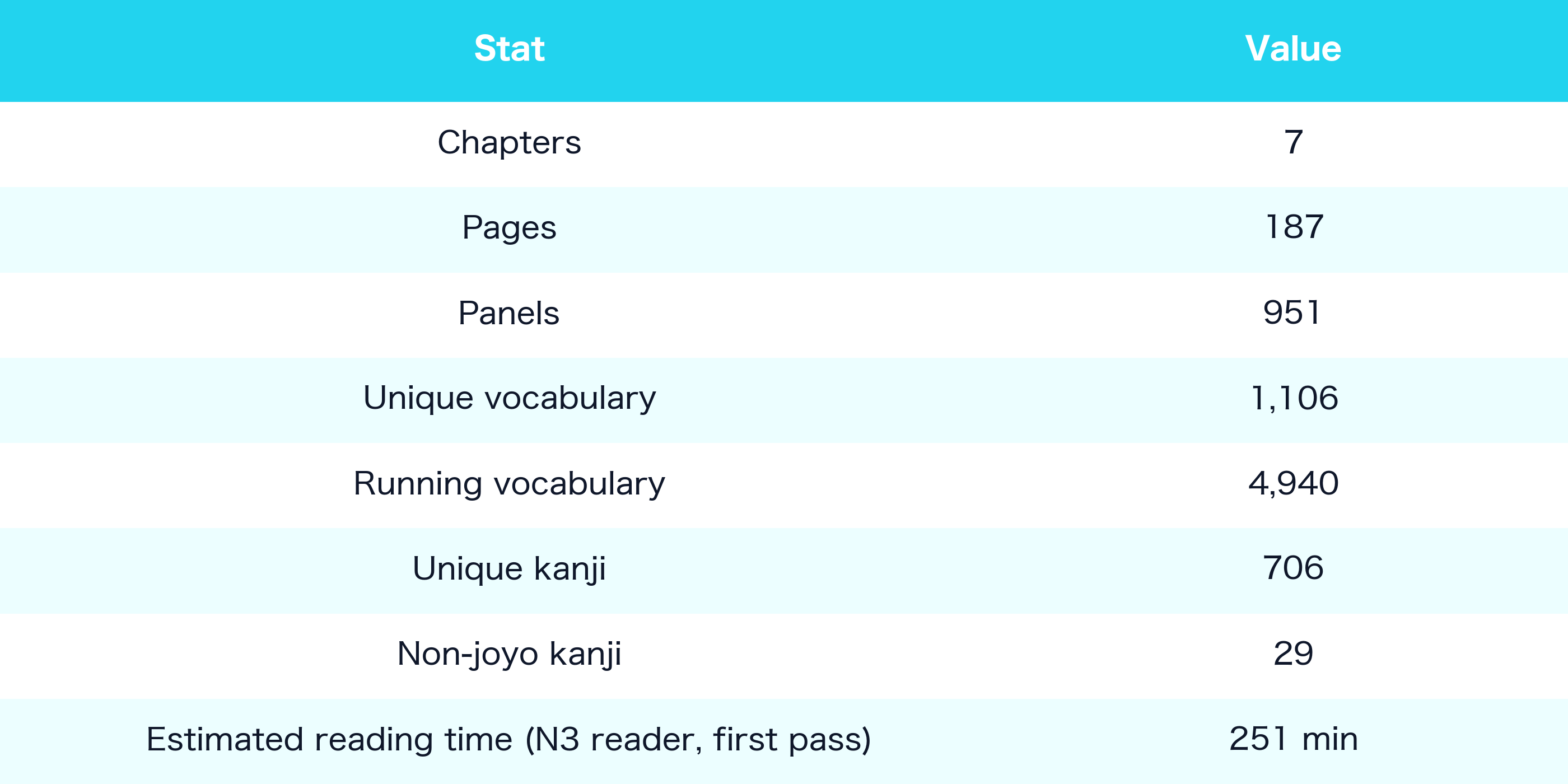
| Metric | Count |
|---|---|
| Chapters | 7 |
| Pages | 187 |
| Panels | 951 |
| Textboxes (speech, thought, narration) | 4,913 |
| Unique vocabulary items | 1,106 |
| Running vocabulary (total word occurrences) | 4,940 |
| Unique kanji | 706 |
| Non-joyo kanji | 29 |
| Estimated reading time (N3 reader, first pass) | 9 to 12 hours |
JLPT coverage
The 1,106 unique vocabulary items in volume 1 break down like this:
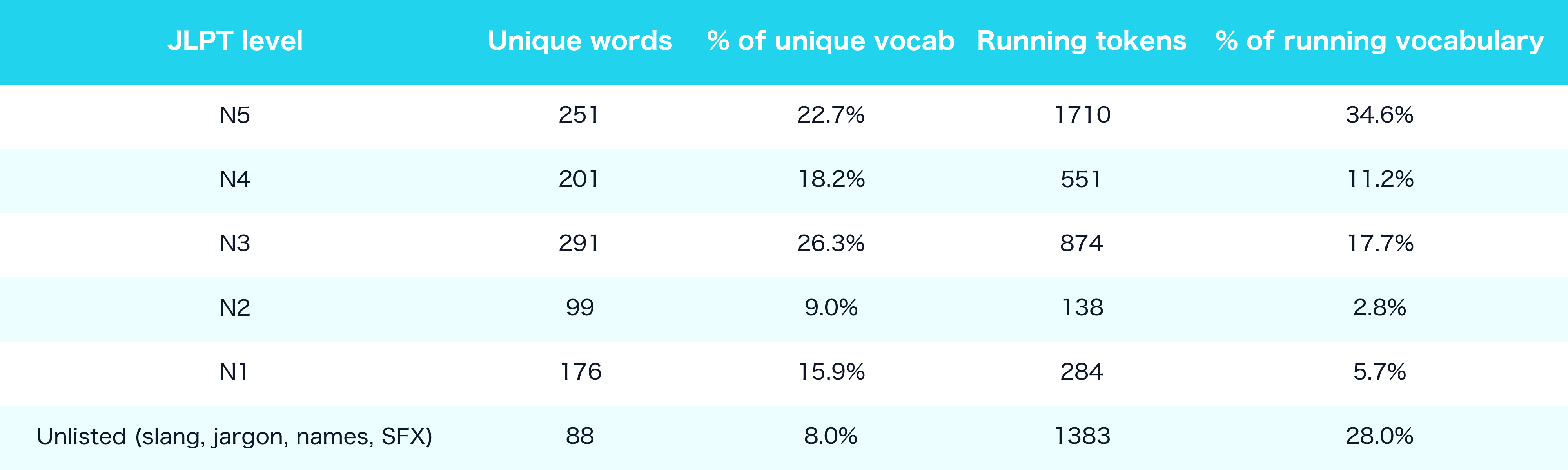
| JLPT level | Unique words | % of unique vocab | Running tokens | % of running vocabulary |
|---|---|---|---|---|
| N5 | 251 | 22.7% | 1,710 | 34.6% |
| N4 | 201 | 18.2% | 551 | 11.2% |
| N3 | 291 | 26.3% | 874 | 17.7% |
| N2 | 99 | 9.0% | 138 | 2.8% |
| N1 | 176 | 15.9% | 284 | 5.7% |
| Unlisted (fantasy nouns, slang, names, SFX) | 88 | 8.0% | 1,383 | 28.0% |
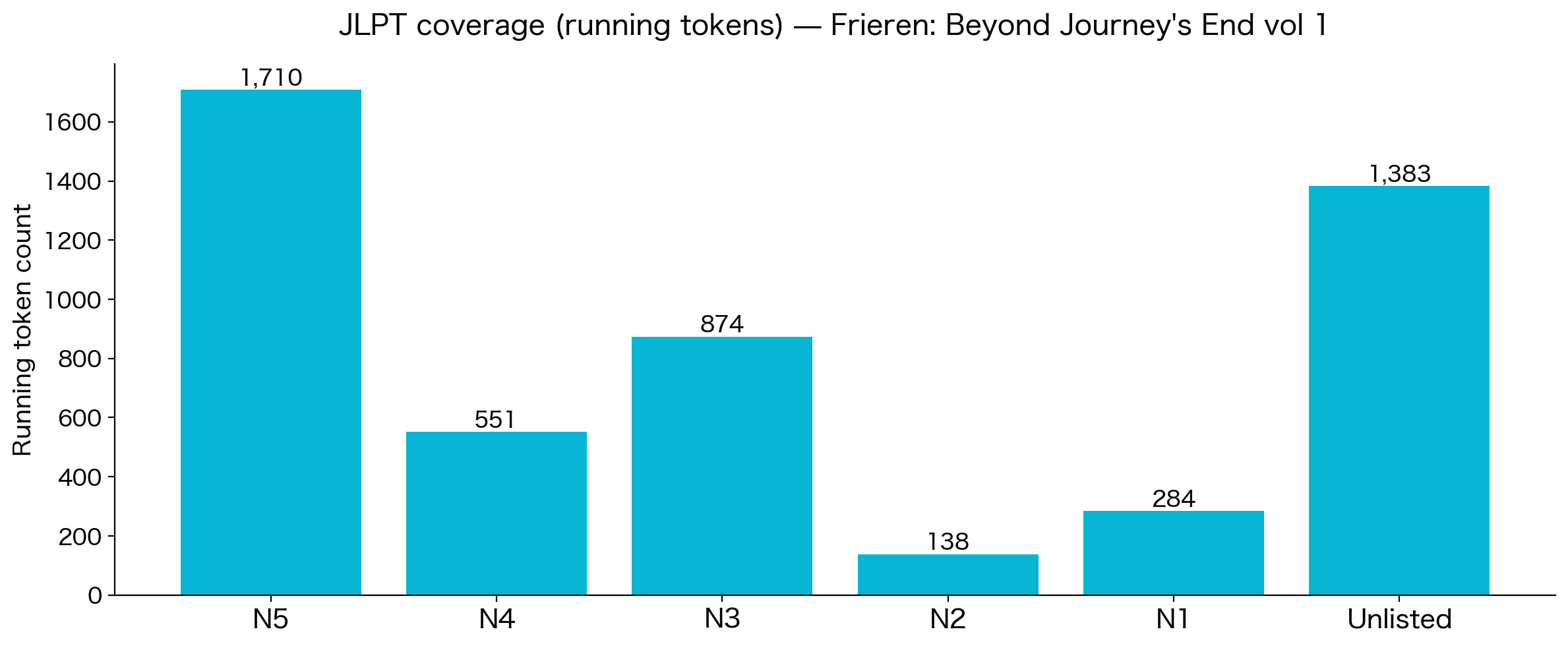
Read both columns. 45.8% of the running vocabulary is N5 or N4. Add N3 and you reach 63.5%. The hard stuff (N2 and N1 combined) is 8.5% of what you actually read, because the hardest words appear rarely. The unlisted bucket is the strange one. It holds only 88 unique words, the smallest unlisted share of any title we have measured, but those 88 words account for 28% of the running text. The small head of the curve carries the volume.
Reader guidance by level
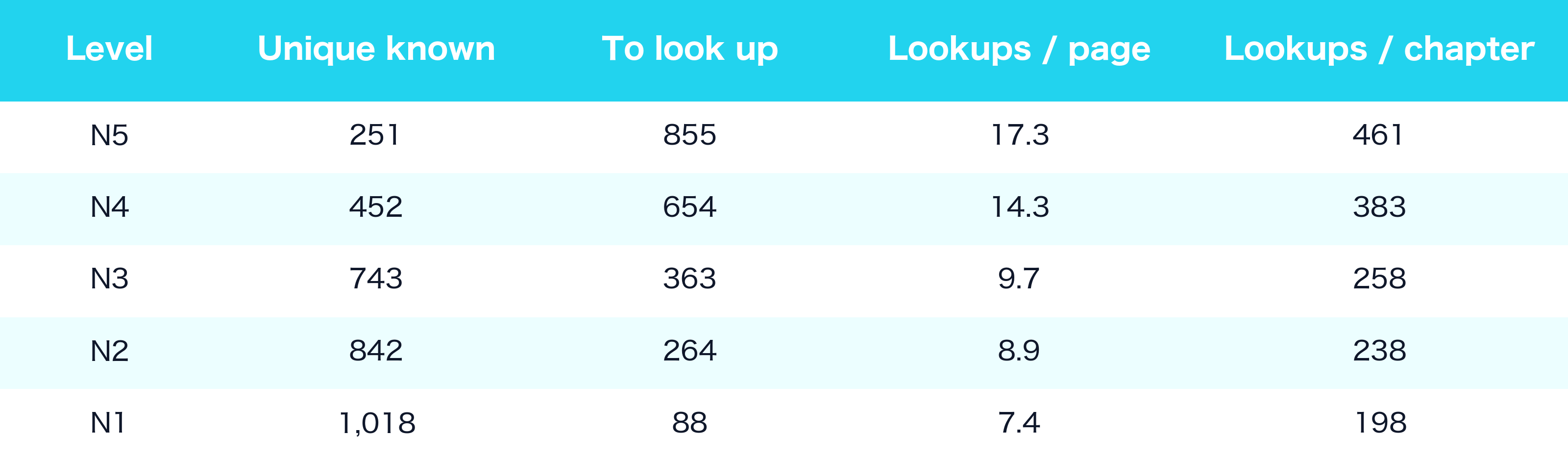
| Level | Unique words known | Unique words to look up | Lookups per page (first pass) | Lookups per chapter (first pass) |
|---|---|---|---|---|
| N5 | 251 | 855 | 17.3 | 461 |
| N4 | 452 | 654 | 14.4 | 384 |
| N3 | 743 | 363 | 9.7 | 258 |
| N2 | 842 | 264 | 8.5 | 226 |
| N1 | 1,018 | 88 | 7.4 | 198 |
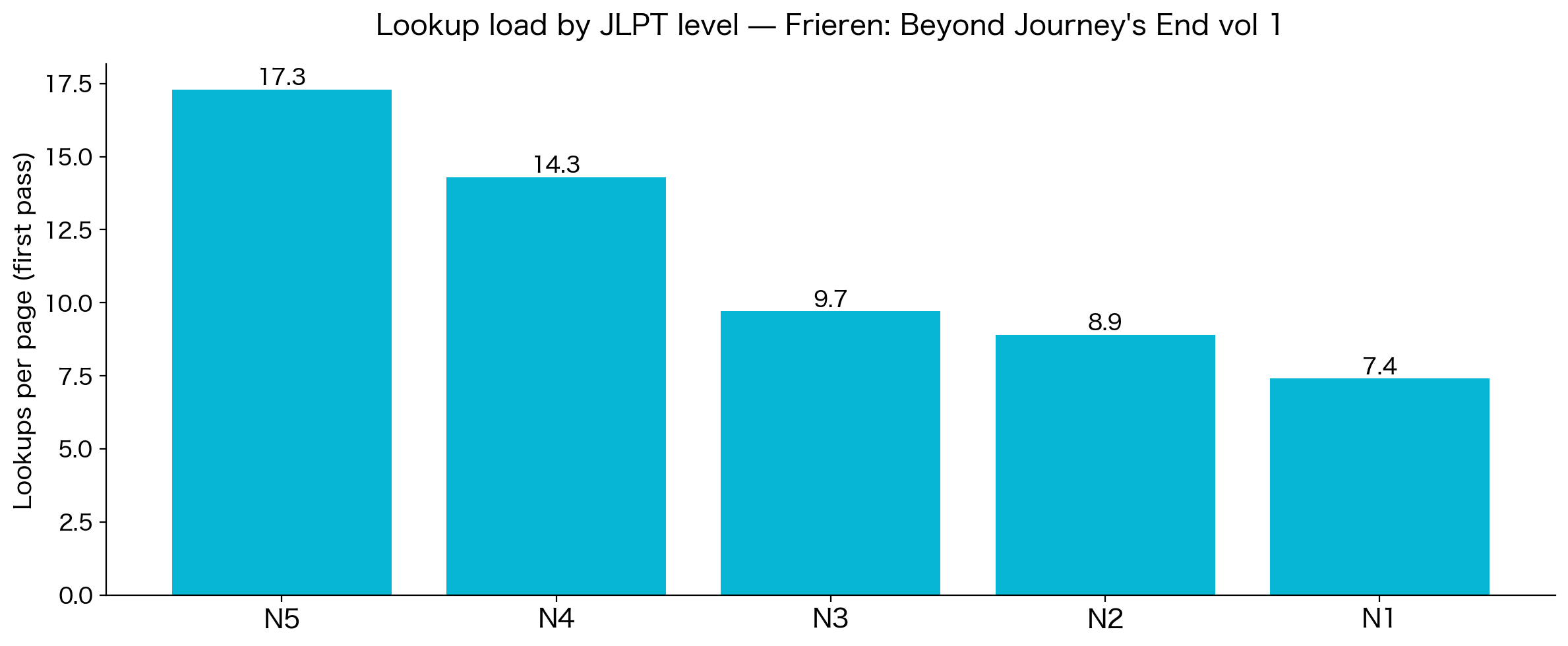
Lookups are unavoidable and painful, but you can lower the pain by completing the grammar foundation guide first. If you do not have kana yet, start there. That is table stakes.
N1 ≠ mastery
N1 means you passed a test. Real Japanese is not the test. Even N1 readers reading Frieren for the first time will look things up. There are 88 unique unlisted words to learn from this volume alone, plus first-encounter recognition for vocabulary you know from study but have never seen in flowing prose. Even at N1, expect roughly 7 to 8 lookups per page on a first pass, almost all of them on the fantasy-specific noun layer. The best way to learn real Japanese is to read real Japanese. Then you can pass any test.
Kanji
Frieren volume 1 has 706 unique kanji on the page (counted from actual surface forms, not lemma headwords). 677 are joyo. Only 29 are non-joyo. That is the cleanest joyo ratio of any title in our corpus. The non-joyo characters skew toward common-but-old words an artist chose to print in kanji rather than fantasy terminology, which is the opposite of how JJK and Apothecary work.
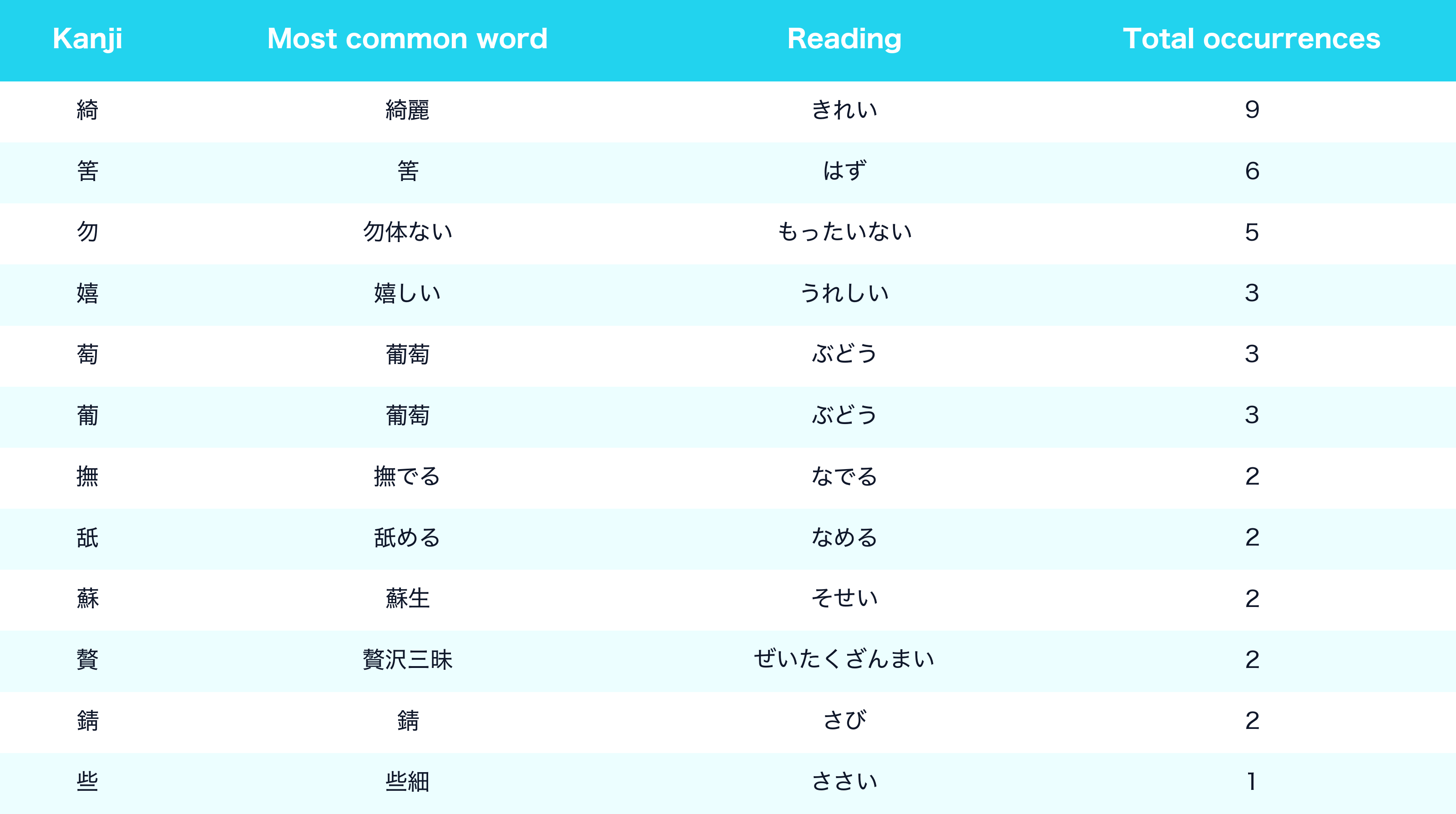
| Kanji | Most common word | Reading | Occurrences |
|---|---|---|---|
| 綺 | 綺麗 | きれい (beautiful) | 9 |
| 筈 | 筈 | はず (expected) | 6 |
| 勿 | 勿体ない | もったいない (a waste) | 5 |
| 嬉 | 嬉しい | うれしい (happy) | 3 |
| 萄 | 葡萄 | ぶどう (grape) | 3 |
| 葡 | 葡萄 | ぶどう (grape) | 3 |
| 撫 | 撫でる | なでる (to stroke) | 2 |
| 舐 | 舐める | なめる (to lick or mock) | 2 |
| 蘇 | 蘇生 | そせい (resurrection) | 2 |
| 贅 | 贅沢三昧 | ぜいたくざんまい (indulgence) | 2 |
| 錆 | 錆 | さび (rust) | 2 |
| 些 | 些細 | ささい (trivial) | 1 |
Notice what is missing from the non-joyo list. There are no rare fantasy kanji, no invented technique characters, no archaic court vocabulary. The Frieren author writes the magic system using ordinary joyo characters in compounds: 魔法 (magic), 魔王 (demon king), 魔法使い (mage), 防御魔法 (defensive magic), 術式 (incantation system). All of those are joyo characters producing series-domain vocabulary. The kanji recognition you already have works on this book. The vocabulary recognition is what you have to build.
Frequency
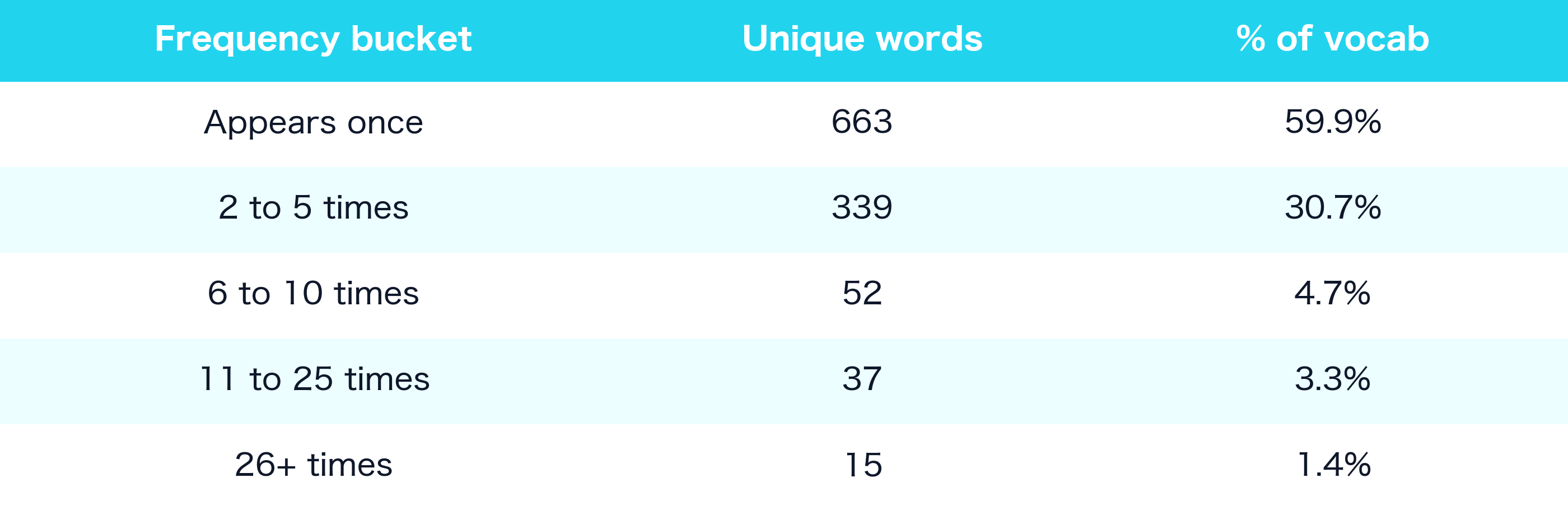
| Occurrence bucket | Unique words | % of unique vocab |
|---|---|---|
| Once in the volume | 663 | 59.9% |
| 2 to 5 times | 339 | 30.7% |
| 6 to 10 times | 52 | 4.7% |
| 11 to 25 times | 37 | 3.3% |
| 26 or more times | 15 | 1.4% |
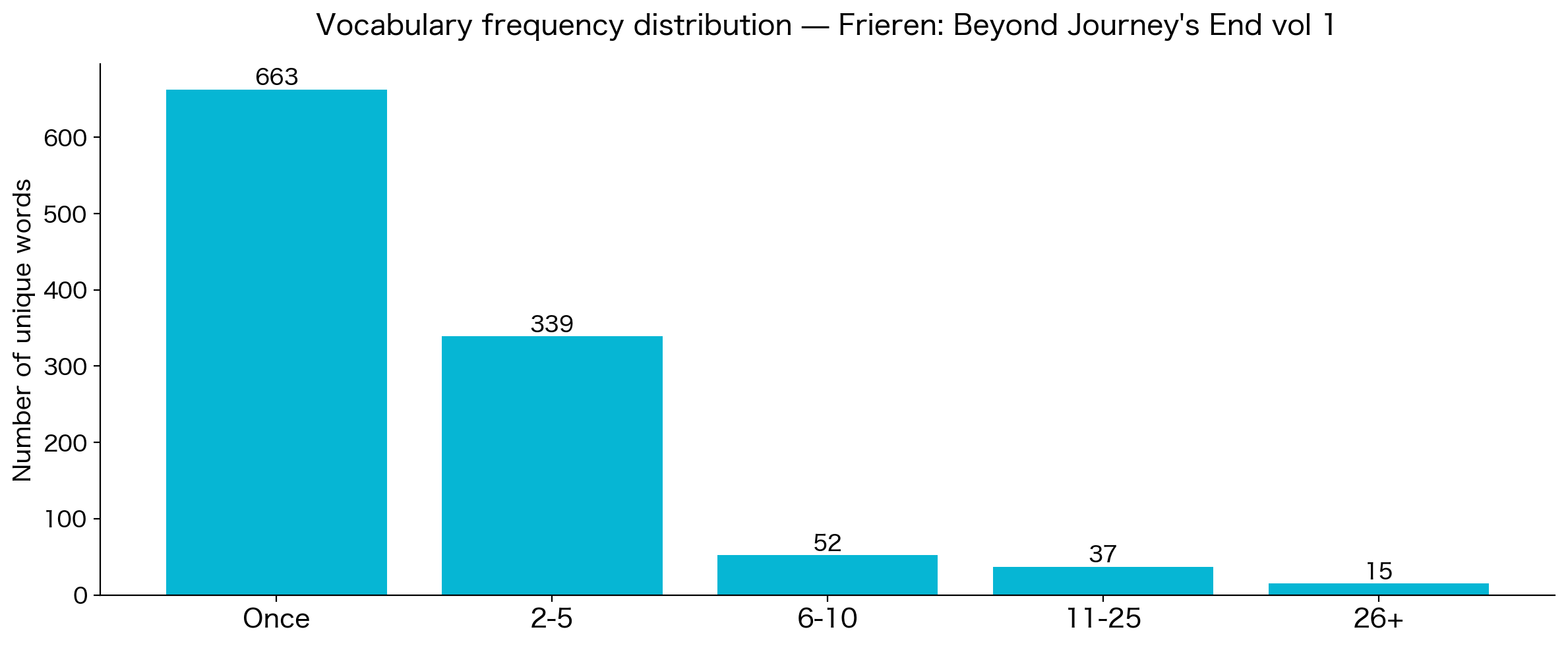
60% of the volume's unique vocabulary appears exactly once. Do not read "appears once" as "not worth learning." These words recur across the series. Later volumes pick them up and use them again. The 15 words that appear 26 or more times, though, are the real spine of volume 1, and they carry the running text on every single page.
The 20 most frequent content words
Pre-study these 20 and you have learned the most common content words on almost every page. By the time you finish volume 1, all 20 are locked into your memory just from how often they appear.
Particles, auxiliary verbs, pronouns, conjunctions, proper nouns, and adnominals are excluded so the list surfaces meaningful content words.
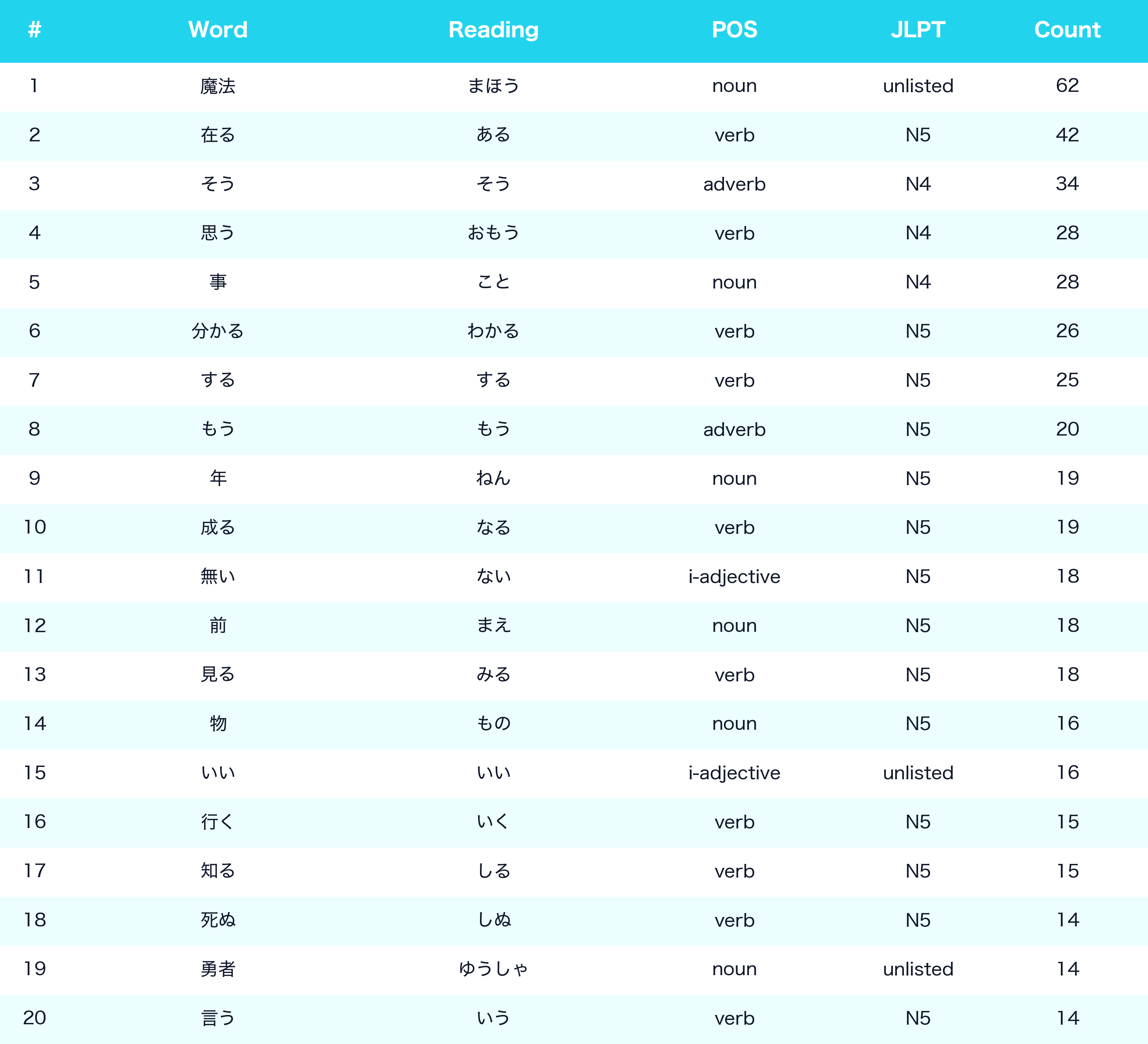
| Rank | Word | Reading | Part of speech | JLPT | Occurrences |
|---|---|---|---|---|---|
| 1 | 魔法 | まほう | noun | unlisted | 62 |
| 2 | 在る | ある | verb | N5 | 42 |
| 3 | そう | そう | adverb | N4 | 34 |
| 4 | 思う | おもう | verb | N4 | 28 |
| 5 | 事 | こと | noun | N4 | 28 |
| 6 | 分かる | わかる | verb | N5 | 26 |
| 7 | する | する | verb | N5 | 25 |
| 8 | もう | もう | adverb | N5 | 20 |
| 9 | 年 | ねん | noun | N5 | 19 |
| 10 | 成る | なる | verb | N5 | 19 |
| 11 | 無い | ない | i-adjective | N5 | 18 |
| 12 | 前 | まえ | noun | N5 | 18 |
| 13 | 見る | みる | verb | N5 | 18 |
| 14 | 物 | もの | noun | N5 | 16 |
| 15 | いい | いい | i-adjective | unlisted | 16 |
| 16 | 行く | いく | verb | N5 | 15 |
| 17 | 知る | しる | verb | N5 | 15 |
| 18 | 死ぬ | しぬ | verb | N5 | 14 |
| 19 | 勇者 | ゆうしゃ | noun | unlisted | 14 |
| 20 | 言う | いう | verb | N5 | 14 |
Two of these are worth calling out. 魔法 (まほう, magic) is the noun the whole series is built on, and it appears 62 times in volume 1. Once you learn this single word you have decoded a third of the running fantasy vocabulary in the book, because it also seeds the compounds 魔法使い (まほうつかい, mage), 防御魔法 (ぼうぎょまほう, defensive magic), and 攻撃魔法 (こうげきまほう, offensive magic). One word, four phrases, half the magic-system load resolved.
勇者 (ゆうしゃ, hero) is the other central word and the one that signals what kind of fantasy this is. The story opens after the hero party has already defeated the demon king. 勇者 in Frieren is past tense from page one. The word does the genre inversion before the protagonist says anything.
How each main character speaks
フリーレン (Frieren)
The protagonist. An elf mage roughly a thousand years old. Uses 私 (わたし) for "I." Speaks in flat, plain-form Japanese with short clauses and almost no emotional intensifiers. Sentence-final particles are rare. When she does end a sentence with よ or ね, the effect is muted, almost clinical. Her dialogue is the easiest to parse mechanically and the hardest to feel, because the manga is asking you to register the absence of affect as the emotion. Her monologues use 普通形 (plain form) consistently and read like stripped-down narration: subject, object, verb, period. If you have finished Genki II, Frieren’s sentences are within reach from page one.
フェルン (Fern)
Frieren’s human apprentice, introduced later in volume 1. Speaks in polite ですます register almost without exception, including with Frieren herself. Uses 私 (わたし) and addresses Frieren as フリーレンさま. The contrast with Frieren’s flat plain form is the point. When Fern talks, every line is gentle and structured. When Frieren replies, the register drops two steps. Reading the two of them in conversation is the cleanest example of register contrast in volume 1.
ハイター (Heiter)
The old human cleric from the original hero party. Wry, philosophical, and unrepentantly fond of wine. Uses literary plain form for serious thoughts and casual sentence enders (なあ, さ, だろう) when the tone lightens. His chapter 2 conversations with Frieren about lifespan and mortality are the emotional center of the volume. His vocabulary leans on N3-N2 abstract nouns: 寿命 (じゅみょう, lifespan), 信仰 (しんこう, faith), 弟子 (でし, apprentice). Slow him down and parse line by line.
ヒンメル (Himmel)
The hero himself. Already dead at the start of the volume; appears in flashbacks throughout. Bright, idealistic, formal in the way young protagonists in shōnen fantasy are formal: long declarations, sentence-final ね, occasional ぞ. He uses 僕 (ぼく) for "I" and refers to the party with collective pronouns. His lines feel familiar because they sound like the prototypical fantasy-hero register a Japanese reader expects, which is exactly what makes the contrast with Frieren’s plain voice so heavy. He is the warmth Frieren is mourning in plain form.
Expressions with depth
These are volume 1 words where the dictionary entry will mislead you. Surface meaning is one thing. What the word actually does in a panel is another.
魔法 (まほう, magic)
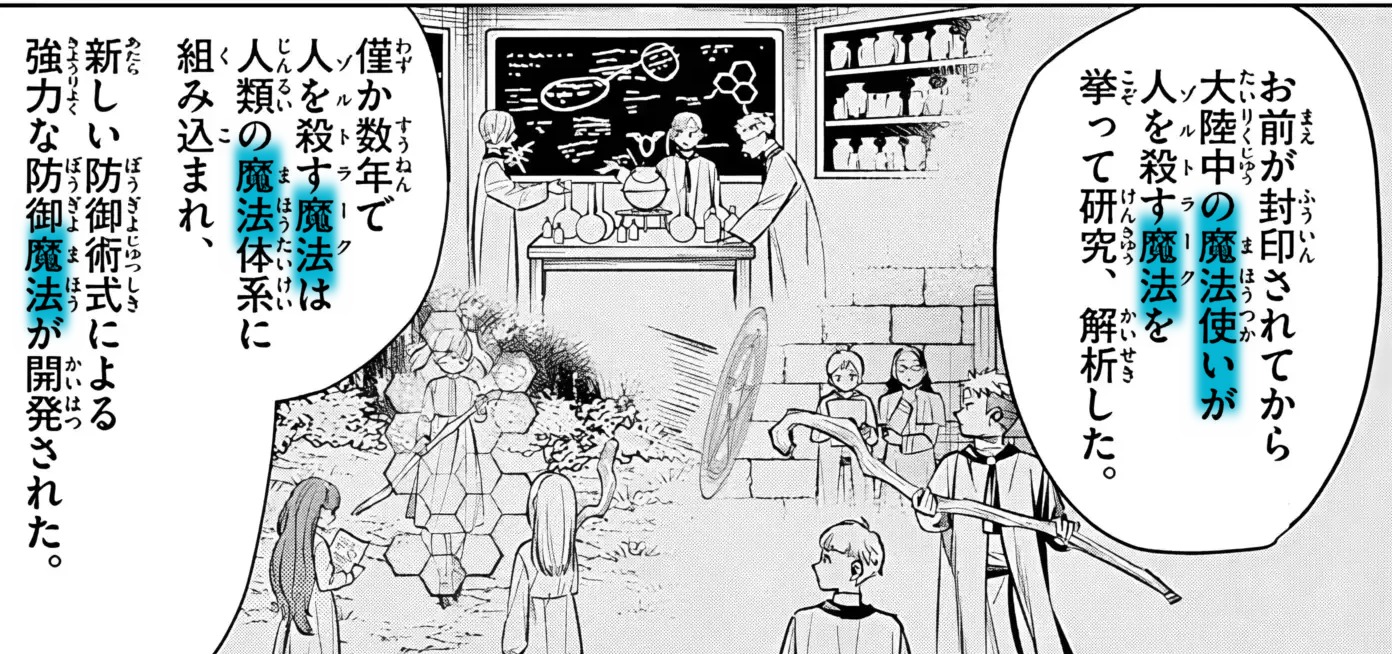
Dictionary: "magic." What it actually does in Frieren: this is the load-bearing noun of the entire series, and it lives in compound after compound. 魔法使い (mage), 防御 魔法 (defensive magic), 攻撃魔法 (offensive magic), 魔法体系 (magic system), 魔法史 (history of magic). The chapter 5 exposition panel uses the word 魔法 five times in three textboxes. When you see the kanji 魔, expect 魔法 right behind it most of the time. Memorize this single word and the rest of the magic vocabulary becomes pattern-matching instead of cold lookup.
勇者 (ゆうしゃ, hero)
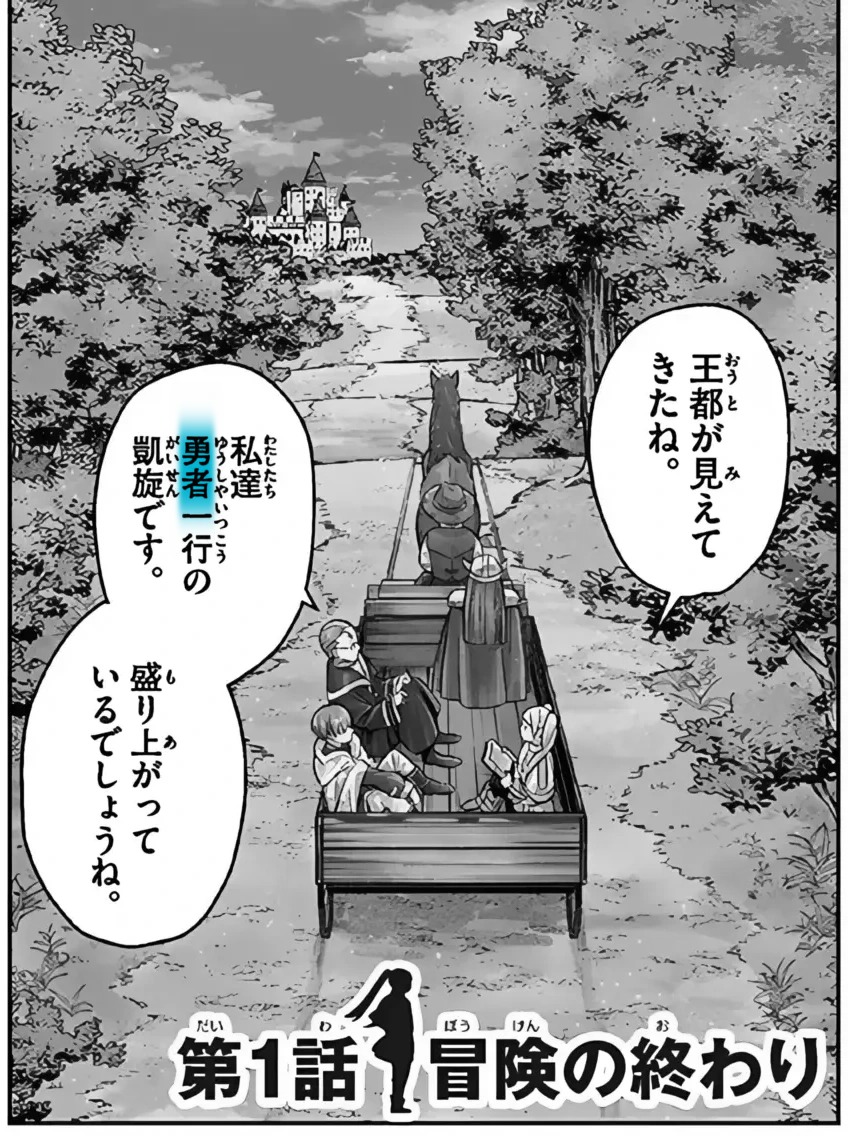
Dictionary: "hero, brave warrior." The texture: in Frieren, 勇者 is always already in the past. The volume opens with the heroes' return parade and the word 勇者一行の 凱旋 (the triumphant return of the hero party). The story is what happens to the title after the trope expires. Whenever this word appears in volume 1, read it with that weight. The 勇者 is dead by chapter 2.
魔王 (まおう, demon king)
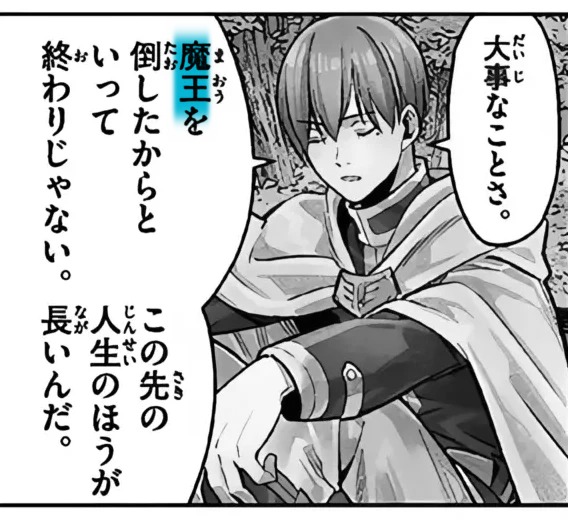
Dictionary: "demon lord" or "demon king," the standard JRPG / shōnen-fantasy final boss. What the word actually does here: it is the structural midpoint of the story, not the endpoint. Himmel's line 魔王を倒したからといって終わりじゃない ("just because we defeated the demon king, that does not mean it is over") is the thesis statement of the entire series. Volume 1 begins after the demon king has already been defeated, which is exactly the inversion of every JRPG-style fantasy that came before it.
旅 (たび, journey)
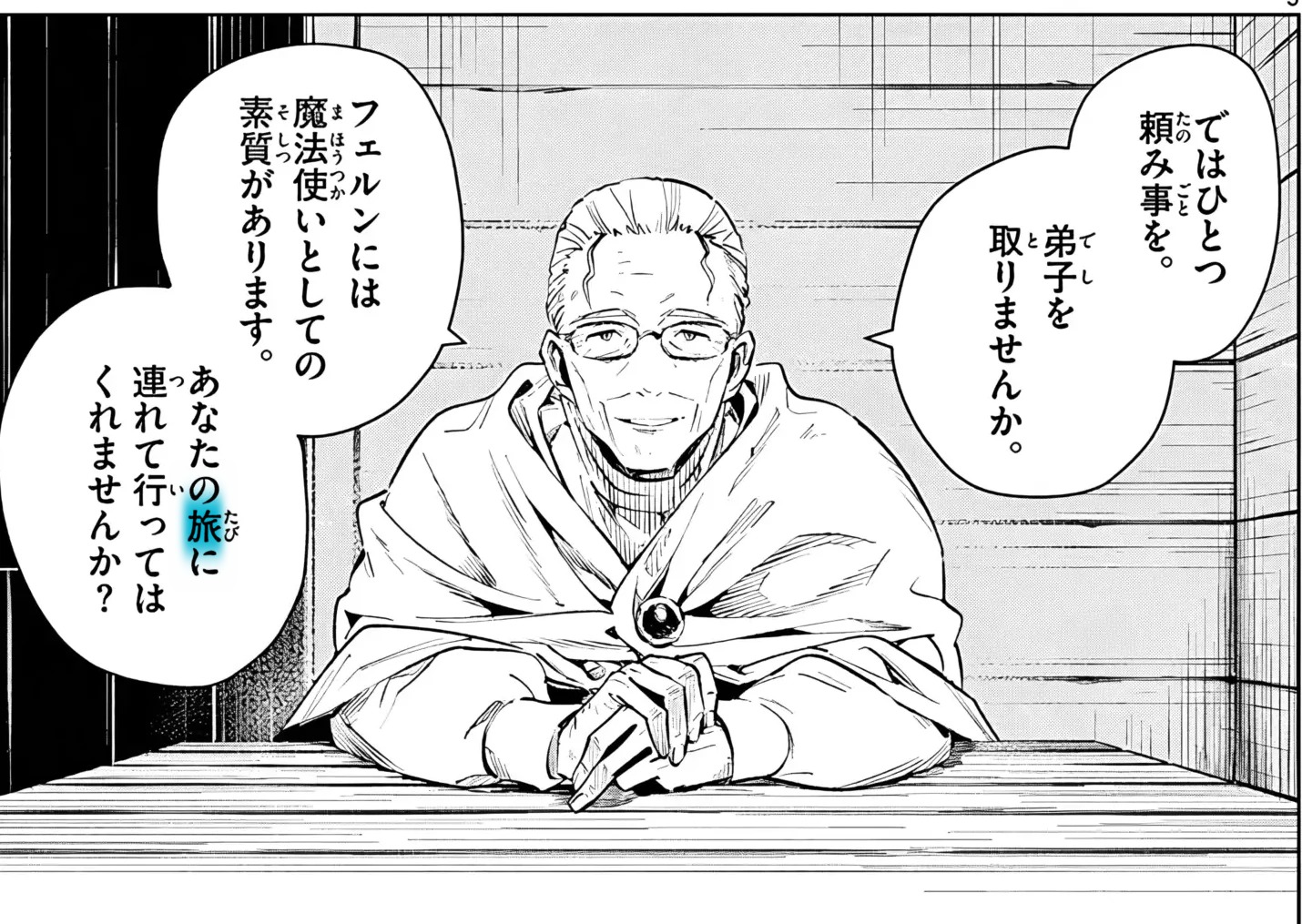
Dictionary: "trip, journey, travels." What the word does in Frieren: it stretches to mean a years-long pilgrimage, a lifetime, sometimes a metaphor for the time you have left. When Heiter in chapter 2 asks Frieren あなたの旅に連れて行ってはくれませんか ("could you take her with you on your journey?"), the journey he is talking about is open-ended on Frieren's elf-lifespan timeline. There is no destination. The word sits inside the series' meditation on time.
僧侶 (そうりょ, cleric / monk)
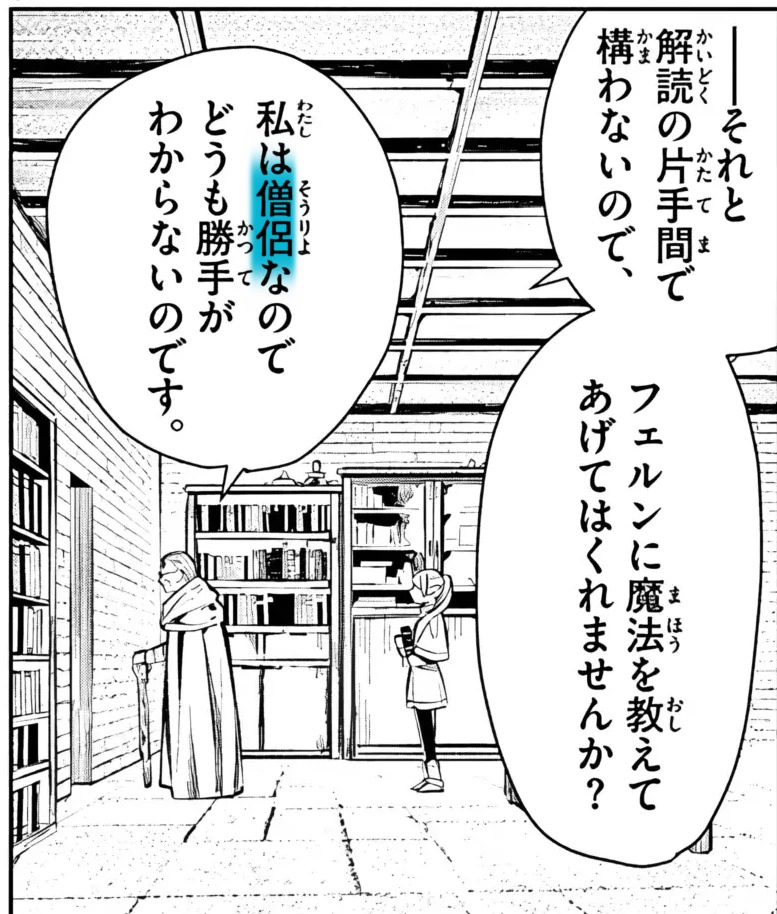
Dictionary: "Buddhist monk, priest." The trick: in fantasy manga the word functions as the JRPG class name "cleric," the healer / support spellcaster slot. Heiter is a 僧侶 in this sense. When he says 私は僧侶なのでどうも勝手がわからないのです ("as a cleric, I am unfamiliar with how it works"), he means he cannot teach offensive magic to Fern because his magic class is the wrong one. The word sits between Buddhist priesthood and JRPG class system, and Frieren leans on both at once. This kind of register collision is normal in Japanese fantasy and it is one of the rewarding reading experiences this volume offers.
Pop culture and context in volume 1
The post-JRPG inversion. Standard Japanese fantasy structure, from Dragon Quest through every shōnen ever published, ends with the hero defeating the demon king. Frieren begins where those stories end. The opening panel is the heroes' victory parade. Everything afterward is the question that the genre never asks: what does the rest of your life look like once the quest is over? Japanese readers come to volume 1 already knowing the formula the author is breaking.
寿命 (じゅみょう, lifespan). The word appears repeatedly in chapter 2. Frieren is an elf with a thousand-year lifespan. Heiter is an aging human cleric. The gap between their lifespans is the engine of the chapter and a long-running theme in Japanese fantasy literature, where elf longevity is a borrowed Western trope filtered through the Japanese pop-culture preoccupation with mortality. Read every conversation between the two of them with both timelines visible.
葬送 (そうそう, funeral procession). The Japanese title is 葬送のフリーレン, literally "Frieren of the funeral procession." 葬送 means "funeral procession" or "the act of seeing off the dead." The title positions Frieren as the one who survives, who buries her companions, who carries them in memory. The English subtitle "Beyond Journey's End" loses the elegiac weight of the Japanese phrase. When you see the word 葬送 in the manga, it is the title arriving inside the story.
魔法使い vs 僧侶 as JRPG class system. Mage versus cleric is borrowed directly from the Dragon Quest / Final Fantasy class taxonomy that has saturated Japanese pop culture since the 1980s. Frieren expects readers to recognize the class names as gameplay-derived shorthand. 魔法使い does offensive magic. 僧侶 does support and healing. 戦士 (せんし, warrior) does melee. Volume 1 uses these labels as if they were ordinary professions, which is how four decades of JRPG influence read in the modern fantasy register.
Inside the app: one panel, fully broken down
Reading manga in Japanese is, at the bottom of it, a vocabulary-acquisition problem. Let me get you one word: 魔法. All the context around it is broken down here the same way The Ashiba App provides it, so you finish this section actually understanding the word, not just having seen it.
Chapter 5, page 13: how human magic evolved
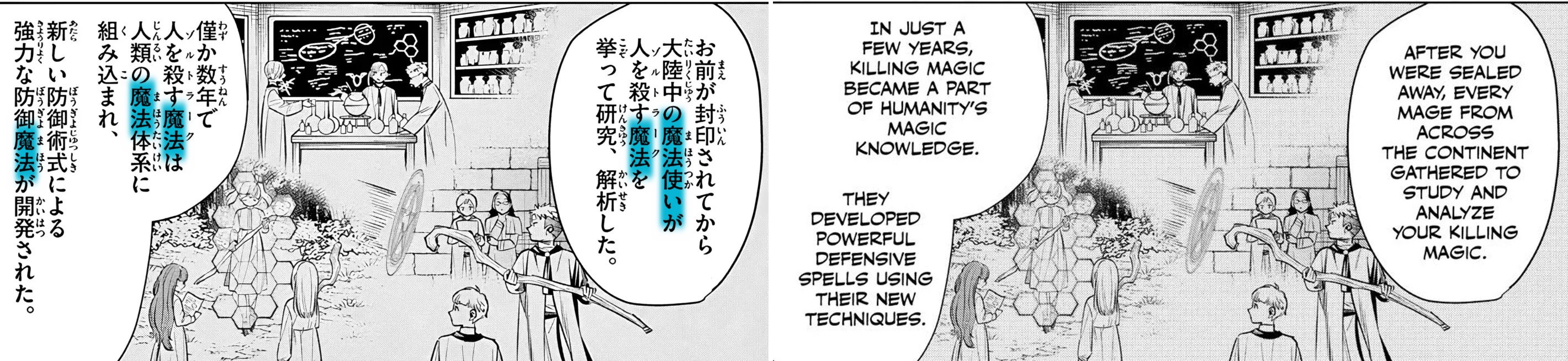
Scroll the image sideways to read the Japanese in full size.
Summary. Frieren explains, to a sealed demon she is about to fight, how human magic evolved during the time the demon was sealed away. The whole research arc of humanity's mages reduced to three textboxes. This is the densest exposition panel in the volume.
Textbox 1
JP: お前が封印されてから大陸中の魔法使いが人を殺す魔法を挙って研究、解析した。
EN: After you were sealed away, every mage from across the continent gathered to study and analyze your killing magic.
Overview: The premise. Humans took the demon's technique apart while it was locked away.
Breakdown:
- 封印された (ふういんされた): was sealed; passive of 封印する
- 大陸中 (たいりくじゅう): across the continent
- 魔法使い (まほうつかい): mage, magic user
- 殺す (ころす): to kill
- 魔法 (まほう): magic
- 挙って (こぞって): in unison, en masse; an N1 adverb you will see in formal narration
- 研究 (けんきゅう): research, study
- 解析 (かいせき): analysis
Textbox 2
JP: 僅か数年で人を殺す魔法は人類の魔法体系に組み込まれ、
EN: In just a few years, killing magic became a part of humanity's magic knowledge.
Overview: The compression. Humans turned the demon's art into ordinary curriculum.
Breakdown:
- 僅か (わずか): a mere; only
- 数年 (すうねん): a few years
- 人類 (じんるい): humanity, the human race
- 魔法体系 (まほうたいけい): magic system, body of magical knowledge
- 組み込まれ (くみこまれ): incorporated, built into; passive of 組み込む
Textbox 3
JP: 新しい防御術式による強力な防御魔法が開発された。
EN: They developed powerful defensive spells using their new techniques.
Overview: The result. New defenses are now stronger than the demon's old offense.
Breakdown:
- 新しい (あたらしい): new
- 防御 (ぼうぎょ): defense
- 術式 (じゅつしき): incantation system, magical formula
- による: by means of
- 強力 (きょうりょく): powerful
- 防御魔法 (ぼうぎょまほう): defensive magic
- 開発された (かいはつされた): was developed; passive of 開発する
Key points
- 魔法 (まほう): magic. The single most important word in the volume. Memorize it once and you have the root for 魔法使い, 防御魔法, 攻撃魔法, 魔法体系, 魔法史.
- 挙って (こぞって): in unison, en masse. Formal narration register; uncommon in everyday speech but standard in expository fantasy prose.
- 術式 (じゅつしき): "incantation system," the same compound JJK uses for cursed-technique formulae. A reusable fantasy-jargon noun across multiple series.
This is what you see in The Ashiba App for this panel. Pre-study, then read.
How to actually read volume 1
- Get a foundation. How much you need depends on how much discomfort you can sit with. Genki I and II is the polished path. At a minimum, lock in N5. Without N5 this volume is a wall. With N5 plus the top 20 content words pre-studied, it is a slow climb that rewards every page.
- Start with chapter 1. Take your time. Not a week. Not a day. This is the first chapter of manga you have ever read in Japanese. Set a timer for 15 minutes. Early on, you crack one to three sentences in that window. Later, you crack a full chapter. Consistency compounds. Rack up the reps.
- When you get stuck, reference the translation. Looking things up is not failure. It is learning. The fastest way to get unstuck is to see the answer and understand why the sentence means what it means. Goal: parse the sentence. Match the English to the Japanese, identify the word or grammar that blocked you, and move on. You will hurdle (probably in chapter 1 when the time-jump opens up the fifty-year gap, in chapter 3 or 4 when Fern's magic-theory training scenes turn into exposition, and in chapter 7 when Sein and Stark are introduced and the cast doubles). Those chapters are dense. The answer is not to grind harder. The answer is what I wrote about in Why You Will Quit Learning Japanese: put the book down and come back tomorrow.
If you want the deeper version of this reading strategy, the fastest way to learn Japanese article has the volume-control framework in full.
The Takeaway
The main reason reading manga in Japanese is hard is the sheer amount of vocabulary you do not know.
Frieren is a special case of that problem. The unique vocabulary count is moderate. The long tail is shorter than usual. The kanji is overwhelmingly joyo and entirely furigana- supported. What slows you down is a small head of fantasy-specific words that hit the page on every spread, and the meditative slowness of Frieren's plain-form voice that rewards re-reading the panels you already understood.
Most readers never get past the first wall. The pain is too great. The effort-to-reward ratio collapses, and the book gets shelved.
The easiest way out is to pre-study the words you do not know that will appear in the chapter you are about to read. The Ashiba App does this for every chapter of every series we cover. It surfaces the vocabulary, shows readings and POS, and includes grammar breakdowns so you see how each word is being used. Nothing is studied in isolation. Every flashcard carries its full panel context. You see the word in the sentence in the panel where it lives.
You can get started today.
Frequently asked questions
Should I watch the anime before reading Frieren in Japanese?
Yes. Watch episode 1 before you start the manga. The 2023 Madhouse anime is one of the best-translated fantasy adaptations of the last decade and the early episodes track volume 1 closely. Knowing the beats kills comprehension FOMO: you are not anxious about missing the story, because you already know the story. Watch again after you finish volume 1 and you will hear how much more you picked up by reading.
Does Frieren have furigana?
Yes. The Japanese print and digital editions print furigana on every kanji, every appearance, every chapter. Weekly Shōnen Sunday is a Shogakukan publication and follows the standard shōnen-magazine furigana practice. That includes the non-joyo characters in the kanji table above and the fantasy compounds 魔法, 勇者, 魔王, 僧侶. Kanji is not the blocker. Vocabulary is.
Do I need to know all the kanji before starting?
No. Furigana is provided everywhere. You need to know hiragana and katakana. That is the hard prerequisite. Kanji you pick up as you read. If you have not finished kana yet, start with how to learn hiragana and katakana.
How long does it take to read Frieren volume 1 in Japanese?
A solid N3 reader, first pass, looking up every unknown word: 9 to 12 hours across the full volume. An N2 reader who knows the magic-system vocabulary: 6 to 8 hours. A native speaker: 45 minutes to an hour. You are not the native speaker. Respect the pace.
Do I need to read volume 1 first or can I start anywhere?
Follow the fun. If a different volume pulls you harder, start there. The reasons to pick volume 1 anyway: the Heiter chapter (chapter 2) is the emotional foundation of the entire series, the magic-system vocabulary is introduced here, and Fern joins the party here. Skip volume 1 and you spend the next several volumes catching up to the lifespan conversation that everything else is built on.
Where can I buy Frieren volume 1 in Japanese?
Free preview: read chapter 1 in Japanese on Weekly Shōnen Sunday, Shogakukan's official magazine site, or via the Sunday Webry app for full chapters. For the English translation to compare against, Viz Media publishes the English release. Digital recommendation: Kindle on Amazon Japan or BookWalker, both carry the full series in Japanese. Physical paperback also via Amazon Japan or BookWalker.