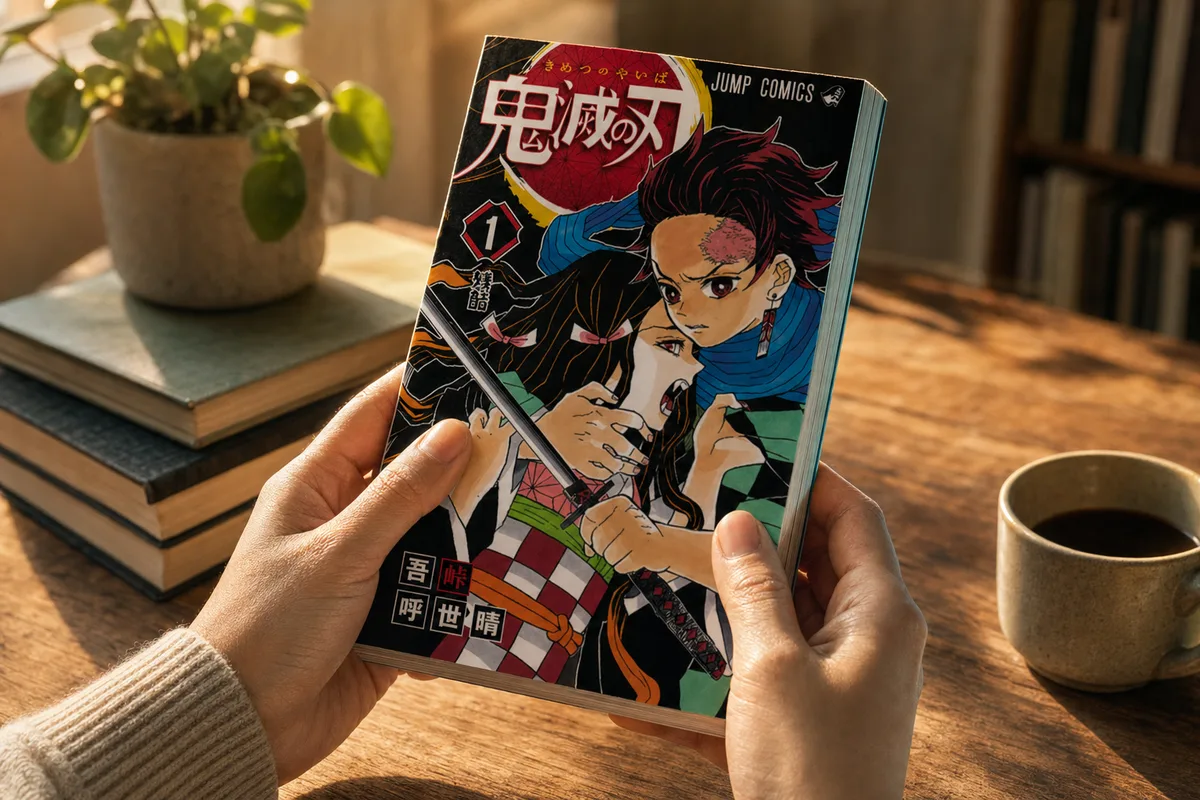
Volume 1 of Demon Slayer (鬼滅の刃) contains 998 unique vocabulary items across 7 chapters, 173 pages, 730 panels, and 3,760 textboxes. The script uses 614 unique kanji on the page, and only 29 are non-joyo. The hardest single thing in this book is not the kanji, not the grammar, and not even the workload of new words. It is the register: a 1910s mountain village, a samurai master's training speech, and a folklore vocabulary of demons and Nichirin swords stacked on top of standard Tokyo Japanese. If you have finished Genki II, you already know about 426 of the words in this volume outright. You have roughly 572 more to learn.
That is the whole problem with Demon Slayer volume 1 in one paragraph. Here is exactly what is in this book, and exactly what you need to read it.
Every number in this article comes from Ashiba's production corpus, measured against the official N5 to N1 JLPT vocabulary lists and the 2,136-character joyo kanji set. Last measured 2026-04-27.
Is Demon Slayer volume 1 hard to read in Japanese?
Upper-intermediate. Not beginner. Not advanced. If you can read a Genki II dialogue without stopping every line, you will finish volume 1. It will take longer than you think, and you will look up more words than you want to. You will also finish.
People mis-rate this book in both directions. Here is the actual shape.
What makes it easier than you think
Kanji is not a blocker. Furigana, the small phonetic companion written above every kanji, is provided everywhere in this manga: every kanji, every appearance, every chapter. Demon Slayer ran in Weekly Shōnen Jump and follows Shueisha's standard practice. The book hands you the readings on the page. Volume 1 uses 614 unique kanji, and 585 of them (95.3%) are joyo. Even when they are not, the manga prints the reading anyway.
The 29 non-joyo kanji split into two groups. The first is old-style writing of common modern words. 喰う (くう, to wolf down) appears 5 times, 筈 (はず, expectation) appears 6 times, and 此奴 (こいつ, this guy) appears 3 times, all with the reading printed right above them. The second group is sword-and-folklore vocabulary the series leans into for atmosphere: 頸 (くび, neck) appears 8 times, 罠 (わな, trap) 6 times, 狐 (きつね, fox) 5 times, 斧 (おの, axe) 6 times, 仇 (かたき, enemy/foe) 2 times, 天狗 (てんぐ, tengu) 2 times. All of them get furigana every appearance.
Stop worrying about the kanji list. The book hands you the readings.
What makes it harder than it looks
The long tail. 611 unique words appear exactly once in the entire volume. That is 61% of the unique vocabulary. This is the single biggest difficulty in volume 1, not kanji, not grammar. Most words you encounter do not repeat enough times within volume 1 to give you the in-volume spaced-repetition benefit. They will recur across the series. They will not recur much in this book.
Vocabulary acquisition is iterative. A word does not stick the first time. Each word takes multiple painful encounters before recognition becomes automatic, and every encounter breaks the story flow. You stop, you look up, you re-read the sentence, you re-set the panel in your head, you keep going. The tipping point where the manga starts reading easily is further out than most learners expect. The only path through is volume.
There is one way to lower the pain without lowering the reps. Pre-study the chapter vocabulary before you open the chapter. That moves the lookups out of the story and into focused study time. Same words, different context. The story stays intact.
The second-largest weight is register collision. The book opens in a Taishō-era mountain village where Tanjiro speaks in plain modern Japanese with a younger-brother register, then snaps to Tomioka Giyū's clipped Hashira-rank declaratives, then to Urokodaki's archaic sword-master instruction. 133 unique words sit outside the JLPT framework entirely after Gemini-classification, and the bulk of those are folklore-and-sword nouns (鬼共 おにども, 鬼殺隊 きさつたい, 日輪刀 にちりんとう, 最終選別 さいしゅうせんべつ, 鱗滝 うろこだき) that no general dictionary will help you with. Pre-study them or they eat your reading time.
You don't need permission. Just go for it.
The real question is not whether this book is at your level. The real question is whether the pain is tolerable for the reward. If you actually want this story, the level mismatch is just a tax on time, not a wall. You pay it in lookups and re-reads and slow chapters until the cost goes down. Always read above your level. Attack the stories that motivate you. Permission is something other people give themselves and then complain about. Just go for it.
What the data says about volume 1
Every number below was calculated from the approved vocabulary set for Demon Slayer volume 1 in Ashiba's production database. JLPT level was assigned by matching against the official N5 to N1 vocabulary lists. Words not on any list were classified by Gemini 3 Pro against context. 133 unique words remained outside the N5 to N1 framework and are marked "unlisted" (proper nouns, folklore terms, sword-and-corps jargon, slang, onomatopoeia).
A note on terminology. Running vocabulary means every word token as it occurs in the text, counting every repeat. If 鬼 appears 44 times, that is 44 running tokens from 1 unique word. Unique vocabulary means the distinct words themselves, counted once each.
Volume 1 at a glance
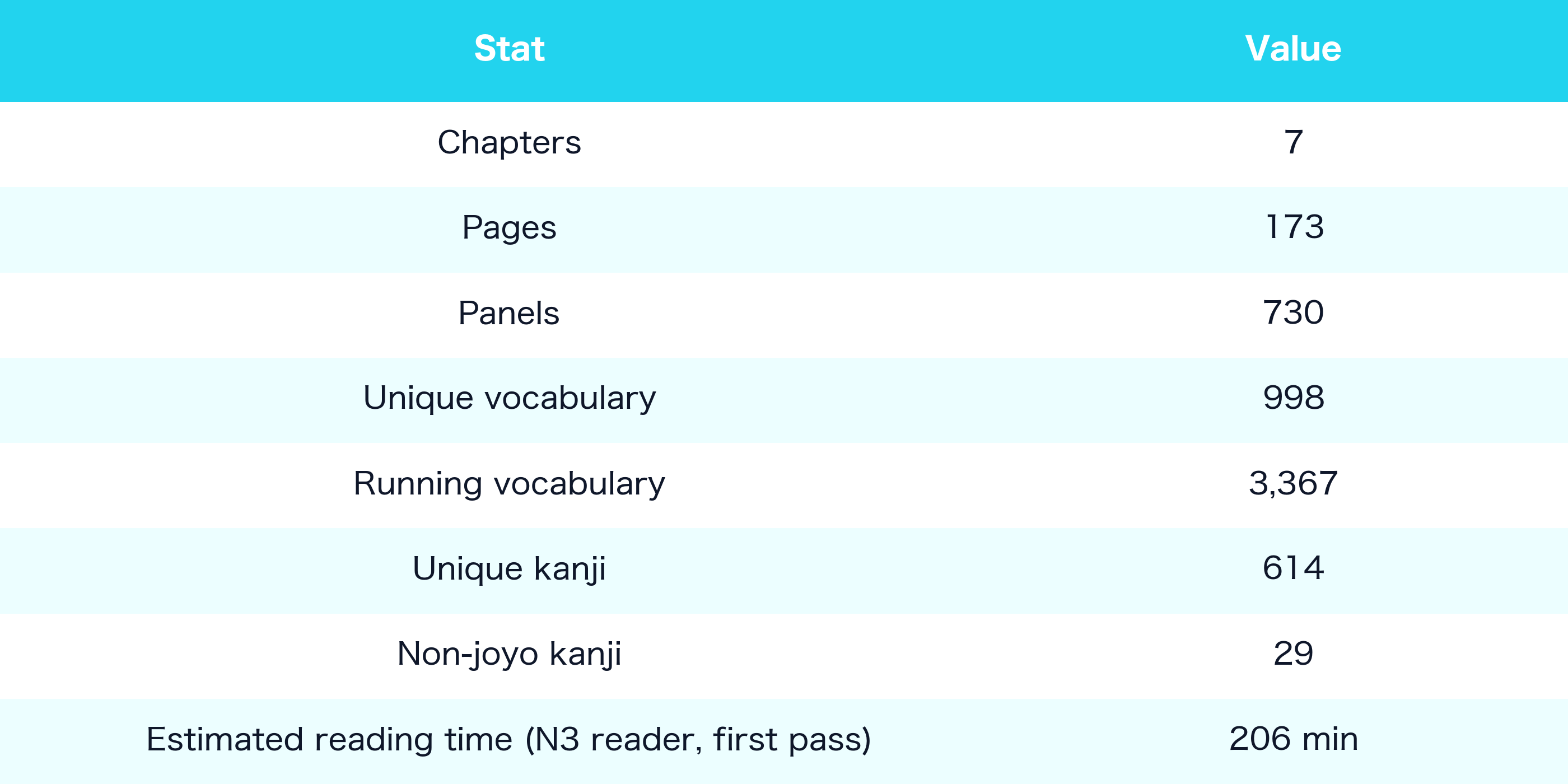
| Stat | Value |
|---|---|
| Chapters | 7 |
| Pages | 173 |
| Panels | 730 |
| Textboxes (speech, thought, narration) | 3,760 |
| Unique vocabulary | 998 |
| Running vocabulary | 3,367 |
| Unique kanji | 614 |
| Non-joyo kanji | 29 |
| Estimated reading time (N3 reader, first pass) | 6 to 8 hours |
JLPT coverage
The 998 unique vocabulary items in volume 1 break down like this:
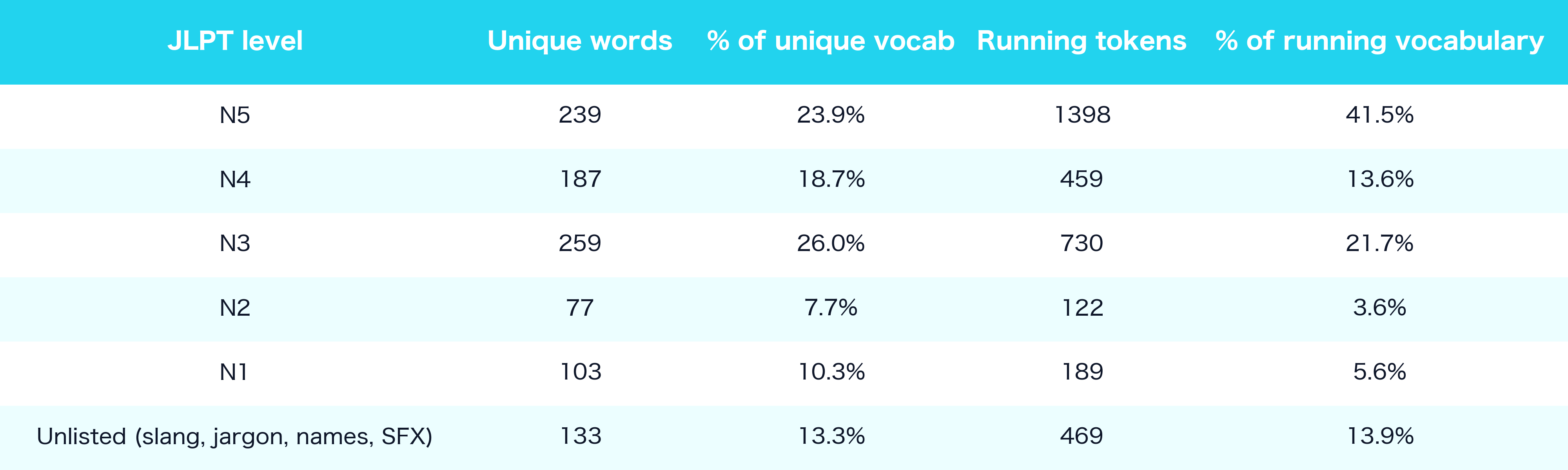
| JLPT level | Unique words | % of unique vocab | Running tokens | % of running vocabulary |
|---|---|---|---|---|
| N5 | 239 | 23.9% | 1,398 | 41.5% |
| N4 | 187 | 18.7% | 459 | 13.6% |
| N3 | 259 | 26.0% | 730 | 21.7% |
| N2 | 77 | 7.7% | 122 | 3.6% |
| N1 | 103 | 10.3% | 189 | 5.6% |
| Unlisted (slang, jargon, names, SFX) | 133 | 13.3% | 469 | 13.9% |
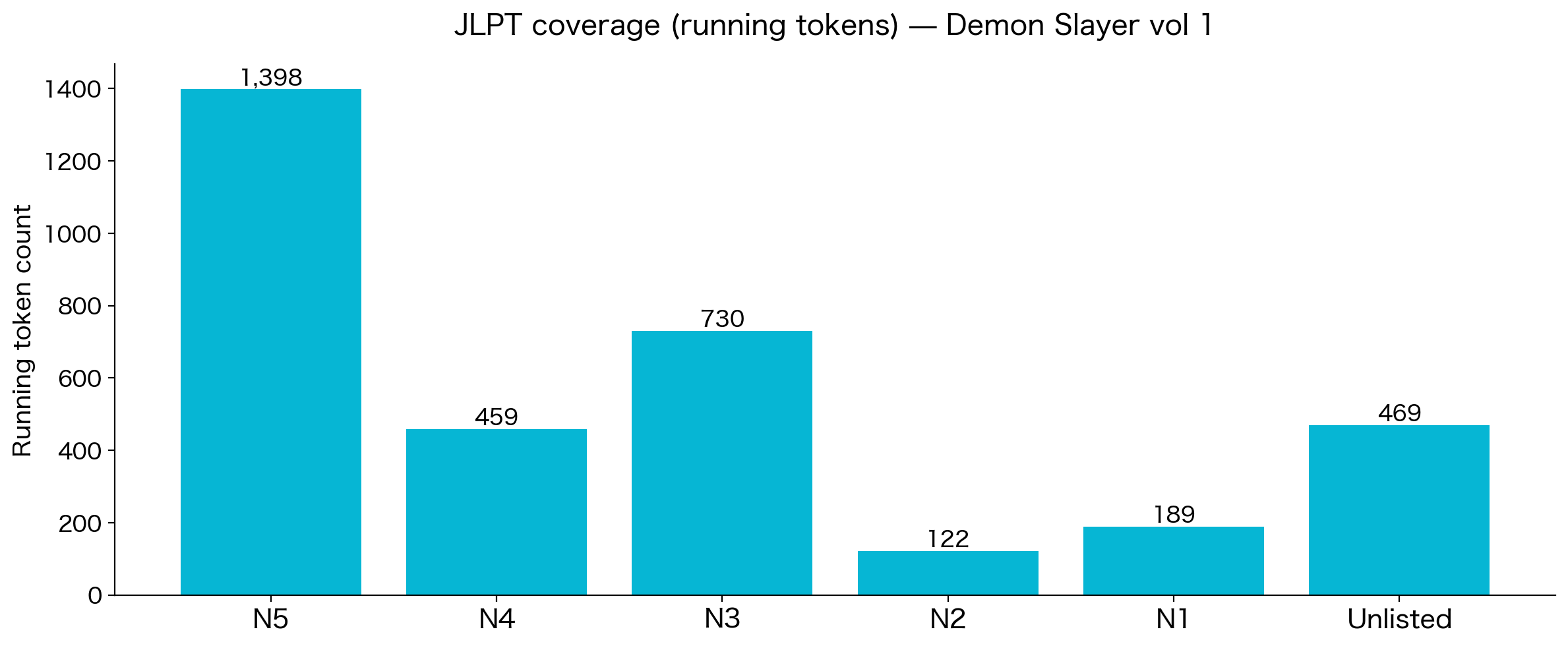
Read the last column. 55.1% of the running vocabulary is N5 or N4. Add N3 and you are at 76.8% of running vocabulary. The hard stuff (N2 and N1 combined) is 9.2% of what you actually read, because the hardest words appear rarely. The unlisted bucket sits at 13.9% of running tokens. Demon Slayer's difficulty is not sitting in the JLPT-hard column. It sits in the long tail and in the folklore vocabulary that no JLPT list tests.
Reader guidance by level
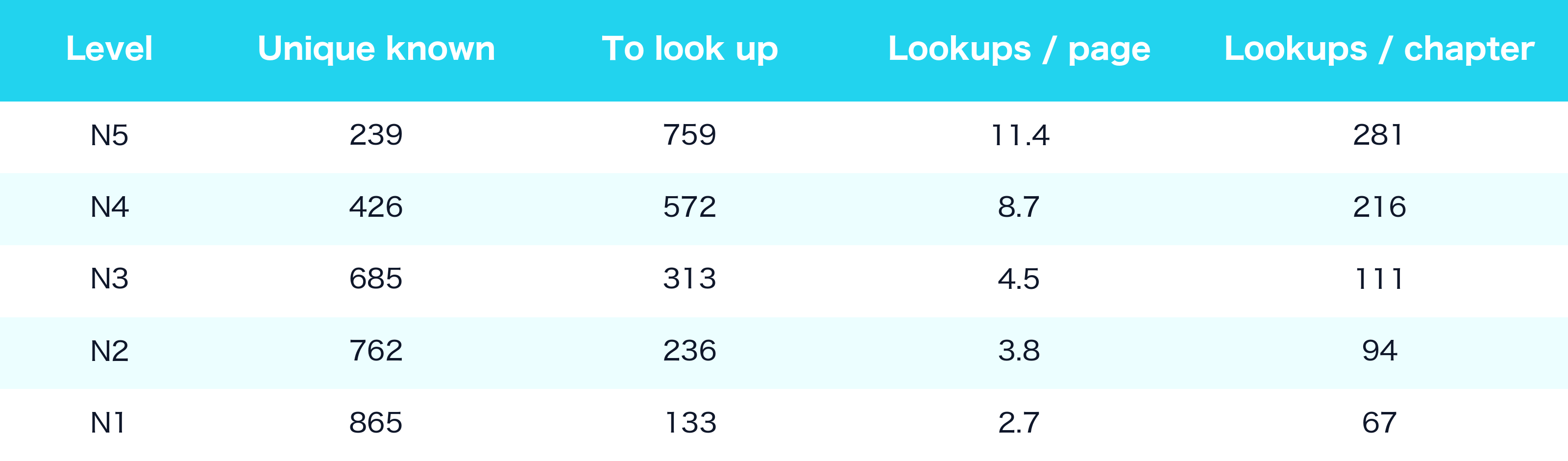
| Level | Unique words known | Unique words to look up | Lookups per page (first pass) | Lookups per chapter (first pass) |
|---|---|---|---|---|
| N5 | 239 | 759 | 11.4 | 281 |
| N4 | 426 | 572 | 8.7 | 216 |
| N3 | 685 | 313 | 4.5 | 111 |
| N2 | 762 | 236 | 3.8 | 94 |
| N1 | 865 | 133 | 2.7 | 67 |
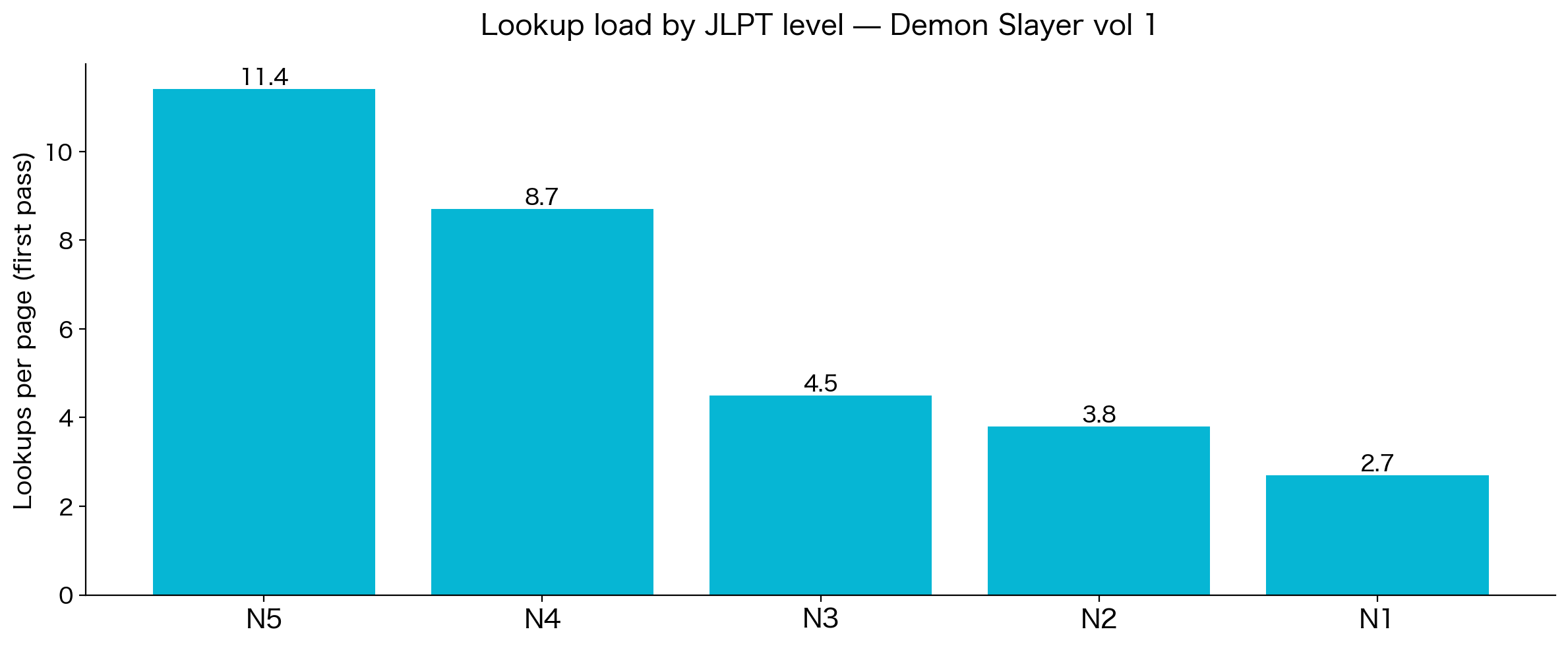
Lookups are unavoidable and painful, but you can lower the pain by completing the grammar foundation guide first. If you do not have kana yet, start there. That is table stakes.
N1 ≠ mastery
N1 means you passed a test. Real Japanese is not the test. Even N1 readers reading Demon Slayer for the first time will look things up. The best way to learn real Japanese is to read real Japanese. Then you can pass any test.
An N1 reader still has 133 unique unlisted words in this volume alone, plus first-encounter recognition on vocabulary they know from study but have never seen embedded in Taishō-era folklore prose. Even at N1, expect 2 to 3 lookups per page on first pass.
Kanji
Demon Slayer volume 1 has 614 unique kanji on the page, counted from the actual surface forms. 585 are joyo. 29 are non-joyo. Furigana is printed on every one.
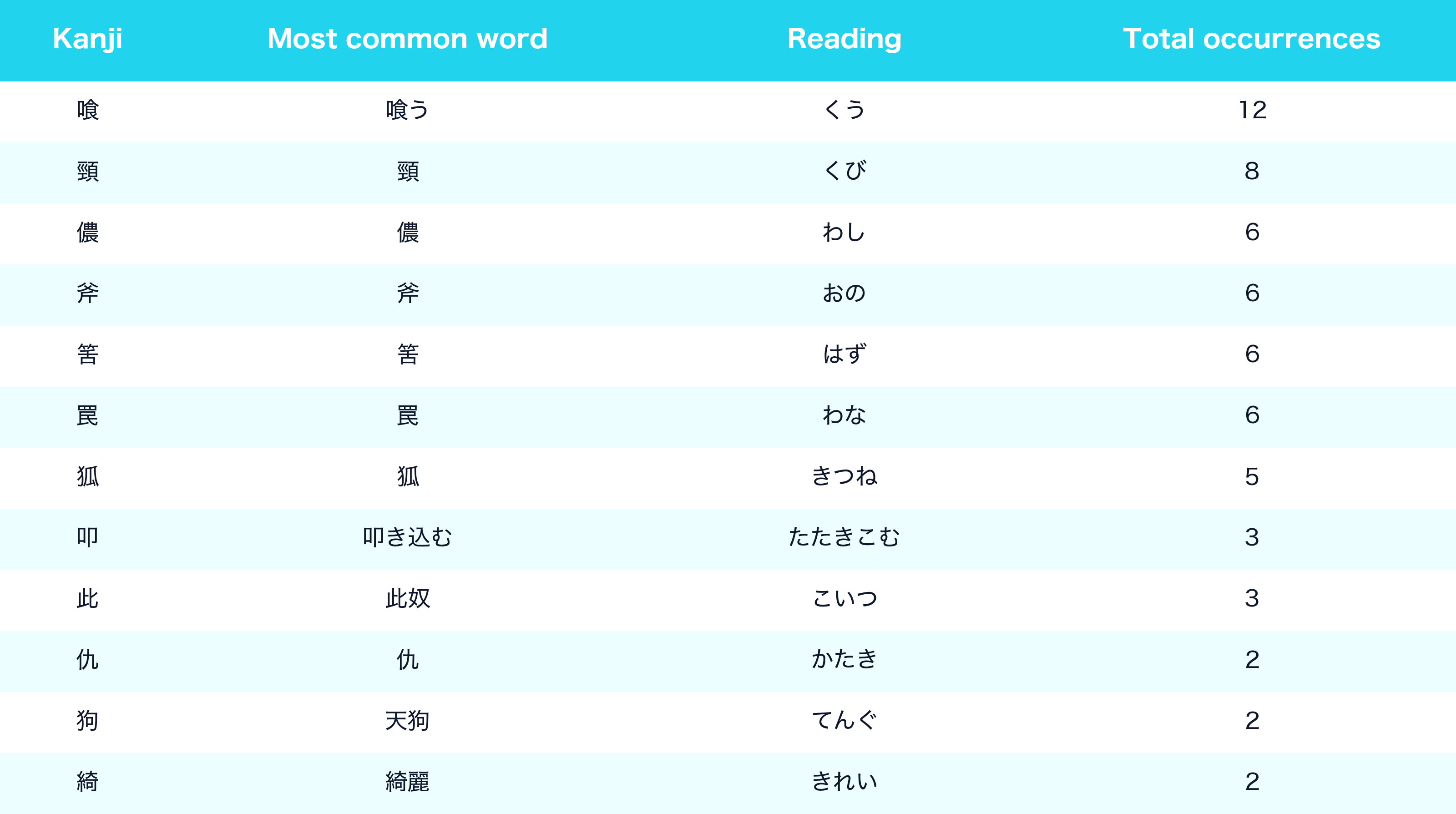
| Kanji | Most common word | Reading | Total occurrences |
|---|---|---|---|
| 喰 | 喰う | くう (to wolf down) | 12 |
| 頸 | 頸 | くび (neck) | 8 |
| 儂 | 儂 | わし (I, old-man pronoun) | 6 |
| 斧 | 斧 | おの (axe) | 6 |
| 筈 | 筈 | はず (expectation) | 6 |
| 罠 | 罠 | わな (trap) | 6 |
| 狐 | 狐 | きつね (fox) | 5 |
| 叩 | 叩き込む | たたきこむ (to drum into) | 3 |
| 此 | 此奴 | こいつ (this guy) | 3 |
| 仇 | 仇 | かたき (foe, enemy) | 2 |
| 狗 | 天狗 | てんぐ (tengu) | 2 |
| 綺 | 綺麗 | きれい (beautiful) | 2 |
| 繋 | 繋がる | つながる (to be linked) | 2 |
| 藁 | 藁 | わら (straw) | 2 |
| 刎 | 刎ねる | はねる (to lop off) | 1 |
Where the kanji weight actually lives is in joyo characters combining into series-domain compounds. 鬼殺隊 (きさつたい, Demon Slayer Corps) is built from 鬼 (demon), 殺 (kill), and 隊 (corps). All three are joyo. Together they make the institutional noun the entire series turns on. Same story with 日輪刀 (にちりんとう, sun-wheel sword, from 日 + 輪 + 刀), 最終選別 (さいしゅうせんべつ, Final Selection, from 最 + 終 + 選 + 別), and 鬼狩り (おにがり, demon hunting, from 鬼 + 狩). Every character in those compounds is on the joyo list, but the compound itself is series-domain vocabulary you will not see outside this title. The bottleneck is the word, not the kanji. Stop worrying about the character list. Start worrying about the compounds.
Frequency
Vocabulary appears in a long-tail distribution. 611 of 998 unique words (61%) appear exactly once; only 9 words appear 26 times or more. The small head of the curve is where the leverage lives.
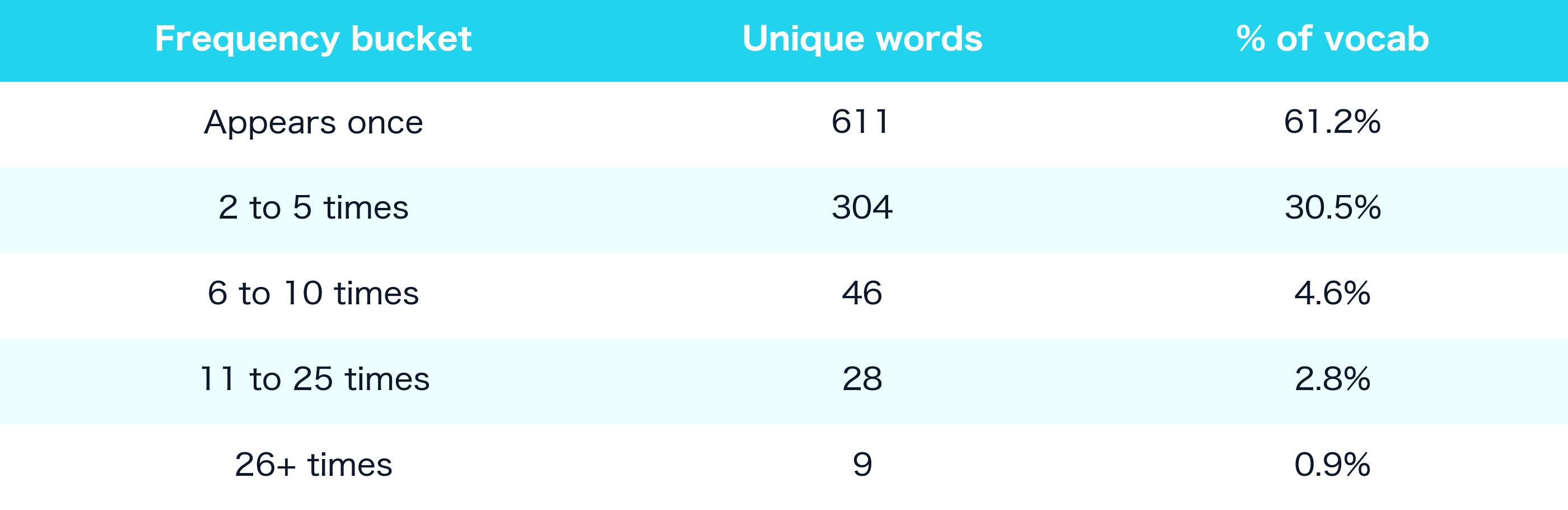
| Frequency bucket | Unique words | % of vocab |
|---|---|---|
| Appears once | 611 | 61.2% |
| 2 to 5 times | 304 | 30.5% |
| 6 to 10 times | 46 | 4.6% |
| 11 to 25 times | 28 | 2.8% |
| 26 or more times | 9 | 0.9% |
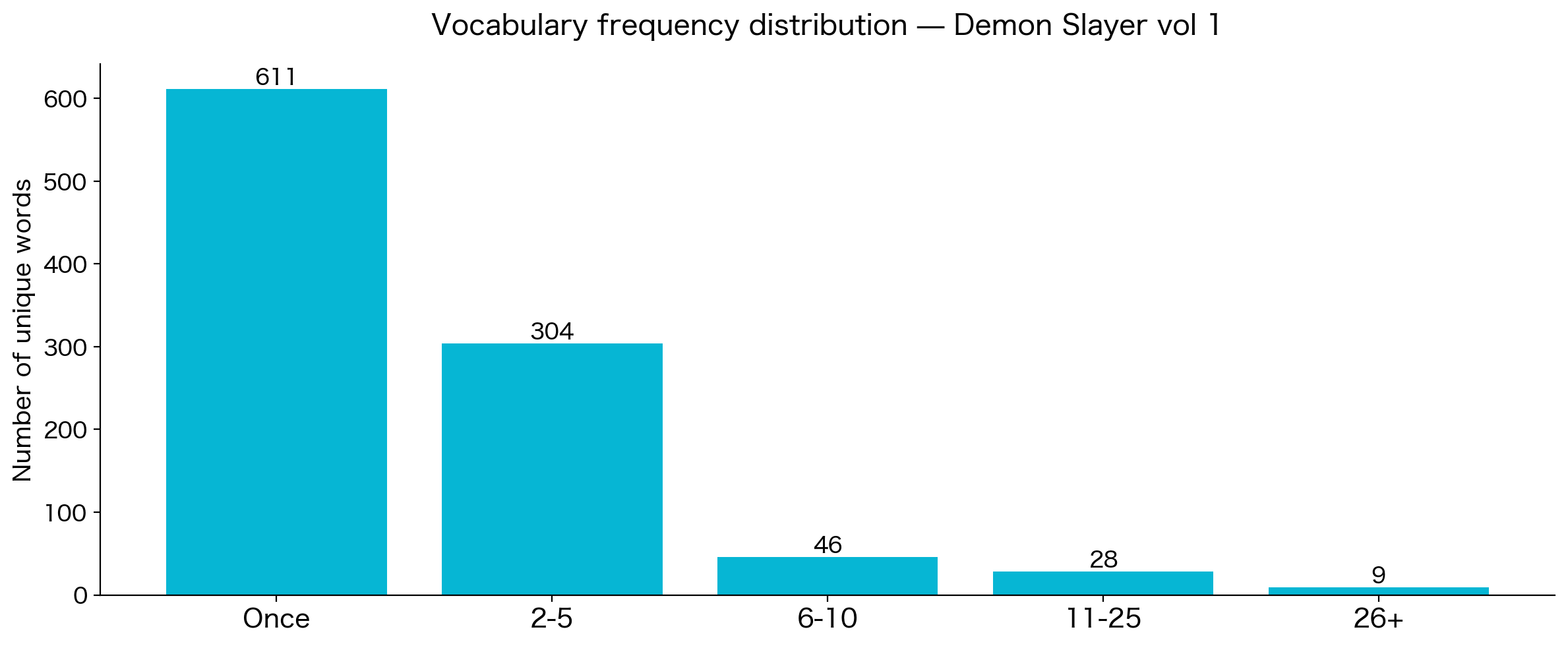
Do not read "appears once" as "not worth learning." These words recur across the series. Later volumes pick them up and use them again. The 83 words that appear six times or more are the real spine of volume 1 specifically.
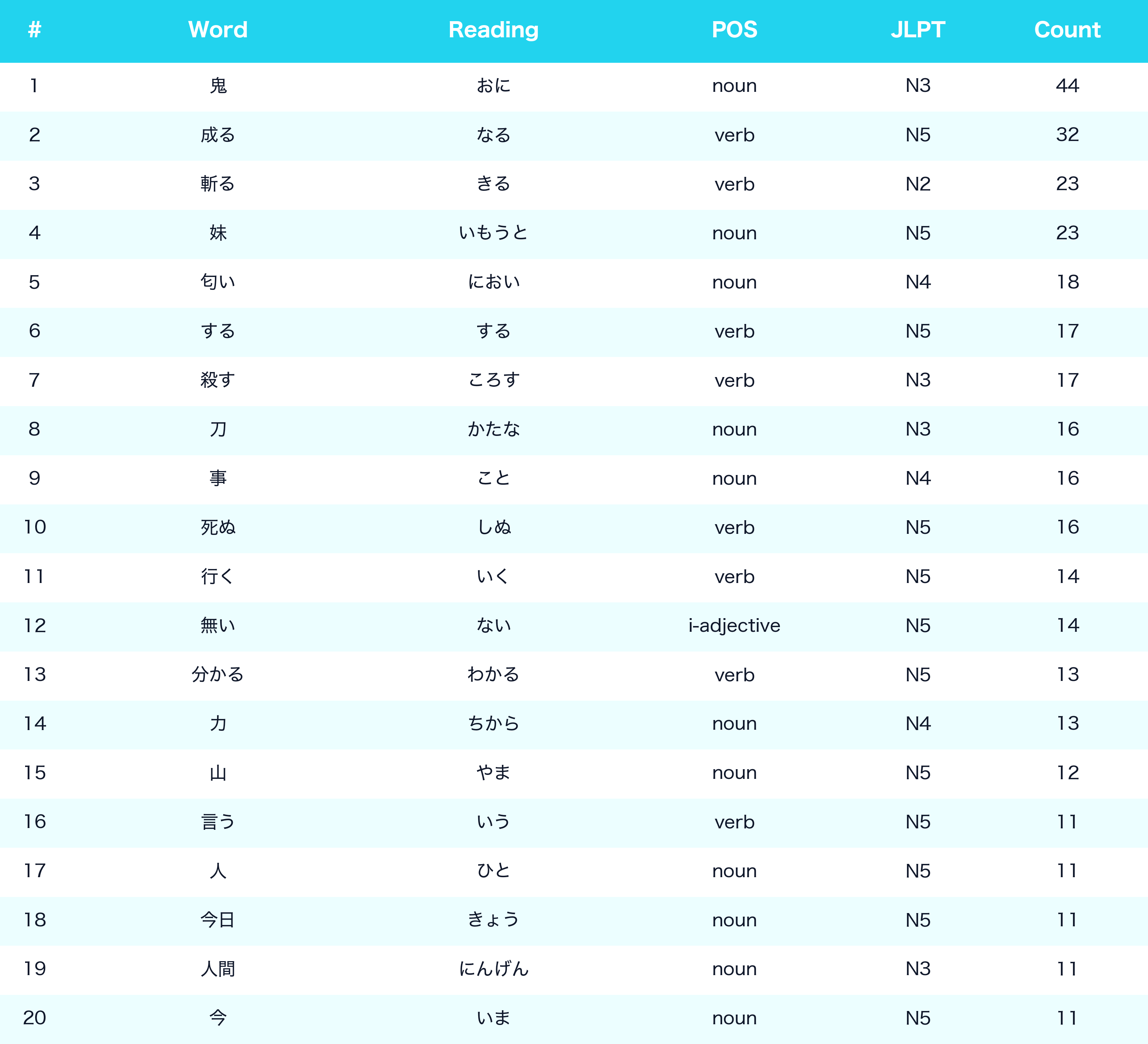
The 20 most frequent content words
Pre-study these 20 and you have learned the most common content words on almost every page. By the time you finish volume 1, all 20 are locked into your memory just from how often they appear.
Particles, auxiliary verbs, pronouns, conjunctions, proper nouns, and adnominals are excluded so the list surfaces meaningful content words.
| # | Word | Reading | POS | JLPT | Count |
|---|---|---|---|---|---|
| 1 | 鬼 | おに | noun | N3 | 44 |
| 2 | 成る | なる | verb | N5 | 32 |
| 3 | 斬る | きる | verb | N2 | 23 |
| 4 | 妹 | いもうと | noun | N5 | 23 |
| 5 | 匂い | におい | noun | N4 | 18 |
| 6 | する | する | verb | N5 | 17 |
| 7 | 殺す | ころす | verb | N3 | 17 |
| 8 | 刀 | かたな | noun | N3 | 16 |
| 9 | 事 | こと | noun | N4 | 16 |
| 10 | 死ぬ | しぬ | verb | N5 | 16 |
| 11 | 行く | いく | verb | N5 | 14 |
| 12 | 無い | ない | i-adjective | N5 | 14 |
| 13 | 分かる | わかる | verb | N5 | 13 |
| 14 | 力 | ちから | noun | N4 | 13 |
| 15 | 山 | やま | noun | N5 | 12 |
| 16 | 言う | いう | verb | N5 | 11 |
| 17 | 人 | ひと | noun | N5 | 11 |
| 18 | 今日 | きょう | noun | N5 | 11 |
| 19 | 人間 | にんげん | noun | N3 | 11 |
| 20 | 今 | いま | noun | N5 | 11 |
Two of these are worth calling out. 鬼 (おに, demon) is the genre-defining noun the entire series is built on, and it appears 44 times in volume 1 alone. You will also see the same character recombine across the cast and the institutions: 鬼共 (おにども, the demons, plural), 鬼殺隊 (きさつたい, Demon Slayer Corps), 鬼狩り (おにがり, demon hunter), 鬼舞辻 (きぶつじ, Kibutsuji, the antagonist's name). Learn this one character and you decode the entire institutional vocabulary at once.
斬る (きる, to slash) is the verb the action set pieces are built on. It is N2 by the JLPT lists, but it is N5 by the corpus, and it appears 23 times in volume 1 across surface forms (斬る, 斬って, 斬れる, 斬れない, 斬った). Pre-study it once, recognise it everywhere.
How each main character speaks
竈門 炭治郎 (Kamado Tanjirō)
Fifteen years old, eldest son of a charcoal-burning family in the mountains, polite by default. Tanjiro uses 俺 (おれ) for "I," but he also bows to elders and apologises to strangers, which is unusual for an action-shōnen lead. His sentences run long because he thinks out loud, and his thoughts double back on themselves. The other thing his speech does is name smells. He has a preternatural sense of smell and constantly narrates what he is picking up, which means 匂い (におい, smell) and its compounds drive his internal monologue. He is the easiest main character to read once you accept that his politeness is sincere, not register-shifting.
竈門 禰豆子 (Kamado Nezuko)
Tanjiro's younger sister. Turned into a demon in chapter 1 and silent for almost the entire volume after that. Her speech in the opening pages is gentle and family-register (お兄ちゃん, 行ってきます). After the transformation she communicates almost entirely through sound and body language. There is no register to study here. She is the easiest character in the volume to read because she barely speaks.
富岡 義勇 (Tomioka Giyū)
Water Hashira. The Demon Slayer Corps' top-rank Water-style swordsman. Cold, formal, verbally efficient. His sentences are short, declarative, and almost free of sentence-final particles. He uses 俺 (おれ) for "I" in plain speech but switches to neutral polite-register prose when he is delivering institutional information. Where Tanjiro thinks in long arcs, Giyū sentences out facts: 妹を殺すお前は腹を切って死ぬ. (Kill your sister. You disembowel yourself and die.) The grammar is easy. The emotional density is what makes him hard to parse fast.
鱗滝 左近次 (Urokodaki Sakonji)
Tanjiro's training master. A retired Water Hashira and a sword-style instructor. His speech is the archaic-instructor register: classical sentence enders, frequent imperatives in old-fashioned forms, and a vocabulary loaded with 太刀筋 (たちすじ, sword line), 急所 (きゅうしょ, vital point), 鋼 (はがね, steel), and 頸 (くび, neck) where a modern speaker would say 首. He also delivers the chapter-4 mountain training and the chapter-5 Final Selection rules in long expository monologues. His lines are the densest text in the volume, and they are where the unlisted-bucket vocabulary clusters hardest.
Expressions with depth
These are volume 1 expressions where the dictionary entry will mislead you. Surface meaning is one thing. What the phrase actually does in a panel is another.
鬼 (おに, demon)
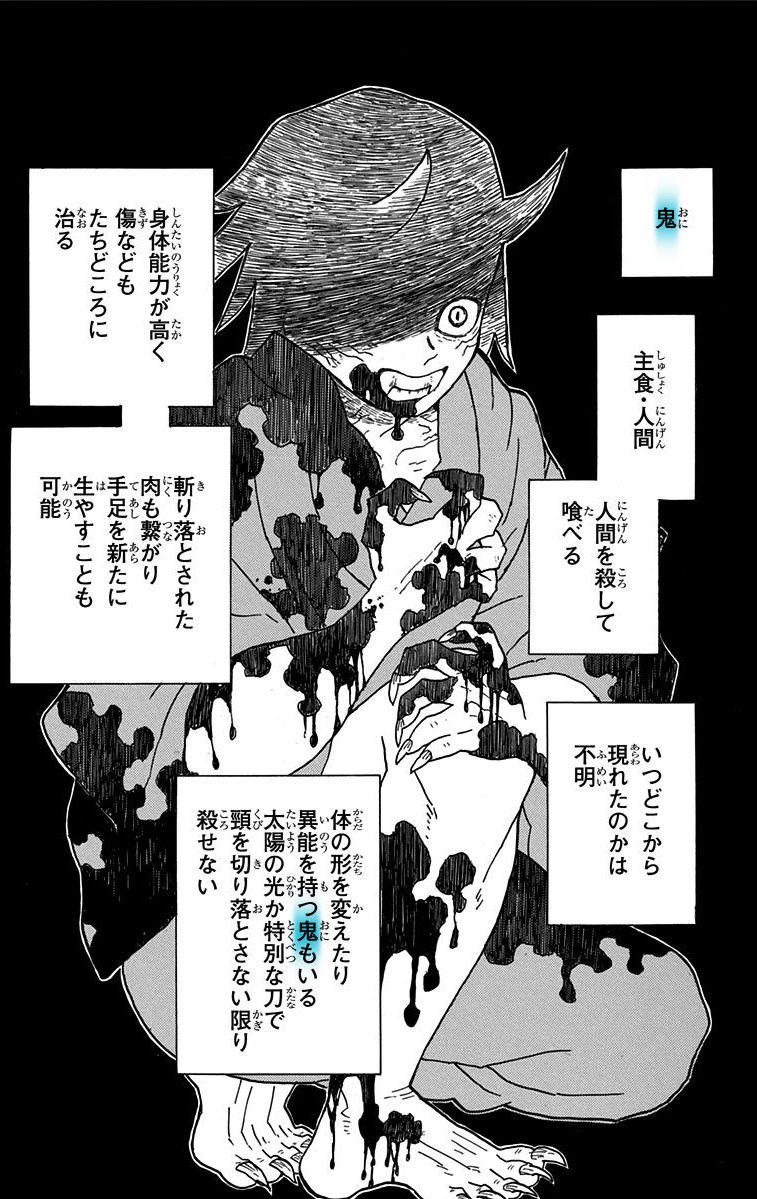
Dictionary: "demon" or "ogre." The texture: 鬼 in pre-modern Japanese folklore is a horned mountain spirit, often associated with thunder and disease, sometimes a punishing yokai and sometimes a wronged human transformed by grief. Demon Slayer keeps the folklore silhouette but reroutes the etymology: in this manga, 鬼 are former humans cursed into immortality by Kibutsuji's blood, frozen in the moment of their worst emotional injury. The chapter-4 narration that introduces 鬼 (体の形を変えたり, 異能を持つ 鬼もいる, 太陽の光か特別な刀でしか殺せない) is doing genre-work, not creature-design. A Japanese reader hears 鬼 and reaches for centuries of Setsubun-festival imagery and Momotarō. Translate it as "monster" and you lose all of that.
妹 (いもうと, younger sister)
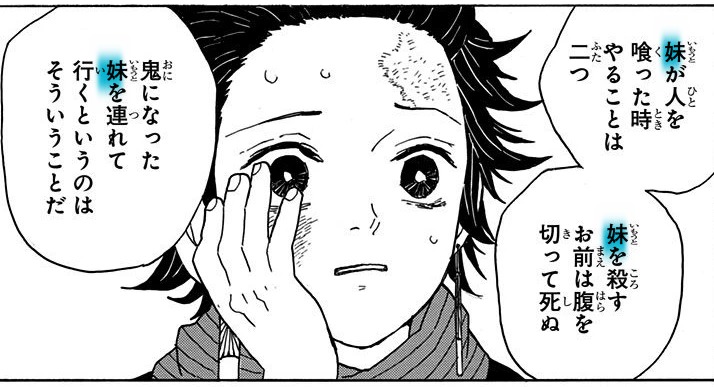
Dictionary: "younger sister." The texture: 妹 in Demon Slayer is not a kinship term, it is the protagonist's entire premise. The chapter-3 confrontation between Tanjiro and Giyū rotates the word three times in two textboxes: 妹が人を喰った時やることは 二つ / 妹を殺す / お前は腹を切って死ぬ (When your sister has eaten a human there are two things to do. Kill your sister. You disembowel yourself and die.) The repetition is intentional. Giyū is hammering the word in to make the obligation feel inescapable. Read 妹 as a load-bearing noun, not a relationship label.
斬る (きる, to slash)
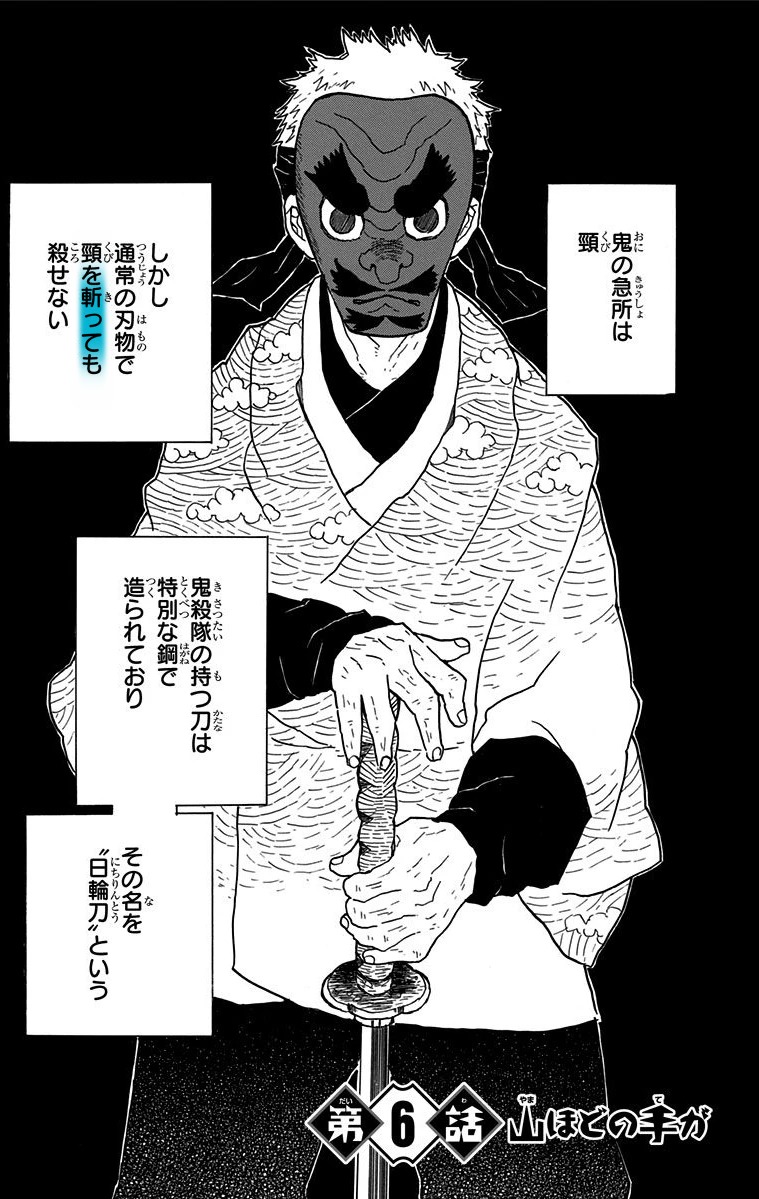
Dictionary: "to cut" or "to slash." The texture: Japanese has multiple verbs that translate to "cut" (切る, 裂く, 削る, 刈る) and Demon Slayer reaches specifically for 斬る every time, because 斬る is the sword-cut verb. It is the verb a chronicle uses for a samurai cleaving an enemy in two. Urokodaki's chapter-6 exposition on Nichirin swords (鬼の急所は頸 / しかし通常の刃物で頸を斬っても殺せない / 鬼殺隊の持つ刀は 特別な鋼で造られており) uses it three times in three textboxes to set the rule. Translate it as "cut" and you lose the genre signal: this is sword-and-corps register, not butcher-shop register.
匂い (におい, smell)
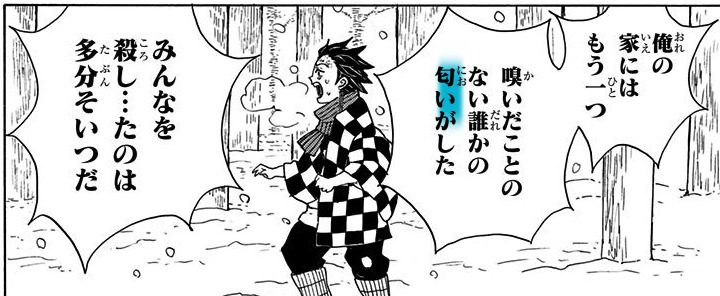
Dictionary: "smell" or "scent." The texture: 匂い is Tanjiro's protagonist ability and the verb the manga uses to handle exposition without saying "Tanjiro intuited." Most main characters in shōnen get power introductions through explicit narration. Tanjiro gets his through 匂い: he keeps remarking on 怒りの匂い (the smell of anger), 哀しみの匂い (the smell of sorrow), 鬼の匂い (the smell of a demon), and the reader is meant to track which scent he is chasing. Translate it as a regular "he smelled something" and you flatten the panel rhythm. Read 匂い as the ability tag.
刀 (かたな, sword)
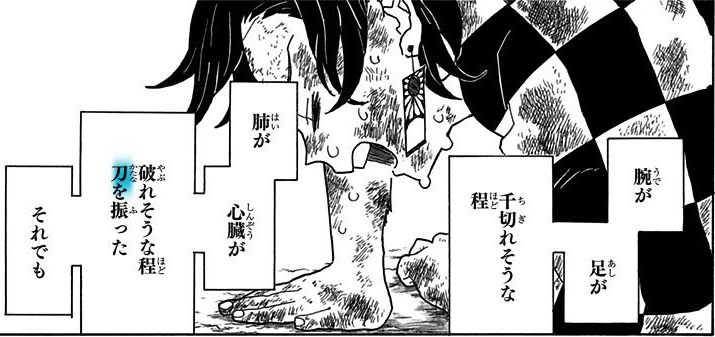
Dictionary: "sword" or "katana." The texture: 刀 in modern Japanese means a single-edged curved blade in the Japanese tradition, and the cultural register is feudal-period samurai vocabulary. Demon Slayer takes the word and welds it onto its central magic-system noun, 日輪刀 (にちりんとう, sun-wheel sword), which is forged from 鋼 (はがね, a specific Japanese sword-steel) and changes colour to its wielder. When the chapter-5 panel says 破れそうな程刀を振った (he swung the sword to the point it nearly broke), the word choice is doing the work: this is not a generic sword, it is a Nichirin sword, and the weight of every Japanese sword-craft tradition rides under the kanji.
Pop culture and context in volume 1
大正時代 (たいしょうじだい, Taishō era). Demon Slayer is set in the early Taishō period (1912 to 1926), a 14-year window where Japan modernised hard but the rural mountain villages still ran on charcoal-burning, oil lamps, and wooden footwear. The chapter-1 opening on a snowy mountainside, with Tanjiro hauling charcoal down to town, is not generic period dressing. It is a culturally specific image of poverty and family duty that Japanese readers register immediately. The Western-style city clothing that appears in chapter 7 (Asakusa) is the same era's other half: the modernised urban wedge punching into a country still wearing 着物.
鬼 in folk religion versus the manga. Pre-modern 鬼 are mountain spirits from Japanese folk religion, often appearing in Setsubun-festival imagery (every February 3rd Japanese kids throw beans at 鬼 to drive them out: 鬼は外, 福は内). They are also the enemies in the canonical Momotarō folktale. Demon Slayer keeps the silhouette and the word, and reverses the metaphysics: every 鬼 in this manga is a former human, cursed into the form. The cultural friction between the folklore and the rewrite is part of the manga's emotional register, and Japanese readers register it without being told.
日輪刀 (にちりんとう) and traditional swordsmithing. The Nichirin swords are forged from a metal that absorbs sunlight, and the term-of-art for the steel is 鋼 (はがね). Real Japanese swordsmithing has its own technical vocabulary that survived from feudal Japan into modern usage, and Demon Slayer leans on it: 鋼, 太刀筋, 急所, 頸. The register is samurai-chronicle prose grafted onto a 1910s setting, and the friction is deliberate. Read 鋼 not as "steel" but as "Japanese sword steel," with all the craft tradition that implies.
鬼殺隊 (きさつたい, Demon Slayer Corps) as paramilitary secret society. Volume 1 spends chapter 4 establishing the rules: the corps is several hundred members strong, government-unauthorised, and ancient. That cluster of features (state-tolerated, not state-sanctioned, multi-generational, sworn to a hidden master) places it in a specific Japanese cultural slot, the gentleman's secret society of the late-Meiji and Taishō period. Real-world examples were everywhere, mostly political. Demon Slayer's version is supernatural, but the institutional silhouette is recognisable.
最終選別 (さいしゅうせんべつ, Final Selection) and ascetic mountain training. Chapter 6 sends Tanjiro into a wisteria-warded mountain to survive seven days alone among bound demons. The setup is shōnen-tournament arc, but the cultural anchor is 山下り (mountain ascent and descent), the folk-religion ascetic practice where trainees withdraw into the mountains for purification and trial. Urokodaki's instruction register carries the same weight: he speaks like a 修行 (しゅぎょう, ascetic training) master, because that is what he is.
Inside the app: one panel, fully broken down
Reading manga in Japanese is, at the bottom of it, a vocabulary-acquisition problem. Let me get you one panel: chapter 6, page 9, the Final Selection rules panel. All the context around it is broken down here the same way The Ashiba App provides it, so you finish this section actually understanding the institutional vocabulary that drives the rest of the volume, not just having seen it.
Chapter 6, page 9: the Final Selection rules
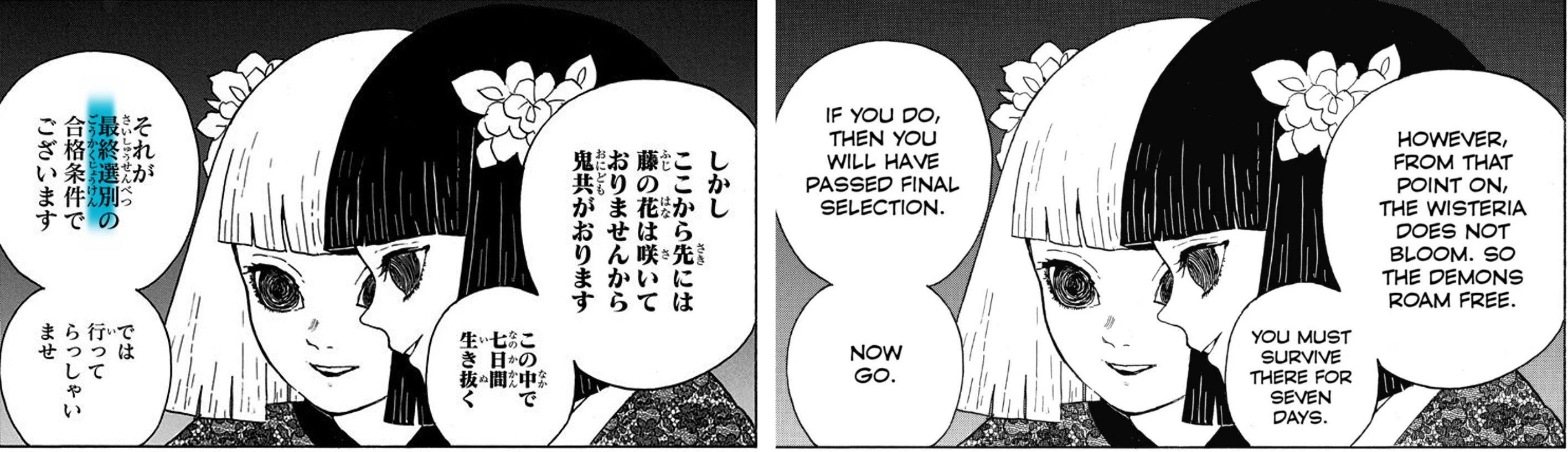
Scroll the image sideways to read the Japanese in full size.
Summary. The wisteria-flower attendant at Mount Fujikasane explains Final Selection to the assembled applicants: from this point forward the wisteria does not bloom, so the demons are loose, you have to survive seven days in there, and that is the passing condition. The register is institutional formal-polite (おります, ません, でございます, ませ). This is the panel that converts the volume from family drama to shōnen arc.
Textbox 1
JP: しかしここから先には藤の花は咲いておりませんから鬼共がおります
EN: However, from this point forward, the wisteria does not bloom. So the demons are loose.
Overview: Setting the rule by negation. The wisteria's absence is the threat condition.
Breakdown:
- しかし: however; conjunction (sentence-initial pivot)
- ここから先 (ここからさき): from this point forward; common compound phrase
- 藤 (ふじ): wisteria; N1 noun, central plot element (demons cannot pass under it)
- 花 (はな): flower; N5 noun
- 咲いておりません (さいておりません): does not bloom; humble-polite negative form of 咲く. The おる auxiliary signals the speaker is using formal-attendant register, not modern desu-masu.
- 鬼共 (おにども): the demons (plural, slightly derogatory); 共 is a humble pluraliser
- おります: there are (humble-polite form of いる); attendant-register
Textbox 2
JP: この中で七日間生き抜く
EN: You must survive there for seven days.
Overview: The trial parameters. Bare imperative-by-implication, no sentence-final verb.
Breakdown:
- この中 (このなか): in here; demonstrative + N5 noun
- 七日 (なのか): seven days; the standard counter reading for seven-day stretches
- 間 (かん): for the duration of; suffix attaching to time spans
- 生き抜く (いきぬく): to survive (lit. live-through); compound verb that carries connotation of grim endurance, not casual living
Textbox 3
JP: それが最終選別の合格条件でございます
EN: If you do, then you will have passed Final Selection.
Overview: Naming the institution. でございます is the maximum-formal copula.
Breakdown:
- それ: that; demonstrative pronoun referring back to surviving seven days
- 最終選別 (さいしゅうせんべつ): Final Selection; series-domain compound (最 + 終 + 選 + 別), every character joyo, the compound itself unlisted
- 合格条件 (ごうかくじょうけん): passing condition; standardised exam-vocabulary compound (合格 + 条件)
- でございます: is (humble-formal copula); the highest-register version of だ/です
Textbox 4
JP: では行ってらっしゃいませ
EN: Now go.
Overview: Send-off in attendant register. The phrase a Japanese parent says to a kid heading to school. Used here for applicants heading toward demons.
Breakdown:
- では: well then; sentence-initial transition
- 行ってらっしゃい (いってらっしゃい): go and come back (set phrase used to send someone off); from 行って (go) + いらっしゃい (honorific come)
- ませ: polite imperative ending; turns the set phrase into a formal request
Key points
- The register is institutional-attendant formal: おる-auxiliary verbs, でございます copula, ませ imperatives. This is the highest-formality register most modern readers ever encounter, and Demon Slayer uses it specifically when the Demon Slayer Corps machinery is speaking in its official voice.
- 最終選別 (さいしゅうせんべつ) and 合格条件 (ごうかくじょうけん) together signal the manga has moved into shōnen-exam-arc territory: the protagonist is now being graded by an institution. Both compounds use joyo characters and recur unchanged in later volumes. Pre-study them.
- The cultural joke and the cultural anchor are the same: 行ってらっしゃいませ is what you say to a kid going to school. Saying it to teenagers walking into a forest of demons is the manga's first signal that this institution does not flinch at the body count.
This is what you see in The Ashiba App for this panel. Pre-study, then read.
How to actually read volume 1
- Get a foundation. How much you need depends on how much discomfort you can sit with. Genki I and II is the polished path. At a minimum, lock in N5. Nothing else moves until kana and basic grammar are automatic.
- Start with chapter 1. Take your time. Not a week. Not a day. This is the first chapter of manga you have ever read in Japanese. Set a timer for 15 minutes. Early on, you crack one to three sentences in that window. Later, you crack a full chapter. Consistency compounds. Rack up the reps.
- When you get stuck, reference the translation. Looking things up is not failure. It is learning. The fastest way to get unstuck is to see the answer and understand why the sentence means what it means. Goal: parse the sentence. Match the English to the Japanese, identify the word or grammar that blocked you, and move on. You will hurdle (probably in chapters 1 and 2 when Giyū's clipped Hashira-rank declaratives land for the first time, in chapters 4 and 5 when Urokodaki's archaic sword-master register and training-arc vocabulary stack up, or in chapters 6 and 7 when Final Selection unleashes mountain-forest demon vocabulary on top of everything else). Those panels are dense. The answer is not to grind harder. The answer is what I wrote about in Why You Will Quit Learning Japanese: put the book down and come back tomorrow.
If you want the deeper version of this reading strategy, the fastest way to learn Japanese article has the volume-control framework in full.
The Takeaway
The main reason reading manga in Japanese is hard is the sheer amount of vocabulary you do not know.
Most readers never get past this. The pain is too great. The effort-to-reward ratio collapses, and the book gets shelved.
The easiest way out is to pre-study the words you do not know that will appear in the chapter you are about to read. The Ashiba App does this for every chapter of every series I cover. It surfaces the vocabulary, shows readings and POS, and includes grammar breakdowns so you see how each word is being used. Nothing is studied in isolation. Every flashcard carries its full panel context. You see the word in the sentence in the panel where it lives.
You can get started today.
Frequently asked questions
Should I watch the anime before reading Demon Slayer in Japanese?
Yes. The Demon Slayer anime first aired in 2019 and the early arc is famously close to the manga panel-for-panel. Watch episodes 1 through 5 before opening the manga. The anime gives you the visual register for the Taishō-era setting, the voice work for Tanjiro and Giyū, and the pacing of the demon encounters, so the manga reads with familiar pictures already loaded. Watch the same episodes again after you finish volume 1 and you will feel exactly how much more you picked up by reading.
Does Demon Slayer have furigana?
Yes. The Japanese print and digital editions print furigana on every kanji, every appearance. This is standard Shōnen Jump practice and Demon Slayer follows it without exception. Kanji you cannot read by sight is still readable on the page. The blocker is not kanji. The blocker is vocabulary count.
Do I need to know all the kanji before starting?
No. Furigana is provided everywhere, every kanji, every appearance. You need to know hiragana and katakana. That is the hard prerequisite. Kanji you pick up as you read. If you have not finished kana yet, start with how to learn hiragana and katakana.
How long does it take to read Demon Slayer volume 1 in Japanese?
A solid N3 reader, first pass, cracking every unknown word: 6 to 8 hours across the full volume. An N2 reader who has pre-studied the corps and Nichirin sword vocabulary: 3 to 5 hours. A native speaker: 35 to 45 minutes. You are not the native speaker. Respect the pace.
Do I need to read volume 1 first or can I start anywhere?
Follow the fun. If a different volume pulls you harder, start there. The reasons to pick volume 1 anyway: the corps vocabulary (鬼殺隊, 日輪刀, 最終選別, 鱗滝) and the Tanjiro-and-Nezuko premise are introduced here and assumed in every later arc. Skip volume 1 and you spend volume 2 looking up volume 1 words.
Where can I buy Demon Slayer volume 1 in Japanese?
Free English preview: read chapter 1 on VIZ Media's Shonen Jump. VIZ volume 1 product page: Demon Slayer volume 1 on VIZ. Buy the full Japanese volume on Amazon Japan or BookWalker (Kindle or paperback).