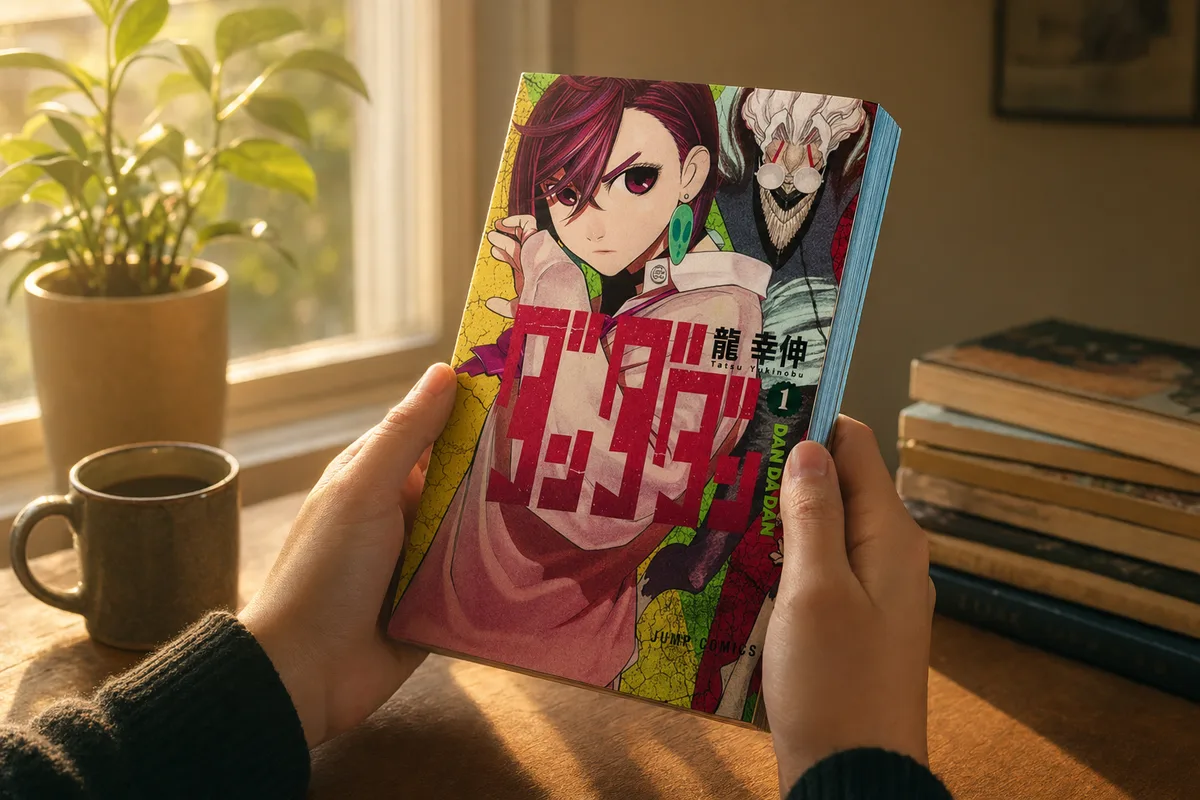
Volume 1 of Dandadan (ダンダダン) contains 1,137 unique vocabulary items across 5 chapters, 201 pages, 861 panels, and 4,950 textboxes. The script uses 641 unique kanji on the page, of which only 25 are non-joyo. The hardest single thing in this book is not the grammar and not the long tail. It is the register collision the manga lives in: occult-spirit terminology stacked on top of alien sci-fi terminology stacked on top of a slangy teenage girl protagonist arguing with a vulgar-elder ghost who has just possessed her crush. Ghosts on one page, UFOs on the next, and Tatsu Yukinobu prints furigana sparingly through all of it.
That is the whole problem with Dandadan volume 1 in one paragraph. Here is exactly what is in this book, and exactly what you need to read it.
Every number in this article comes from Ashiba's production corpus, measured against the official N5 to N1 JLPT vocabulary lists and the 2,136-character joyo kanji set. Last measured 2026-04-27.
Is Dandadan volume 1 hard to read in Japanese?
Advanced. Not because the grammar is difficult. Because Dandadan does not print furigana on most kanji. Where Jujutsu Kaisen and Blue Lock spoon-feed the reading on every kanji, Tatsu Yukinobu prints furigana only sparingly: on the occasional rare reading or stylized chant. Without furigana, kanji you cannot read becomes a wall, not a speed bump. If you do not already know how to read 呪い, 幽霊, 超能力, 心霊現象, and 地縛霊 on sight, you will spend the volume in a dictionary.
People mis-rate this book in both directions. Here is the actual shape.
What makes it easier than you think
The base register is unusually approachable. Dandadan is, before it is anything else, a modern teenage-romance manga about two high-schoolers arguing about the supernatural. Most of what is on the page is short conversational lines: contracted endings, sentence-final よ and ぞ and じゃん, and the rapid-fire banter you would hear in any Tokyo classroom. 48% of the running tokens are N5 or N4, and another 18% are N3. Add it up and roughly 66% of the words on the page are textbook vocabulary. The series leans heavily on N5 verbs (言う 44 times, 見る 28 times, 行く 21 times). The grammar is modern, the registers are recognisable, and the sentence rhythm is short.
The kanji set is also small for a series this dense with supernatural vocabulary. Volume 1 uses 641 unique kanji, and 616 of them (96.1%) are joyo. The 25 non-joyo characters are mostly old-character spellings of common slangy or colloquial words: 儂 for わし (the Turbo-Granny's self-reference, 26 times), 此奴 for こいつ, 嘘 for うそ, 喋る for しゃべる, 筈 for はず. If you can read joyo, you can read the kanji that carry the plot.
What makes it harder than it looks
Out of 1,137 unique vocabulary items, 652 (57.3%) appear exactly once. That long tail is the real difficulty: most words you look up will not appear again in the same volume. Lookups are not difficulty in disguise. They are volume of unknowns.
Vocabulary acquisition is iterative. A word does not stick the first time. Each word takes multiple painful encounters before recognition becomes automatic, and every encounter breaks the story flow. You stop, you look up, you re-read the sentence, you re-set the panel in your head, you keep going. The tipping point where the manga starts reading easily is further out than most learners expect, and Dandadan's tipping point gets pushed further by the register collision the series is built on. Three flavours stack on the same page: occult-spirit terminology (呪い, 幽霊, 心霊現象, 霊媒師, 地縛霊), alien sci-fi terminology (宇宙人, UFO, 超能力), and Momo's slangy teenage-girl voice crashing into the Turbo Granny's vulgar elder talk (小僧, ガキ, ワシ). At an N3 reader's pace, that is 8.3 lookups per page on first pass, and most of them are domain nouns you will not find in any general dictionary. The fix is to pre-study them. Same words, different context. The story stays intact.
You don't need permission. Just go for it.
The real question is not whether this book is at your level. The real question is whether the pain is tolerable for the reward. If you actually want this story, the level mismatch is just a tax on time, not a wall. You pay it in lookups and re-reads and slow chapters until the cost goes down. Always read above your level. Attack the stories that motivate you. Permission is something other people give themselves and then complain about. Just go for it.
What the data says about volume 1
Every number below was calculated from the approved vocabulary set for Dandadan volume 1 in Ashiba's production database. JLPT level was assigned by matching against the official N5 to N1 vocabulary lists. Words not on any list were classified by Gemini 3 Pro against context. 204 unique words remained outside the N5 to N1 framework and are marked "unlisted" (proper nouns, occult-spirit jargon, alien sci-fi compounds, slang, onomatopoeia).
A note on terminology. Running vocabulary means every word token as it occurs in the text, counting every repeat. If 言う appears 44 times, that is 44 running tokens from 1 unique word. Unique vocabulary means the distinct words themselves, counted once each.
Volume 1 at a glance
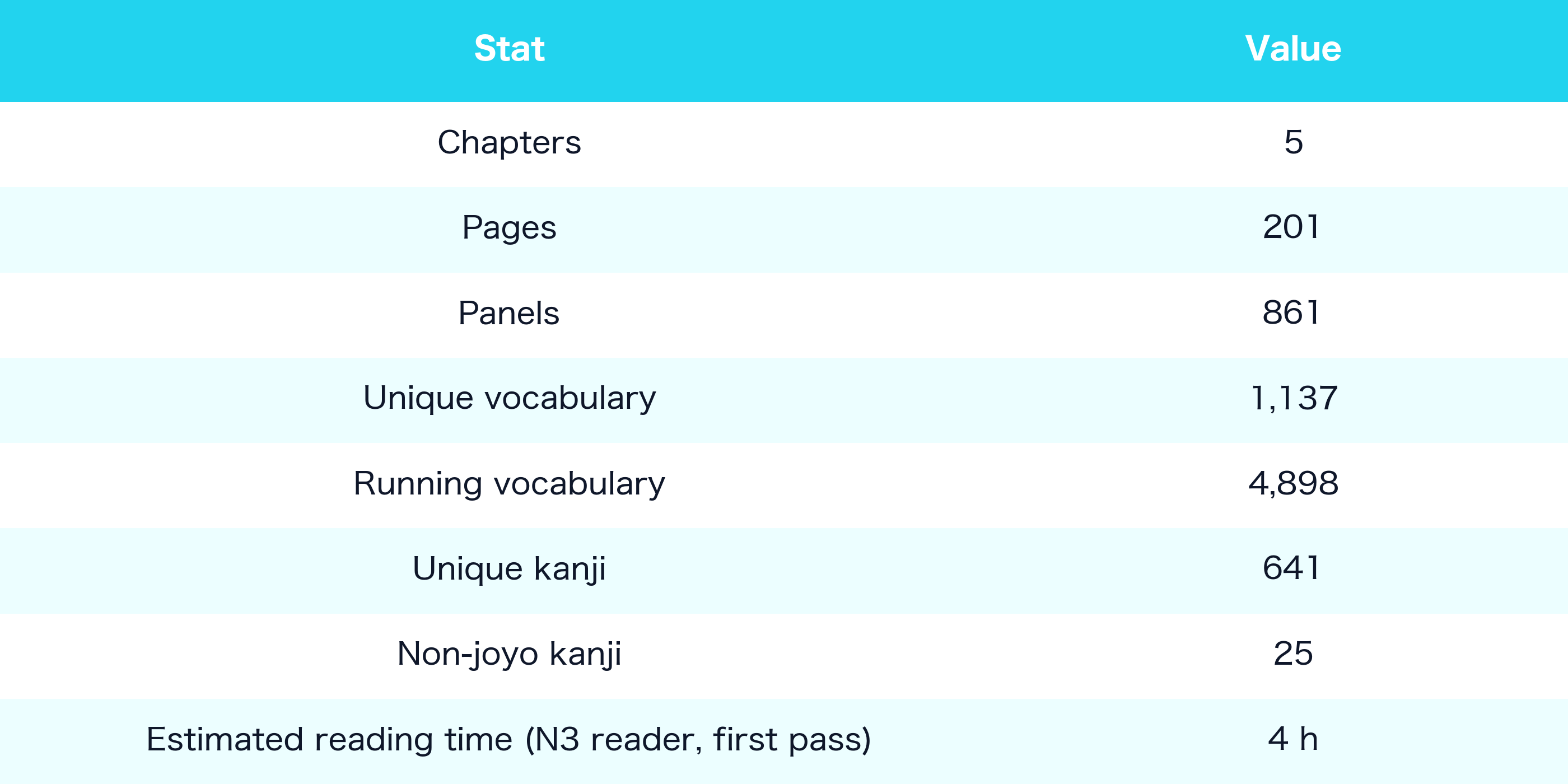
| Stat | Value |
|---|---|
| Chapters | 5 |
| Pages | 201 |
| Panels | 861 |
| Textboxes (speech, thought, narration) | 4,950 |
| Unique vocabulary | 1,137 |
| Running vocabulary | 4,898 |
| Unique kanji | 641 |
| Non-joyo kanji | 25 |
| Estimated reading time (N3 reader, first pass) | 5 to 7 hours |
JLPT coverage
The 1,137 unique vocabulary items in volume 1 break down like this:
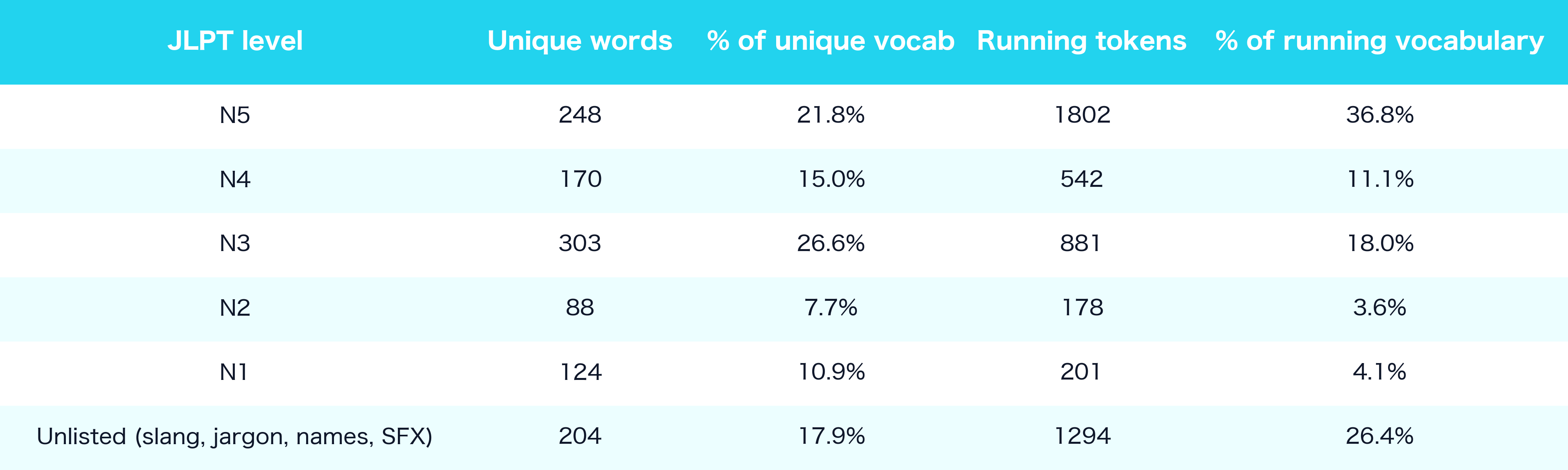
| JLPT level | Unique words | % of unique vocab | Running tokens | % of running vocabulary |
|---|---|---|---|---|
| N5 | 248 | 21.8% | 1,802 | 36.8% |
| N4 | 170 | 15.0% | 542 | 11.1% |
| N3 | 303 | 26.7% | 881 | 18.0% |
| N2 | 88 | 7.7% | 178 | 3.6% |
| N1 | 124 | 10.9% | 201 | 4.1% |
| Unlisted (slang, jargon, names, SFX) | 204 | 17.9% | 1,294 | 26.4% |
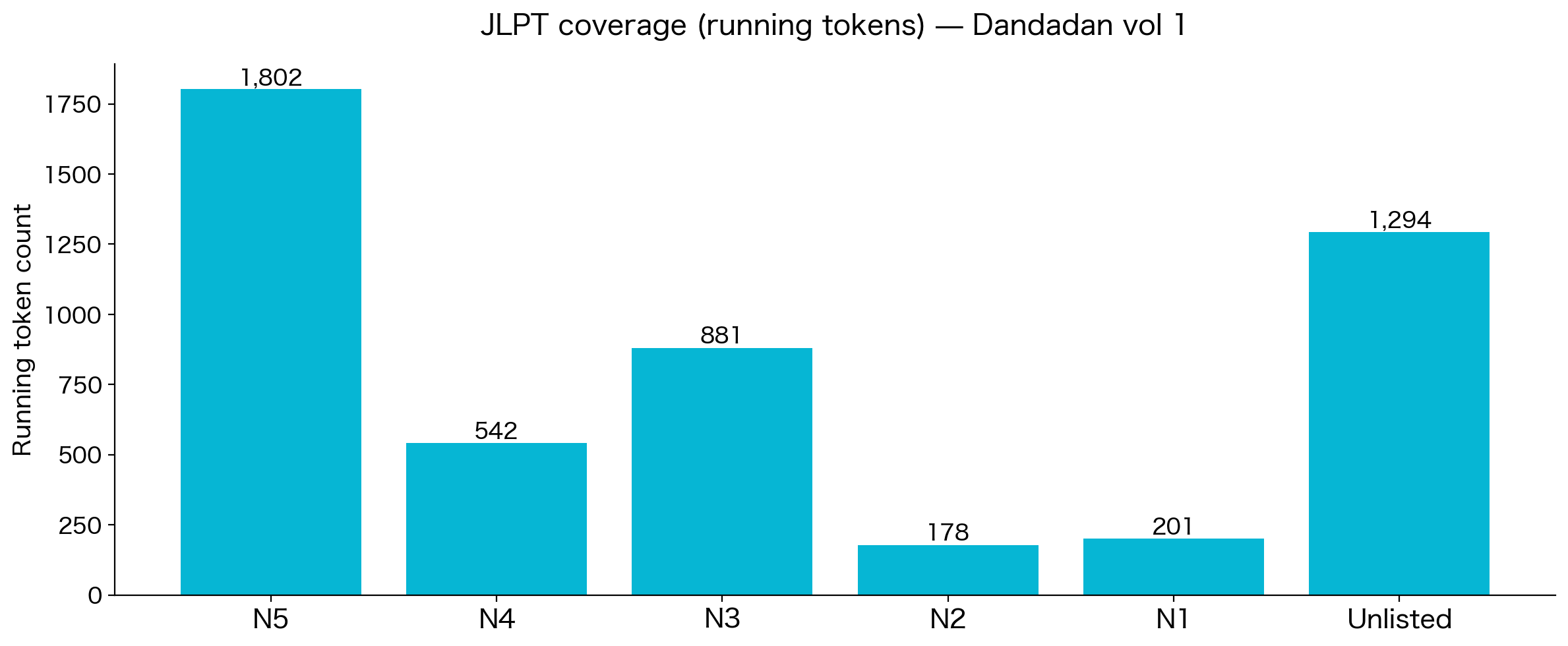
Read the last column. 47.9% of the running vocabulary is N5 or N4. Add N3 and you are at 65.9% of running vocabulary. The hard stuff (N2 and N1 combined) is just 7.7% of what you actually read, because the hardest words appear rarely. The unlisted bucket sits at 26.4% of running tokens. Dandadan's vocabulary weight lives in two places at once: a heavy N5 core (the chatty teenage banter) and a heavy unlisted tail (the supernatural-sci-fi domain words). The middle is thin.
Reader guidance by level
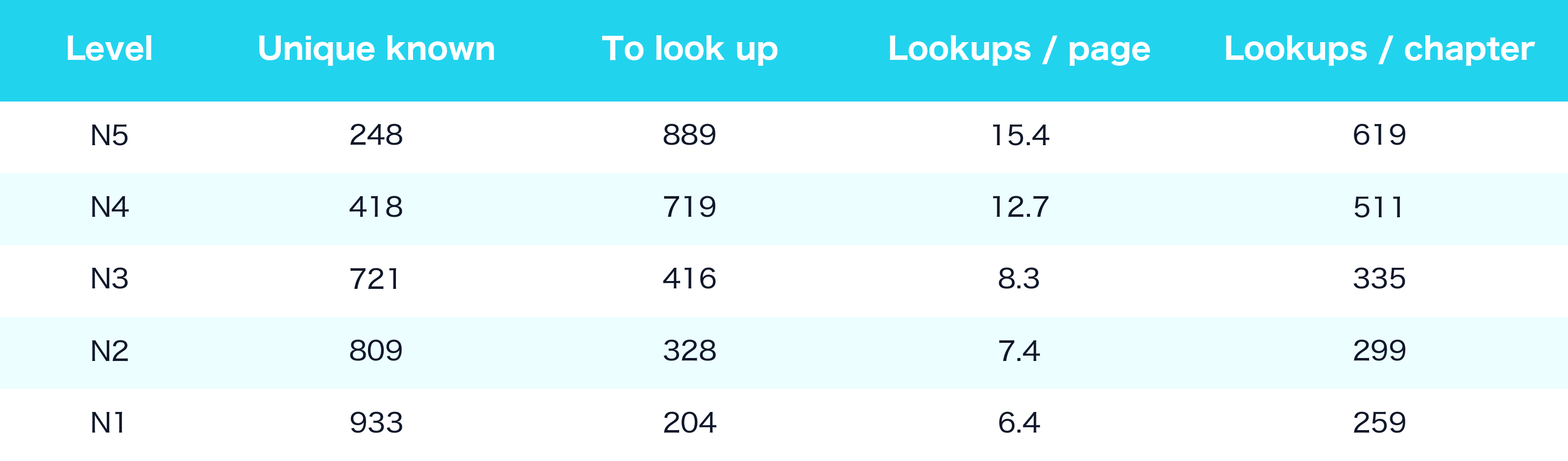
| Level | Unique words known | Unique words to look up | Lookups per page (first pass) | Lookups per chapter (first pass) |
|---|---|---|---|---|
| N5 | 248 | 889 | 15.4 | 619 |
| N4 | 418 | 719 | 12.7 | 511 |
| N3 | 721 | 416 | 8.3 | 335 |
| N2 | 809 | 328 | 7.4 | 299 |
| N1 | 933 | 204 | 6.4 | 259 |
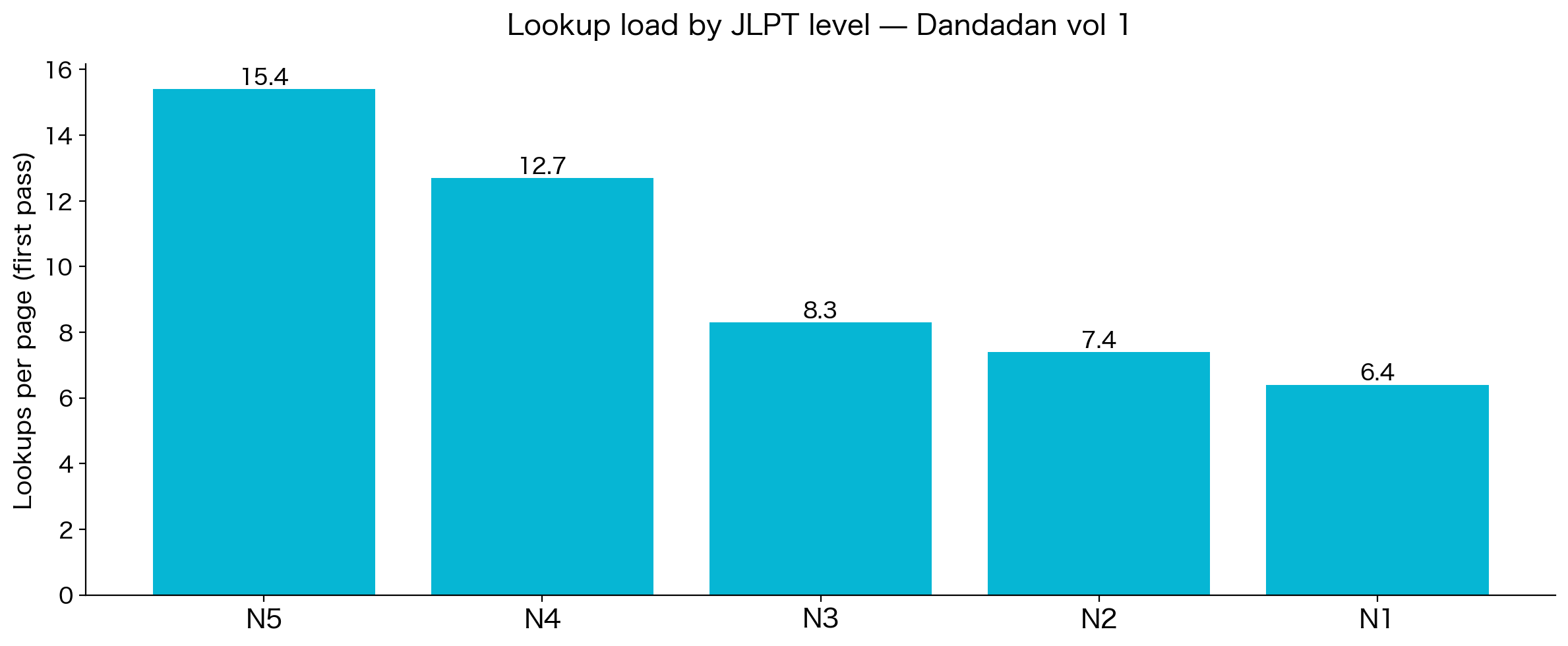
Lookups are unavoidable and painful, but you can lower the pain by completing the grammar foundation guide first. If you do not have kana yet, start there. That is table stakes.
N1 ≠ mastery
N1 means you passed a test. Real Japanese is not the test. Even N1 readers reading Dandadan for the first time will look things up. An N1 reader still has 204 unique unlisted words in this volume alone, plus first-encounter recognition on vocabulary they know from study but have never seen embedded in occult-medium shoptalk or Turbo-Granny insults. Even at N1, expect 6.4 lookups per page on first pass. The best way to learn real Japanese is to read real Japanese. Then you can pass any test.
Kanji
Dandadan volume 1 has 641 unique kanji on the page (counted from the actual surface forms, not lemma headwords; words written in pure hiragana do not count). 616 are joyo. 25 are non-joyo. That non-joyo count is comparable to Blue Lock (26) and higher than KN8 (18), but lower than JJK (41) or Apothecary (51). What is unusual is the composition of the non-joyo set: the top entry is 儂 (わし), the Turbo Granny's self-reference, and it appears 26 times in volume 1 alone. That single kanji accounts for more than half the non-joyo running tokens.
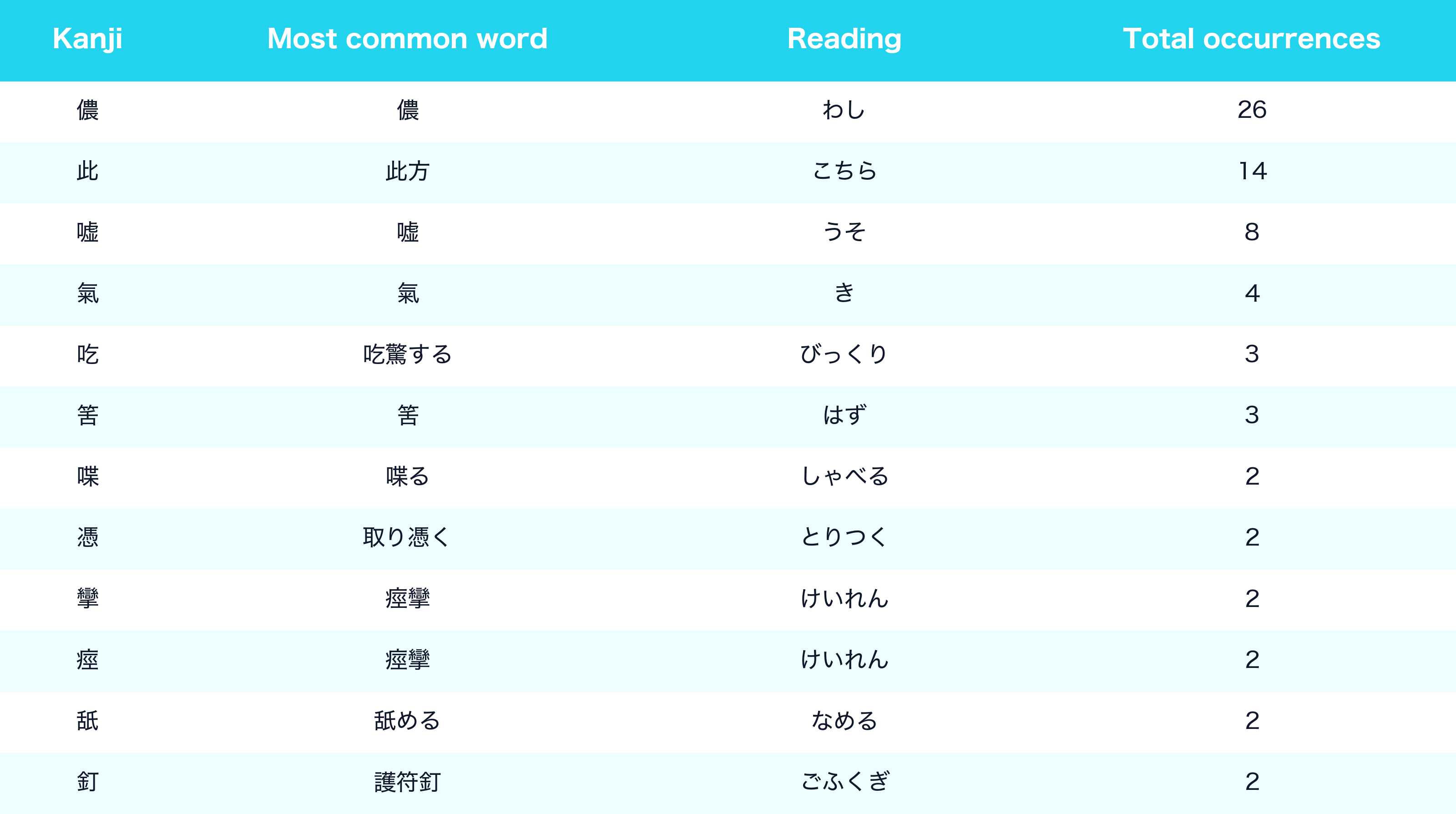
| Kanji | Most common word | Reading | Total occurrences |
|---|---|---|---|
| 儂 | 儂 | わし | 26 |
| 此 | 此方 / 此奴 | こちら / こいつ | 14 |
| 嘘 | 嘘 | うそ | 8 |
| 氣 | 氣 | き | 4 |
| 吃 | 吃驚する | びっくり | 3 |
| 筈 | 筈 | はず | 3 |
| 喋 | 喋る | しゃべる | 2 |
| 憑 | 取り憑く | とりつく | 2 |
| 痙 | 痙攣 | けいれん | 2 |
| 攣 | 痙攣 | けいれん | 2 |
| 舐 | 舐める | なめる | 2 |
| 釘 | 釘 / 護符釘 | くぎ / ごふくぎ | 2 |
Most of the non-joyo set is what you would expect from any modern shonen with strong regional and colloquial flavour: archaic-style spellings of common slang words. 儂 (わし) is the standout, almost exclusively the Turbo-Granny's self-reference. 此奴 (こいつ), 嘘 (うそ), 喋る (しゃべる), and 筈 (はず) round out the everyday-slang block. Then the supernatural set creeps in: 取り憑く (とりつく, to possess), 痙攣 (けいれん, convulsion), 護符釘 (ごふくぎ, talisman nail). None of these are series-specific. They are the everyday register of an occult-comedy manga that lets its characters write the way they speak. Where Dandadan's kanji weight actually lives is in joyo characters combining into supernatural-and-sci-fi compounds. 呪い (のろい, curse) is built from 呪 alone. Joyo. 幽霊 (ゆうれい, ghost) is 幽 + 霊. Both joyo. 超能力 (ちょうのうりょく, psychic powers) is 超 + 能 + 力. All joyo. 心霊現象 (しんれいげんしょう, psychic phenomenon), 宇宙人 (うちゅうじん, alien), 地縛霊 (じばくれい, bound spirit). All joyo characters, every one. The bottleneck is the word, not the kanji. Stop worrying about the character list. Start worrying about the compounds.
Frequency
Vocabulary appears in a long-tail distribution. 652 of 1,137 unique words (57.3%) appear exactly once; only 20 words appear 26 times or more. The small head of the curve is where the leverage lives.
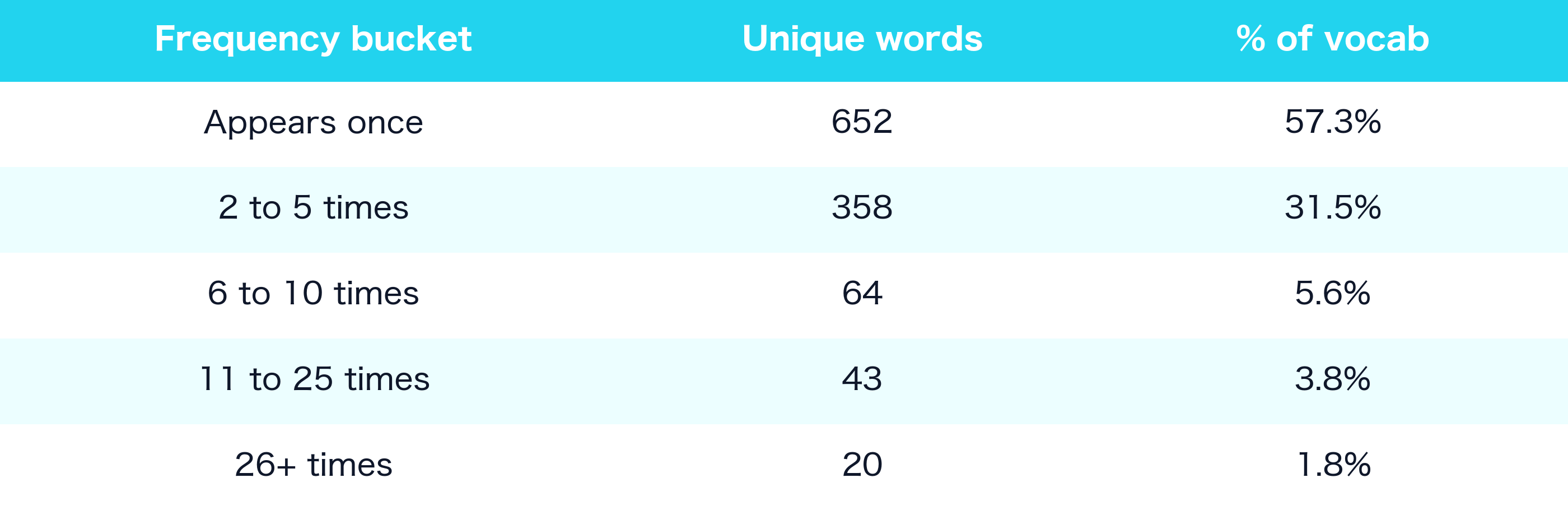
| Frequency bucket | Unique words | % of vocab |
|---|---|---|
| Appears once | 652 | 57.3% |
| 2 to 5 times | 358 | 31.5% |
| 6 to 10 times | 64 | 5.6% |
| 11 to 25 times | 43 | 3.8% |
| 26+ times | 20 | 1.8% |
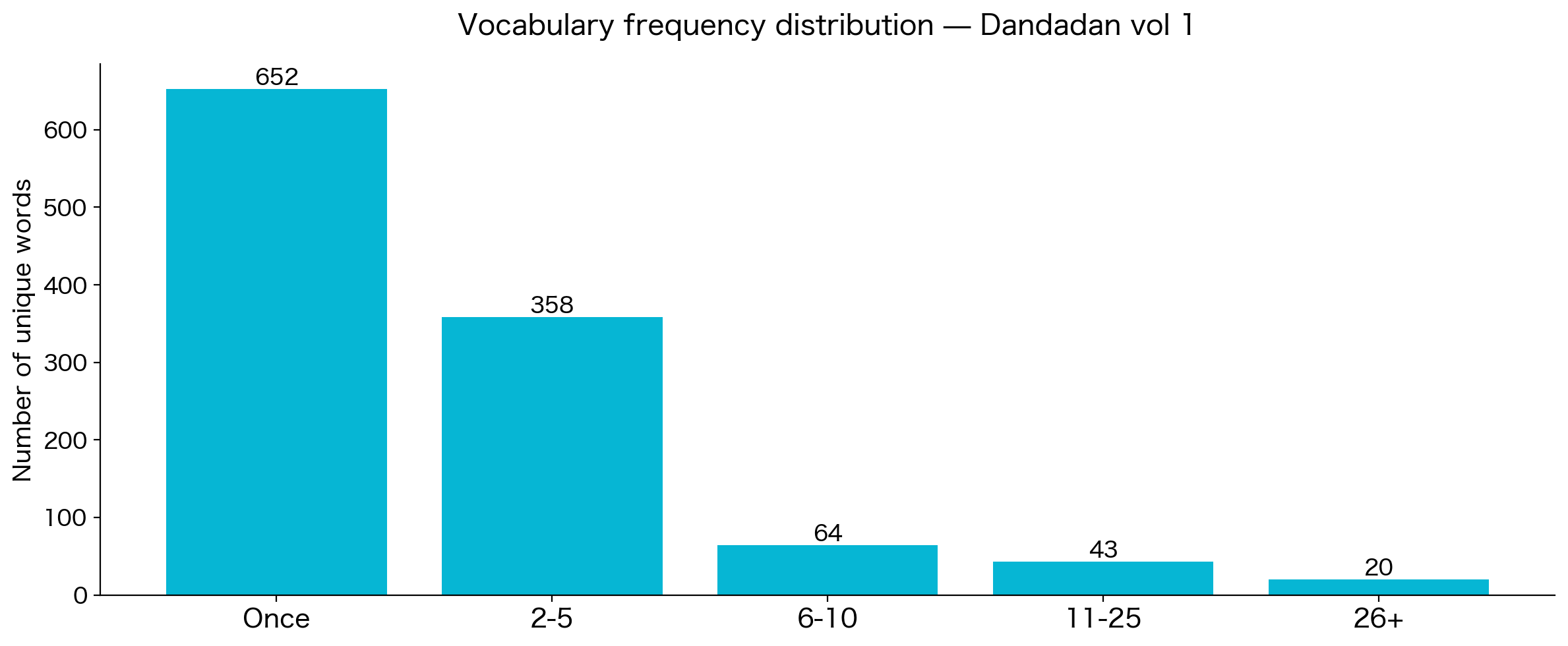
Do not read "appears once" as "not worth learning." These words recur across the series. Later volumes pick them up and use them again. The 127 words that appear six times or more are the real spine of volume 1 specifically.
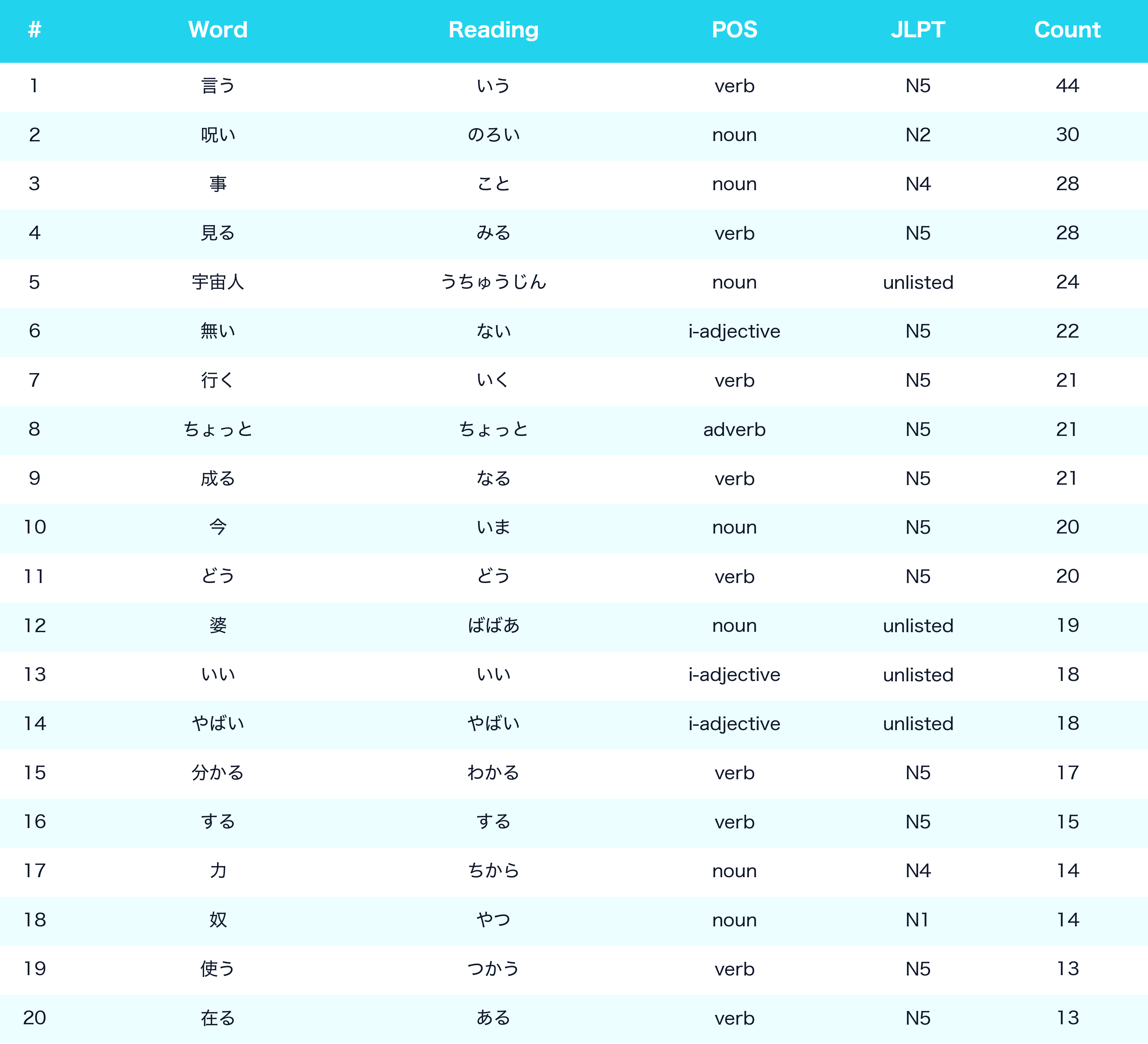
The 20 most frequent content words
Pre-study these 20 and you have learned the most common content words on almost every page. By the time you finish volume 1, all 20 are locked into your memory just from how often they appear.
Particles, auxiliary verbs, pronouns, conjunctions, proper nouns, and adnominals are excluded so the list surfaces meaningful content words.
| # | Word | Reading | POS | JLPT | Count |
|---|---|---|---|---|---|
| 1 | 言う | いう | verb | N5 | 44 |
| 2 | 呪い | のろい | noun | N2 | 30 |
| 3 | 事 | こと | noun | N4 | 28 |
| 4 | 見る | みる | verb | N5 | 28 |
| 5 | 宇宙人 | うちゅうじん | noun | unlisted | 24 |
| 6 | 無い | ない | i-adjective | N5 | 22 |
| 7 | 行く | いく | verb | N5 | 21 |
| 8 | ちょっと | ちょっと | adverb | N5 | 21 |
| 9 | 成る | なる | verb | N5 | 21 |
| 10 | 今 | いま | noun | N5 | 20 |
| 11 | どう | どう | adverb | N5 | 20 |
| 12 | 婆 | ばばあ | noun | unlisted | 19 |
| 13 | いい | いい | i-adjective | unlisted | 18 |
| 14 | やばい | やばい | i-adjective | unlisted | 18 |
| 15 | 分かる | わかる | verb | N5 | 17 |
| 16 | する | する | verb | N5 | 15 |
| 17 | 力 | ちから | noun | N4 | 14 |
| 18 | 奴 | やつ | noun | N1 | 14 |
| 19 | 使う | つかう | verb | N5 | 13 |
| 20 | 在る | ある | verb | N5 | 13 |
Two of these are worth calling out. 呪い (のろい, curse) is the central state-mechanic the entire volume turns on, and it appears 30 times in volume 1. Okarun is cursed in chapter 2, the curse drives the rest of the volume, and Momo's grandmother spends most of chapter 4 trying to unwind it. If you only learn one word before opening this manga, learn this one. It will carry you through every page.
宇宙人 (うちゅうじん, alien) is the genre frame the series argues with itself about. Momo believes in ghosts, Okarun believes in aliens, and the entire premise of the manga is the two of them discovering they are both right. The word appears 24 times in volume 1 and carries the cultural weight of forty years of Showa-era UFO-boom anxiety. Pre-study this one and the genre register stops being a wall.
How each main character speaks
綾瀬 桃 (Ayase Momo)
High-school protagonist, female, the half of the duo who believes in ghosts and refuses to believe in aliens. Momo uses ウチ for "I," a Kansai-flavoured colloquial that signals she is brash, casual, and not from the polite-textbook world. Her speech is fast, slangy, and full of teenage-girl markers: っしょ (instead of でしょ), さー (filler), じゃ ね (sentence-final), マジ (seriously), やばい (whoa, no way). She drops particles constantly. Her register is the easiest grammar in the volume to parse and the hardest tone to render in English. The translation will read flat. The Japanese will read like every teenager you have ever met.
高倉 健 (Takakura Ken / "Okarun")
Male protagonist, occult enthusiast, the foil to Momo's aggressive energy. Okarun is polite to a fault, uses じぶん (literally "oneself") for self-reference instead of a normal pronoun, and defaults to です/ます-form even with classmates. The contrast with Momo is the recurring joke. After he is cursed in chapter 2, he flips registers entirely: the Turbo Granny's vulgar elder voice takes over inside his body, and the page register collapses from textbook politeness to old-lady street insults in the span of a panel. That register-collapse is intentional, and it is the funniest thing in the volume if you can read both registers.
ターボババア (Turbo Granny)
The antagonist who possesses Okarun's body in chapter 2 and proceeds to narrate from inside it for most of the rest of the volume. Crude elder-female voice. Uses 儂 (わし) for self-reference, calls Okarun 小僧 (こぞう) and ガキ for "kid," threatens everyone, and runs an entire register of explicit-and-vulgar humour Tatsu Yukinobu deliberately stacks against the cute teenage-romance register the rest of the manga operates in. She is the hardest character to read in volume 1, not because her grammar is complex but because the vocabulary set is colloquial-elder Japanese that does not appear on any JLPT list and rarely in any modern manga.
綾瀬 星子 (Ayase Seiko, Momo's grandma)
Momo's grandmother, also called 婆ちゃん (ばあちゃん). A real medium (霊媒師) who runs a spirit-cleansing practice out of her home. Her register mixes affectionate-grandma casual (calling Momo by name, soft sentence-final endings) with professional-medium confidence (she snaps into formal religious chant the moment a spirit shows up). She is the volume's emotional anchor and its expository voice for everything supernatural. When she explains how the curse works, she is the panel doing the worldbuilding. Pre-study the spirit-vocabulary block and her chapters parse at twice the speed.
Expressions with depth
These are volume 1 expressions where the dictionary entry will mislead you. Surface meaning is one thing. What the phrase actually does in a panel is another.
呪い (のろい, curse)
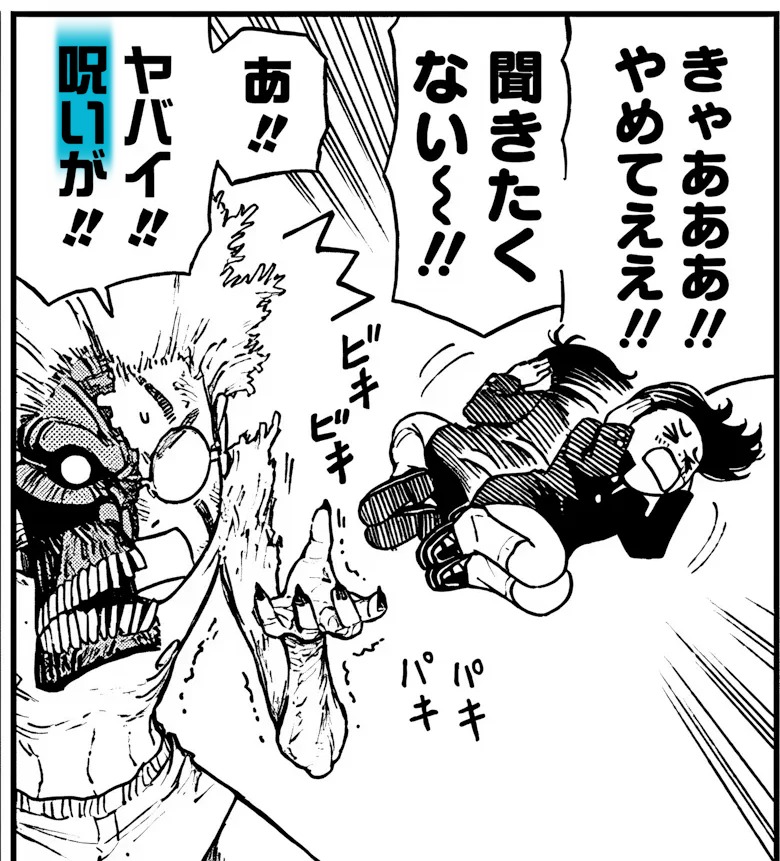
Dictionary: "curse" or "hex." The texture: 呪い in Dandadan is not the flowery folkloric curse of older fantasy manga. It is a state-mechanic, the supernatural equivalent of a status condition. When the chapter-2 panel screams ヤバイ!!呪いが!! ("crap, the curse...!!"), the word is doing diagnostic work, not metaphorical work. Okarun is currently afflicted by 呪い the way a video-game character is currently afflicted by poison, and the rest of the volume is the unwinding of that state. Translate it as "curse" in the abstract and you lose the specificity. Read it as "he is currently in a cursed state and the plot is now the cure" and the panel snaps into focus.
宇宙人 (うちゅうじん, alien)
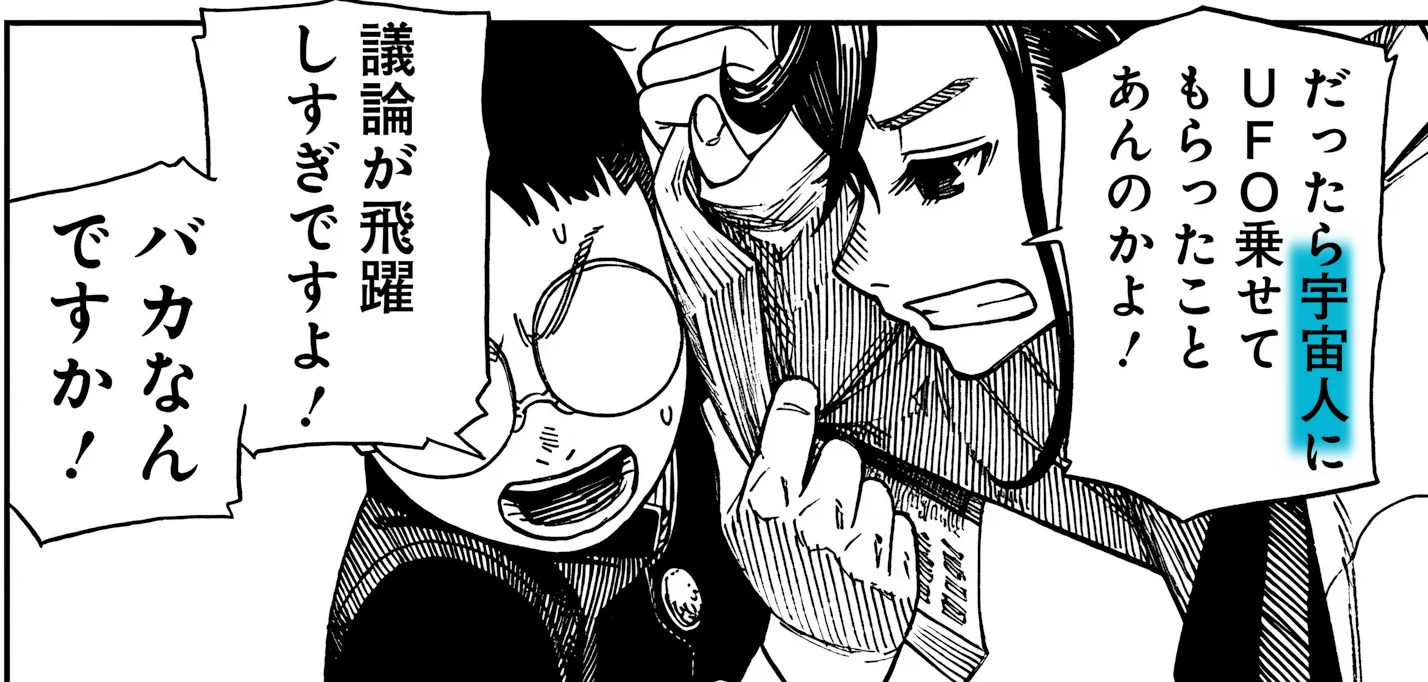
Dictionary: "alien" or "extraterrestrial." The texture: 宇宙人 in Japanese carries the entire Showa-era UFO-boom register, the Kasahara-Kazuo magazine articles of the 1970s, the Yujiro Ishihara TV specials, the "実は宇宙人は実在する" layer of pop-occulture that anchored a generation of Japanese kids. When Momo hits Okarun with だったら宇宙人にUFO乗せてもらったことあんのかよ!("then have you ever ridden in a UFO with an alien!"), the line lands as schoolyard mockery, but the cultural slot the word fills is decades older than either of them. The whole genre-thesis of Dandadan rests on the reader feeling that 宇宙人 and 幽霊 (ghost) are competing siblings, not foreign concepts. Translate it as "alien" and the seriousness leaks out.
超能力 (ちょうのうりょく, psychic powers)
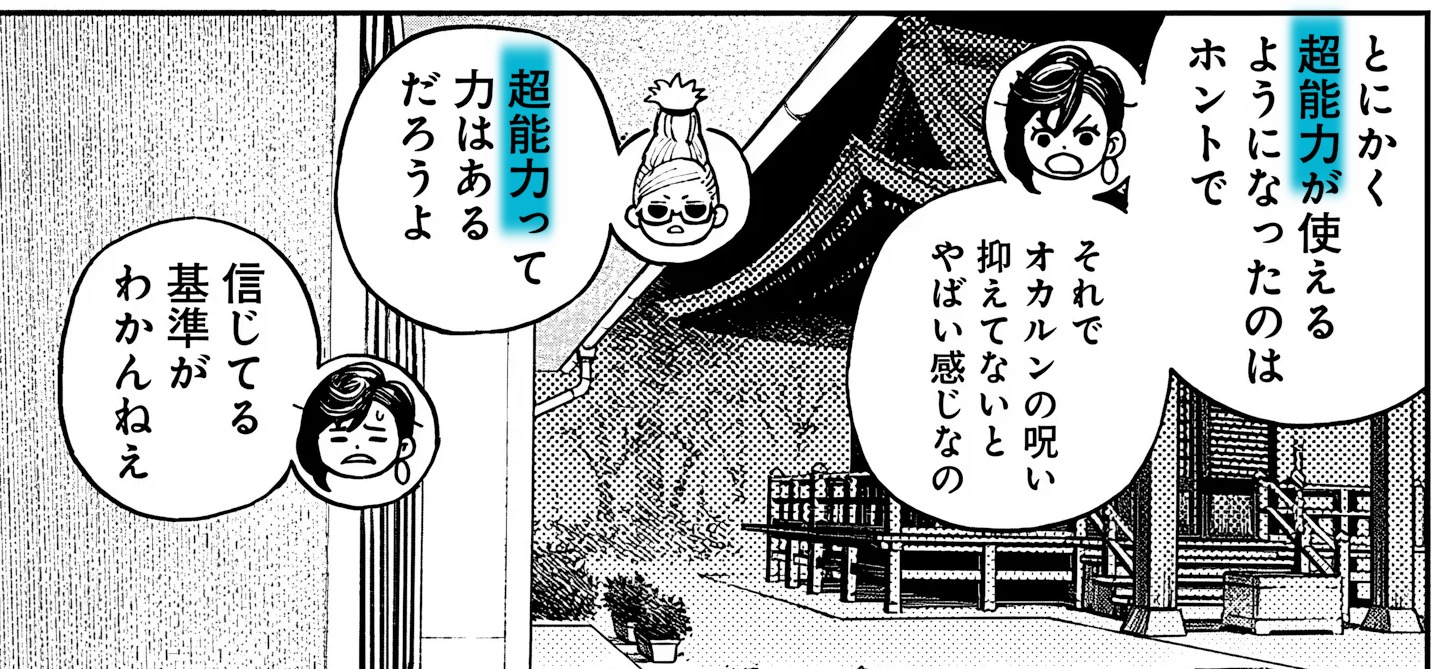
Dictionary: "supernatural ability" or "psychic powers." The texture: 超能力 carries the cultural weight of the 1970s-80s spoon-bending Uri Geller boom that Japanese television absorbed and ran with for two decades. When Momo says とにかく超能力が 使えるようになったのはホントで... ("anyway, the fact that I can now use psychic powers is real..."), the word is doing throwback work, not novel work. She is reaching for the genre vocabulary every Japanese reader has loaded since childhood. The kanji are heavy (超 + 能 + 力, all joyo, all third-grade or earlier), but Tatsu Yukinobu prints no furigana and assumes you have seen the word a hundred times on TV before this page. Read it with that history attached, not as a coined fantasy term.
幽霊 (ゆうれい, ghost)
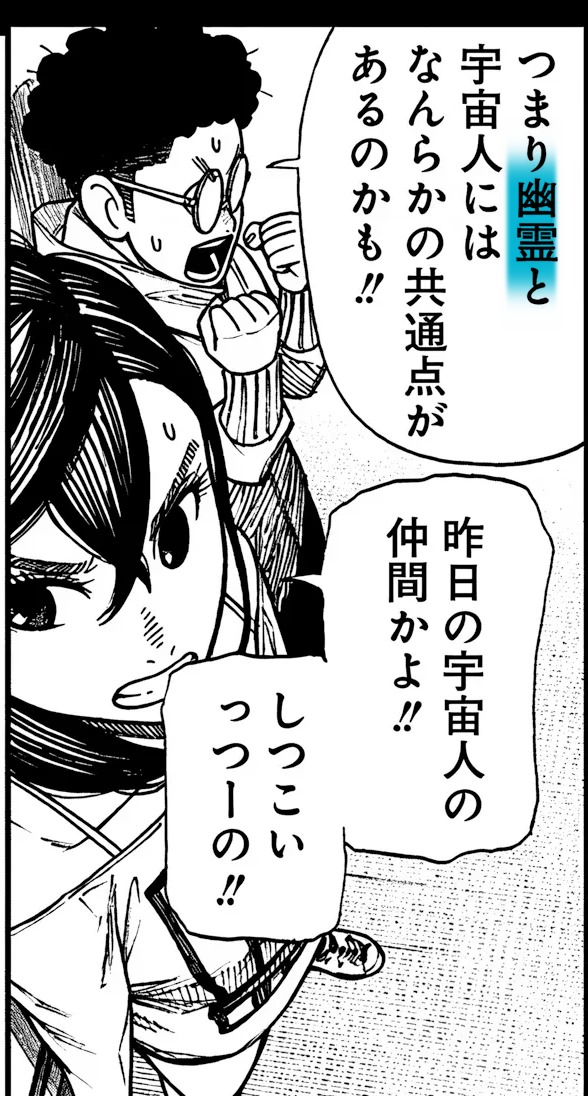
Dictionary: "ghost." The texture: 幽霊 in Japanese is not the bedsheet-and-chains Western ghost. It is a specific folklore category with cultural baggage going back to Edo-period kabuki: the spirit of someone who died with unfinished business, often a woman, often vengeful. When Okarun delivers the line つまり幽霊と宇宙人にはなんらかの共通点があ るのかも!!("in other words, ghosts and aliens might share some common feature!"), the word he uses for ghost is loaded with that folklore weight, and the entire thesis of the manga (ghosts and aliens are the same phenomenon viewed from different angles) gets its rhetorical lift from the seriousness of 幽霊. Translate it flat as "ghost" and the cultural register dissolves.
婆 (ばばあ, old woman / "granny")
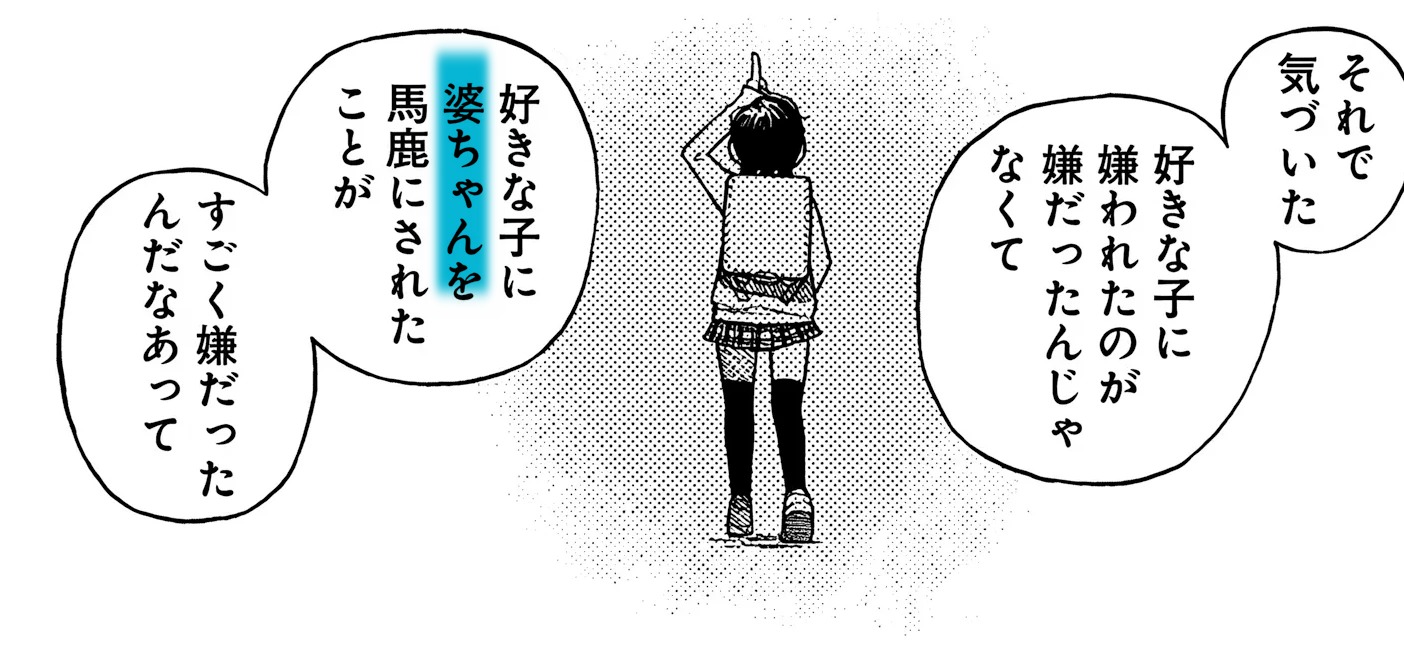
Dictionary: "old woman." The texture: this is the colloquial-vulgar register of the standard 老婆, and Dandadan uses it in two registers at once. As 婆ちゃん (ばあちゃん) with the diminutive suffix attached, it is affectionate Japanese for "grandma," the word Momo uses for Seiko in tender moments. As bare 婆 or ババア, it is an insult, the word the Turbo Granny throws at herself and others, the word that signals vulgar elder register the moment it appears. Same kanji, two opposite social charges. Reading the panel correctly means catching which register is on. The dictionary will give you one or the other. The manga uses both in the same chapter and expects you to feel the difference.
Pop culture and context in volume 1
心霊現象 and the Japanese occult-horror tradition. Dandadan opens with a chapter-1 dispute over whether ghosts or aliens are real, and the vocabulary it reaches for (心霊, 霊媒師, 地縛霊, 呪い, 取り憑く) is drawn straight from the postwar Japanese occult-horror lineage that runs through 怪談 cinema (1960s), the J-horror boom of Ringu and Ju-on (late 1990s), and the late-night ghost-story TV programmes that were a fixture of Showa-era summer broadcasts. When Tatsu Yukinobu uses 心霊現象 (psychic phenomenon), the word is doing throwback work to that whole tradition. The reader is supposed to feel the cultural slot the word fills, not just the dictionary gloss.
UFOブーム and the Showa-era alien moral panic. Okarun's entire worldview is built on the 1970s-80s Japanese UFO boom: the magazine articles, the late- night TV specials about Mu and Atlantis, the alien-sighting reports that filled tabloid pages for two decades. Volume 1 hits UFO and 宇宙人 in the kind of running argument that would have happened verbatim on a Japanese variety show in 1985. The joke is generational: Okarun is a teenager carrying the credulity of his grandfather's generation, and Momo's mockery is the post-2000 reader catching up with the gag.
霊媒師 (medium) as a Japanese folk profession. Momo's grandmother Seiko runs a working medium practice out of her home, and the manga treats this as a normal small-business career. That is not invented worldbuilding. Real Japanese mediums (霊媒師, 占い師, 拝み屋) are a recognised folk-profession category, often advertised on local television, often visited at New Year's for spiritual cleansing. When Seiko snaps into chant-form to perform a 除霊 (exorcism), she is doing the recognisable professional thing a Japanese reader has seen actual mediums do on actual TV.
ターボババア as an actual urban legend. The Turbo Granny is not a Tatsu Yukinobu invention. She is a real Japanese 都市伝説 (urban legend) that surfaced in the early 1990s: an elderly female ghost who runs along expressways at over 100 km/h, chasing cars and dragging passengers out of windows. The legend was popular enough to spawn published collections and TV reenactments. Dandadan's decision to make her a first-volume antagonist signals the manga's commitment to using actual Japanese folklore rather than coining new monsters.
高倉健 as Momo's celebrity crush. The protagonist Okarun's real name is 高倉 健 (Takakura Ken), and the joke is that this is the name of one of the most famous Japanese actors of the twentieth century: Ken Takakura, the stoic-cool action star of yakuza films and rugged-leading-man roles from the 1960s through the 2010s. Momo, a modern teenager, has a celebrity crush on the original Takakura Ken, and discovering her nerdy classmate shares the name is the volume's opening character beat. The comic-cultural joke is a teen girl idolising an 80-year-old movie star, and the joke doesn't land if the reader misses the reference.
Inside the app: one panel, fully broken down
Reading manga in Japanese is, at the bottom of it, a vocabulary-acquisition problem. Let me get you one panel: chapter 2, page 24, Okarun's exposition panel where he proposes the central thesis of the volume (that ghosts and aliens are the same phenomenon viewed from different angles). All the context around it is broken down here the same way The Ashiba App provides it, so you finish this section actually understanding the rhetoric that defines volume 1, not just having seen it.
Chapter 2, page 24: the ghost-and-alien thesis

Scroll the image sideways to read the Japanese in full size.
Summary. Okarun is mid-exposition. The doorbell that just rang in the previous panel was, he claims, a trap meant for a ghost, and the alien outside reacted to it. He cites a statistic: people who frequently encounter ghostly phenomena also frequently see UFOs. This is the panel that establishes the ghosts-and-aliens-are-one thesis the entire series is built on.
Textbox 1
JP: じゃああの呼び鈴は!?
EN: Then what about that doorbell?!
Overview: Short, casual, sentence-final は dropping the verb. Reads as panicked teenage demand.
Textbox 2
JP: 霊の仕掛けに宇宙人が反応したってこと!?
EN: You mean the alien reacted to the ghost's trap?!
Overview: The connection statement. ってこと is colloquial "you mean," and the sentence is doing the rhetorical work of binding 霊 (spirit) and 宇宙人 (alien) into a single causal chain.
Textbox 3
JP: 心霊現象をよく見る人はUFOもよく見るという調査結果が出ています!!
EN: Statistics show people who frequently see ghostly phenomena also often see UFOs!!
Overview: Polite ですます-form, a clinical statement of survey results. Okarun's register snaps from teenage panic to research-paper formality in one panel. That switch is the joke and the thesis at the same time.
Breakdown:
- 呼び鈴 (よびりん): doorbell; everyday noun
- 霊 (れい): spirit, ghost; N1 noun
- 仕掛け (しかけ): trap, mechanism, device; N2 noun
- 宇宙人 (うちゅうじん): alien, extraterrestrial; unlisted noun, 24 occurrences in volume 1
- 反応 (はんのう): reaction, response; N1 noun
- 心霊 (しんれい): psychic, spiritual; N1 noun, the highlighted word
- 現象 (げんしょう): phenomenon; N1 noun
- よく: often, frequently; N5 adverb
- 見る (みる): to see; N5 verb, 28 occurrences in volume 1
- 人 (ひと): person; N5 noun
- UFO (ユーフォー): UFO; loanword, full-width letters per Japanese typesetting convention
- 調査 (ちょうさ): investigation, survey; N3 noun
- 結果 (けっか): result; N3 noun
- 出る (でる): to come out, to emerge; N5 verb
Key points
- The register oscillates inside the same panel. Textboxes 1 and 2 are casual, colloquial, particle-dropping teenage panic. Textbox 3 is polite ですます-form research register. Okarun's register switch is the running joke that defines his character, and the panel is doing it in three textboxes.
- 心霊現象 is a 4-kanji compound where every character is joyo and Tatsu Yukinobu prints no furigana. If you cannot read 心霊現象 (しんれいげんしょう) on sight, the panel stops working. Pre-study this compound and the rest of the volume's spiritual-vocabulary block decompresses by half.
- The full-width UFO is the Japanese typographical convention for Western letter loanwords inside vertical text. It is read ユーフォー out loud, and the loanword is unlisted on every JLPT level. The word is so culturally Japanese-coded by 1970s-80s UFO boom magazines that the typography itself signals genre register.
How to actually read volume 1
- Get a foundation. How much you need depends on how much discomfort you can sit with. Genki I and II is the polished path. At a minimum, lock in N5. Nothing else moves until kana and basic grammar are automatic.
- Start with chapter 1. Take your time. Not a week. Not a day. This is the first chapter of manga you have ever read in Japanese. Set a timer for 15 minutes. Early on, you crack one to three sentences in that window. Later, you crack a full chapter. Consistency compounds. Rack up the reps.
- When you get stuck, reference the translation. Looking things up is not failure. It is learning. The fastest way to get unstuck is to see the answer and understand why the sentence means what it means. Goal: parse the sentence. Match the English to the Japanese, identify the word or grammar that blocked you, and move on. You will hurdle (probably in chapter 1 when the kanji-heavy supernatural exposition first lands, in chapter 2 when the alien-ghost thesis panel stacks 心霊現象 and 宇宙人 on the same page, or in chapter 4 when the Turbo Granny's vulgar elder register takes over most of the dialogue). Those panels are dense. The answer is not to grind harder. The answer is what I wrote about in Why You Will Quit Learning Japanese: put the book down and come back tomorrow.
If you want the deeper version of this reading strategy, the fastest way to learn Japanese article has the volume-control framework in full.
The Takeaway
The main reason reading manga in Japanese is hard is the sheer amount of vocabulary you do not know.
Most readers never get past this. The pain is too great. The effort-to-reward ratio collapses, and the book gets shelved.
The easiest way out is to pre-study the words you do not know that will appear in the chapter you are about to read. The Ashiba App does this for every chapter of every series I cover. It surfaces the vocabulary, shows readings and POS, and includes grammar breakdowns so you see how each word is being used. Nothing is studied in isolation. Every flashcard carries its full panel context. You see the word in the sentence in the panel where it lives.
You can get started today.
Frequently asked questions
Should I watch the anime before reading Dandadan in Japanese?
Yes. The Dandadan anime aired in 2024 (season 1) and 2025 (season 2), and the early episodes track volume 1 closely. Watch episodes 1 through 3 before you open the manga. The anime gives you the visual context for the curse, the Turbo Granny, and Momo's Kansai-flavoured speech rhythm, so the manga reads with familiar pictures already loaded. Watch the same episodes again after you finish volume 1 and you will feel exactly how much more you picked up by reading.
Does Dandadan have furigana?
Mostly no. Same answer as Kaiju No. 8. Dandadan prints furigana sparingly, on the occasional rare reading or stylized chant, but leaves the bulk of the kanji bare. This is the single biggest difficulty signal in this volume. If you cannot read joyo kanji on sight, you cannot read this manga.
Do I need to know all 641 kanji before I start?
Effectively yes. Without furigana to bail you out, you need to recognise the kanji to access the word. The good news: 616 of the 641 are joyo, so a solid joyo foundation unlocks the volume. The bad news: there is no shortcut. If kanji is your weak point, this is not the manga to start on.
How long will volume 1 take to read?
For an N3 reader on a first pass at the lookup rate above (about 8.3 lookups per page across 201 pages), plan for 5 to 7 hours of focused reading time spread across multiple sessions. An N1 reader will finish it in 3 to 4 hours but will still pause on the unlisted occult-and-sci-fi vocabulary. Reread for fluency afterward.
Should I start with volume 1 or jump in further?
Follow the fun. If a different volume is pulling you harder, start there. The reasons to pick volume 1 anyway: the curse mechanic and the role of 婆ちゃん (Seiko) as the practising medium are introduced here and used unchanged in every later volume. Skip it and you spend volume 2 looking up volume 1 words.
Where can I buy Dandadan volume 1 in Japanese?
Free Japanese preview: Shonen Jump+ chapter 1. Free English preview: VIZ Shonen Jump (chapters 1 to 3 free). Buy the full Japanese volume on Amazon Japan or BookWalker (Kindle or paperback).