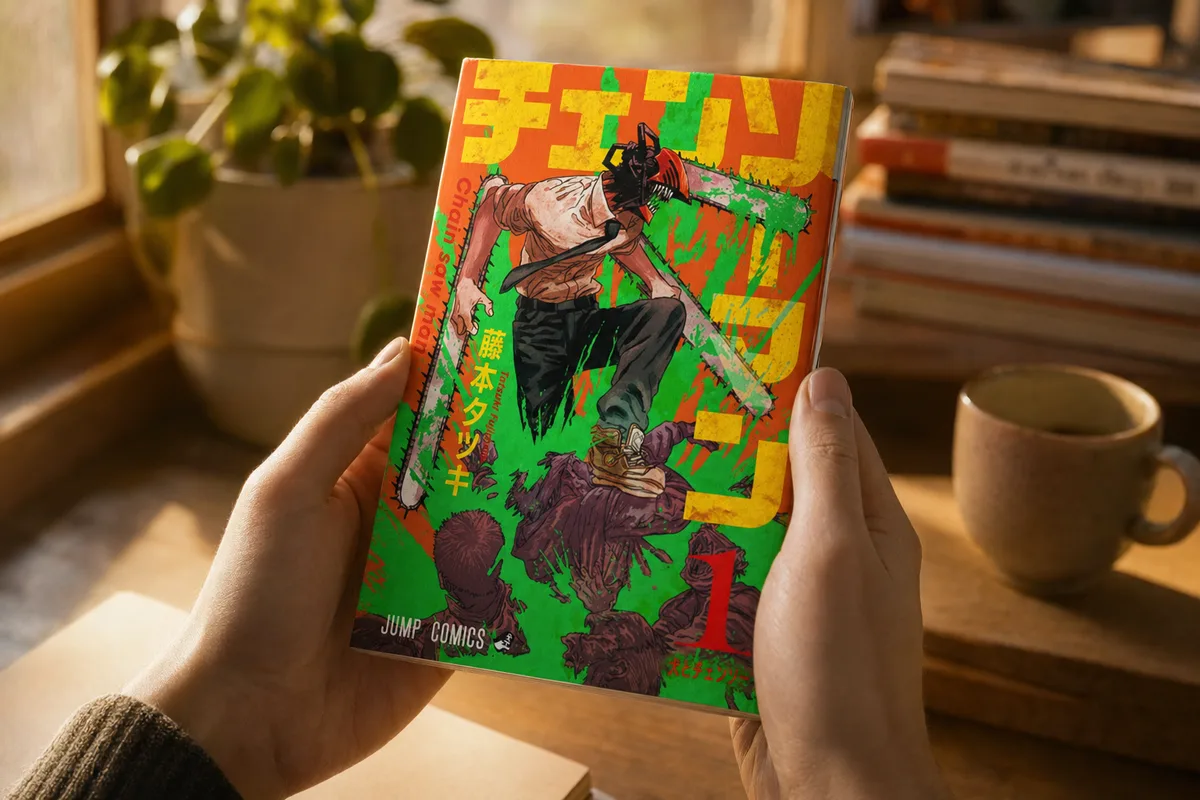
Volume 1 of Chainsaw Man (チェンソーマン) contains 794 unique vocabulary items across 7 chapters, 180 pages, 786 panels, and 3,811 textboxes. The script uses 508 unique kanji on the page, of which only 19 are non-joyo. The hardest single thing in this book is not the kanji and not the grammar. It is the volume of devil-and-debt jargon Tatsuki Fujimoto stacks on top of teenage shouting and Public Safety bureaucratic speech: 悪魔, 魔人, デビルハンター, 契約, 公安. Once that vocabulary unlocks, the reading slope drops fast.
That is the whole problem with Chainsaw Man volume 1 in one paragraph. Here is exactly what is in this book, and exactly what you need to read it.
Every number in this article comes from Ashiba's production corpus, measured against the official N5 to N1 JLPT vocabulary lists and the 2,136-character joyo kanji set. Last measured 2026-04-27.
Is Chainsaw Man volume 1 hard to read in Japanese?
Upper-intermediate. Not beginner. Not advanced. If you can read a Genki II dialogue without stopping every line, you will finish volume 1. It will take you longer than you think, and you will look up more words than you want to. You will also finish.
People mis-rate this book in both directions. Here is the actual shape.
What makes it easier than you think
Kanji is not a blocker. Furigana, the small phonetic companion written above every kanji, is provided everywhere in this manga: every kanji, every appearance, every chapter. Volume 1 uses 508 unique kanji, and 489 of them (96.3%) are joyo. Even when they are not, the manga shows the reading anyway.
The 19 non-joyo kanji split into two groups. The first is common-but-old words an artist chose to print in kanji for the look. 儂 (わし, an old-man pronoun used by the elder devils) appears 16 times with furigana. 此奴 (こいつ, this guy) appears 9 times. 貰う (もらう, to receive) and 嘘 (うそ, lie) round out the everyday set. The second is register-specific words like 復讐 (ふくしゅう, revenge) and 喧嘩 (けんか, fight) that Fujimoto leans on for tone. Furigana sits above every one.
The base register is also unusually approachable for a Shōnen Jump+ action title. Chainsaw Man spends most of its panels in two modes: Denji's teenage internal monologue (loud, crude, punchy) and the workplace banter of Public Safety division 4. Both lean on patterns you already know from beginner Japanese. 47.3% of the running tokens are N5 or N4, and another 22.1% are N3. Add it up and roughly 70% of the words on the page are textbook vocabulary.
What makes it harder than it looks
The long tail. 479 unique words appear exactly once in the entire volume. That is 60% of the unique vocabulary. This is the biggest difficulty in volume 1, not kanji, not grammar. Most words you encounter do not repeat enough times within volume 1 to give you the in-volume spaced-repetition benefit. They will recur across the series. They will not recur much in this book.
Vocabulary acquisition is iterative. A word does not stick the first time. Each word takes multiple painful encounters before recognition becomes automatic, and every encounter breaks the story flow. You stop, you look up, you re-read the sentence, you re-set the panel in your head, you keep going. The tipping point where the manga starts reading easily is further out than most learners expect. The only path through is volume.
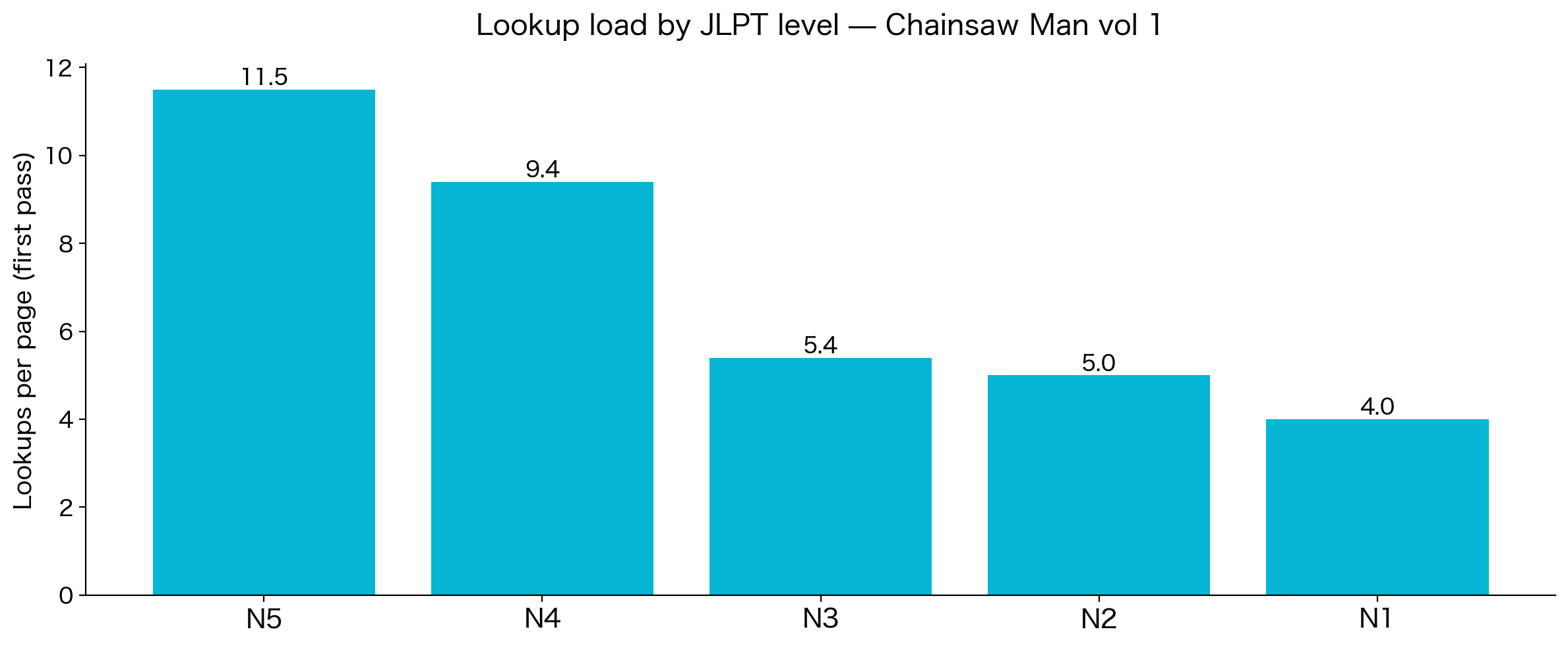
The other shape of the difficulty is the unlisted bucket. 103 unique words (13.0%) sit outside the JLPT N5 to N1 framework entirely after Gemini-classification, and they account for 22.2% of running tokens. Almost all of it is series-specific or modern-casual: 悪魔 (devil) appears 84 times, デビルハンター (devil hunter) 27 times, 魔人 (fiend) 16 times, plus the slangy edge of Denji's narration and Power's vulgar register. At an N3 reader's pace, that is 5.4 lookups per page on first pass. The fix is to pre-study them. Same words, different context. The story stays intact.
You don't need permission. Just go for it.
The real question is not whether this book is at your level. The real question is whether the pain is tolerable for the reward. If you actually want this story, the level mismatch is just a tax on time, not a wall. You pay it in lookups and re-reads and slow chapters until the cost goes down. Always read above your level. Attack the stories that motivate you. Permission is something other people give themselves and then complain about. Just go for it.
What the data says about volume 1
Every number below was calculated from the approved vocabulary set for Chainsaw Man volume 1 in Ashiba's production database. JLPT level was assigned by matching against the official N5 to N1 vocabulary lists. Words not on any list were classified by Gemini 3 Pro against context. 103 unique words remained outside the N5 to N1 framework and are marked "unlisted" (proper nouns, devil-hunter jargon, manga-specific compounds, slang, onomatopoeia).
A note on terminology. Running vocabulary means every word token as it occurs in the text, counting every repeat. If 悪魔 appears 84 times, that is 84 running tokens from 1 unique word. Unique vocabulary means the distinct words themselves, counted once each.
Volume 1 at a glance
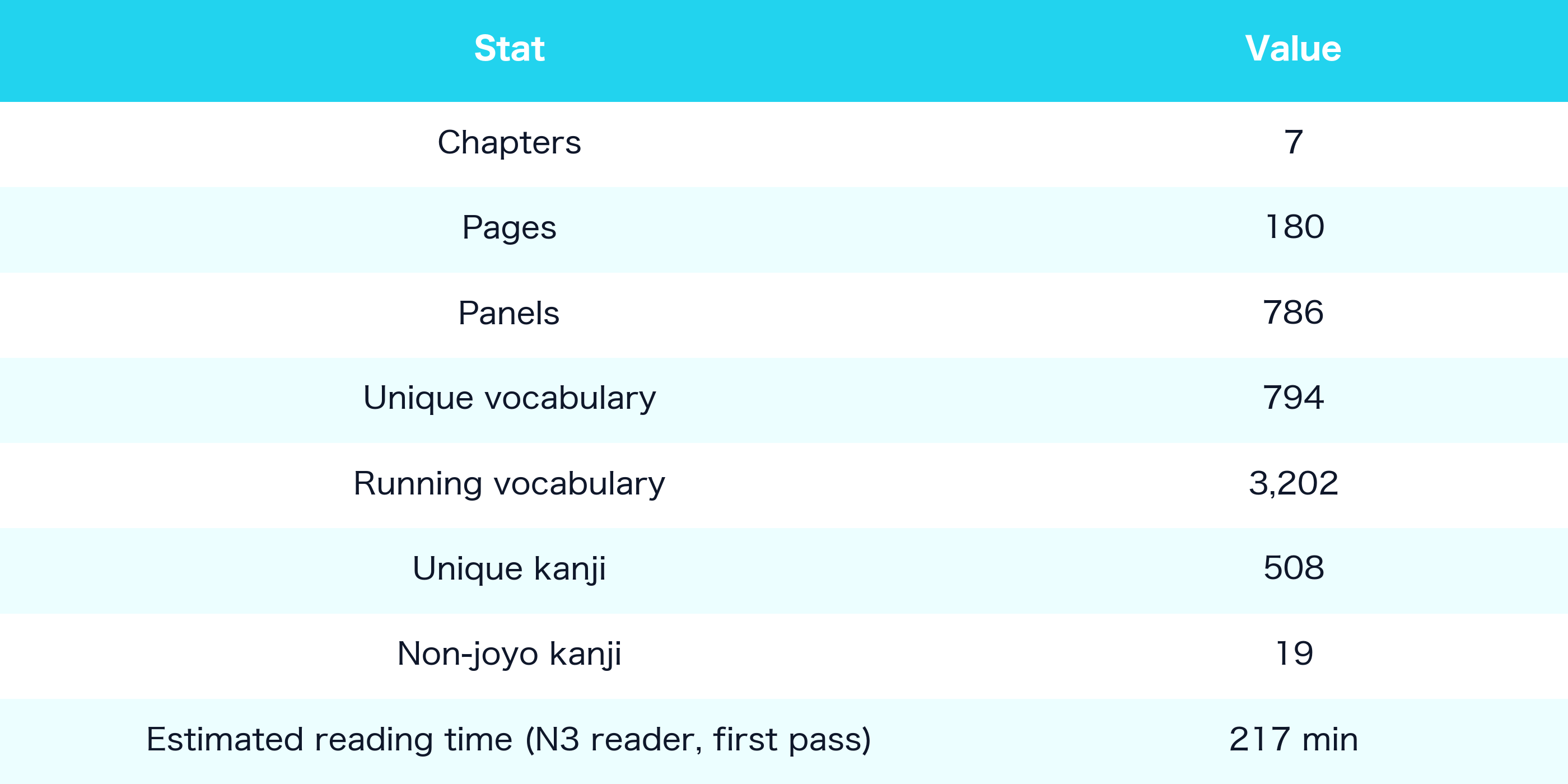
| Stat | Value |
|---|---|
| Chapters | 7 |
| Pages | 180 |
| Panels | 786 |
| Textboxes (speech, thought, narration) | 3,811 |
| Unique vocabulary | 794 |
| Running vocabulary | 3,202 |
| Unique kanji | 508 |
| Non-joyo kanji | 19 |
| Estimated reading time (N3 reader, first pass) | 5 to 7 hours |
JLPT coverage
The 794 unique vocabulary items in volume 1 break down like this:
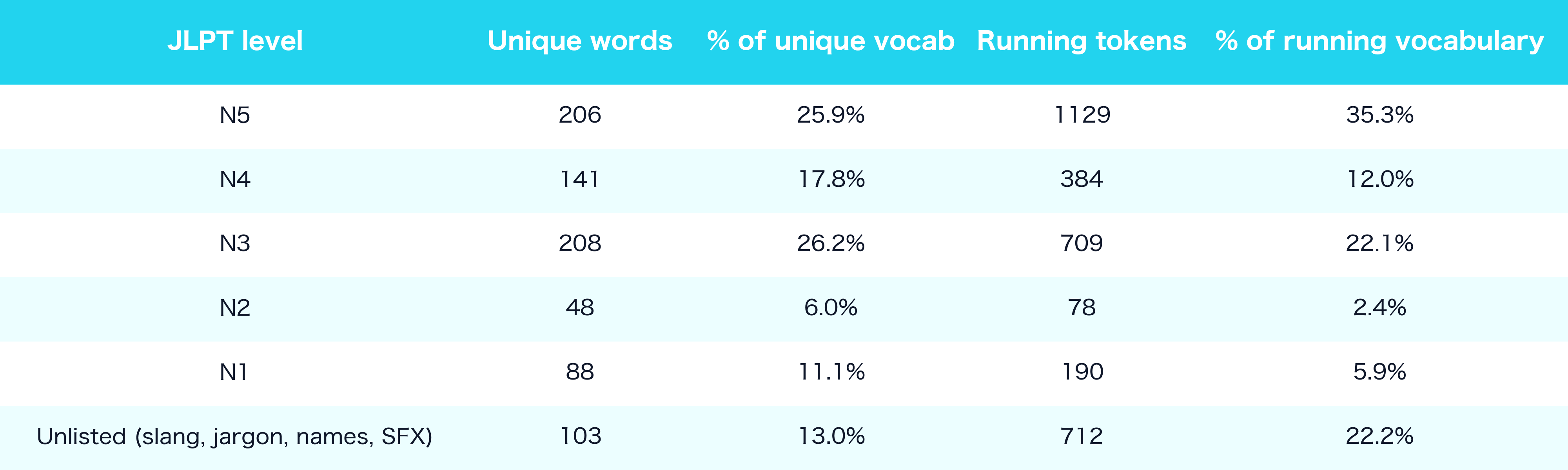
| JLPT level | Unique words | % of unique vocab | Running tokens | % of running vocabulary |
|---|---|---|---|---|
| N5 | 206 | 25.9% | 1,129 | 35.3% |
| N4 | 141 | 17.8% | 384 | 12.0% |
| N3 | 208 | 26.2% | 709 | 22.1% |
| N2 | 48 | 6.0% | 78 | 2.4% |
| N1 | 88 | 11.1% | 190 | 5.9% |
| Unlisted (slang, jargon, names, SFX) | 103 | 13.0% | 712 | 22.2% |
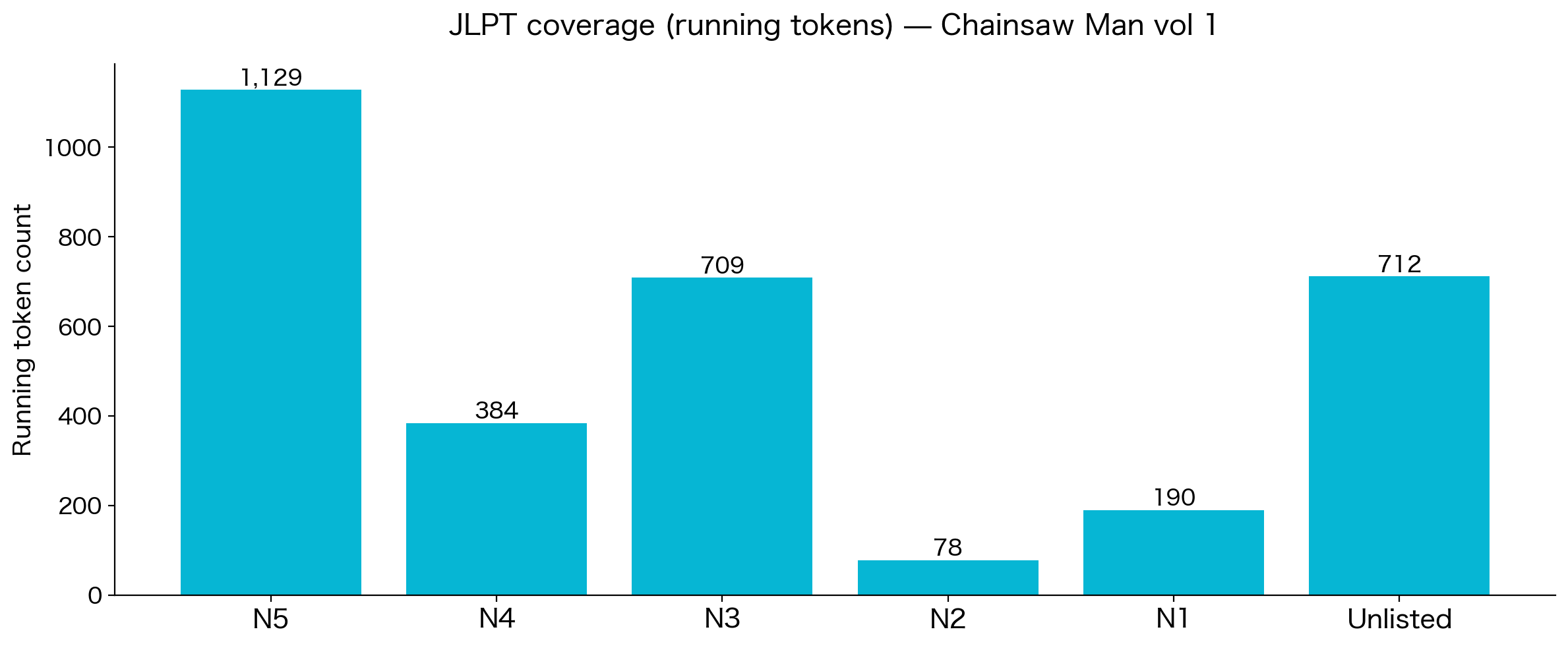
Read the last column. 47.3% of the running vocabulary is N5 or N4. Add N3 and you are at 69.4% of running vocabulary. The hard stuff (N2 and N1 combined) is 8.3% of what you actually read, because the hardest words appear rarely. The unlisted bucket sits at 22.2% of running tokens. That is where Chainsaw Man's vocabulary weight lives, and that is because the JLPT does not test devil-hunter slang.
Reader guidance by level
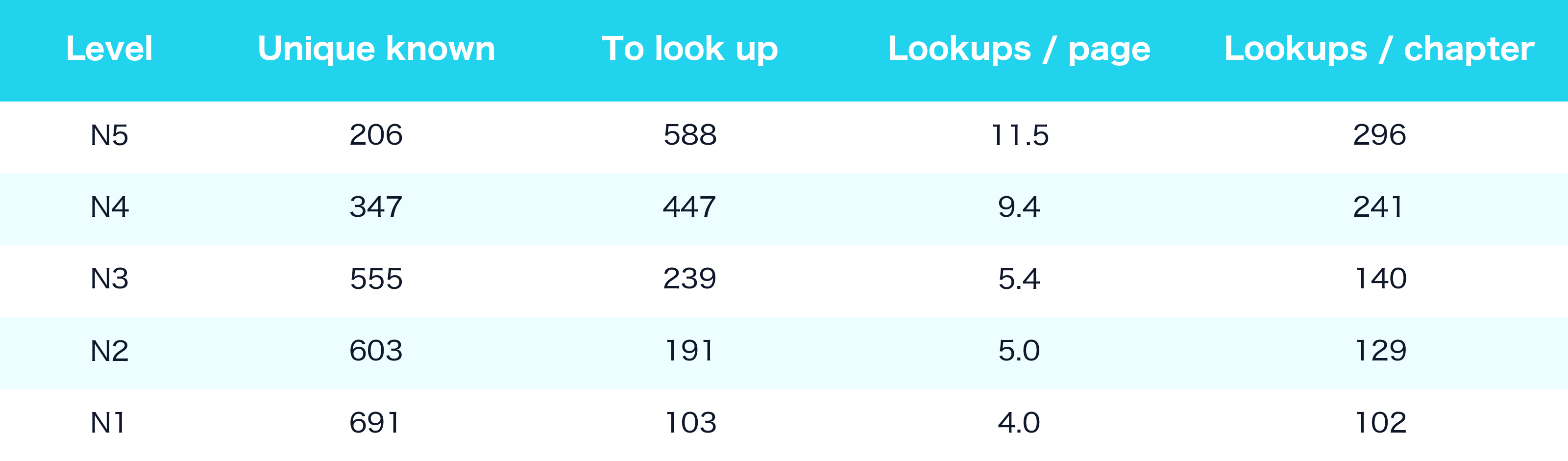
| Level | Unique words known | Unique words to look up | Lookups per page (first pass) | Lookups per chapter (first pass) |
|---|---|---|---|---|
| N5 | 206 | 588 | 11.5 | 296 |
| N4 | 347 | 447 | 9.4 | 241 |
| N3 | 555 | 239 | 5.4 | 140 |
| N2 | 603 | 191 | 5.0 | 129 |
| N1 | 691 | 103 | 4.0 | 102 |
Lookups are unavoidable and painful, but you can lower the pain by completing the grammar foundation guide first. If you do not have kana yet, start there. That is table stakes.
N1 ≠ mastery
N1 means you passed a test. Real Japanese is not the test. Even N1 readers reading Chainsaw Man for the first time will look things up. An N1 reader still has 103 unique unlisted words in this volume alone, plus first-encounter recognition on vocabulary they know from study but have never seen embedded in the Public-Safety-meets-yakuza register Fujimoto runs in. Even at N1, expect 4 lookups per page on first pass. The best way to learn real Japanese is to read real Japanese. Then you can pass any test.
Kanji
Chainsaw Man volume 1 has 508 unique kanji on the page (counted from the actual surface forms, not lemma headwords; words written in pure hiragana do not count). 489 are joyo. 19 are non-joyo. That non-joyo count puts CSM in the same band as Kaiju No. 8 (18) and Blue Lock (26), well below JJK (41) or Apothecary (51). Furigana is printed on every one.
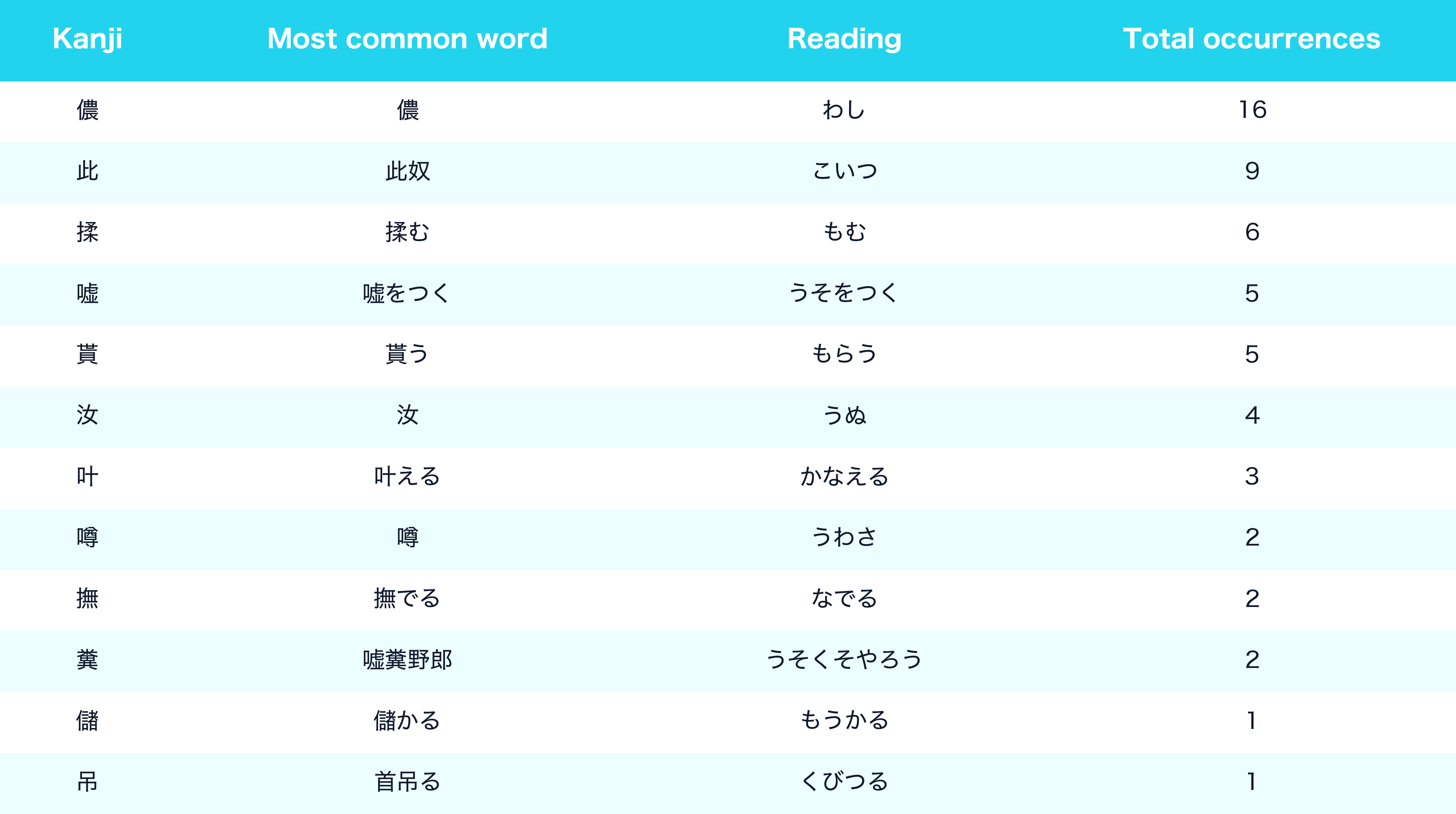
| Kanji | Most common word | Reading | Total occurrences |
|---|---|---|---|
| 儂 | 儂 | わし | 16 |
| 此 | 此奴 | こいつ | 9 |
| 揉 | 揉む | もむ | 6 |
| 嘘 | 嘘をつく | うそをつく | 5 |
| 貰 | 貰う | もらう | 5 |
| 汝 | 汝 | うぬ | 4 |
| 叶 | 叶える | かなえる | 3 |
| 噂 | 噂 | うわさ | 2 |
| 撫 | 撫でる | なでる | 2 |
| 糞 | 糞親父 | くそおやじ | 2 |
| 儲 | 儲かる | もうかる | 1 |
| 吊 | 首吊る | くびつる | 1 |
| 吠 | 吠える | ほえる | 1 |
| 喧 | 喧嘩 | けんか | 1 |
| 嘩 | 喧嘩 | けんか | 1 |
| 筈 | 筈 | はず | 1 |
| 舐 | 舐める | なめる | 1 |
| 讐 | 復讐 | ふくしゅう | 1 |
| 轢 | 轢く | ひく | 1 |
Where the kanji weight actually lives is in joyo characters combining into series-domain compounds. 悪魔 (あくま, devil) is built from 悪 (bad, evil) and 魔 (demon, magic). Both joyo. Together they make the noun the entire series turns on. Same story with 魔人 (まじん, fiend, from 魔 + 人), 公安 (こうあん, public safety, from 公 + 安), and 契約 (けいやく, contract, from 契 + 約). Every character in those compounds is on the joyo list, but the compound itself is series vocabulary you will not see in this exact register outside this genre. The bottleneck is the word, not the kanji. Stop worrying about the character list. Start worrying about the compounds.
Frequency
Vocabulary appears in a long-tail distribution. 479 of 794 unique words (60.3%) appear exactly once; only 13 words appear 26 times or more. The small head of the curve is where the leverage lives.
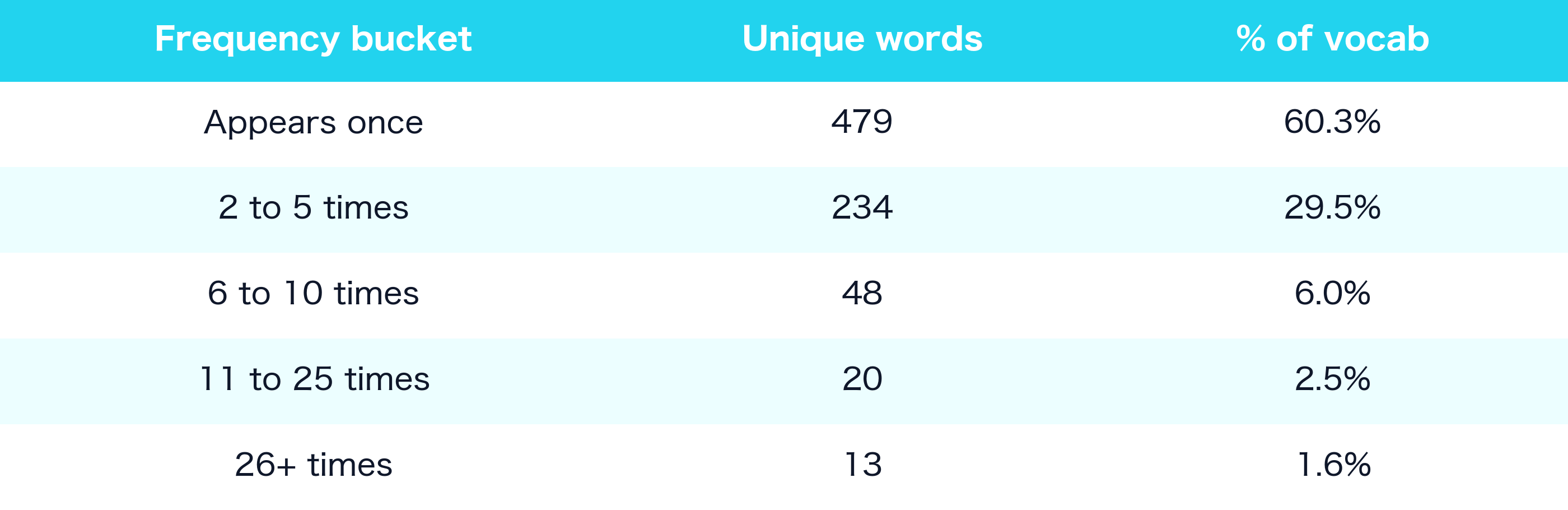
| Frequency bucket | Unique words | % of vocab |
|---|---|---|
| Appears once | 479 | 60.3% |
| 2 to 5 times | 234 | 29.5% |
| 6 to 10 times | 48 | 6.0% |
| 11 to 25 times | 20 | 2.5% |
| 26+ times | 13 | 1.6% |
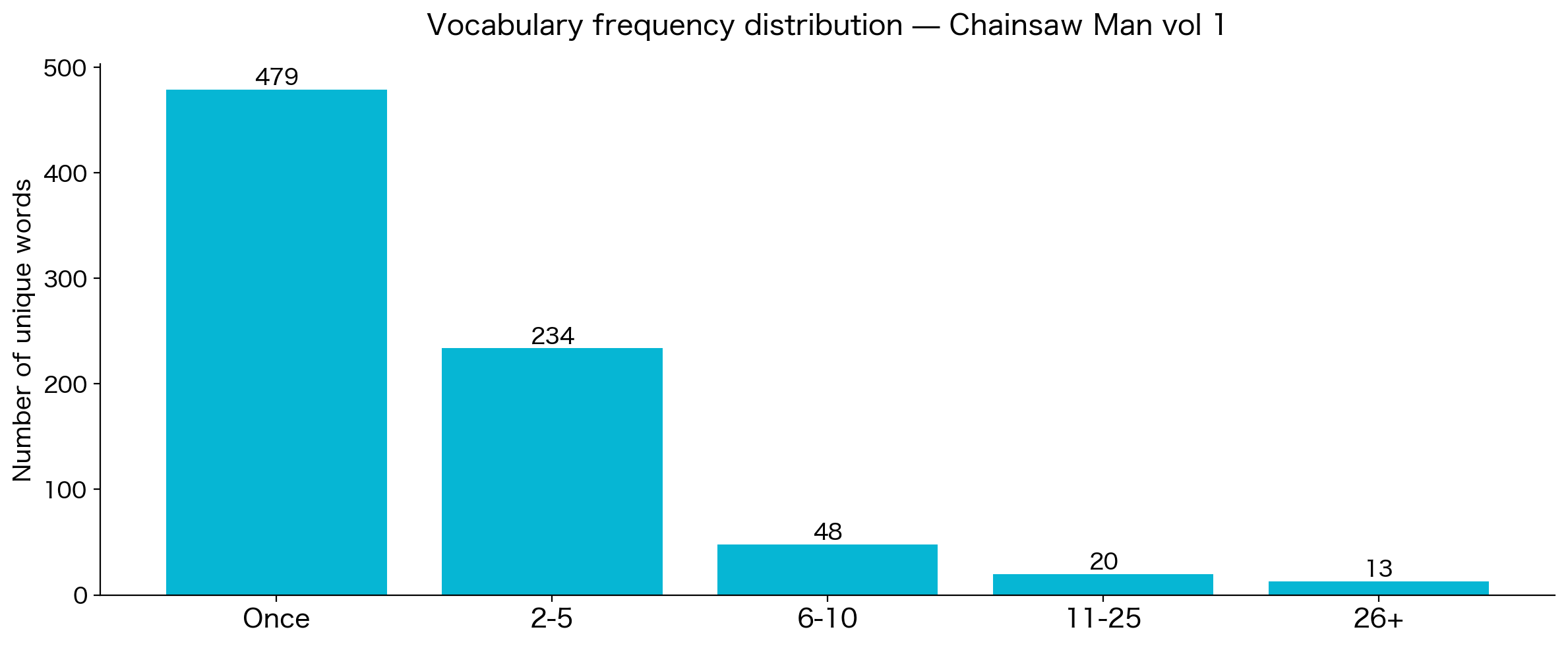
Do not read "appears once" as "not worth learning." These words recur across the series. Later volumes pick them up and use them again. The 81 words that appear six times or more are the real spine of volume 1 specifically.
The 20 most frequent content words
Pre-study these 20 and you have learned the most common content words on almost every page. By the time you finish volume 1, all 20 are locked into your memory just from how often they appear.
Particles, auxiliary verbs, pronouns, conjunctions, proper nouns, and adnominals are excluded so the list surfaces meaningful content words.
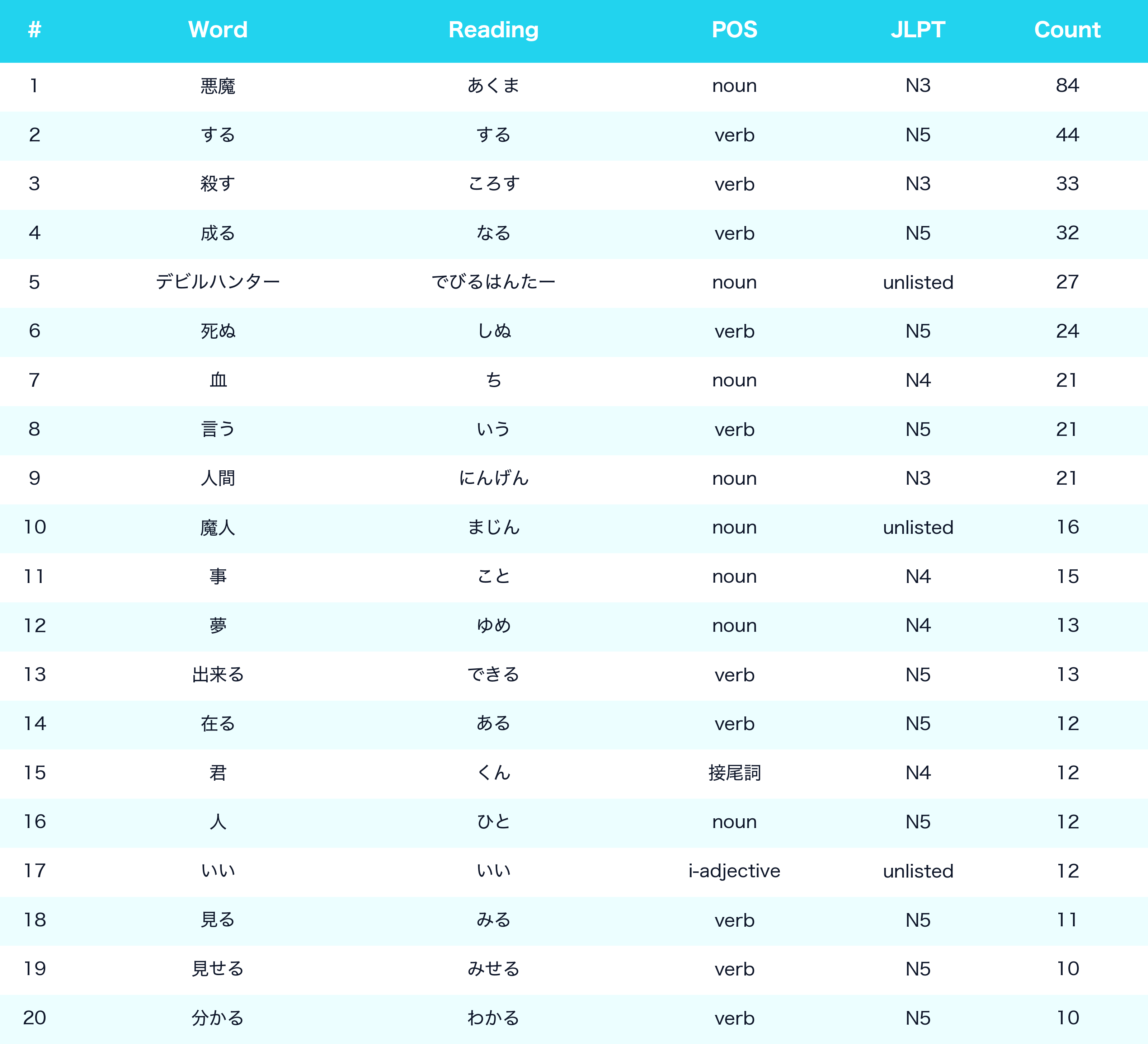
| # | Word | Reading | POS | JLPT | Count |
|---|---|---|---|---|---|
| 1 | 悪魔 | あくま | noun | N3 | 84 |
| 2 | する | する | verb | N5 | 44 |
| 3 | 殺す | ころす | verb | N3 | 33 |
| 4 | 成る | なる | verb | N5 | 32 |
| 5 | デビルハンター | でびるはんたー | noun | unlisted | 27 |
| 6 | 死ぬ | しぬ | verb | N5 | 24 |
| 7 | 血 | ち | noun | N4 | 21 |
| 8 | 言う | いう | verb | N5 | 21 |
| 9 | 人間 | にんげん | noun | N3 | 21 |
| 10 | 魔人 | まじん | noun | unlisted | 16 |
| 11 | 事 | こと | noun | N4 | 15 |
| 12 | 夢 | ゆめ | noun | N4 | 13 |
| 13 | 出来る | できる | verb | N5 | 13 |
| 14 | 在る | ある | verb | N5 | 12 |
| 15 | 君 | くん | suffix | N4 | 12 |
| 16 | 人 | ひと | noun | N5 | 12 |
| 17 | いい | いい | i-adjective | unlisted | 12 |
| 18 | 見る | みる | verb | N5 | 11 |
| 19 | 見せる | みせる | verb | N5 | 10 |
| 20 | 分かる | わかる | verb | N5 | 10 |
Two of these are worth calling out. 悪魔 (あくま, devil) is the genre-defining noun the entire series is built on, and it appears 84 times in volume 1 alone. If you only learn one word before opening this manga, learn this one. It will carry you through every page.
デビルハンター (devil hunter) is the institution everything else in the volume revolves around: the recruits, the captains, Public Safety division 4, the contracts Denji signs to keep working. It appears 27 times directly and far more often via its components (魔人 16 times, 公安 throughout chapters 3 to 7). Pre-study these pieces and the institutional vocabulary that follows them slots into place chapter by chapter.
How each main character speaks
電次 (デンジ, Denji)
Sixteen-year-old debt-collector turned Chainsaw Devil. Uses 俺 (おれ) for "I." His speech is street Tokyo: contracted endings (じゃねぇ for じゃない, 〜てる for 〜ている), sentence-final よ, ぞ, and a steady drip of 〜なんだ to flatten everything into complaint. Denji's internal monologue runs the whole volume and it runs in plain form with crude register. He is the easiest main character to read once you stop expecting politeness, and his vocabulary is the gateway into the volume.
マキマ (Makima)
Public Safety devil-hunter who recruits Denji at the end of chapter 1. Her register is the opposite of Denji's: gentle, declarative, almost completely free of crude markers, but she keeps Denji on plain form and uses 君 (きみ or くん) when addressing him. Her panels are the cleanest grammar in the volume and the densest in institutional vocabulary (悪魔, 契約, 駆除, 公安). Easy to parse word-by-word, harder to read fast because every sentence carries a Public-Safety load.
早川アキ (Hayakawa Aki)
Senior in division 4, a few years older than Denji, Public-Safety lifer. Aki speaks with the polite-but-cold register of someone who works inside an institution and resents the new kid he has been assigned: 〜です/〜ます endings stay intact in formal contexts and collapse to plain form when he is annoyed. He is the character who shows you the workplace register of devil hunting, and most of his exposition lands in chapter 4 (titled 力, Power) when he explains the chain of command.
パワー (Power)
Blood-Devil fiend, brand-new partner in Aki's squad as of chapter 5. Power uses 儂 (わし, an old-man pronoun rendered with a non-joyo kanji) for "I," which lands as a register joke every time it appears: ancient devil pronoun in a teenage girl's mouth. Sentence-final ぞ, frequent register breaks into outright lies, vulgar nouns (糞親父, 嘘糞野郎). She is the reason the non-joyo kanji 儂 appears 16 times. Pre-study her register before chapter 5 or her introduction reads as a wall of unparseable slang.
Expressions with depth
These are volume 1 expressions where the dictionary entry will mislead you. Surface meaning is one thing. What the phrase actually does in a panel is another.
悪魔 (あくま, devil)
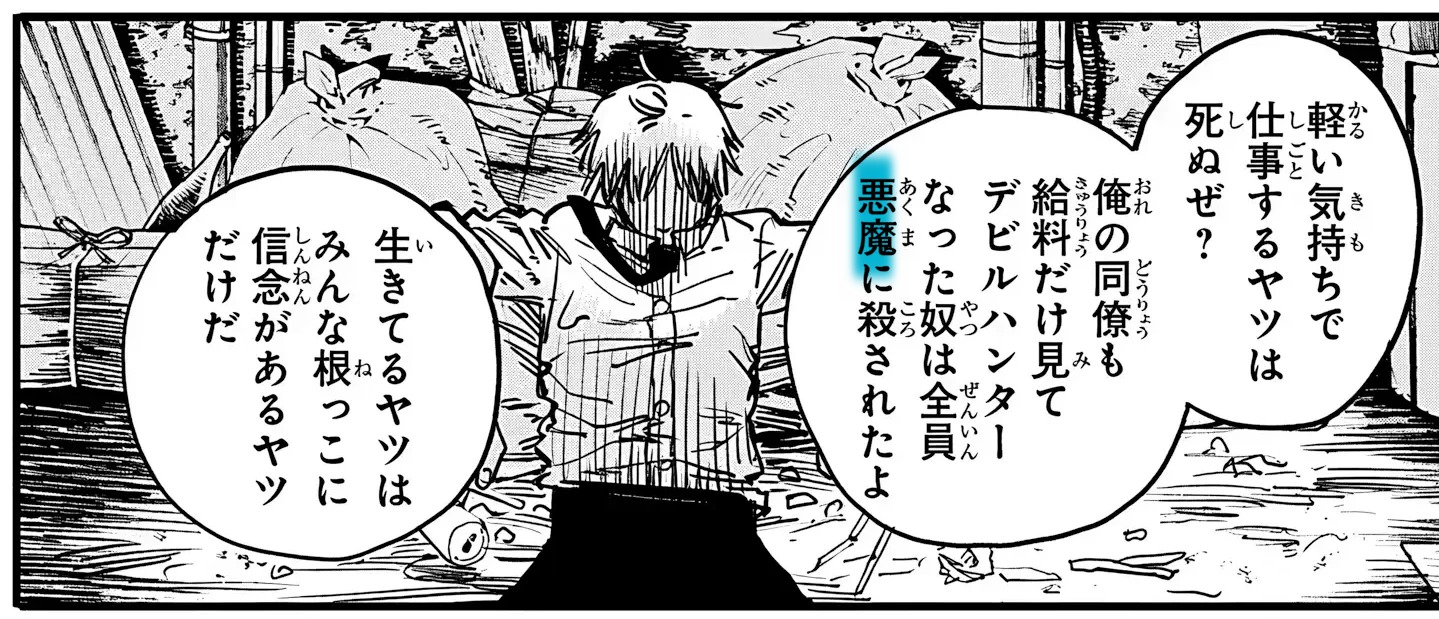
Dictionary: "devil" or "demon." The texture: 悪魔 in Chainsaw Man is not the Christian Satan and not a Buddhist 魔 (mara). Fujimoto's devils are concept- creatures named after the human fear that animates them: Gun Devil, Tomato Devil, Sea Devil, Chainsaw Devil. Translate it as "demon" and an English reader hears Catholicism. Translate it as "monster" and you lose the contract structure that defines the entire genre. The word stays as a Japanese-fantasy category that means: a creature whose strength scales with how much humans fear the thing it is named after. When a chapter-3 character says 悪魔になった奴は全員殺されたよ ("every guy who became a devil got killed"), the word is doing all of that work at once.
デビルハンター (devil hunter)
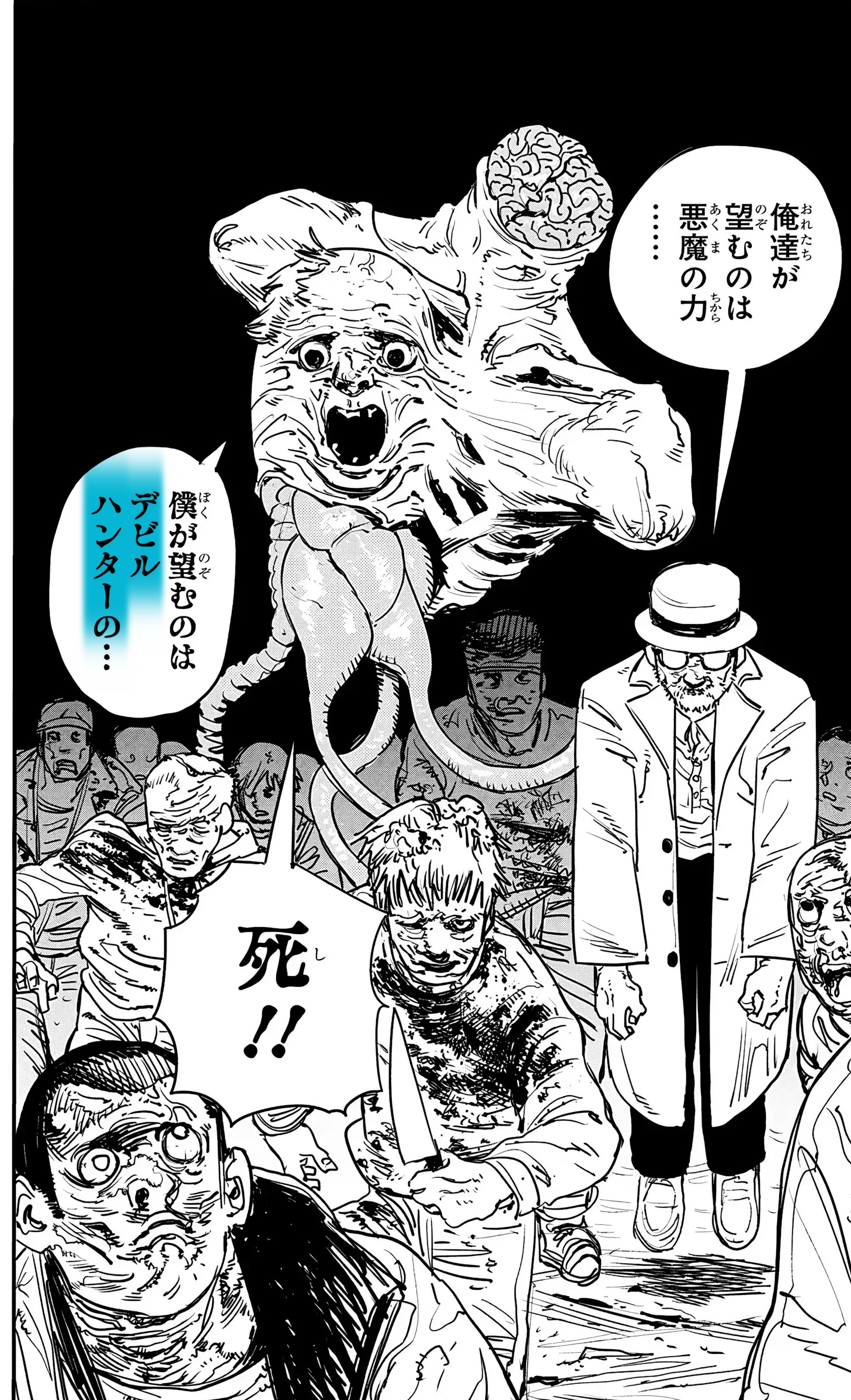
Dictionary: "devil hunter," a katakana coinage from English. The texture: in Chainsaw Man this is a job title, not a vocation. A デビルハンター signs contracts with Public Safety, draws a salary, files paperwork, and dies on Tuesday. Fujimoto deliberately chose the loanword over a Japanese compound (祓魔師, 退魔師) so the register reads as modern bureaucratic Japan, not feudal exorcism. When a chapter-1 character says 僕が望むのはデビルハンターの・・・死!! ("what I want is the death of devil hunters"), he is targeting an occupational class, not a holy order. The katakana does the work the kanji would not.
魔人 (まじん, fiend)
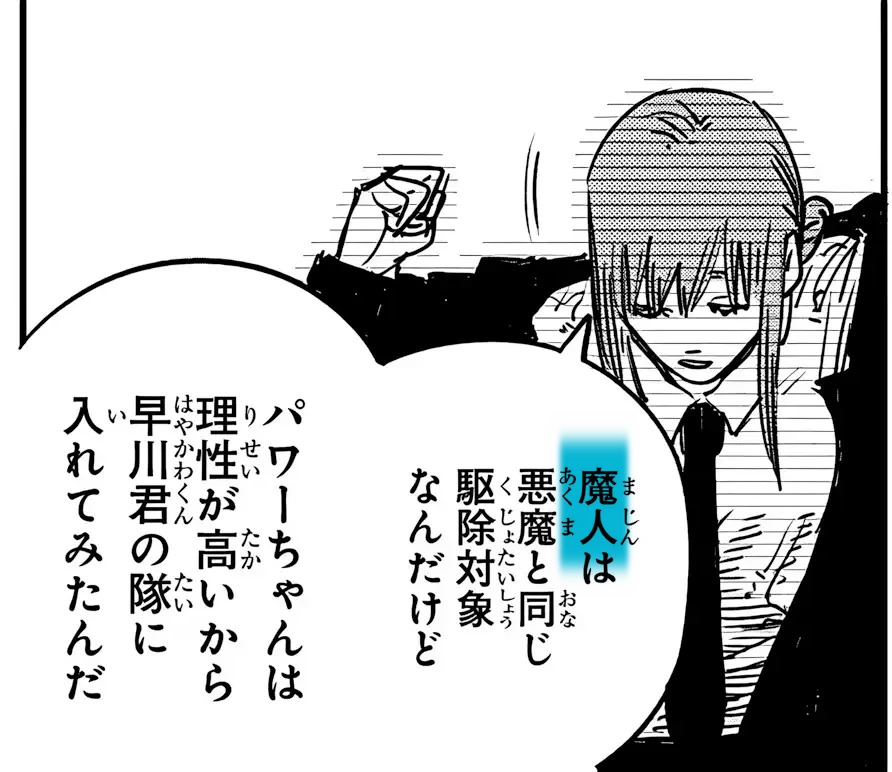
Dictionary: "fiend," "genie," or generically "evil spirit." The texture: in Chainsaw Man, 魔人 is a precise taxonomic category, distinct from 悪魔. A 魔人 is a devil that has possessed a human corpse and is now walking around with the host's memories scrambled and its devil-power intact. Power, introduced in chapter 5, is a 魔人. When Makima says 魔人は悪魔と同じ駆除対象なんだけど ("fiends are the same elimination targets as devils"), the panel is telling you Public Safety treats them as enemy units in the same operations table. VIZ's English "fiend" is the canonical translation; it is also the only translation that holds the bureaucratic edge.
殺す (ころす, kill)
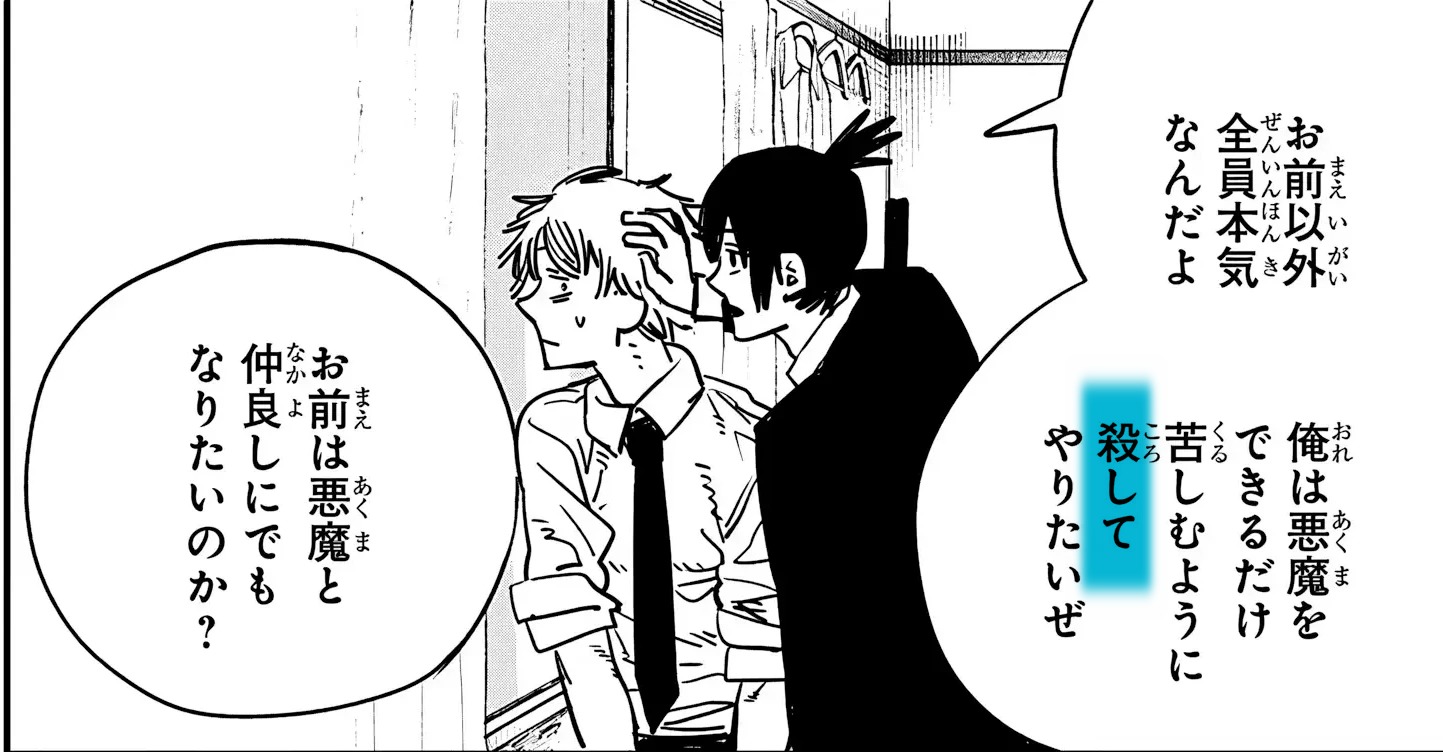
Dictionary: "to kill." The texture: 殺す is the most-used violence verb in the volume by a wide margin (33 occurrences, third-most-frequent content word in the book), and it carries the entire emotional spectrum of Chainsaw Man at once. Denji's lines use it casually (殺すぜ, "I'm gonna kill it"), Aki's use it professionally (the chapter-4 line where he says he wants to kill devils "as painfully as possible"), and the antagonists use it as a contract clause. The verb does not change. The register around it does. Read 殺す in CSM the way you would read "process" in an HR document: same word, different stakes per speaker.
契約 (けいやく, contract)
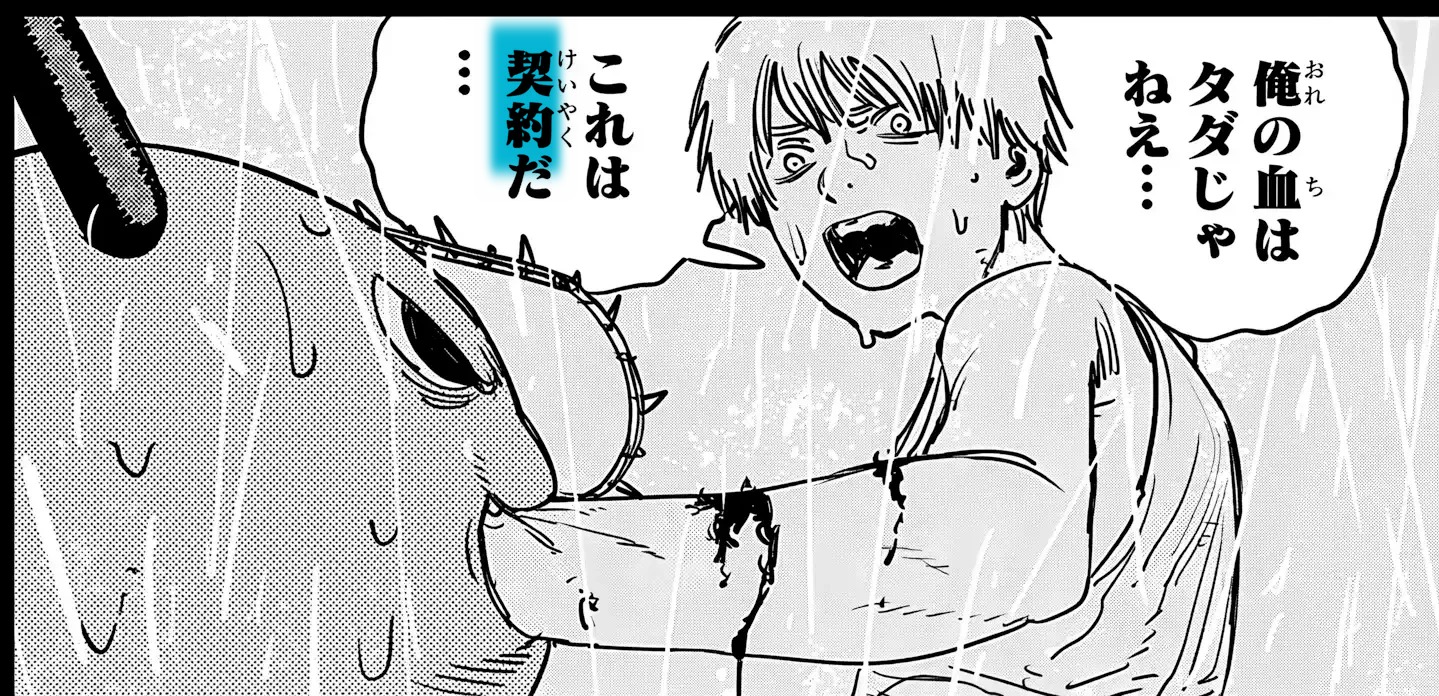
Dictionary: "contract" or "agreement." The texture: 契約 is the load-bearing noun of the entire CSM cosmology. Devils gain power by signing contracts with humans; humans gain power by signing contracts with devils; Public Safety runs on contracts; the entire volume is a chain of contracts being negotiated, broken, and re-signed. When chapter 1 has a devil say これは契約だ ("this is a contract"), the word is telling you the relationship that follows is not metaphorical. It is a literal ledger entry the universe enforces. Faustian fiction supplies the vibe; Japanese sōzōbusshin (creative-property) law supplies the register. Pre-study this word and chapter 1's revival scene reads the way Fujimoto wants it to: as a transaction.
Pop culture and context in volume 1
悪魔 as a Japanese-fantasy category, not a Christian or Buddhist one. Western readers default to Satan-and-Hell connotations and Buddhist-leaning readers default to 魔 (mara, the obstacle to enlightenment). Fujimoto's 悪魔 is neither. It is closer to Shintō kami logic: a being whose existence is a direct function of the human attention paid to the thing it embodies. The Gun Devil is strong because guns scare people. The Tomato Devil is weak because tomatoes do not. Read every devil panel with that mechanic loaded and Fujimoto's worldbuilding clicks into place.
公安 (こうあん, Public Safety). The institution Aki and Makima work for is 公安, a real category of Japanese governmental security agency that handles domestic intelligence and counter-extremism. The cultural connotation is closer to FBI plus Homeland Security than to a military branch. Fujimoto borrows that bureaucratic register wholesale: division numbers, captains, contract paperwork, salary negotiations. Devil-hunting is run as a domestic-security operation in this world, not as a heroic calling. The salaries are low and the death rate is high, just like the real 公安.
暴力団 (ぼうりょくだん, yakuza). Denji's pre-recruitment work in chapter 1 is debt-collection for a small-time outfit that is, in plain language, yakuza. He cuts up devils with his Chainsaw partner Pochita and hands the corpses over for cash. Japanese readers register the institution immediately because the manga uses the visual and verbal cues of low-tier 暴力団 work: cramped office, bald boss in a track suit, bath-house meeting, the boss casually breaking Denji's ribs. The chapter is designed to make you feel the ceiling on Denji's life before Makima offers him a different ceiling.
The Faustian 契約 trope, modernized. Devil-pact stories run from Faust through Ghost Rider through every Western occult genre, and Japanese readers know that lineage. What Fujimoto adds is the bureaucratic frame. Contracts in Chainsaw Man are not signed at midnight in Latin. They are signed in the back of a Public Safety van in plain Japanese, with a salary attached. The chapter-1 contract between Denji and Pochita is presented as a literal exchange of body parts (Pochita becomes Denji's heart in return for Denji showing him the world). The trope is ancient. The framing is modern. The word 契約 carries both layers.
Inside the app: one panel, fully broken down
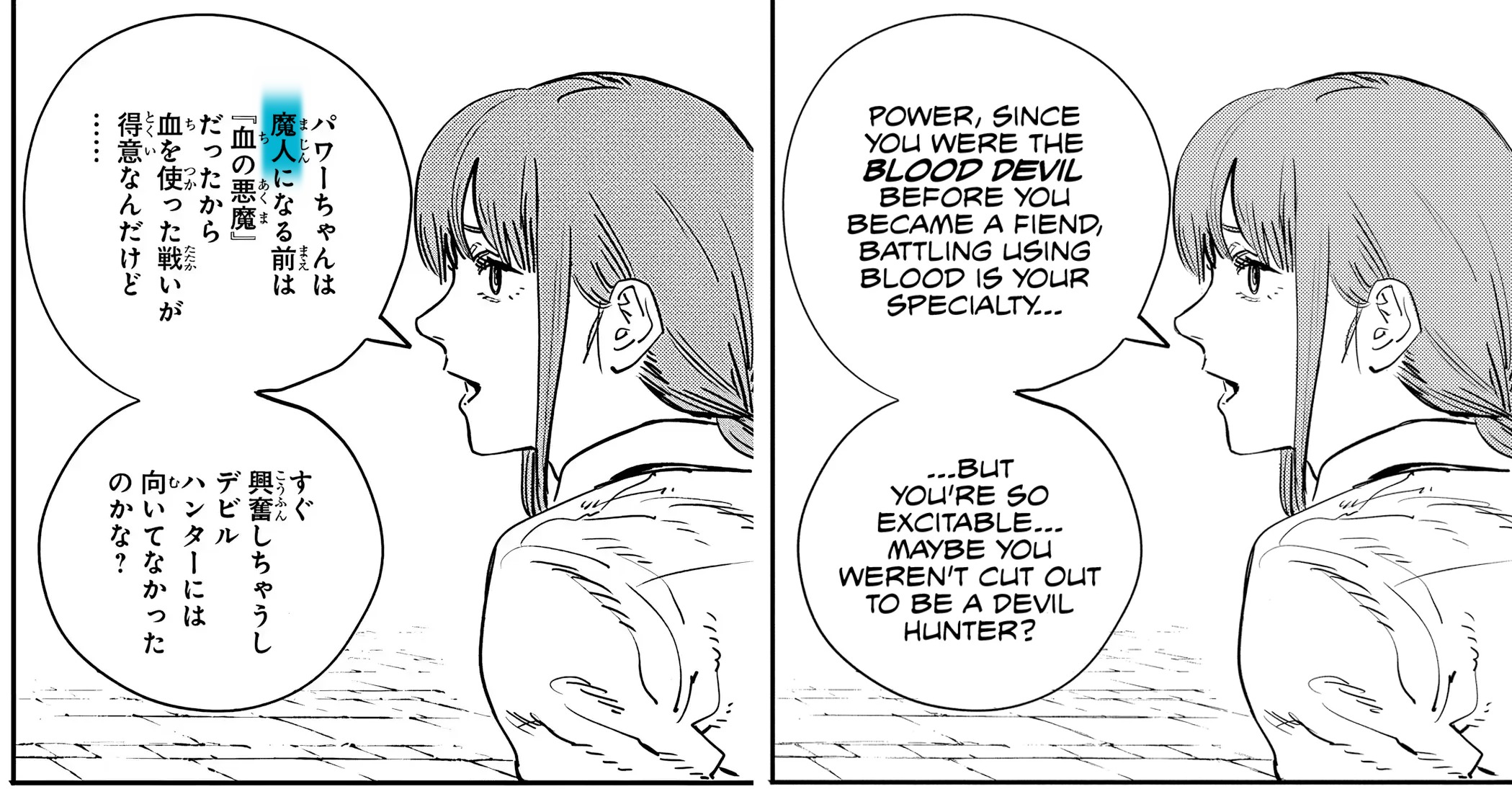
Reading manga in Japanese is, at the bottom of it, a vocabulary-acquisition problem. Let me get you one panel: chapter 5, page 12, Power explaining her Blood-Devil background to Denji. All the context around it is broken down here the same way The Ashiba App provides it, so you finish this section actually understanding the vocabulary that defines volume 1, not just having seen it.
Chapter 5, page 12: Power explains the Blood Devil
Scroll the image sideways to read the Japanese in full size.
Summary. Makima walks Denji through Power's background. Power was a Blood Devil before her host body died and her devil-soul possessed the corpse, turning her into a 魔人. The panel is dense in series-defining vocabulary: 魔人, 悪魔, デビルハンター, all three of the words this article has been pre-studying you for.
Textbox 1
JP: パワーちゃんは魔人になる前は『血の悪魔』だったから血を使った戦いが得意なんだけど・・・
EN: Power, since you were the Blood Devil before you became a fiend, battling using blood is your specialty...
Overview: Background exposition. The word 魔人 (fiend) is the load-bearing term: it tells you Power is not a 悪魔 anymore, she is the next category up.
Breakdown:
- パワーちゃん (ぱわーちゃん): "Power-chan," Makima's familiar form for Power
- 魔人 (まじん): fiend; series-specific term for a devil that has possessed a human corpse
- なる: to become; N5 verb, the hinge of the sentence
- 前 (まえ): before; N5 noun
- 血 (ち): blood; N4 noun, central to Power's power-set
- 悪魔 (あくま): devil; N3 noun, the category Power used to belong to
- 使った (つかう): used; N5 verb, past plain form
- 戦い (たたかい): battle, fighting; N3 noun
- 得意 (とくい): skilled at, specialty; N3 na-adjective
Textbox 2
JP: すぐ興奮しちゃうしデビルハンターには向いてなかったのかなー?
EN: But you're so excitable... maybe you weren't cut out to be a devil hunter?
Overview: Makima ribbing Power. The grammar pivots through 〜しちゃう (an emphasis-with-regret form) and 〜のかなー (rhetorical wondering).
Breakdown:
- すぐ: immediately, easily; N5 adverb
- 興奮しちゃう (こうふん): get excited; 興奮する with the 〜ちゃう contraction of 〜てしまう
- デビルハンター: devil hunter; series-specific job title, 27 occurrences in volume 1
- 向いてなかった (むく): was not suited to; 向く + 〜てない past form
- のかなー: I wonder if...; rhetorical sentence-final phrase
Key points
- 魔人 vs 悪魔 vs デビルハンター is the three-way taxonomy that runs the entire volume. Pre-study this trio and chapter 5 onward reads at half the lookup rate.
- The register is intimate-but-clinical: Makima uses ちゃん to address Power and 君 to address Denji while still using technical Public-Safety vocabulary. That register collision is the texture of every Makima panel in the volume.
- 〜ちゃう (interpolated emphasis) and 〜のかなー (rhetorical wondering) are spoken-Japanese patterns that do not show up in Genki. Volume 1 is full of them. Once you map them to their textbook equivalents (〜てしまう, 〜のだろうか), Fujimoto's dialogue resolves quickly.
How to actually read volume 1
- Get a foundation. How much you need depends on how much discomfort you can sit with. Genki I and II is the polished path. At a minimum, lock in N5. Nothing else moves until kana and basic grammar are automatic.
- Start with chapter 1. Take your time. Not a week. Not a day. This is the first chapter of manga you have ever read in Japanese. Set a timer for 15 minutes. Early on, you crack one to three sentences in that window. Later, you crack a full chapter. Consistency compounds. Rack up the reps.
- When you get stuck, reference the translation. Looking things up is not failure. It is learning. The fastest way to get unstuck is to see the answer and understand why the sentence means what it means. Goal: parse the sentence. Match the English to the Japanese, identify the word or grammar that blocked you, and move on. You will hurdle (probably in chapter 1 when Denji is processing yakuza-debt slang and his contract with Pochita lands, or in chapters 3 to 5 when Public Safety procedure and Power's vulgar register both arrive at full speed). Those panels are dense. The answer is not to grind harder. The answer is what I wrote about in Why You Will Quit Learning Japanese: put the book down and come back tomorrow.
If you want the deeper version of this reading strategy, the fastest way to learn Japanese article has the volume-control framework in full.
The Takeaway
The main reason reading manga in Japanese is hard is the sheer amount of vocabulary you do not know.
Most readers never get past this. The pain is too great. The effort-to-reward ratio collapses, and the book gets shelved.
The easiest way out is to pre-study the words you do not know that will appear in the chapter you are about to read. The Ashiba App does this for every chapter of every series I cover. It surfaces the vocabulary, shows readings and POS, and includes grammar breakdowns so you see how each word is being used. Nothing is studied in isolation. Every flashcard carries its full panel context. You see the word in the sentence in the panel where it lives.
You can get started today.
Frequently asked questions
Should I watch the anime before reading Chainsaw Man in Japanese?
Yes. The Chainsaw Man anime aired in 2022 and adapts the first arc of the manga, including all of volume 1. Watch episodes 1 through 4 before you open the manga. The anime gives you the visual context for Denji's yakuza work, Pochita, the Public Safety office, and Power's introduction, so the manga reads with the voices and pacing already loaded. Watch the same episodes again after you finish volume 1 and you will feel exactly how much more you picked up by reading.
Does Chainsaw Man have furigana?
Yes. Furigana is printed on every kanji in volume 1, every appearance, every chapter. This is the Shōnen Jump+ standard, and it is the single biggest reason CSM is approachable despite its dense vocabulary. If you cannot read kanji on sight, you can still read this manga.
Do I need to know all the kanji before starting?
No. Furigana is provided everywhere. You need to know hiragana and katakana. That is the hard prerequisite. Kanji you pick up as you read. If you have not finished kana yet, start with how to learn hiragana and katakana.
How long will volume 1 take to read?
For an N3 reader on a first pass at the lookup rate above (about 5.4 lookups per page), plan for 5 to 7 hours of focused reading time spread across multiple sessions. An N1 reader will finish it in 3 to 4 hours but will still pause on the unlisted devil-hunter vocabulary. Reread for fluency afterward.
Should I start with volume 1 or jump in further?
Follow the fun. If a different volume is pulling you harder, start there. The reasons to pick volume 1 anyway: the devil-and-Public-Safety vocabulary (悪魔, 魔人, デビルハンター, 契約, 公安) is introduced here and used unchanged in every later volume. Skip it and you spend volume 2 looking up volume 1 words.
Where can I buy Chainsaw Man volume 1 in Japanese?
Free Japanese preview: Shonen Jump+ chapter 1. Free English preview: VIZ Media volume 1 product page. Buy the full Japanese volume on Amazon Japan or BookWalker (Kindle or paperback).