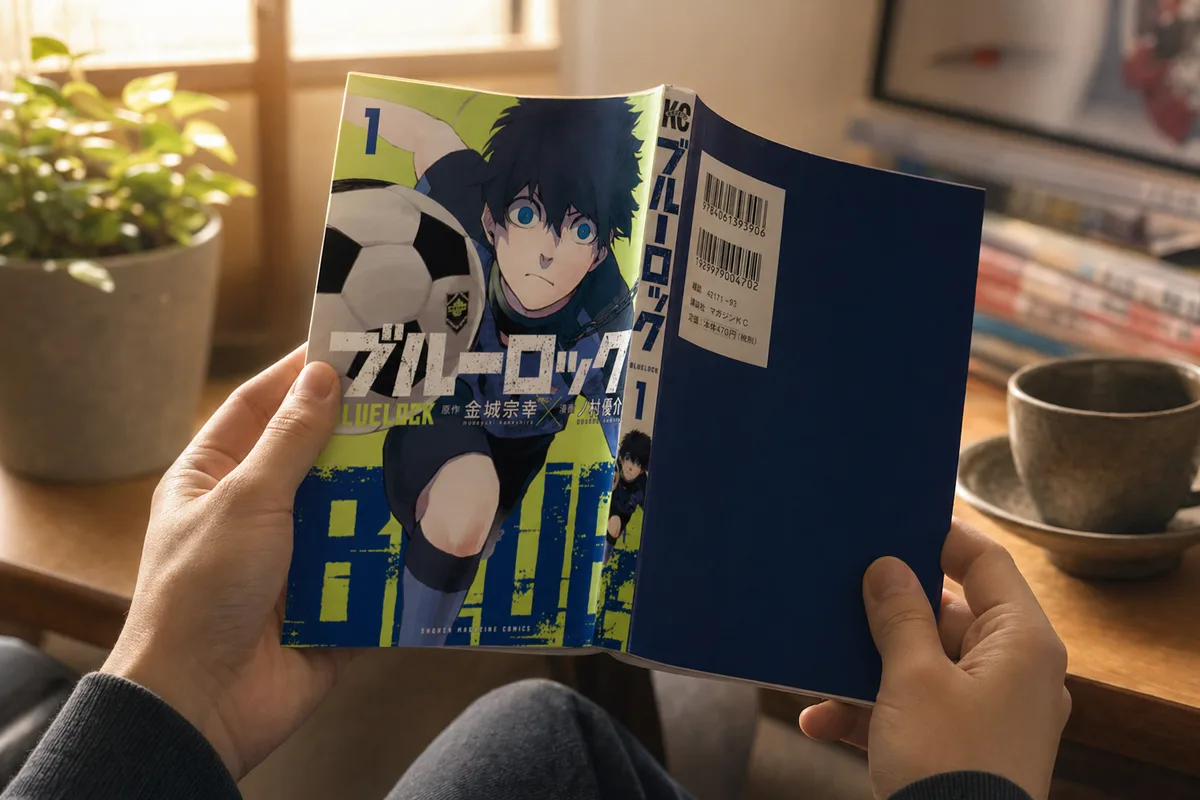
Volume 1 of Blue Lock (ブルーロック) contains 1,135 unique vocabulary items across 4 chapters, 191 pages, and 745 panels. The script uses 580 unique kanji on the page, of which only 26 are non-joyo. The hardest single thing in this book is not the kanji and not the grammar. It is the philosophical register the manga lives in: soccer terminology layered with the egoism vocabulary Ego Jinpachi invents on the fly to demolish every team-first instinct his recruits walked in with.
That is the whole problem with Blue Lock volume 1 in one paragraph. Here is exactly what is in this book, and exactly what you need to read it.
Every number in this article comes from Ashiba's production corpus, measured against the official N5 to N1 JLPT vocabulary lists and the 2,136-character joyo kanji set. Last measured 2026-04-27.
Is Blue Lock volume 1 hard to read in Japanese?
Upper-intermediate. Not beginner. Not advanced. The dialogue is modern, the registers are recognisable, and most of the page is short shouted lines from teenagers who have just been thrown into a tournament. What makes it hard is the sport. Blue Lock is built on soccer jargon a Japanese reader has absorbed from a lifetime of W杯 broadcasts, and on top of that, the entire premise of the manga is one antagonist (Ego Jinpachi) running a philosophy lecture at the recruits in dense rhetorical Japanese. The page register oscillates between "teenager swearing during a scrimmage" and "modern philosophy seminar" with no warning.
People mis-rate this book in both directions. Here is the actual shape.
What makes it easier than you think
Kanji is not a blocker. Furigana, the small phonetic companion written above every kanji, is provided everywhere in this manga: every kanji, every appearance, every chapter. Volume 1 uses 580 unique kanji, and 554 of them (95.5%) are joyo. The 26 non-joyo characters are a small, manageable set, and almost all of them are old-style spellings of common everyday words (此奴 for こいつ, 嘘 for うそ, 喋る for しゃべる, 貰う for もらう). The reading sits right above the character every time. 580 unique kanji is on the lower end of the by-manga corpus we have measured, lower than KN8 (640), JJK (797), or Apothecary (756).
The base register on the action pages is also unusually approachable. Most of what is shouted on the pitch is short, plain-form, sentence-final よ and ぞ and だ. Roughly 39% of the running tokens are N5 or N4, and another 22% are N3. Add it up and roughly 61% of the words on the page are textbook vocabulary. The hard stuff is rare and clusters in the lecture panels.
Stop worrying about the kanji list. The book hands you the readings.
What makes it harder than it looks
Out of 1,135 unique vocabulary items, 687 (60.5%) appear exactly once. That long tail is the real difficulty: most words you look up will not appear again in the same volume. Lookups are not difficulty in disguise. They are volume of unknowns.
Vocabulary acquisition is iterative. A word does not stick the first time. Each word takes multiple painful encounters before recognition becomes automatic, and every encounter breaks the story flow. You stop, you look up, you re-read the sentence, you re-set the panel in your head, you keep going. The tipping point where the manga starts reading easily is further out than most learners expect, and Blue Lock's tipping point gets pushed further by the unlisted bucket. 241 unique words (21.2%) sit outside the JLPT N5 to N1 framework entirely after Gemini classification, and 1,472 of the running tokens (29.7%) come from those 241 words. That is a heavy unlisted load. It is two flavours stacked: real-world soccer terminology (サッカー, ストライカー, FW, W杯, チーム) and the manga-coined egoism vocabulary that defines the program (青い監獄, エゴイスト, the philosophical use of 才能 and 世界一). At an N3 reader's pace, that is 10.1 lookups per page on first pass, and most of them are sport-domain or program-domain nouns you will not find in a general dictionary. The fix is to pre-study them. Same words, different context. The story stays intact.
You don't need permission. Just go for it.
The real question is not whether this book is at your level. The real question is whether the pain is tolerable for the reward. If you actually want this story, the level mismatch is just a tax on time, not a wall. You pay it in lookups and re-reads and slow chapters until the cost goes down. Always read above your level. Attack the stories that motivate you. Permission is something other people give themselves and then complain about. Just go for it.
What the data says about volume 1
Every number below was calculated from the approved vocabulary set for Blue Lock volume 1 in Ashiba's production database. JLPT level was assigned by matching against the official N5 to N1 vocabulary lists. Words not on any list were classified by Gemini 3 Pro against context. 241 unique words remained outside the N5 to N1 framework and are marked "unlisted" (proper nouns, soccer jargon, manga-specific compounds, slang, onomatopoeia).
A note on terminology. Running vocabulary means every word token as it occurs in the text, counting every repeat. If サッカー appears 67 times, that is 67 running tokens from 1 unique word. Unique vocabulary means the distinct words themselves, counted once each.
Volume 1 at a glance
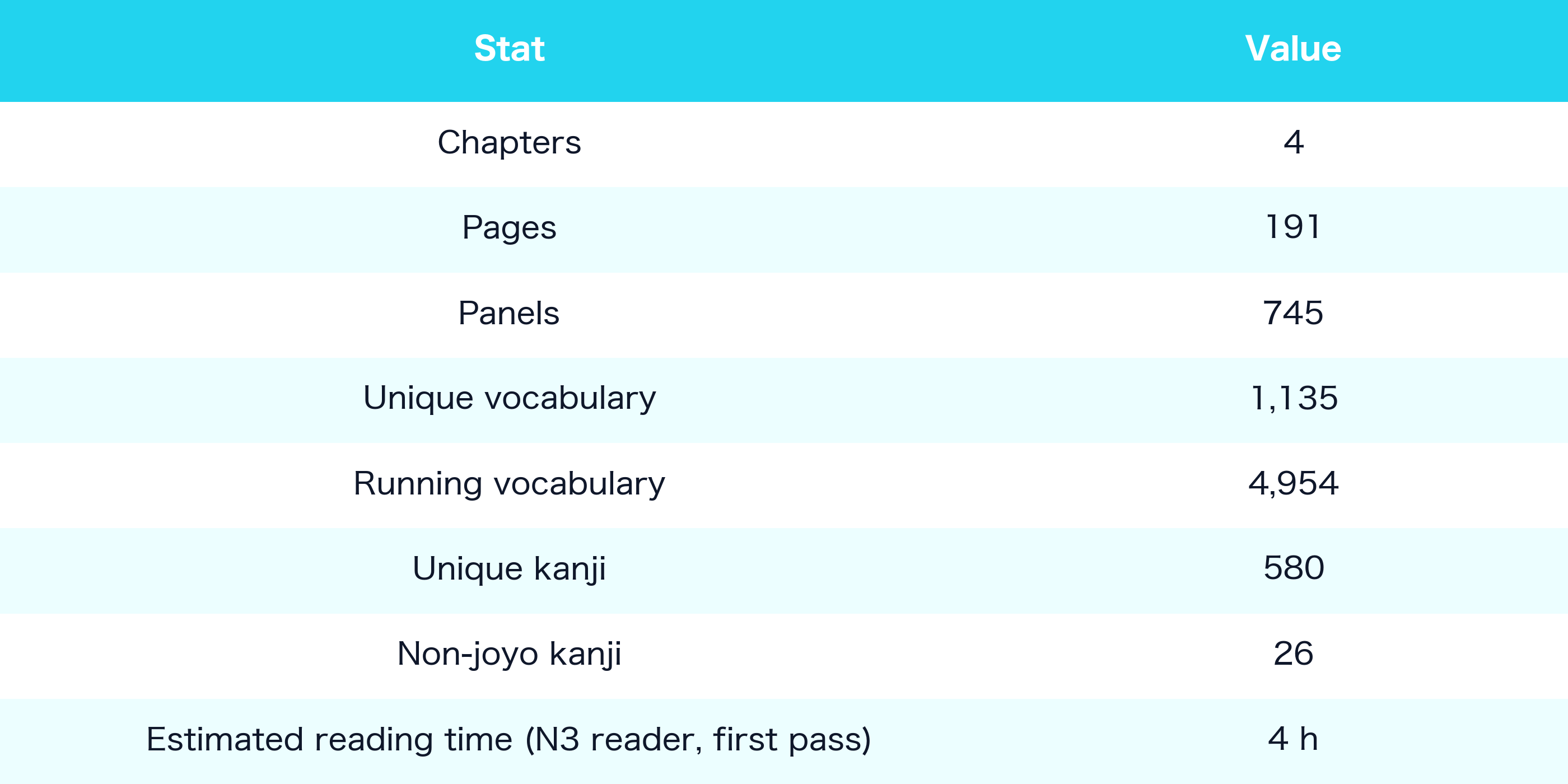
| Stat | Value |
|---|---|
| Chapters | 4 |
| Pages | 191 |
| Panels | 745 |
| Unique vocabulary | 1,135 |
| Running vocabulary | 4,954 |
| Unique kanji | 580 |
| Non-joyo kanji | 26 |
| Estimated reading time (N3 reader, first pass) | 6 to 9 hours |
JLPT coverage
The 1,135 unique vocabulary items in volume 1 break down like this:
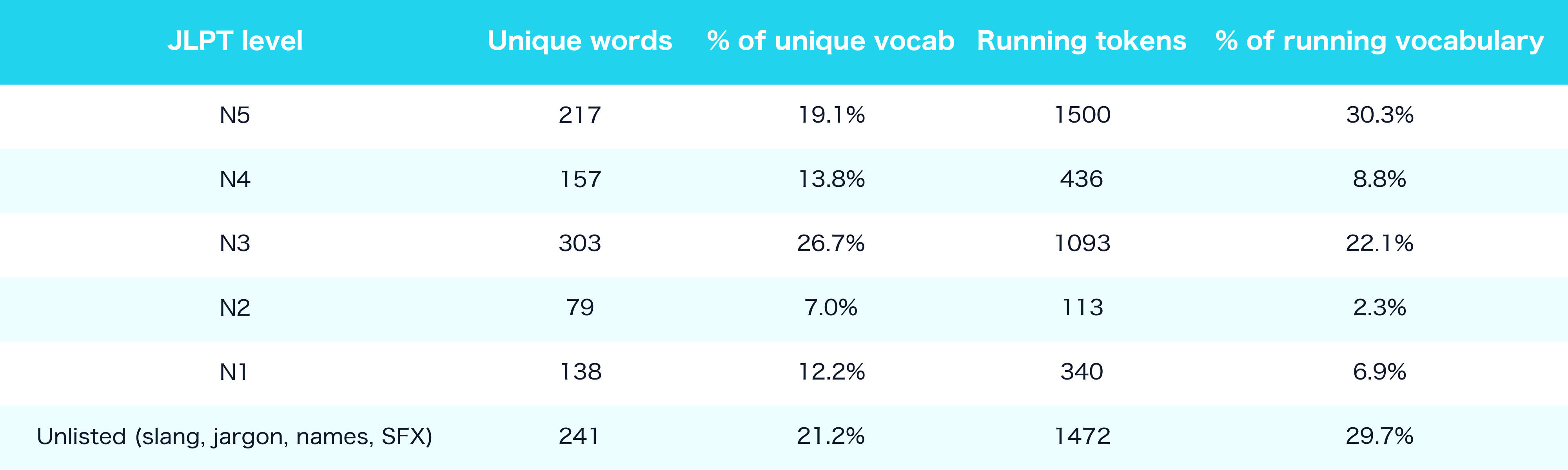
| JLPT level | Unique words | % of unique vocab | Running tokens | % of running vocabulary |
|---|---|---|---|---|
| N5 | 217 | 19.1% | 1,500 | 30.3% |
| N4 | 157 | 13.8% | 436 | 8.8% |
| N3 | 303 | 26.7% | 1,093 | 22.1% |
| N2 | 79 | 7.0% | 113 | 2.3% |
| N1 | 138 | 12.2% | 340 | 6.9% |
| Unlisted (slang, jargon, names, SFX) | 241 | 21.2% | 1,472 | 29.7% |
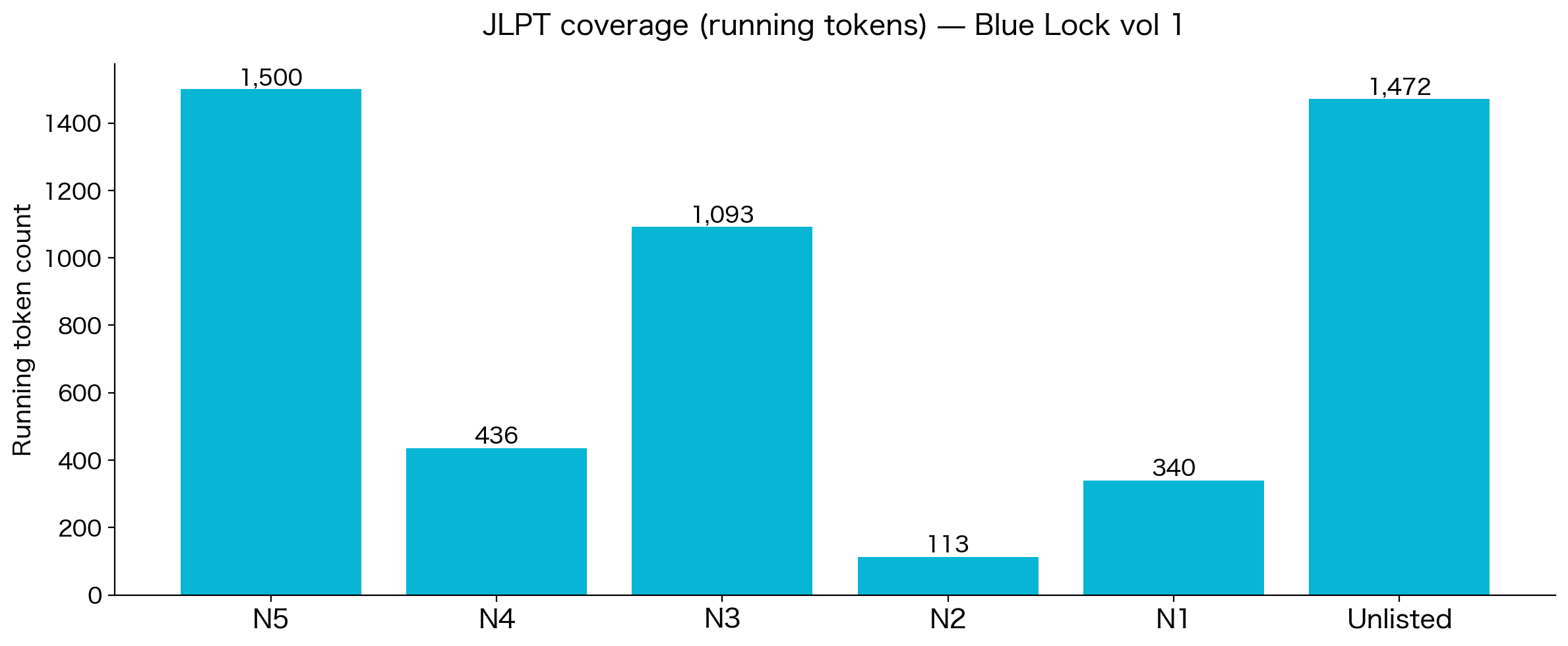
Read the last column. 39.1% of the running vocabulary is N5 or N4. Add N3 and you are at 61.2% of running vocabulary. The hard stuff (N2 and N1 combined) is just 9.2% of what you actually read, because the hardest words appear rarely. The unlisted bucket sits at 29.7% of running tokens. That is heavy. Almost a third of every page is either soccer terminology or the program's own coined philosophy vocabulary, and the JLPT does not test either of those.
Reader guidance by level
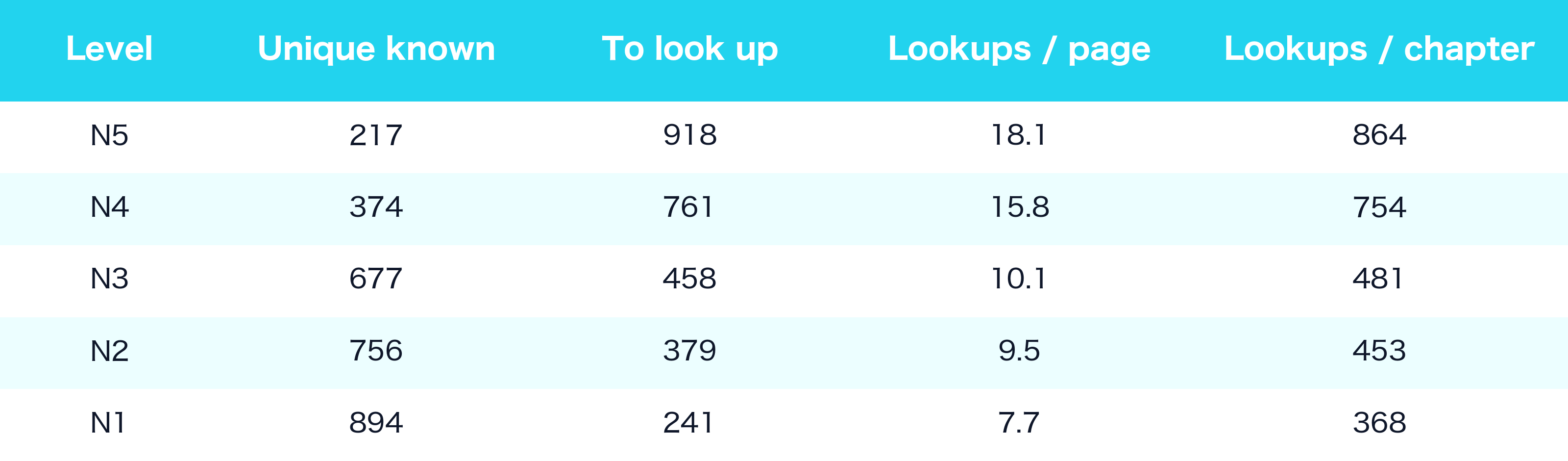
| Level | Unique words known | Unique words to look up | Lookups per page (first pass) | Lookups per chapter (first pass) |
|---|---|---|---|---|
| N5 | 217 | 918 | 18.1 | 864 |
| N4 | 374 | 761 | 15.8 | 754 |
| N3 | 677 | 458 | 10.1 | 481 |
| N2 | 756 | 379 | 9.5 | 453 |
| N1 | 894 | 241 | 7.7 | 368 |
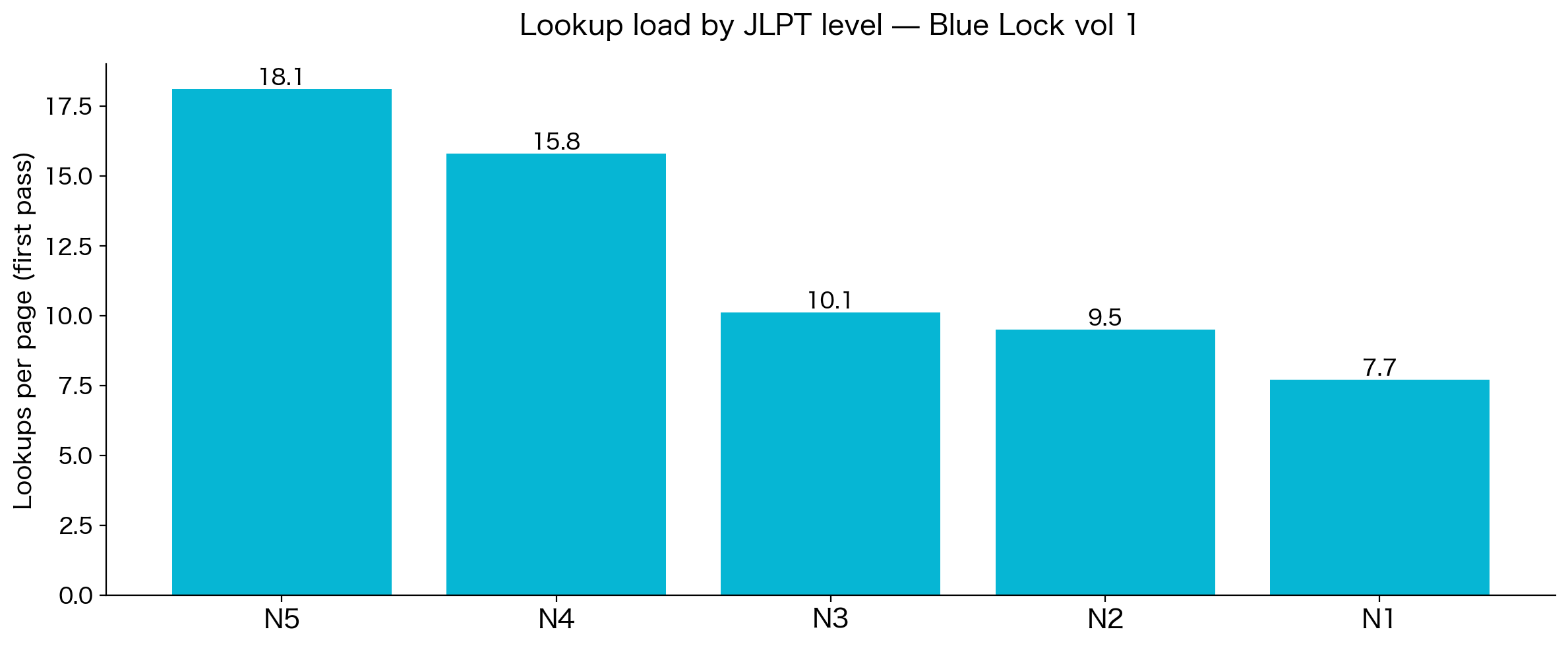
Lookups are unavoidable and painful, but you can lower the pain by completing the grammar foundation guide first. If you do not have kana yet, start there. That is table stakes.
N1 ≠ mastery
N1 means you passed a test. Real Japanese is not the test. Even N1 readers reading Blue Lock for the first time will look things up. An N1 reader still has 241 unique unlisted words in this volume alone, plus first-encounter recognition on vocabulary they know from study but have never seen embedded in soccer-broadcast shoptalk or Ego's philosophy lectures. Even at N1, expect 7.7 lookups per page on first pass. The best way to learn real Japanese is to read real Japanese. Then you can pass any test.
Kanji
Blue Lock volume 1 has 580 unique kanji on the page (counted from the actual surface forms, not lemma headwords; words written in pure hiragana do not count). 554 are joyo. 26 are non-joyo. That non-joyo count is moderate, lower than JJK (41) and Apothecary (51), higher than KN8 (18). Furigana is printed on every one.
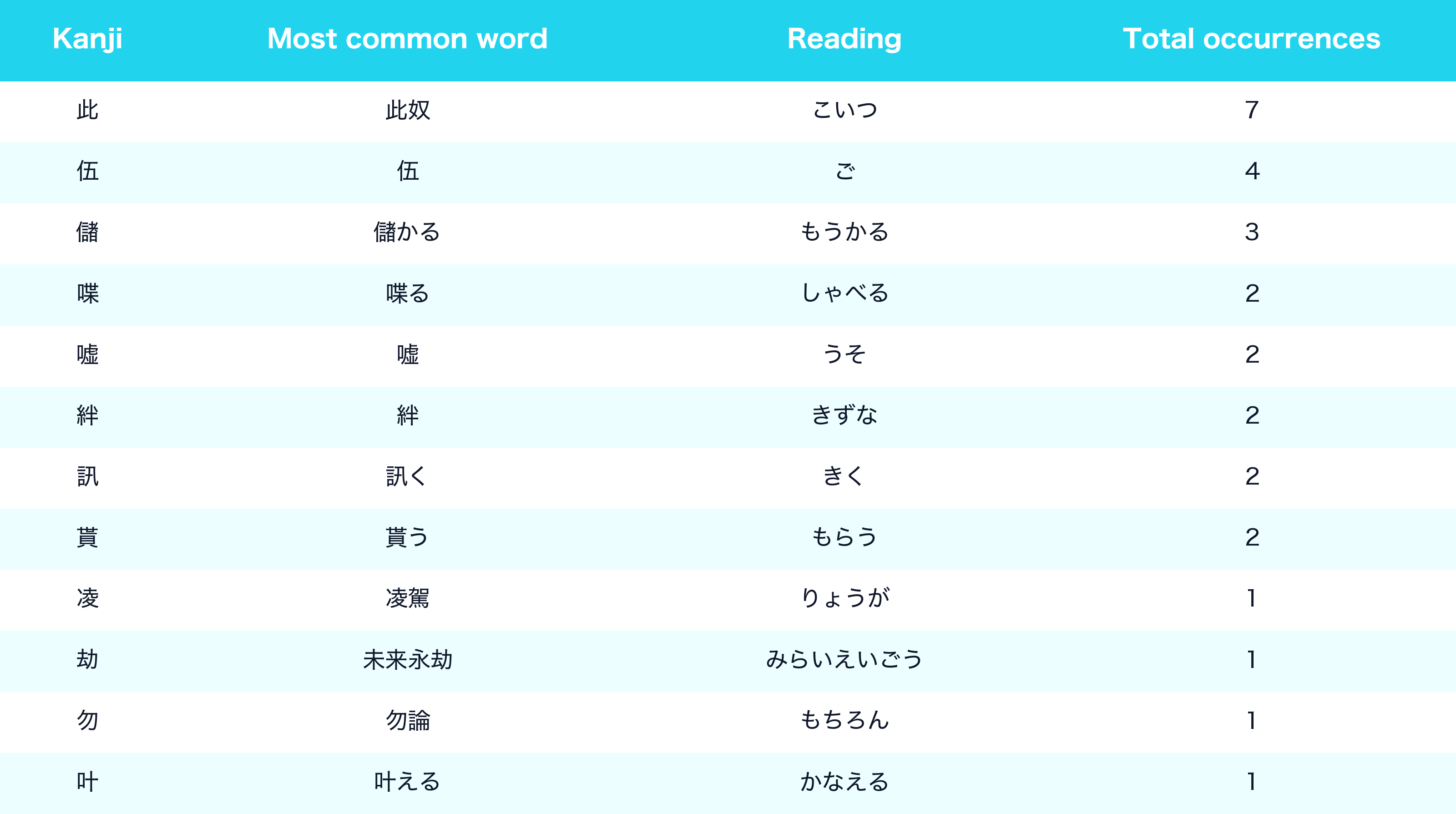
| Kanji | Most common word | Reading | Total occurrences |
|---|---|---|---|
| 此 | 此奴 | こいつ | 7 |
| 伍 | 伍 | ご | 4 |
| 儲 | 儲かる | もうかる | 3 |
| 喋 | 喋る | しゃべる | 2 |
| 嘘 | 嘘 | うそ | 2 |
| 絆 | 絆 | きずな | 2 |
| 訊 | 訊く | きく | 2 |
| 貰 | 貰う | もらう | 2 |
| 稀 | 稀代 | きたい | 1 |
| 叶 | 叶える | かなえる | 1 |
| 嬉 | 嬉しい | うれしい | 1 |
| 昂 | 昂る | たかぶる | 1 |
| 舐 | 舐める | なめる | 1 |
Most of the non-joyo set is what you would expect from any modern shonen: 此奴 (こいつ, this guy, 7 times) and 伍 (ご, used in lineup numbering, 4 times) lead the list, with archaic-style spellings like 喋る, 嘘, 訊く, and 貰う filling in the rest. None of it is series-specific. Where Blue Lock's kanji weight actually lives is in joyo characters combining into soccer-and-egoism compounds. 監獄 (かんごく, prison) is built from 監 (supervise) and 獄 (prison). Both joyo. Together they make the program's defining metaphor: 青い監獄, the Blue Prison. Same story with 戦術 (せんじゅつ, tactics, from 戦 + 術), 才能 (さいのう, talent, from 才 + 能), and 進化 (しんか, evolution, from 進 + 化). Every character in those compounds is on the joyo list, but the compounds themselves are sport-and-philosophy vocabulary you will not see outside this genre. The bottleneck is the word, not the kanji. Stop worrying about the character list. Start worrying about the compounds.
Frequency
Vocabulary appears in a long-tail distribution. 687 of 1,135 unique words (60.5%) appear exactly once; only 16 words appear 26 times or more. The small head of the curve is where the leverage lives.
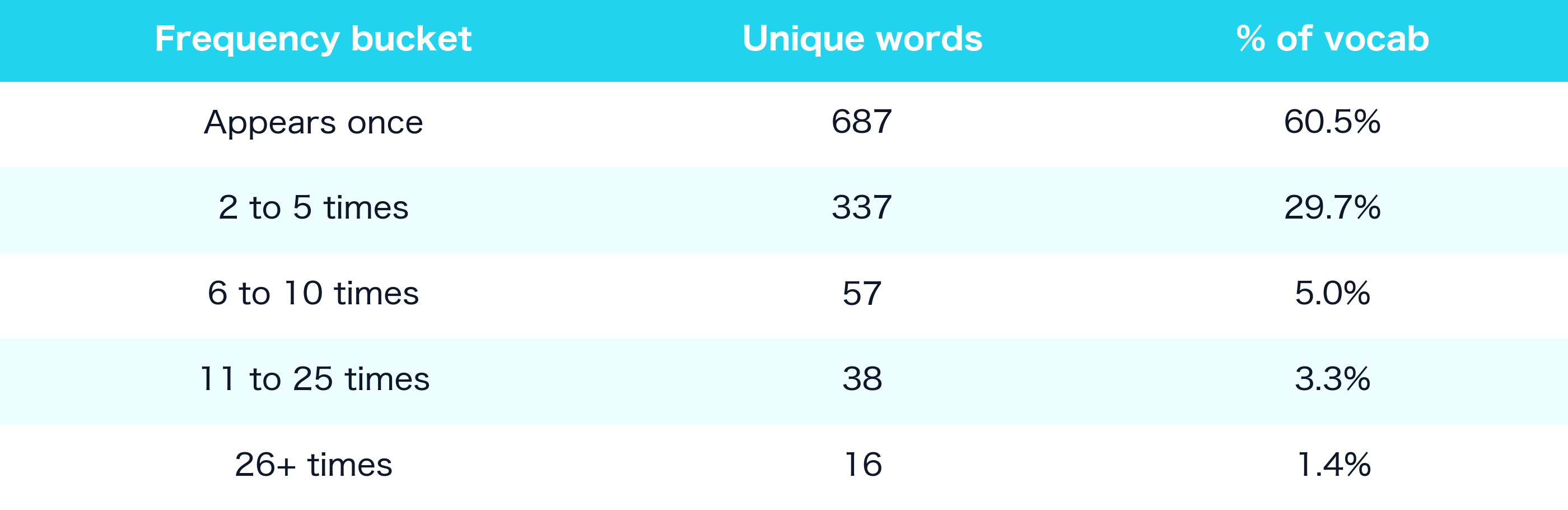
| Frequency bucket | Unique words | % of vocab |
|---|---|---|
| Appears once | 687 | 60.5% |
| 2 to 5 times | 337 | 29.7% |
| 6 to 10 times | 57 | 5.0% |
| 11 to 25 times | 38 | 3.3% |
| 26+ times | 16 | 1.4% |
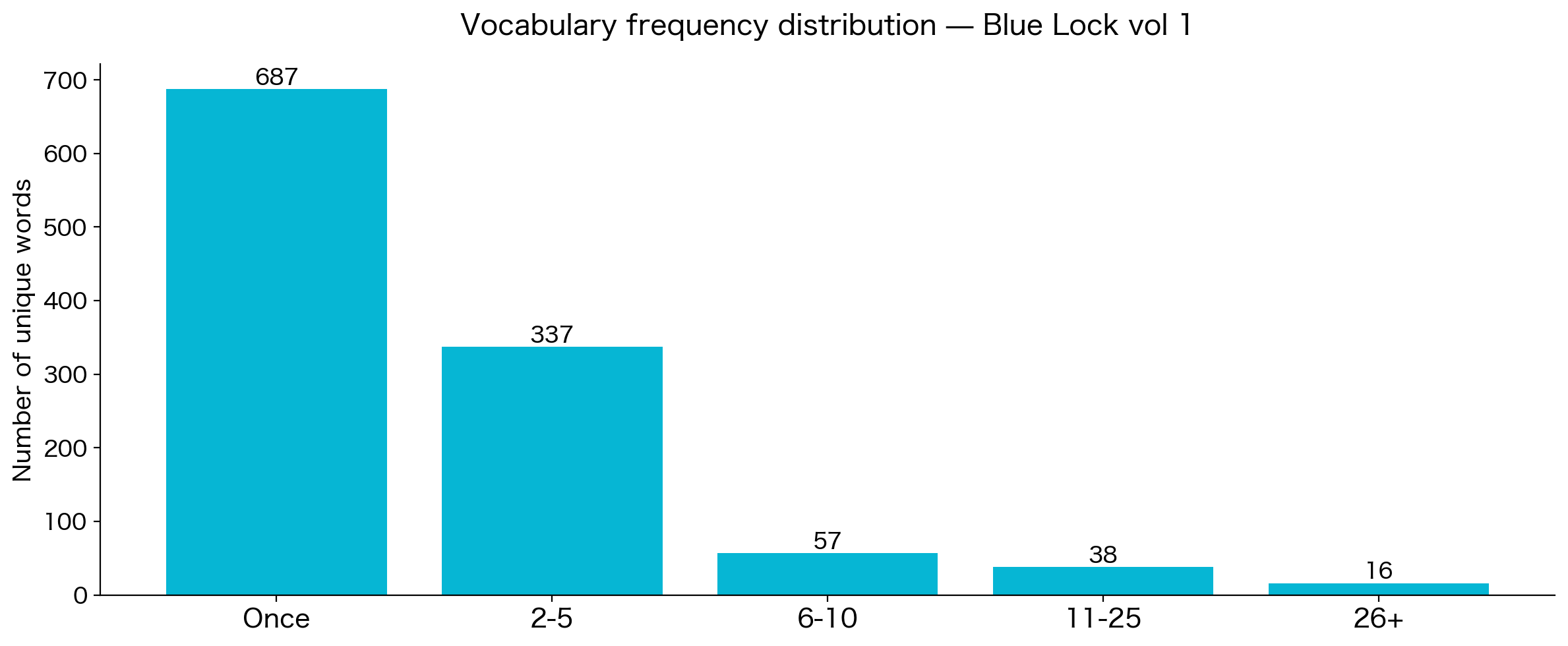
Do not read "appears once" as "not worth learning." These words recur across the series. Later volumes pick them up and use them again. The 111 words that appear six times or more are the real spine of volume 1 specifically.
The 20 most frequent content words
Pre-study these 20 and you have learned the most common content words on almost every page. By the time you finish volume 1, all 20 are locked into your memory just from how often they appear.
Particles, auxiliary verbs, pronouns, conjunctions, proper nouns, and adnominals are excluded so the list surfaces meaningful content words.
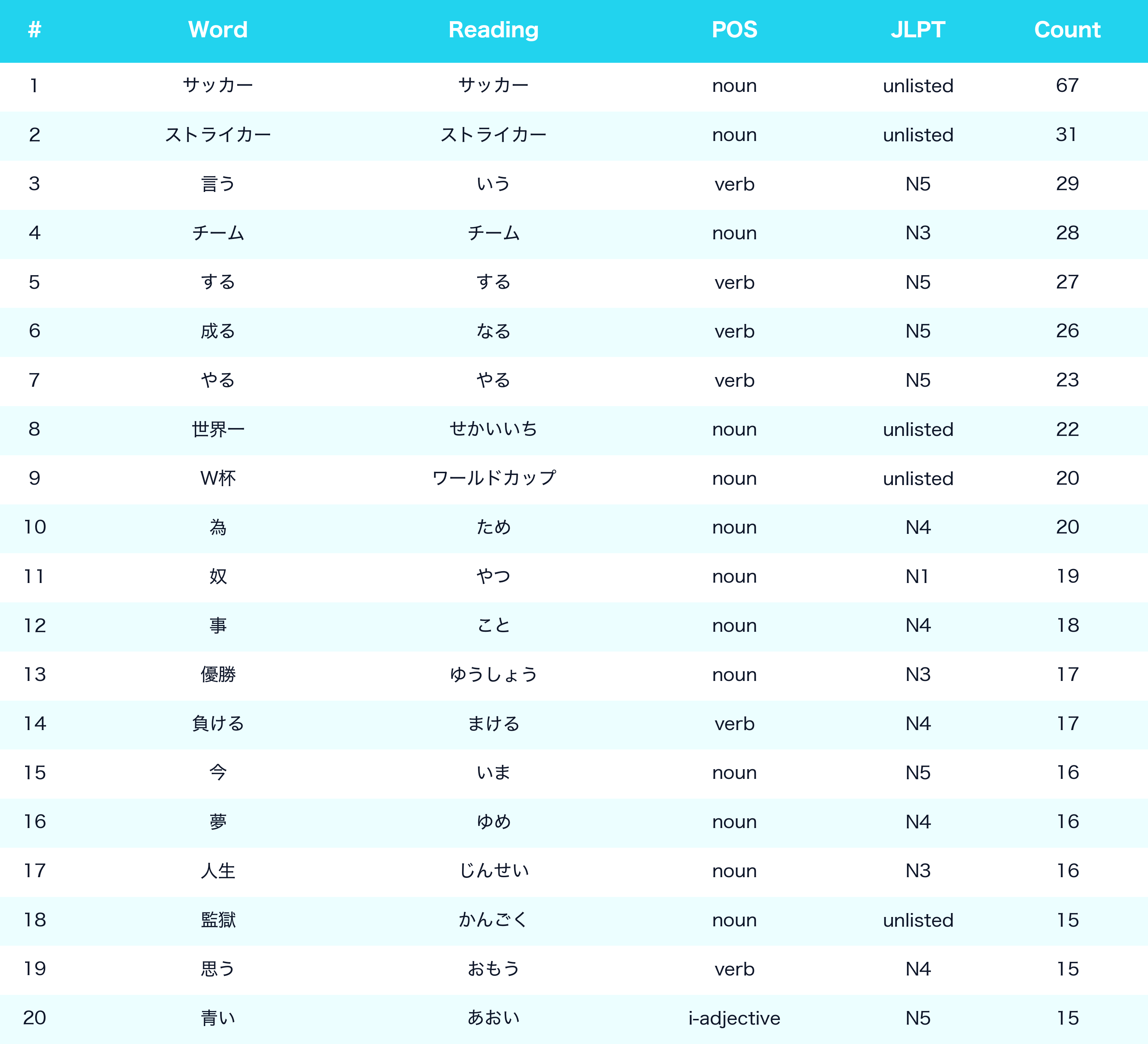
| # | Word | Reading | POS | JLPT | Count |
|---|---|---|---|---|---|
| 1 | サッカー | サッカー | noun | N5 | 67 |
| 2 | ストライカー | ストライカー | noun | unlisted | 31 |
| 3 | 言う | いう | verb | N5 | 29 |
| 4 | チーム | チーム | noun | N3 | 28 |
| 5 | する | する | verb | N5 | 27 |
| 6 | 成る | なる | verb | N5 | 26 |
| 7 | やる | やる | verb | N5 | 23 |
| 8 | 世界一 | せかいいち | noun | N3 | 22 |
| 9 | W杯 | ワールドカップ | noun | unlisted | 20 |
| 10 | 為 | ため | noun | N4 | 20 |
| 11 | 奴 | やつ | noun | N1 | 19 |
| 12 | 事 | こと | noun | N4 | 18 |
| 13 | 優勝 | ゆうしょう | noun | N3 | 17 |
| 14 | 負ける | まける | verb | N4 | 17 |
| 15 | 今 | いま | noun | N5 | 16 |
| 16 | 夢 | ゆめ | noun | N4 | 16 |
| 17 | 人生 | じんせい | noun | N3 | 16 |
| 18 | 監獄 | かんごく | noun | N1 | 15 |
| 19 | 思う | おもう | verb | N4 | 15 |
| 20 | 青い | あおい | i-adjective | N5 | 15 |
Two of these are worth calling out. サッカー (soccer) is the genre-defining noun the entire series is built on, and it appears 67 times in volume 1 alone. If you only learn one word before opening this manga, learn this one. It will carry you through every page.
ストライカー (striker) is the role-defining noun Ego Jinpachi anchors his entire program around: not a forward, not a goal-scorer, not a teammate, the most selfish and most lethal point-creator on the pitch. It appears 31 times in volume 1 directly, and it carries the cultural weight of Ego's entire egoism thesis. Pre-study this one and the rhetoric of the lecture panels stops being a wall.
How each main character speaks
潔 世一 (Isagi Yoichi)
High-school striker, the protagonist, the recruit who walks into Blue Lock thinking he already understands soccer and gets that conviction broken on page one. Isagi uses 俺 (おれ) for "I." His speech is plain teenage shonen Tokyo: contracted endings (じゃねえ for じゃない), sentence-final よ and ぞ, and inner-monologue blocks that swing between self-deprecation and sudden declarations of intent. He is the easiest main character to read once you accept that half his lines are him talking to himself. The narration in his head is the spine of the volume.
蜂楽 廻 (Bachira Meguru)
The grinning chaos forward who befriends Isagi in chapter 2. Also uses 俺. Sentence-final よ, ね, and a steady drip of slangy fragments that read more like cheerful screaming than sentences. Bachira drops particles, breaks grammar for energy, and frequently ends turns on a single noun (e.g. サッカー!). Easy to parse word-by-word once you stop expecting complete predicates.
凪 誠士郎 (Nagi Seishirō)
The bored prodigy who joins the program because someone dragged him in. 俺 for "I," flat affect, low-energy plain form, lots of だるい (a hassle) and めんどくさい (annoying). Nagi's lines are the shortest in the volume. When he does talk, the structure is usually 〜だけ (just) or 〜だろ (right?), low-effort even when the content is dramatic. His register is the easiest grammar in the book and the hardest tone to read in English.
絵心 甚八 (Ego Jinpachi)
The program creator and the manga's ideological centre of gravity. Ego runs the entire first volume in lecture mode: long ですます-form sentences, English loanwords (ストライカー, エゴイスト, レボリューション) dropped into Japanese for emphasis, and a clinical cadence that mimics a TED talk more than a coach's briefing. He is the hardest character to read in volume 1, not because his grammar is hard (it is textbook polite-form) but because every sentence is a vocabulary brick. If a panel feels like it should be slow and it is, Ego is talking. Pre-study the egoism vocabulary and his lectures parse at twice the speed.
Expressions with depth
These are volume 1 expressions where the dictionary entry will mislead you. Surface meaning is one thing. What the phrase actually does in a panel is another.
エゴ (えご, ego)
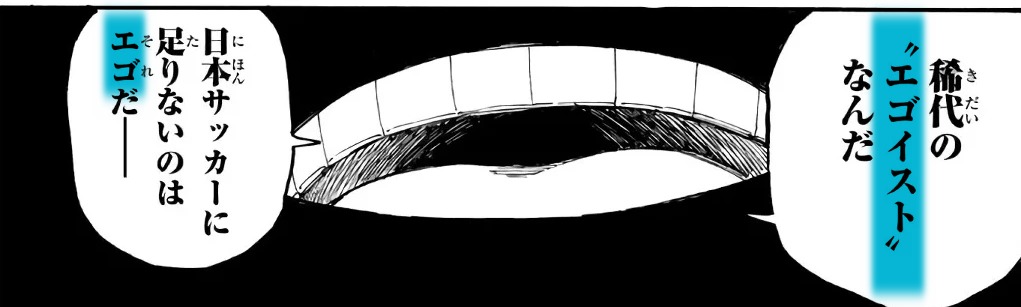
Dictionary: "ego." A katakana loanword. The texture: in everyday Japanese, エゴ is an insult. To call someone エゴイスト is to call them selfish, self-centred, somebody who refuses to read the room. Ego Jinpachi inverts the entire connotation in volume 1. When he tells the recruits 稀代のエゴイストなんだ 日本サッカーに足りないのはエゴだ ("the kind of generation-defining egoist Japanese soccer has been missing"), he is reframing a moral failing as the only viable strategy for producing a world-class striker. The word does not mean "ego" in this manga. It means "the willingness to be the only person in the room who matters," and the entire program is built on rehabilitating it.
ストライカー (すとらいかー, striker)
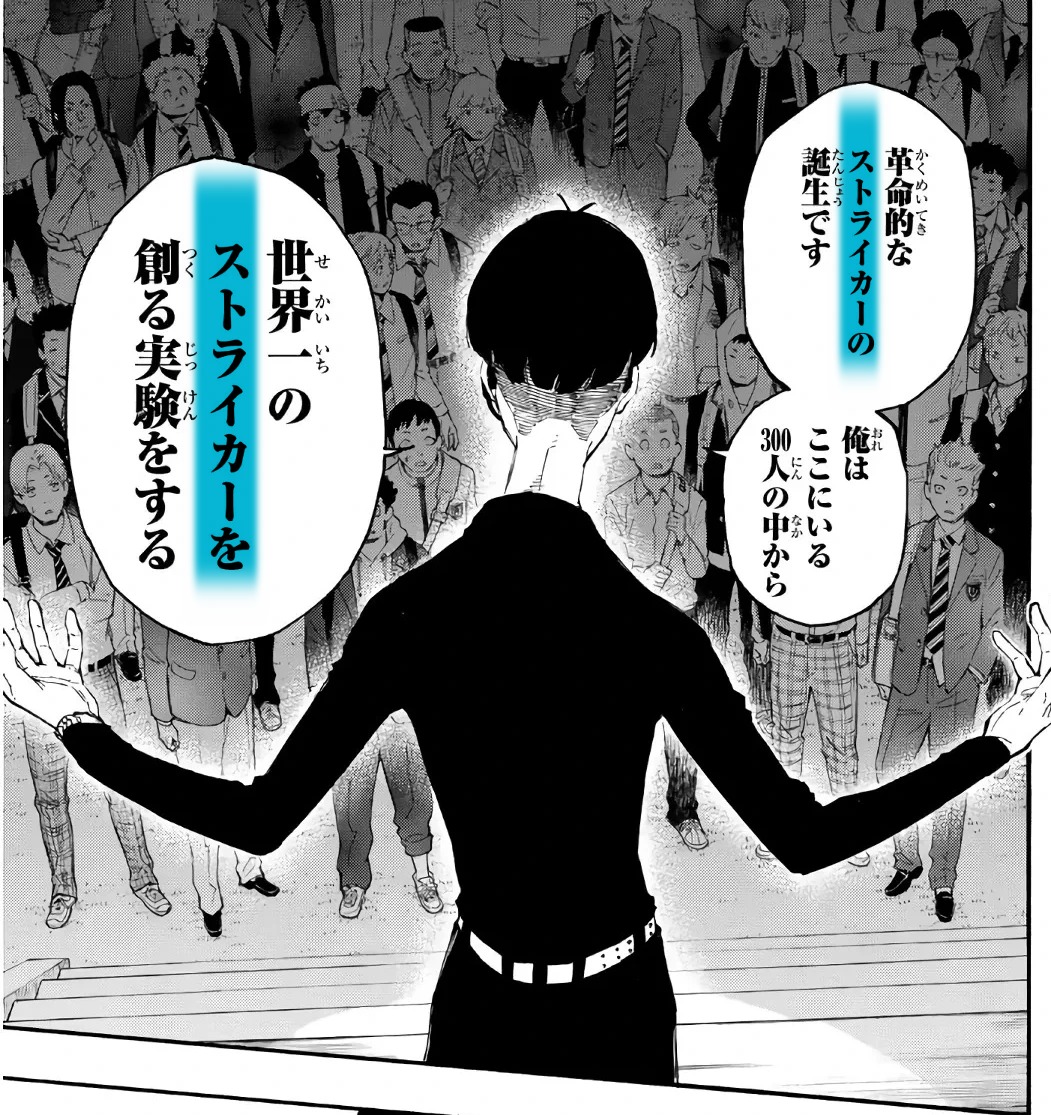
Dictionary: "striker." A soccer position, the forward whose job is to score goals. The texture: every soccer position in Japanese borrows from English (フォワード, ミ ッドフィルダー, ディフェンダー), but ストライカー is the one Blue Lock makes ideological. Ego frames the program as 革命的なストライカーの誕生です... 世界一のストライカーを創る実 験 ("the birth of a revolutionary striker... an experiment to create the world's best striker"), and from that line forward, the word stops describing a position and starts describing a moral status. A ストライカー in Blue Lock is the player who refuses to pass. The one who decides the game alone. Translate it as "forward" and the rhetoric collapses.
監獄 (かんごく, prison)
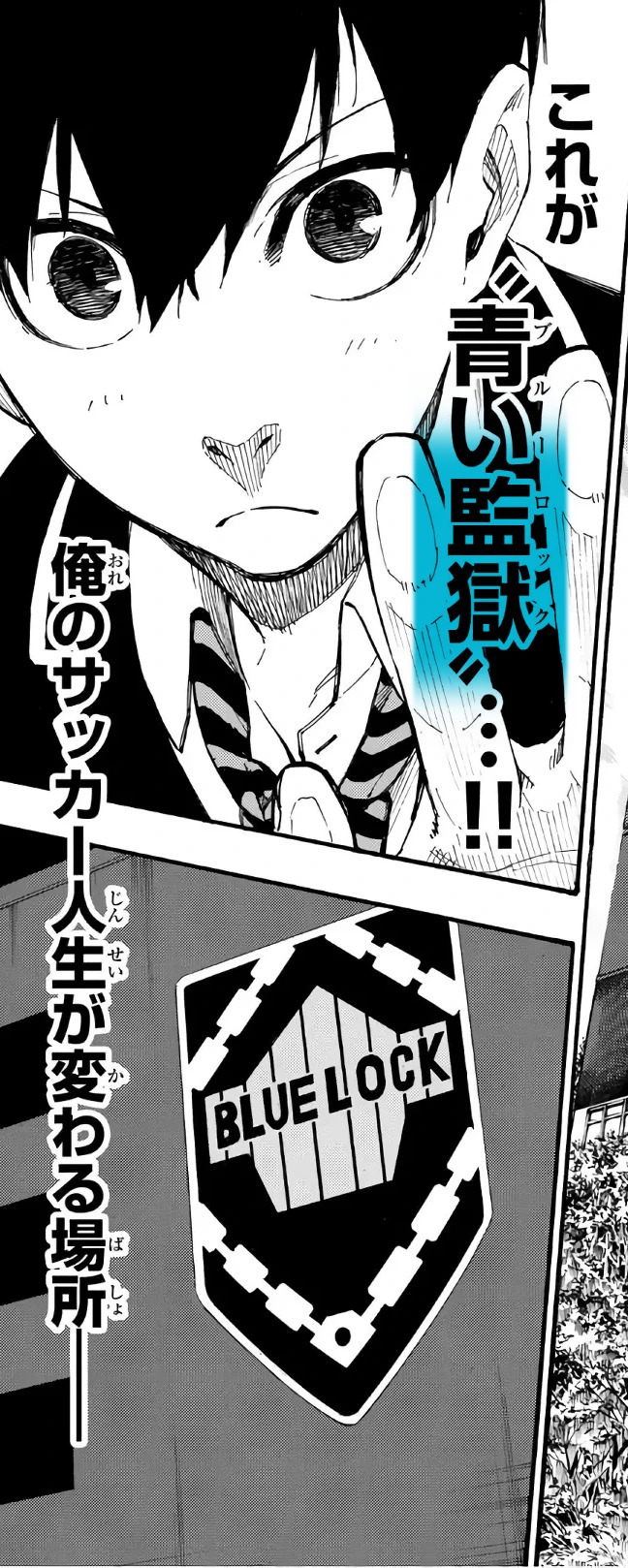
Dictionary: "prison." The texture: the program's name in Japanese is 青い監 獄, the Blue Prison. The English title flattens it into "Blue Lock," but the Japanese is a deliberate genre-violation. 監獄 carries the connotation of an old-style carceral institution: walls, guards, no exit. Isagi's chapter-2 line これが青い監獄〃 ...!! 俺のサッカー人生が変わる場所 ("this is the Blue Prison... the place my soccer life changes") reads as both excited and trapped. The recruits chose to enter, but once they enter they cannot leave until the program is finished. Read "Blue Prison" with both meanings stacked: voluntary commitment, and a literal cage.
世界一 (せかいいち, world's best)
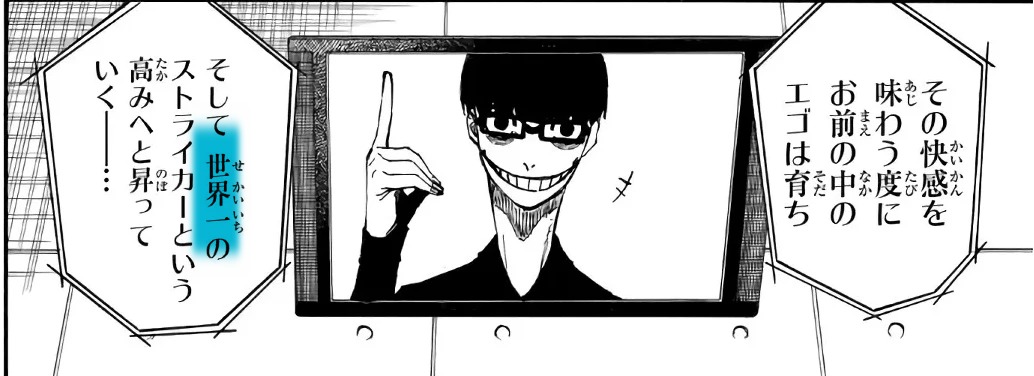
Dictionary: "world's best" or "number one in the world." The texture: in Japanese sports rhetoric, 世界一 is a phrase reserved for actual W杯 winners and Olympic champions. Blue Lock weaponises it as the program's sole reward. When Ego says その快感を味わう度にお前の中のエゴは育ち そして世界一のストライカーという高みへと昇 っていく ("each time you taste that thrill, the ego inside you grows, and you ascend to the heights of being the world's best striker"), the word is doing two things at once: it is the literal goal of the program, and it is the rhetorical lever Ego uses to justify everything else. There is no second prize in Blue Lock. 世界一 or nothing.
才能 (さいのう, talent)
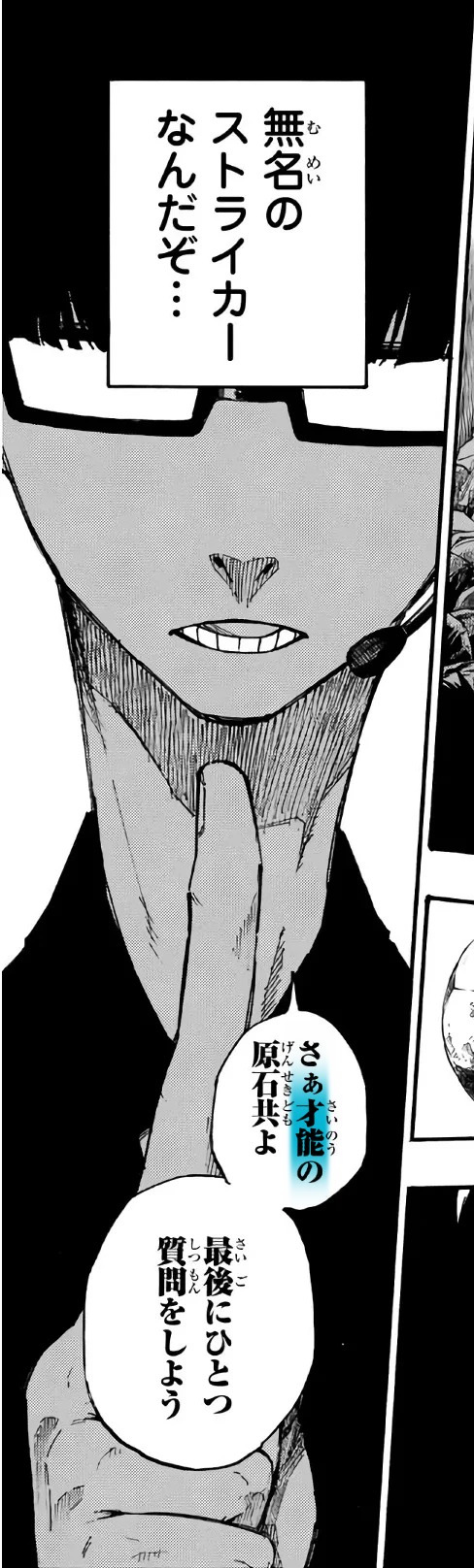
Dictionary: "talent." The texture: the standard Japanese word for innate ability, the kind a teacher uses about a star student. Blue Lock keeps the word but strips the compliment off it. Ego addresses the recruits as さあ才能の原石共よ 無名のストライカーな んだぞ ("come now, you raw lumps of talent, you nameless strikers"), and the register is industrial, not flattering. 才能の原石 (rough stones of talent) reframes the recruits as raw material to be processed. The word still means "talent," but the connotation has shifted from gift to ore. Cut, polished, or discarded.
Pop culture and context in volume 1
W杯 (ワールドカップ) and the Japanese national team narrative. Blue Lock opens with a real-world premise: Japan loses in the round of 16 at the World Cup, the national federation panics, and a private actor steps in to engineer the country's first world-class striker. W杯 appears 20 times in volume 1, and every appearance carries the weight of decades of Japanese soccer fandom (the J-League launch in 1993, the 2002 co-hosted Cup, every quadrennial round-of-16 elimination since). When the manga uses W杯, it is not a hypothetical trophy. It is the grief Japanese fans actually carry.
The team-first sports-manga trope, deliberately broken. Japanese sports manga from キャプテン翼 onward built its rhetoric on teamwork, sacrifice, the unselfish pass, the senpai-kohai bond. Blue Lock is in direct ideological combat with that lineage. The slogan 日本サッカーに足りないのはエゴだ ("what Japanese soccer is missing is ego") is calibrated to scandalise a reader raised on the team-first register. Every panel where Bachira passes when he should have shot is the manga reminding you of the tradition it is trying to demolish.
Selection-show register. The structure of the chapter-1 induction (300 recruits dropped into a sealed facility, a single charismatic host laying out the rules, ranked elimination matches) is borrowed almost wholesale from Japanese reality-TV audition shows (terrace-house elimination dinners, idol-group survival rankings). Ego Jinpachi speaks in the cadence of a host. The recruits are positioned like contestants. The institutional language (規定, ランキング, 脱落) belongs to that register, not to a coaching manual.
ノエル・ノア (Noel Noa) and the Ballon d'Or reference. Volume 1 name- drops a fictional player, ノエル・ノア, framed as the world's best active striker. The name is invented but the role he plays in the rhetoric is real-world: he stands in for Mbappé or Haaland or whichever Ballon d'Or-tier player the reader cares about. Blue Lock uses this fictional anchor to sidestep licensing while still letting Ego point at a real archetype. When Ego invokes Noel Noa, the cultural slot is "the player Japanese soccer has never produced."
Inside the app: one panel, fully broken down
Reading manga in Japanese is, at the bottom of it, a vocabulary-acquisition problem. Let me get you one panel: chapter 4, page 11, Ego Jinpachi's monologue on what a striker actually is. All the context around it is broken down here the same way The Ashiba App provides it, so you finish this section actually understanding the rhetoric that defines volume 1, not just having seen it.
Chapter 4, page 11: Ego on the origin of strikers
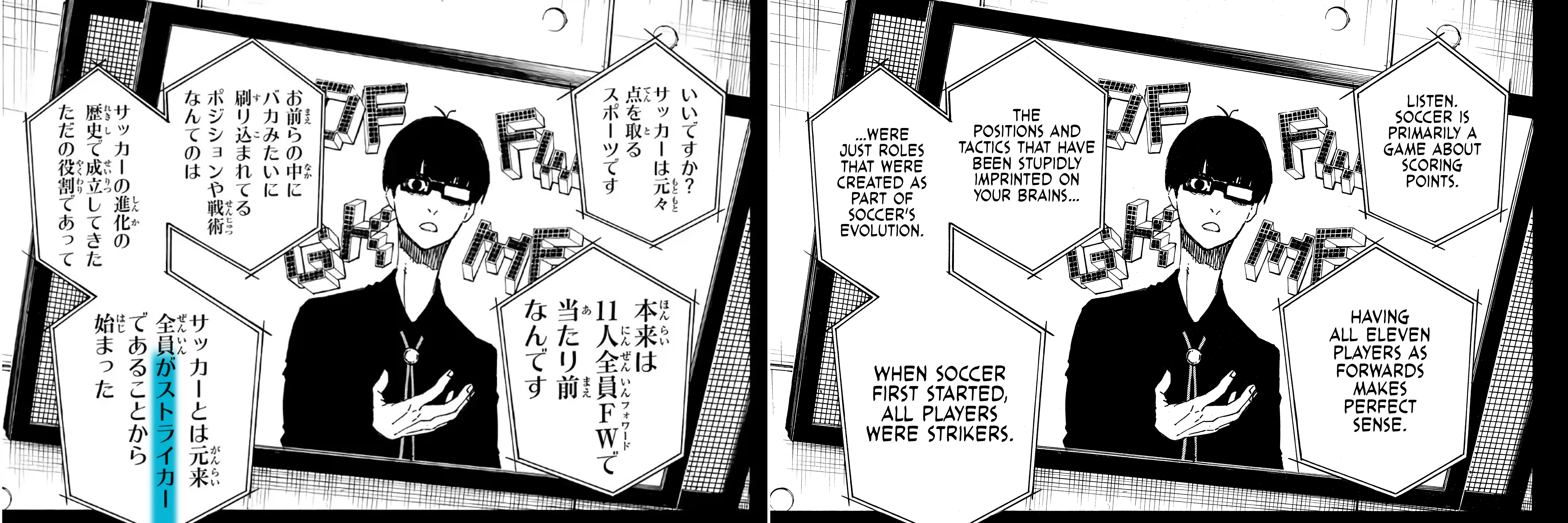
Scroll the image sideways to read the Japanese in full size.
Summary. Ego is mid-lecture in front of the surviving recruits. He resets their entire understanding of soccer in three sentences: the sport is about scoring, therefore every player should be a striker, and the positions and tactics they have spent their lives learning are bureaucratic decoration on top of an originally simple game. This is the panel that establishes the philosophy Blue Lock spends every later volume defending.
Textbox 1
JP: いいですか?サッカーは元々点を取るスポーツです
EN: Listen up. Soccer, originally, is a sport about scoring points.
Overview: The opening of the lecture, set in polite ですます-form. Ego is establishing first principles.
Textbox 2
JP: 本来は11人全員FWで当たり前なんです
EN: By rights, all 11 players being forwards is the natural state.
Overview: The provocative claim. Every position other than forward is reframed as a deviation.
Textbox 3
JP: お前らの中にバカみたいに刷り込まれてるポジションや戦術なんてのは
EN: The positions and tactics that have been hammered into your heads like a bad joke...
Overview: Register flips from polite to confrontational. お前ら, バカみたいに, 刷り込まれてる. Ego is dismissing their entire training.
Textbox 4
JP: サッカーとは元来全員がストライカーであることから始まった歴史の中で成立してきた"ただの役割"
EN: Soccer originally started with all 11 players being strikers. Positions are merely roles that took shape over the course of history.
Overview: The thesis. Positions and tactics are framed as historical accidents, not essential truth.
Breakdown:
- サッカー: soccer; the central noun, 67 occurrences in volume 1
- 元々 (もともと): originally; N3 adverb
- 点 (てん): point; N5 noun
- 取る (とる): to take, to score; N5 verb
- スポーツ: sport; N5 noun
- 本来 (ほんらい): originally, by rights; N3 noun used adverbially
- 11人 (じゅういちにん): 11 people; numeric
- 全員 (ぜんいん): all members; N3 noun
- FW (フォワード): forward; soccer position abbreviation
- 当たり前 (あたりまえ): natural, expected; N3 noun
- バカ (ばか): fool; N5 noun, here used adverbially with みたいに
- 刷り込まれる (すりこまれる): to be imprinted, to be hammered in; passive form of 刷り込む
- ポジション: position; loanword noun
- 戦術 (せんじゅつ): tactics; N1 noun
- 元来 (がんらい): originally, fundamentally; N1 adverb
- ストライカー: striker; the highlighted word, 31 occurrences in volume 1
- 始まる (はじまる): to begin; N5 verb
- 歴史 (れきし): history; N3 noun
- 成立 (せいりつ): establishment, formation; N2 noun
- ただ: merely, just; adverb
- 役割 (やくわり): role; N3 noun
Key points
- The register is a lecture, not a sports panel. Ego uses ですます-form for the establishing claims and switches to plain-form contempt (お前ら, なんてのは) for the demolishing claims. That oscillation is intentional and is how he keeps the recruits off balance.
- 本来 and 元来 are doing the same job in two different sentences: stripping away accumulated convention and pointing at a notional original state. Both are N1-N3 adverbs that English translates flat as "originally," but in Japanese they signal a philosophical move, not a historical one.
- 刷り込まれる is the verb that makes the whole panel land. It is the technical term for imprinting in animal psychology (ducks, geese), and Ego uses it to reduce his recruits' entire soccer education to involuntary conditioning. Pre-study this verb and the rhetorical force of the page registers in real time.
How to actually read volume 1
- Get a foundation. How much you need depends on how much discomfort you can sit with. Genki I and II is the polished path. At a minimum, lock in N5. Nothing else moves until kana and basic grammar are automatic.
- Start with chapter 1. Take your time. Not a week. Not a day. This is the first chapter of manga you have ever read in Japanese. Set a timer for 15 minutes. Early on, you crack one to three sentences in that window. Later, you crack a full chapter. Consistency compounds. Rack up the reps.
- When you get stuck, reference the translation. Looking things up is not failure. It is learning. The fastest way to get unstuck is to see the answer and understand why the sentence means what it means. Goal: parse the sentence. Match the English to the Japanese, identify the word or grammar that blocked you, and move on. You will hurdle (probably in chapter 1 when Ego runs the program-introduction lecture at full speed, or in chapter 4 when the lecture-mode demo panel above stacks egoism vocabulary on top of soccer vocabulary). Those panels are dense. The answer is not to grind harder. The answer is what I wrote about in Why You Will Quit Learning Japanese: put the book down and come back tomorrow.
If you want the deeper version of this reading strategy, the fastest way to learn Japanese article has the volume-control framework in full.
The Takeaway
The main reason reading manga in Japanese is hard is the sheer amount of vocabulary you do not know.
Most readers never get past this. The pain is too great. The effort-to-reward ratio collapses, and the book gets shelved.
The easiest way out is to pre-study the words you do not know that will appear in the chapter you are about to read. The Ashiba App does this for every chapter of every series I cover. It surfaces the vocabulary, shows readings and POS, and includes grammar breakdowns so you see how each word is being used. Nothing is studied in isolation. Every flashcard carries its full panel context. You see the word in the sentence in the panel where it lives.
You can get started today.
Frequently asked questions
Should I watch the anime before reading Blue Lock in Japanese?
Yes. The Blue Lock anime aired in 2022 to 2023 (season 1) and 2024 (season 2, plus the Episode Nagi spinoff film), and the early episodes track volume 1 closely. Watch episodes 1 through 3 before you open the manga. The anime gives you the visual context for the program facility, the recruits, and the cadence of Ego's lectures, so the manga reads with familiar pictures already loaded. Watch the same episodes again after you finish volume 1 and you will feel exactly how much more you picked up by reading.
Does Blue Lock have furigana?
Yes. The Japanese print and digital editions print furigana on every kanji, which means kanji is not the blocker. The blocker is vocabulary count.
Do I need to know all 580 kanji before I start?
No. Furigana solves the kanji-recognition problem on day one. What you need is enough vocabulary that the words you can already read carry the page.
How long will volume 1 take to read?
For an N3 reader on a first pass at the lookup rate above (about 10.1 lookups per page), plan for 6 to 9 hours of focused reading time spread across multiple sessions. An N1 reader will finish it in 3 to 4 hours but will still pause on the unlisted soccer-and-egoism vocabulary. Reread for fluency afterward.
Should I start with volume 1 or jump in further?
Follow the fun. If a different volume is pulling you harder, start there. The reasons to pick volume 1 anyway: the program vocabulary (青い監獄, ストライカー, エゴ, 才能, 世界一) and Ego's rhetorical framework are introduced here and used unchanged in every later volume. Skip it and you spend volume 2 looking up volume 1 words.
Where can I buy Blue Lock volume 1 in Japanese?
Free preview: read the early chapters of Blue Lock in Japanese on Magazine Pocket, Kodansha's official Weekly Shōnen Magazine reader. For the English translation, the manga is published by Kodansha USA and available through K MANGA, Kodansha's English manga reader, with the first volumes also on Kindle, Comixology, BookWalker, and Barnes & Noble. Digital recommendation for Japanese: Amazon Japan Kindle or BookWalker. Physical paperback also via Amazon Japan or BookWalker.