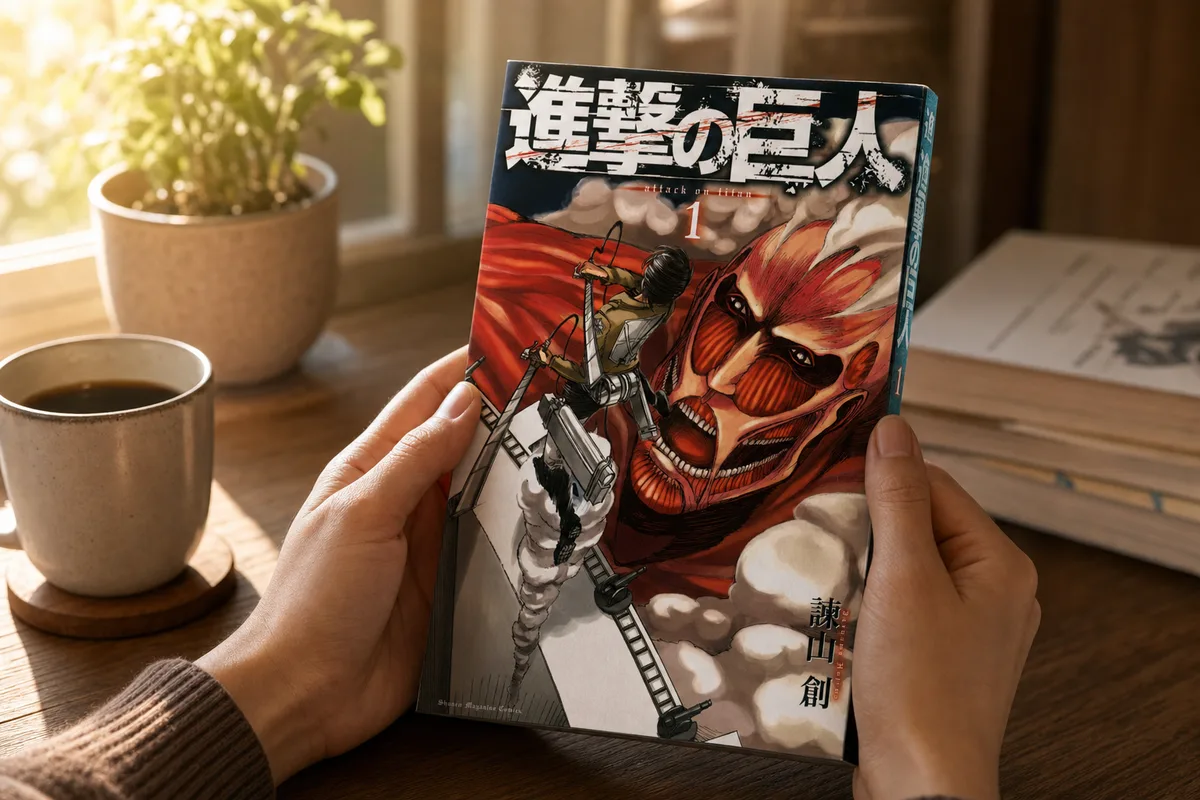
Volume 1 of Attack on Titan (進撃の巨人) contains 1,088 unique vocabulary items across 4 chapters, 188 pages, 917 panels, and 4,250 textboxes. The script uses 700 unique kanji on the page, and only 20 are non-joyo. The hardest single thing in this book is not the kanji, not the grammar, and not even the volume of new words. It is the institutional vocabulary: a paramilitary state behind a 50-meter wall has names for every wall, every corps, every rank, every piece of gear, and Hajime Isayama drops them on you in chapter 4 in long expository monologues. If you have finished Genki II, you already know about 349 of the words in this volume outright. You have roughly 739 more to learn.
That is the whole problem with Attack on Titan volume 1 in one paragraph. Here is exactly what is in this book, and exactly what you need to read it.
Every number in this article comes from Ashiba's production corpus, measured against the official N5 to N1 JLPT vocabulary lists and the 2,136-character joyo kanji set. Last measured 2026-05-01.
Is Attack on Titan volume 1 hard to read in Japanese?
Upper-intermediate. Not beginner. Not advanced. If you can read a Genki II dialogue without stopping every line, you will finish volume 1. It will take longer than you think, and you will look up more words than you want to. You will also finish.
People mis-rate this book in both directions. Here is the actual shape.
What makes it easier than you think
Kanji is not a blocker. Furigana, the small phonetic companion written above every kanji, is provided everywhere in this manga: every kanji, every appearance, every chapter. Attack on Titan ran in Bessatsu Shōnen Magazine, where Kodansha follows full-furigana practice for shōnen titles. The book hands you the readings on the page. Volume 1 uses 700 unique kanji, and 680 of them (97.1%) are joyo. Even when they are not, the manga prints the reading anyway.
The 20 non-joyo kanji are a thin layer of stylistic flourishes. 此奴 (こいつ, this guy) appears 7 times, 捧げる (ささげる, to offer up) appears 3 times, 筈 (はず, expectation) appears 3 times, 殆ど (ほとんど, almost) appears 2 times, 貰う (もらう, to receive) appears 2 times. The rest are one-off appearances: 殺戮 (さつりく, slaughter), 凱旋 (がいせん, triumphant return), 瓦礫 (がれき, rubble), 砦 (とりで, fortress), 屁理屈 (へりくつ, sophistry), 怯える (おびえる, to flinch), 些細 (ささい, trivial). All of them get furigana every appearance.
Stop worrying about the kanji list. The book hands you the readings.
What makes it harder than it looks
The long tail. 741 unique words appear exactly once in the entire volume. That is 68% of the unique vocabulary. This is the single biggest difficulty in volume 1, not kanji, not grammar. Most words you encounter do not repeat enough times within volume 1 to give you the in-volume spaced-repetition benefit. They will recur across the series. They will not recur much in this book.
Vocabulary acquisition is iterative. A word does not stick the first time. Each word takes multiple painful encounters before recognition becomes automatic, and every encounter breaks the story flow. You stop, you look up, you re-read the sentence, you re-set the panel in your head, you keep going. The tipping point where the manga starts reading easily is further out than most learners expect. The only path through is volume.
There is one way to lower the pain without lowering the reps. Pre-study the chapter vocabulary before you open the chapter. That moves the lookups out of the story and into focused study time. Same words, different context. The story stays intact.
The second-largest weight is the institutional vocabulary domain. The walled city is run by three branches of a paramilitary force, and each one comes with its own name, role, and rank vocabulary: 駐屯兵団 (ちゅうとんへいだん, Garrison Regiment) appears 7 times, 調査兵団 (ちょうさへいだん, Survey Corps) appears 17 times, 憲兵団 (けんぺいだん, Military Police Brigade) appears 11 times, 訓練兵 (くんれんへい, trainee soldier) appears 5 times. The signature gear gets one of the most visually iconic names in shōnen: 立体機動装置 (りったいきどうそうち, Three-Dimensional Maneuver Gear). On top of that you get the wall-defense lexicon: 壁 (かべ, wall) appears 31 times, 壁外 (へきがい, outside the walls), ウォール・マリア (Wall Maria), ウォール・ローゼ (Wall Rose), ウォール・シーナ (Wall Sina). 206 unique words sit outside the JLPT framework entirely after Gemini-classification, and the bulk of those are corps-and-wall nouns no general dictionary will help you learn in advance. Pre-study them or they eat your reading time.
You don't need permission. Just go for it.
The real question is not whether this book is at your level. The real question is whether the pain is tolerable for the reward. If you actually want this story, the level mismatch is just a tax on time, not a wall. You pay it in lookups and re-reads and slow chapters until the cost goes down. Always read above your level. Attack the stories that motivate you. Permission is something other people give themselves and then complain about. Just go for it.
What the data says about volume 1
Every number below was calculated from the approved vocabulary set for Attack on Titan volume 1 in Ashiba's production database. JLPT level was assigned by matching against the official N5 to N1 vocabulary lists. Words not on any list were classified by Gemini 3 Pro against context. 206 unique words remained outside the N5 to N1 framework and are marked "unlisted" (proper nouns, paramilitary corps names, gear jargon, archaic registers, slang, onomatopoeia).
A note on terminology. Running vocabulary means every word token as it occurs in the text, counting every repeat. If 巨人 appears 53 times, that is 53 running tokens from 1 unique word. Unique vocabulary means the distinct words themselves, counted once each.
Volume 1 at a glance
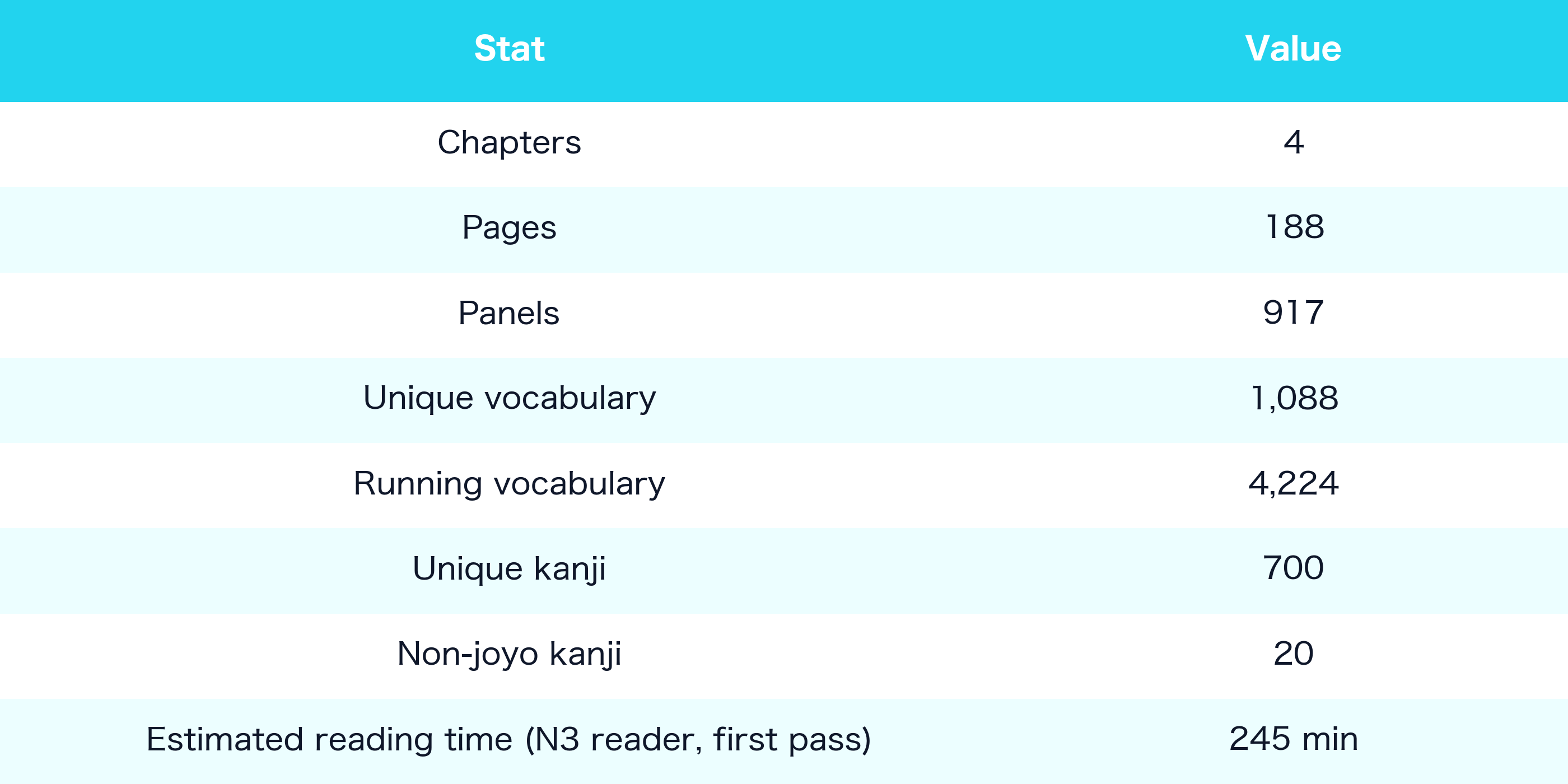
| Stat | Value |
|---|---|
| Chapters | 4 |
| Pages | 188 |
| Panels | 917 |
| Textboxes (speech, thought, narration) | 4,250 |
| Unique vocabulary | 1,088 |
| Running vocabulary | 4,224 |
| Unique kanji | 700 |
| Non-joyo kanji | 20 |
| Estimated reading time (N3 reader, first pass) | 6 to 8 hours |
JLPT coverage
The 1,088 unique vocabulary items in volume 1 break down like this:
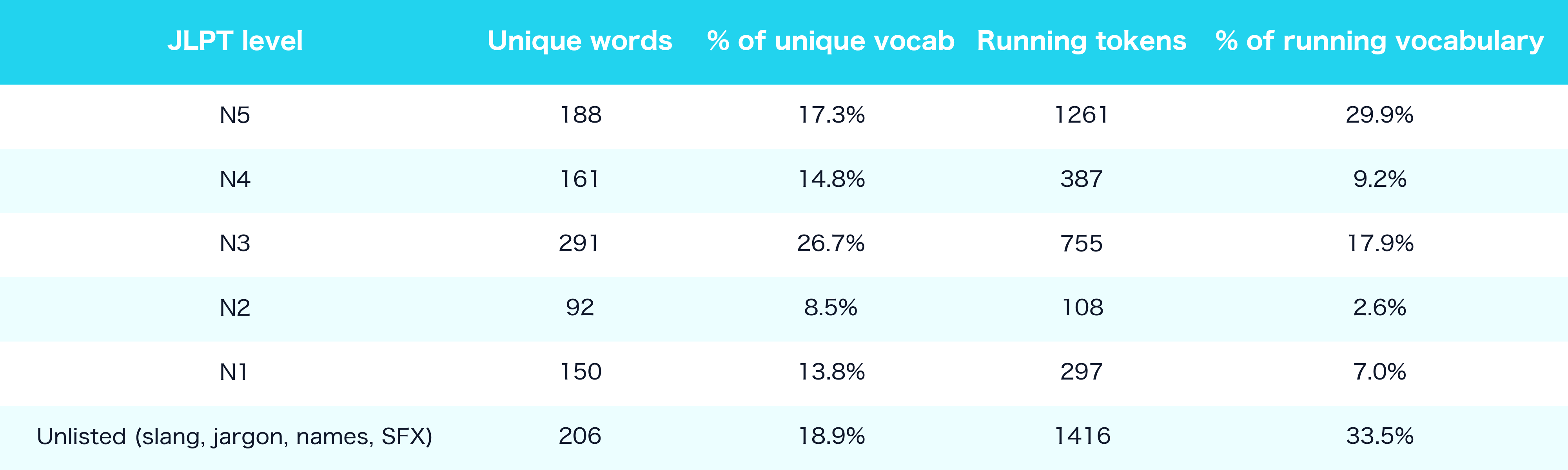
| JLPT level | Unique words | % of unique vocab | Running tokens | % of running vocabulary |
|---|---|---|---|---|
| N5 | 188 | 17.3% | 1,261 | 29.9% |
| N4 | 161 | 14.8% | 387 | 9.2% |
| N3 | 291 | 26.7% | 755 | 17.9% |
| N2 | 92 | 8.5% | 108 | 2.6% |
| N1 | 150 | 13.8% | 297 | 7.0% |
| Unlisted (slang, jargon, names, SFX) | 206 | 18.9% | 1,416 | 33.5% |
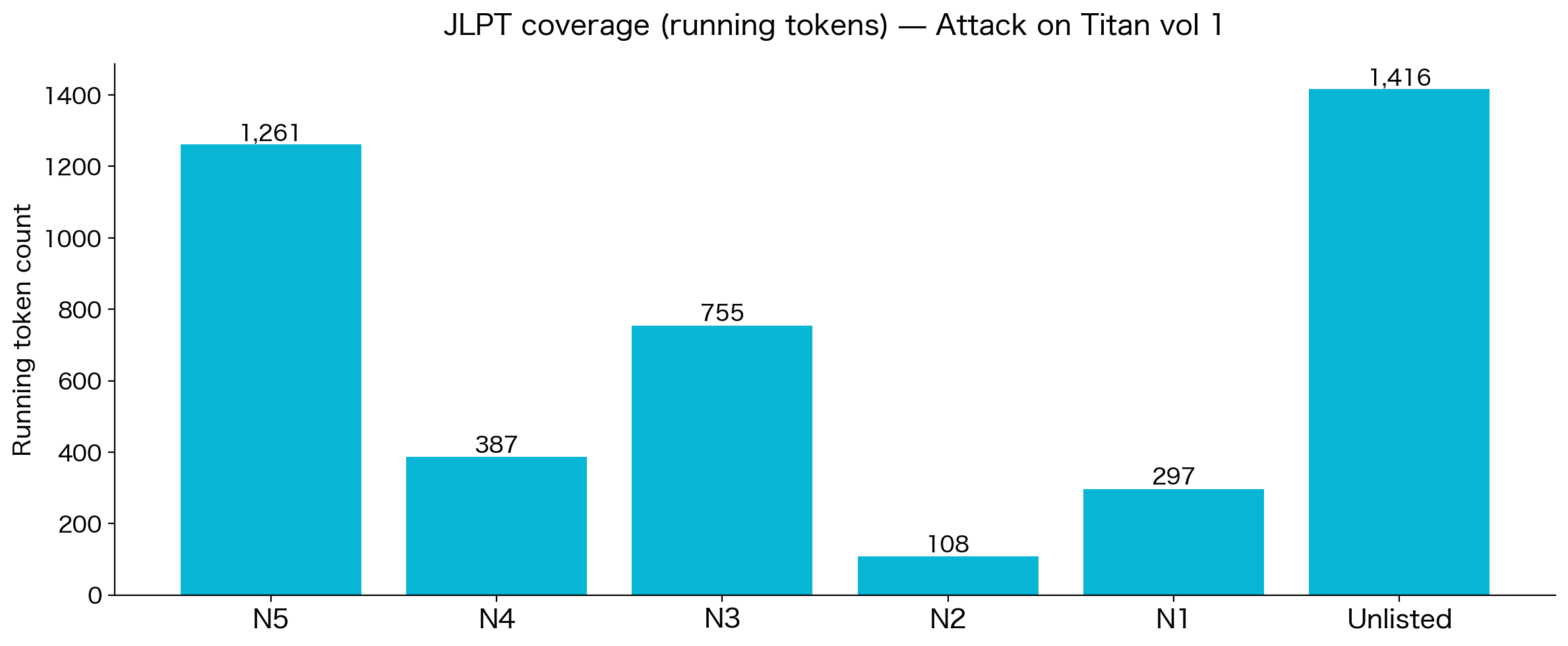
Read the last column. 39.0% of the running vocabulary is N5 or N4. Add N3 and you are at 56.9% of running vocabulary. The hard stuff (N2 and N1 combined) is 9.6% of what you actually read, because the hardest words appear rarely. The unlisted bucket sits at 33.5% of running tokens, the highest unlisted-running share of any title in our corpus so far. Attack on Titan's difficulty is not sitting in the JLPT-hard column. It sits in the corps-and-wall vocabulary that no JLPT list tests, and that vocabulary repeats heavily as the volume builds out the institutional setting.
Reader guidance by level
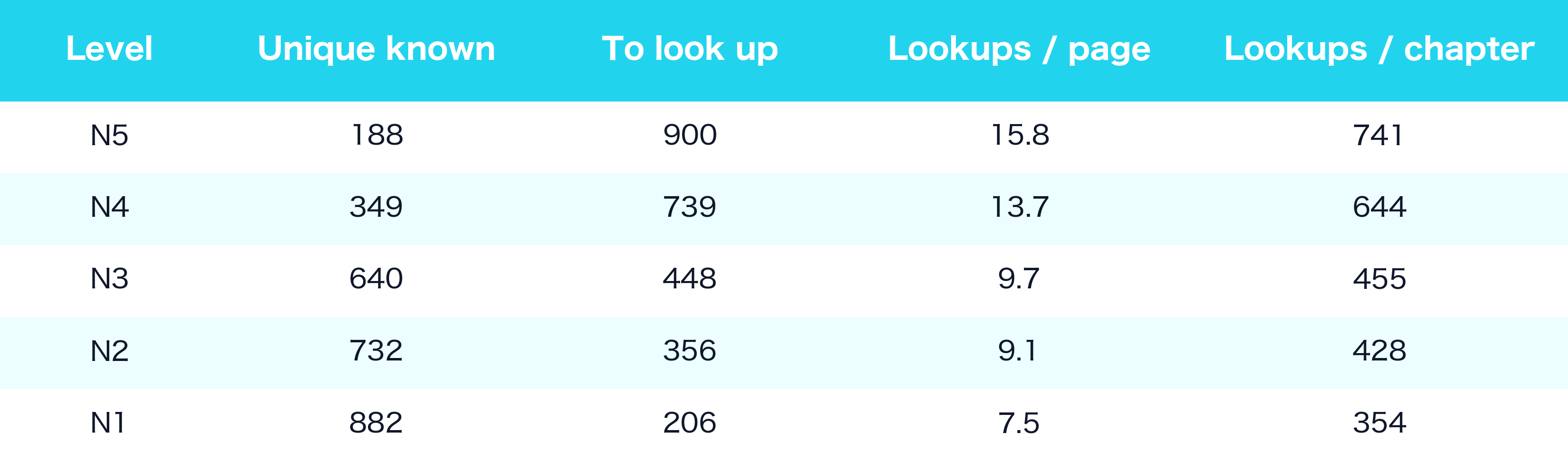
| Level | Unique words known | Unique words to look up | Lookups per page (first pass) | Lookups per chapter (first pass) |
|---|---|---|---|---|
| N5 | 188 | 900 | 15.8 | 741 |
| N4 | 349 | 739 | 13.7 | 644 |
| N3 | 640 | 448 | 9.7 | 455 |
| N2 | 732 | 356 | 9.1 | 428 |
| N1 | 882 | 206 | 7.5 | 354 |
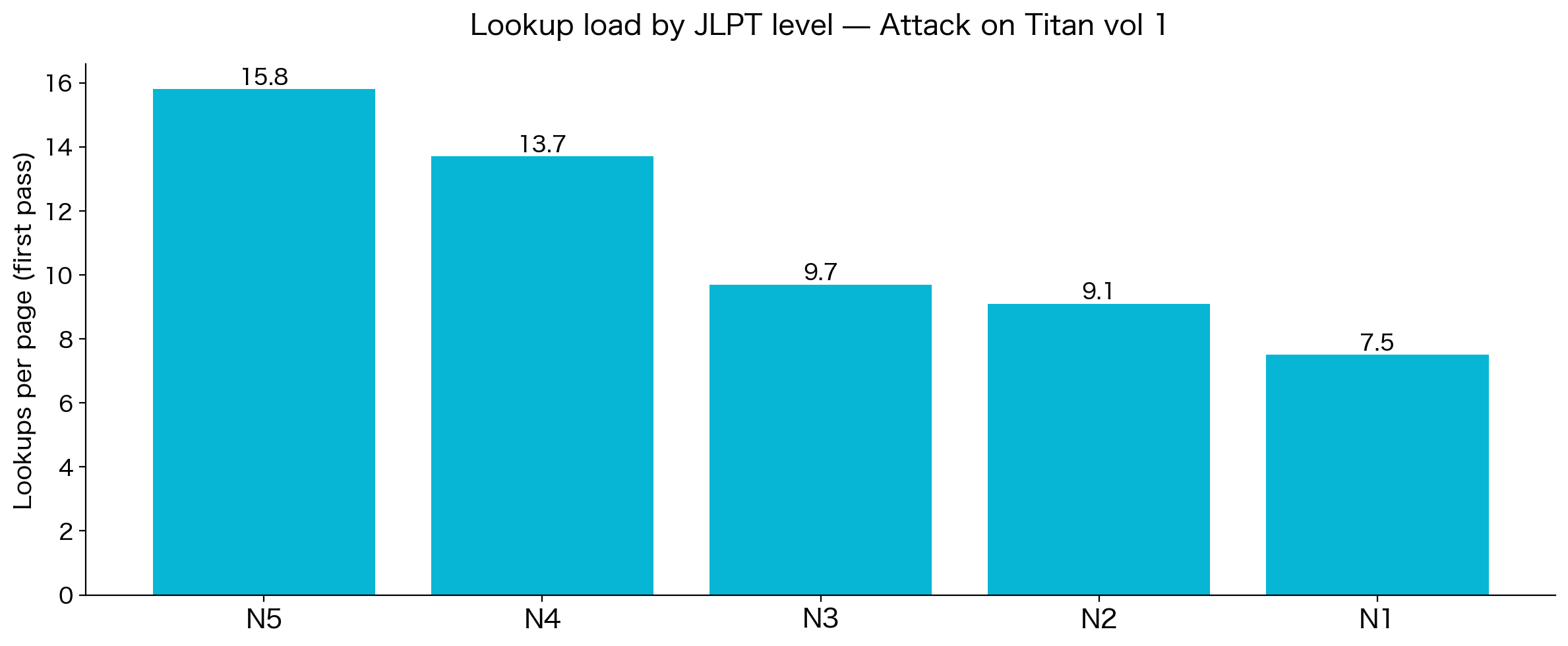
Lookups are unavoidable and painful, but you can lower the pain by completing the grammar foundation guide first. If you do not have kana yet, start there. That is table stakes.
N1 ≠ mastery
N1 means you passed a test. Real Japanese is not the test. Even N1 readers reading Attack on Titan for the first time will look things up. The best way to learn real Japanese is to read real Japanese. Then you can pass any test.
An N1 reader still has 206 unique unlisted words in this volume alone, plus first-encounter recognition on vocabulary they know from study but have never seen embedded in paramilitary-corps prose. Even at N1, expect 7 to 8 lookups per page on first pass, because the unlisted bucket is loaded with the institutional terms that drive the plot.
Kanji
Attack on Titan volume 1 has 700 unique kanji on the page, counted from the actual surface forms. 680 are joyo. 20 are non-joyo. Furigana is printed on every one.
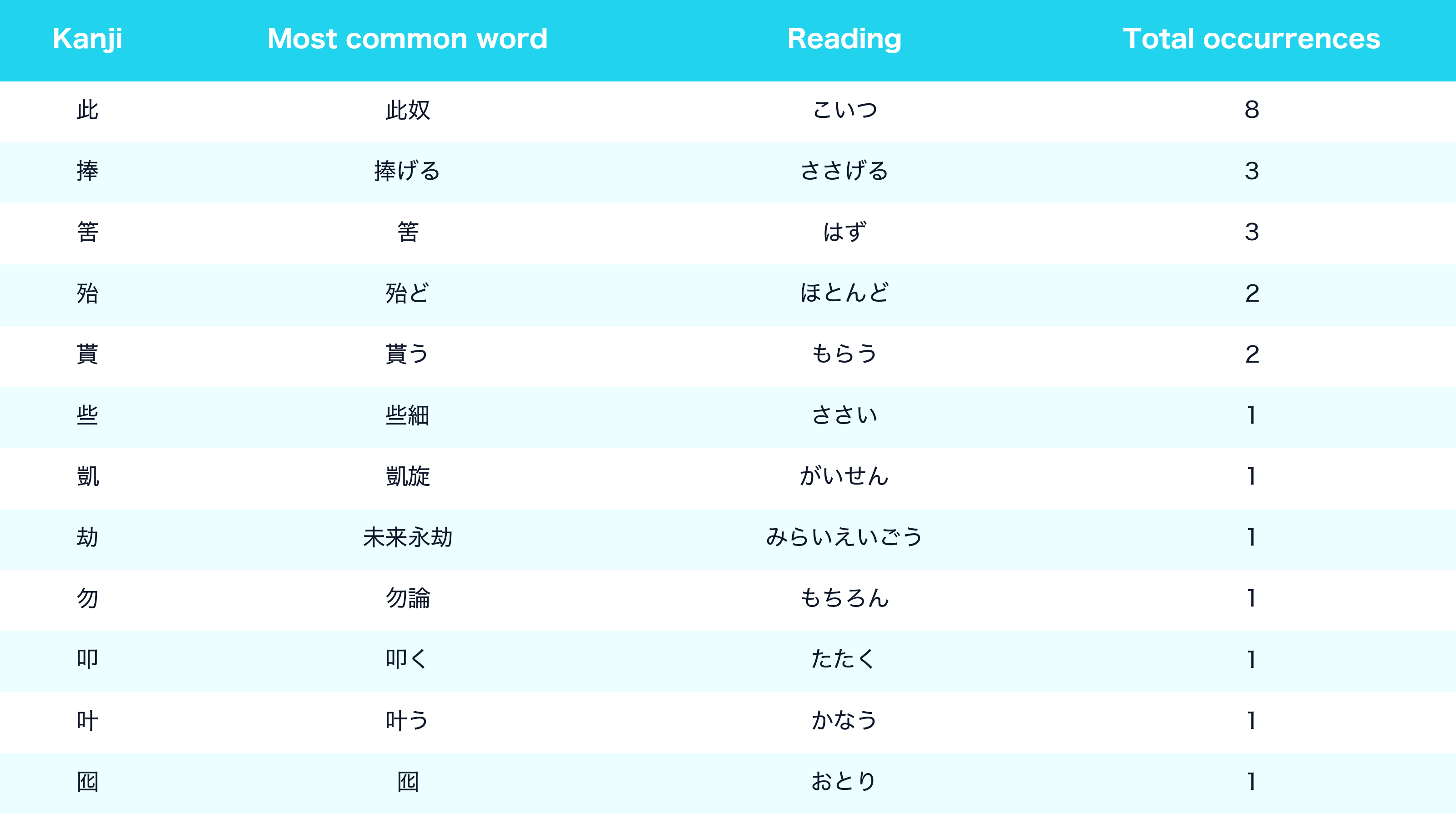
| Kanji | Most common word | Reading | Total occurrences |
|---|---|---|---|
| 此 | 此奴 | こいつ (this guy) | 8 |
| 捧 | 捧げる | ささげる (to offer up) | 3 |
| 筈 | 筈 | はず (expectation) | 3 |
| 殆 | 殆ど | ほとんど (almost) | 2 |
| 貰 | 貰う | もらう (to receive) | 2 |
| 些 | 些細 | ささい (trivial) | 1 |
| 凱 | 凱旋 | がいせん (triumphant return) | 1 |
| 劫 | 未来永劫 | みらいえいごう (eternity) | 1 |
| 勿 | 勿論 | もちろん (of course) | 1 |
| 叩 | 叩く | たたく (to strike) | 1 |
| 叶 | 叶う | かなう (to come true) | 1 |
| 囮 | 囮 | おとり (decoy) | 1 |
| 怯 | 怯える | おびえる (to flinch) | 1 |
| 戮 | 殺戮 | さつりく (slaughter) | 1 |
| 爺 | 爺ちゃん | じいちゃん (grandpa) | 1 |
| 砦 | 砦 | とりで (fortress) | 1 |
| 礫 | 瓦礫 | がれき (rubble) | 1 |
| 罹 | 罹る | かかる (to suffer from) | 1 |
| 腑 | 腑抜ける | ふぬける (to lose nerve) | 1 |
Where the kanji weight actually lives is in joyo characters combining into series-domain compounds. 調査兵団 (ちょうさへいだん, Survey Corps) is built from 調査 (investigation) and 兵団 (corps). All four characters are joyo. Together they make the institutional noun the first arc rotates around. Same story with 立体機動装置 (りったいきどうそうち, Three-Dimensional Maneuver Gear, from 立 + 体 + 機 + 動 + 装 + 置), 駐屯兵団 (ちゅうとんへいだん, Garrison Regiment, from 駐 + 屯 + 兵 + 団), 憲兵団 (けんぺいだん, Military Police Brigade, from 憲 + 兵 + 団), and 超大型巨人 (ちょうおおがたきょじん, Colossal Titan, from 超 + 大 + 型 + 巨 + 人). Every character in those compounds is on the joyo list, but the compound itself is series-domain vocabulary you will not see outside this title. The bottleneck is the word, not the kanji. Stop worrying about the character list. Start worrying about the compounds.
Frequency
Vocabulary appears in a long-tail distribution. 741 of 1,088 unique words (68%) appear exactly once; only 13 words appear 26 times or more. The small head of the curve is where the leverage lives.
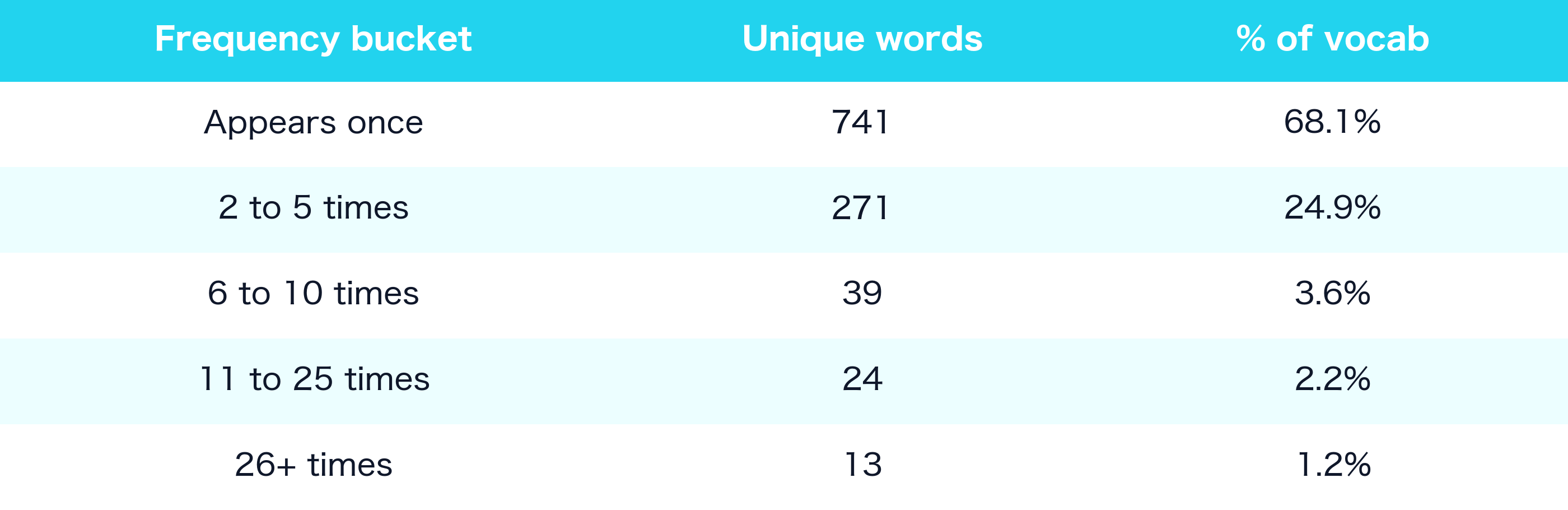
| Frequency bucket | Unique words | % of vocab |
|---|---|---|
| Appears once | 741 | 68.1% |
| 2 to 5 times | 271 | 24.9% |
| 6 to 10 times | 39 | 3.6% |
| 11 to 25 times | 24 | 2.2% |
| 26 or more times | 13 | 1.2% |
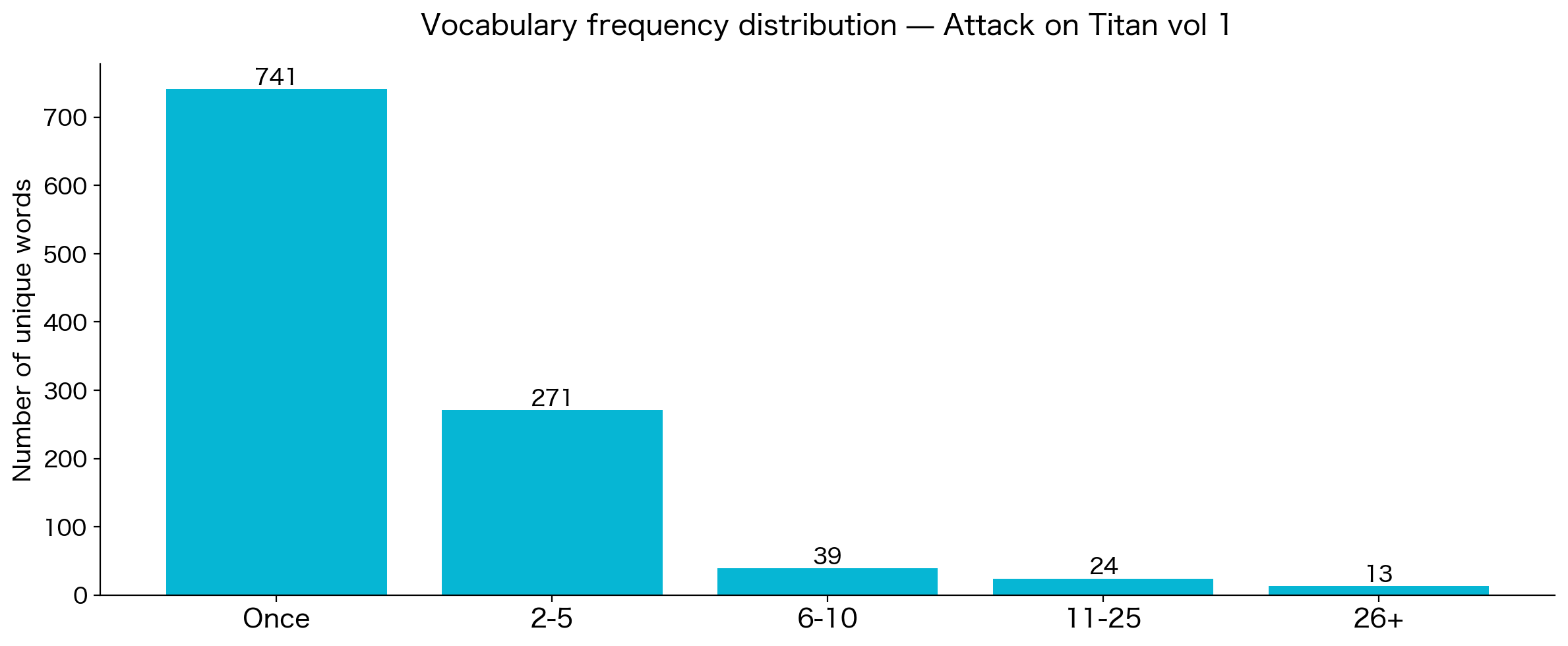
Do not read "appears once" as "not worth learning." These words recur across the series. Later volumes pick them up and use them again. The 76 words that appear six times or more are the real spine of volume 1 specifically.
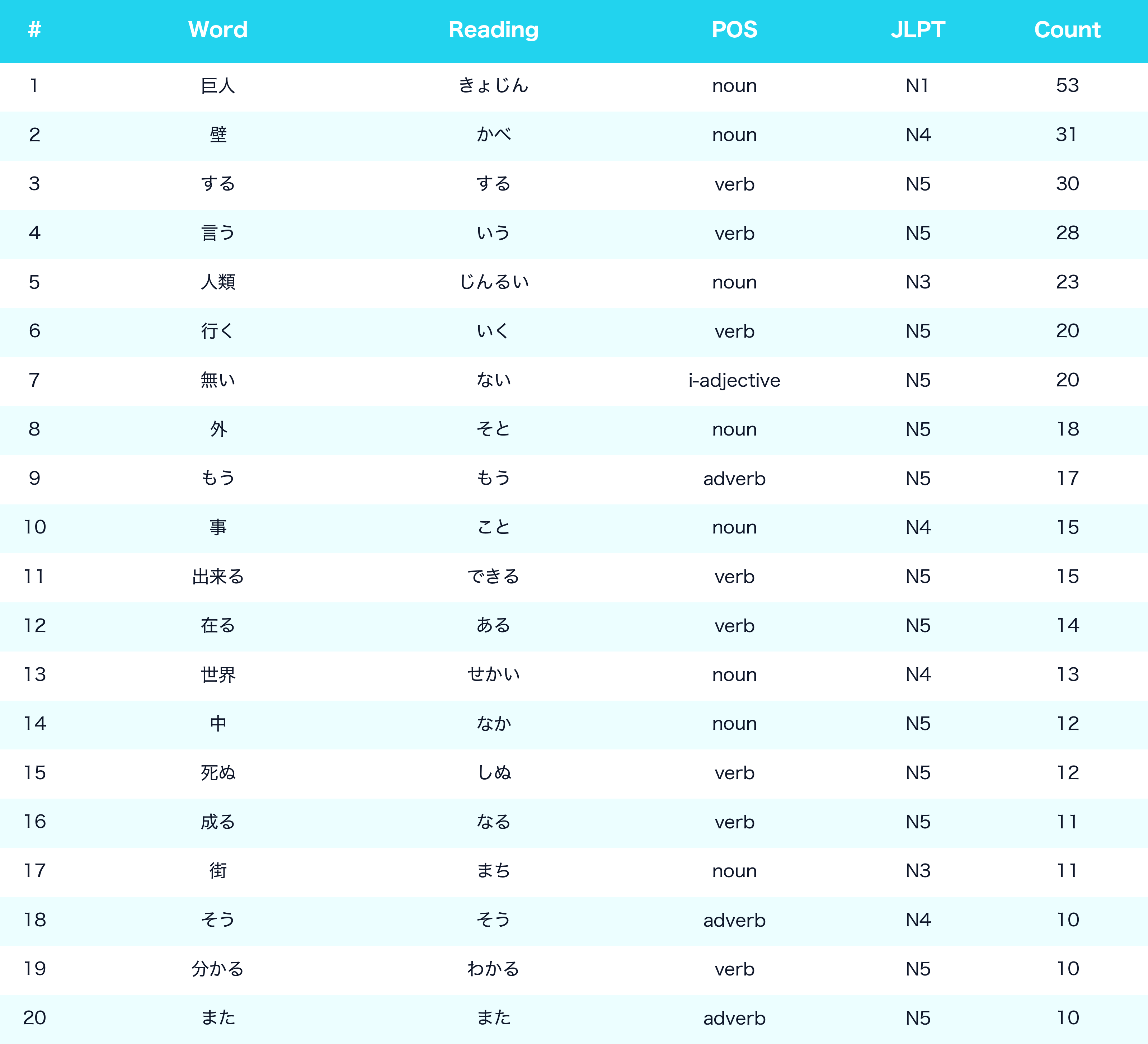
The 20 most frequent content words
Pre-study these 20 and you have learned the most common content words on almost every page. By the time you finish volume 1, all 20 are locked into your memory just from how often they appear.
Particles, auxiliary verbs, pronouns, conjunctions, proper nouns, and adnominals are excluded so the list surfaces meaningful content words.
| # | Word | Reading | POS | JLPT | Count |
|---|---|---|---|---|---|
| 1 | 巨人 | きょじん | noun | N1 | 53 |
| 2 | 壁 | かべ | noun | N4 | 31 |
| 3 | する | する | verb | N5 | 30 |
| 4 | 言う | いう | verb | N5 | 28 |
| 5 | 人類 | じんるい | noun | N3 | 23 |
| 6 | 行く | いく | verb | N5 | 20 |
| 7 | 無い | ない | i-adjective | N5 | 20 |
| 8 | 外 | そと | noun | N5 | 18 |
| 9 | もう | もう | adverb | N5 | 17 |
| 10 | 事 | こと | noun | N4 | 15 |
| 11 | 出来る | できる | verb | N5 | 15 |
| 12 | 在る | ある | verb | N5 | 14 |
| 13 | 世界 | せかい | noun | N4 | 13 |
| 14 | 中 | なか | noun | N5 | 12 |
| 15 | 死ぬ | しぬ | verb | N5 | 12 |
| 16 | 成る | なる | verb | N5 | 11 |
| 17 | 街 | まち | noun | N3 | 11 |
| 18 | そう | そう | adverb | N4 | 10 |
| 19 | 分かる | わかる | verb | N5 | 10 |
| 20 | また | また | adverb | N5 | 10 |
Two of these are worth calling out. 巨人 (きょじん, titan) is the genre-defining noun the entire series is built on, and it appears 53 times in volume 1 alone. You will also see the same character recombine across the cast and the institutions: 超大型巨人 (ちょうおおがたきょじん, Colossal Titan), 鎧の巨人 (よろいのきょじん, Armored Titan), 進撃の巨人 (しんげきのきょじん, the Attack Titan, the title compound itself), 奇行種 (きこうしゅ, aberrant Titan). Learn this one character pair and you decode the entire antagonist vocabulary at once.
壁 (かべ, wall) is the noun the geography is built on, and it appears 31 times across surface forms (壁, 壁外, 壁内, 50mの壁, ウォール・マリア). It is N4 by the JLPT lists, but it is N5 by the corpus, because every panel of volume 1 has a wall in it somewhere. Pre-study it once, recognize it everywhere.
How each main character speaks
エレン・イェーガー (Eren Yeager)
Ten years old when the volume opens, son of a doctor in Shiganshina, the loudest character in the cast. Eren uses 俺 (おれ) for "I" and rarely softens his speech, which makes him the easiest character to read once you accept that almost every sentence ends in an exclamation mark. He speaks in short bursts of declarative anger: 巨人を一匹残らず駆逐し てやる (I'll wipe out every last titan). His vocabulary is small and high-frequency, because his job in volume 1 is to keep saying he wants to join the 調査兵団 and shouting it at people who tell him not to. The hard part is the volume of contractions and sentence-final particles (ぜ, んだ, よ) that the print edition uses to render his shouting register. Translate one panel of him and you can translate ten.
ミカサ・アッカーマン (Mikasa Ackerman)
Eren's adoptive sister, taken in by the Yeager family after a violent backstory in chapter 3. Mikasa says less than any other main character in volume 1, and what she says is formal-protective register: short clipped declaratives, neutral pronouns, soft sentence endings. She tracks Eren and intervenes physically when he picks fights. The reading difficulty in her panels is not her speech, it is the surrounding narration that fills in what she is thinking, because she does not say it out loud. She is the easiest character in the volume to read once you accept the narration carries the load.
アルミン・アルレルト (Armin Arlert)
The third member of the Eren-Mikasa-Armin trio. Smaller, blonder, less violent, the worldbuilding mouthpiece. Armin's panels carry the bulk of the chapter-1 exposition about the world outside the walls (ice fields, fire fields, sand dunes, salt water), and his register is informational and slightly bookish: longer sentences, more abstract nouns, more 〜だろう and 〜らしい hedges. He is harder to read than Eren because his panels actually contain new vocabulary you have to look up. Pre-study chapter 1 and most of his pages get easier.
ピクシス司令 (Commander Pixis) and 訓練教官 (the training instructor)
Volume 1 ends with chapter 4, and chapter 4 is where the institutional voice arrives in force. The corps commanders, the training instructor barking at the new recruits, the bureaucratic exposition introducing 駐屯兵団, 調査兵団, 憲兵団, and 立体機動装置: this is where the densest text in the volume lives. Their lines are formal-military register (我々, 諸君ら, ません, でしょう) loaded with paramilitary-corps vocabulary. Their pages are the densest in the volume, and they are where the unlisted-bucket vocabulary clusters hardest. If you bounce off chapter 4, you bounced off institutional Japanese, not Japanese in general.
Expressions with depth
These are volume 1 expressions where the dictionary entry will mislead you. Surface meaning is one thing. What the phrase actually does in a panel is another.
巨人 (きょじん, titan)
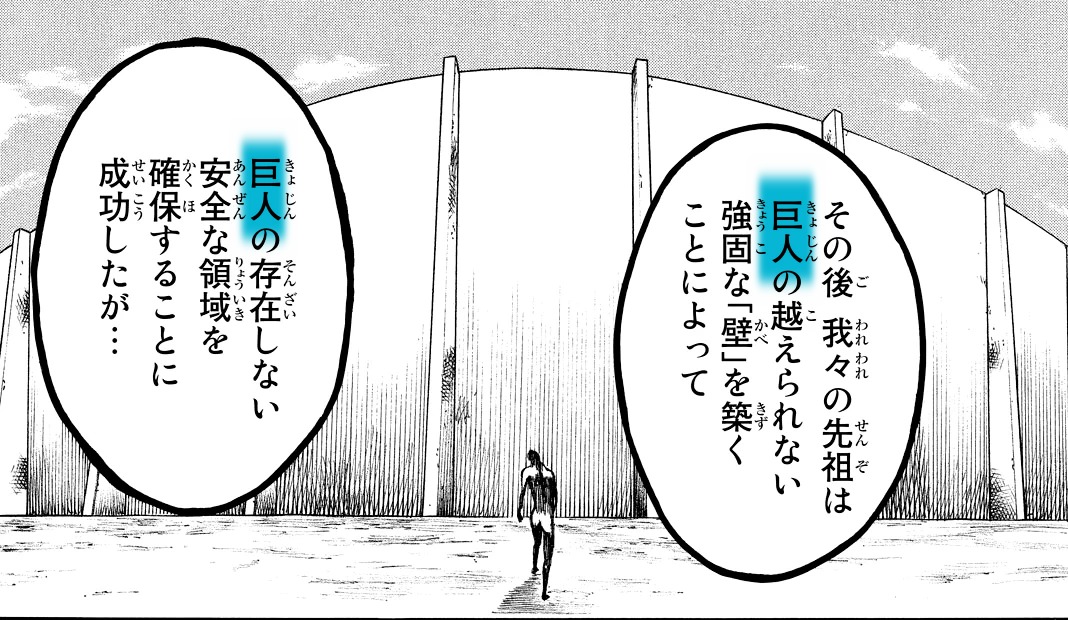
Dictionary: "giant" or "titan." The texture: 巨人 in standard Japanese is a generic word for any oversized humanoid, and it can mean anything from a fairy-tale giant to a baseball team (the Yomiuri Giants are 読売巨人軍). Attack on Titan rebuilds it from scratch as a creature category: 15-meter humanoids with no genitals, no apparent sentience, an attraction to humans they immediately try to eat, and an immune system that regenerates wounds in seconds. The chapter-2 narration that introduces them (巨人の 存在しない安全な領域を確保することに成功したが…その後我々の先祖は巨人の越えられない強固 な「壁」を築くことによって) treats 巨人 as a known threat the reader has lived under for generations. A Japanese reader hears 巨人 and reaches for the giant from the Jack and the Beanstalk equivalent. Translate it as "giant" and you lose the post-apocalyptic weight. Translate it as "titan" like the English release does, and you signal the creature category.
壁 (かべ, wall)
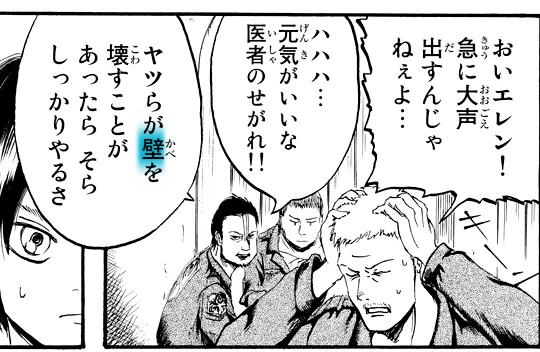
Dictionary: "wall." The texture: 壁 in modern Japanese means any wall, room partition to fortification. Attack on Titan stretches the word into the entire geography of the world: three concentric 50-meter walls (ウォール・マリア, ウォール・ローゼ, ウォール・シーナ) ringing the surviving population of humanity. The chapter-1 panel where Hannes tells Eren ヤツらが壁を壊して (they broke through the wall) is the load-bearing line of the volume, because volume 1 ends after the Colossal Titan kicks a hole in the outer wall and the entire premise of the series begins. Read 壁 in this manga not as "wall" but as "the entire civilizational membrane separating us from extinction." Every time Eren looks up at the wall he is looking at the only reason he is alive.
人類 (じんるい, humanity)
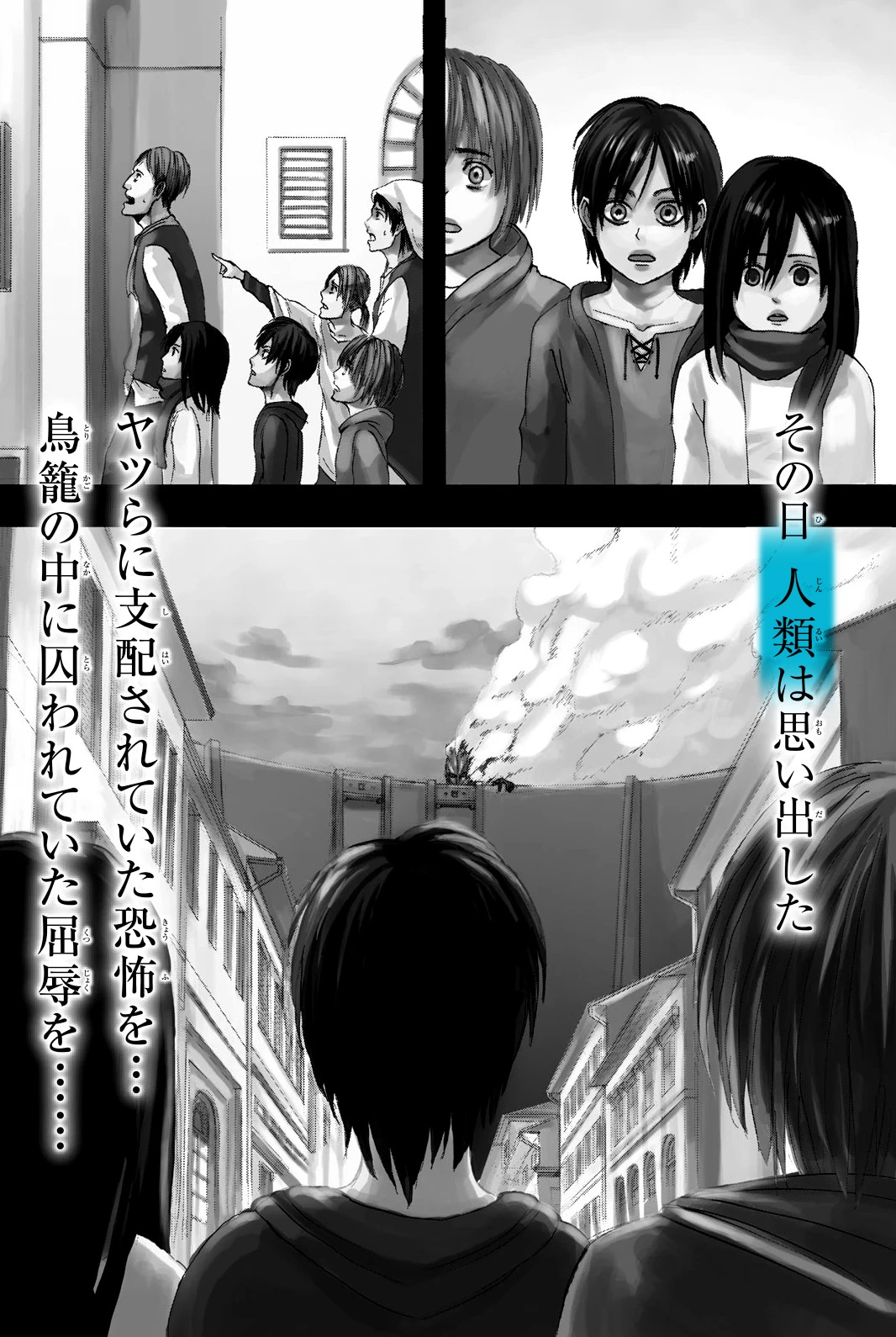
Dictionary: "humanity" or "mankind." The texture: 人類 in everyday Japanese is rare and lofty, the word a textbook uses for "the human species." Attack on Titan uses it constantly because it has to. The opening narration その日人類は 思い出した (on that day humanity remembered) sets the register for the entire series: biblical, retrospective, planetary in scale. The walled city is not a country, it is what is left of the species. Every time a character says 人類, they are not saying "people," they are saying "the last of us." Translate it as "humans" and you flatten the apocalyptic register that powers every speech in volume 1.
調査兵団 (ちょうさへいだん, Survey Corps)
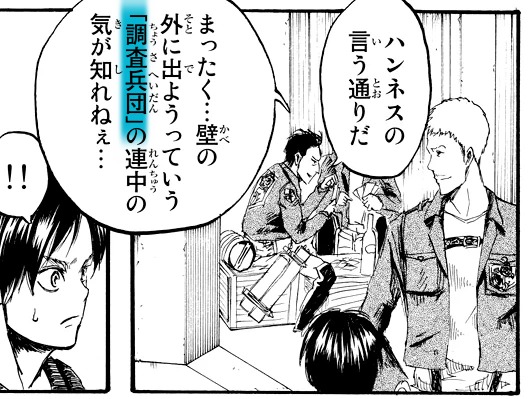
Dictionary: a literal compound meaning "investigation army group." The texture: the word does not exist outside this manga. It is a series-domain compound built from joyo characters (調 + 査 + 兵 + 団) that translators rendered as "Survey Corps." It is the branch of the military that goes outside the walls, takes catastrophic casualties, and is the institution Eren spends the entire chapter shouting that he wants to join while the adults around him say 調査兵団はやめた方がいい (you should give up on the Survey Corps). The word carries the whole emotional load of the volume: childhood ambition versus adult realism, freedom versus survival, the inside of the wall versus the outside. Translate it as "Survey Corps" and you preserve the institutional formality. Just remember that none of the dictionary glosses for the individual characters prepare you for what the compound means in this story.
立体機動装置 (りったいきどうそうち, Three-Dimensional Maneuver Gear)
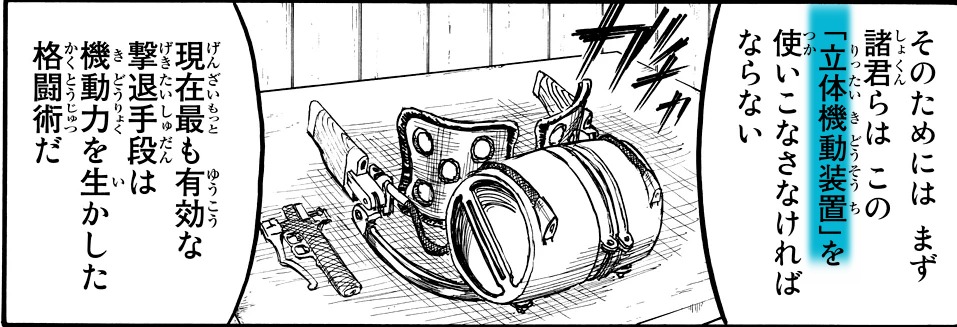
Dictionary: another series-domain compound, literal gloss "three-dimensional movement device." The texture: 立体機動装置 is the grappling-hook-and-gas-canister gear that lets the corps fight 15-meter titans by zipping between buildings and trees. It is also the visual signature of the entire franchise. The chapter-4 introduction (現在最も有効な 撃退手段は機動力を生かした格闘術だ そのためにはまず諸君らはこの「立体機動装置」を使い こなさなければならない) is delivered in formal-instructor register to a class of new recruits, and it is the single most lookup-heavy panel in the volume. 立体 ( three-dimensional), 機動 (mobility, military jargon), 装置 (device) are all joyo, but the compound is unique to this series. The English translation "ODM gear" (omni- directional mobility gear) is the term every fan uses, but the Japanese reading is りったいきどうそうち and you will hear it pronounced that way on every cover, panel, and anime episode.
Pop culture and context in volume 1
Walled-city paranoia and the Edo-period seclusion echo. Attack on Titan is nominally a 19th-century European-coded fantasy, but the walled-city premise where a population has lived inside fortifications for a hundred years and forgotten what is outside reads to a Japanese audience as a meditation on the Edo period's 鎖国 (sakoku, closed-country policy). For 200-plus years Japan walled itself off from the outside world by official decree. The chapter-2 narration about humanity successfully living in peace for 100 years inside the walls maps onto Japanese cultural memory in a way Western readers may not feel. The 調査兵団 are the 19th-century scholars who pried the country open. Eren is the young patriot who wants to walk through the gate.
進撃 (しんげき, attack/charge) as a militaristic register. The word in the title is not a casual one. 進撃 is military-historical vocabulary for an offensive advance, the kind of word that shows up in textbook sentences about World War II. Pairing it with の and 巨人 produces a compound that lands as "the titan that charges," or, with the inflection the series eventually reveals, "the Attack Titan" as a proper noun. The cultural register is martial. The English translation "Attack on Titan" loses the agency of the original (the Japanese has the titan as the agent attacking; the English has the titan as the target being attacked) but preserves the register.
The German naming convention. Hajime Isayama loaded the cast with German- coded names rendered in katakana: エレン・イェーガー (Eren Jaeger, German for "hunter"), ミカサ・アッカーマン (Mikasa Ackerman), アルミン・アルレルト (Armin Arlert), ハンネス (Hannes). The walls themselves use German: ウォール・マリア, ウォール・ローゼ, ウォール・シーナ. The katakana rendering is consistent and unambiguous once you accept that this is a series where European-coded names are the norm. Read the katakana phonetically, do not try to find a Japanese kanji compound that fits.
巨人 in Japanese folklore versus the manga. Pre-modern Japanese folklore has its own giants: 大太法師 (だいだらぼっち, gigantic mountain-creating spirits), 鬼 (おに, horned mountain spirits), 山姥 (やまんば, mountain hag). Attack on Titan's 巨人 share the silhouette but reroute the metaphysics: these are not spirits, they are biologically-categorized organisms with reproductive anomalies and high body temperatures. The chapter-4 specimen-table narration about titan biology (体は極端に高温で…生殖器は存在 せず…殆どが男性のような体つき) is doing biology-textbook work, not folklore work. That is a deliberate genre break, and Japanese readers register it.
三大兵団 (さんだいへいだん, the three corps). The Garrison Regiment, the Survey Corps, and the Military Police Brigade form a three-branch military structure that echoes both Imperial Japanese military organization (the Army, Navy, and Imperial Guard before WWII) and standard fantasy-world worldbuilding. The chapter-3 graduation ceremony scene where Mikasa says あなたが憲兵団に行くのなら私も憲兵団に行こう / あなたが駐屯兵団に 行くのなら / 私もそうしよう is the panel where the three corps become emotionally weighted choices, not just bureaucratic categories. The vocabulary cluster (調査, 駐屯, 憲兵, 兵団, 司令, 中央憲兵, 訓練兵団) carries the politics of the entire first arc.
Inside the app: one panel, fully broken down
Reading manga in Japanese is, at the bottom of it, a vocabulary-acquisition problem. Let me get you one panel: chapter 4, page 15, the panel where Pixis explains the corps allocation for the wall defense. All the context around it is broken down here the same way The Ashiba App provides it, so you finish this section actually understanding the institutional vocabulary that drives the rest of the volume, not just having seen it.
Chapter 4, page 15: the corps allocation
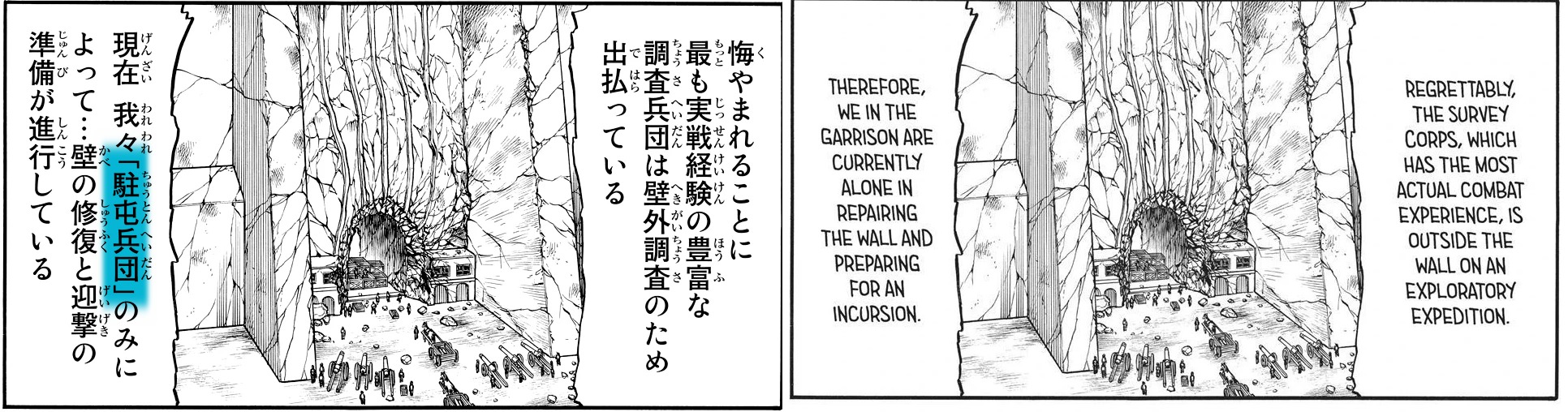
Scroll the image sideways to read the Japanese in full size.
Summary. Pixis is briefing the assembled forces on who is doing what after the Colossal Titan breaches Wall Maria. The Garrison Regiment is currently the only branch actually inside the walls and ready to fight. The Survey Corps, the most combat-experienced branch, is outside the walls on a survey mission and unavailable. The register is formal- military exposition (我々, 進行している, 出払っている). This is the panel where the institutional logic of the world locks into place.
Textbox 1
JP: 現在我々「駐屯兵団」のみによって…壁の修復と迎撃の準備が進行している
EN: Right now wall repair and battle preparation are being carried out by us, the Garrison Regiment, alone.
Overview: The status report. The Garrison is the only force currently active.
Breakdown:
- 現在 (げんざい): currently; N3 noun, formal register
- 我々 (われわれ): we (formal-plural); pronoun, used in institutional and military speech
- 駐屯兵団 (ちゅうとんへいだん): Garrison Regiment; series-domain compound (駐 + 屯 + 兵 + 団, all joyo)
- のみ: only (formal); particle, more formal than だけ
- によって: by means of, by; particle compound, marks the agent in formal sentences
- 壁 (かべ): wall; N4 noun, the load-bearing noun of the entire volume
- 修復 (しゅうふく): repair, restoration; N1 noun
- 迎撃 (げいげき): interception, counter-attack; N1 noun, military jargon
- 準備 (じゅんび): preparation; N4 noun
- 進行している (しんこうしている): is in progress; 進行 (N3 noun) + する progressive
Textbox 2
JP: 悔やまれることに最も実戦経験の豊富な調査兵団は壁外調査のため出払っている
EN: Regrettably, the most combat-experienced branch, the Survey Corps, is currently away on an outside-the-walls expedition.
Overview: The bad news. The branch the audience would want to be present is not present.
Breakdown:
- 悔やまれる (くやまれる): is regrettable; passive of 悔やむ (N1 verb)
- ことに: it is the case that; sentence-internal connective
- 最も (もっとも): most; N3 adverb, superlative marker
- 実戦 (じっせん): actual combat; N1 noun, military jargon
- 経験 (けいけん): experience; N4 noun
- 豊富な (ほうふな): abundant, plentiful; N2 na-adjective
- 調査兵団 (ちょうさへいだん): Survey Corps; series-domain compound, the central institution of the volume
- 壁外 (へきがい): outside the walls; series-domain compound (壁 + 外), unlisted
- 調査 (ちょうさ): survey, investigation; N3 noun
- 出払っている (ではらっている): is all out, is away; 出払う + ている progressive, formal register
Key points
- The register is formal-military briefing: 我々 pronouns, 〜による agent marking, ている progressive aspect, formal verbs of state (出払う, 進行している). This is the highest-formality register in volume 1, and Hajime Isayama uses it specifically when the corps machinery is speaking in its official voice.
- 駐屯兵団 (ちゅうとんへいだん) and 調査兵団 (ちょうさへいだん) together signal the manga has moved into institutional-allocation territory: the protagonists are now being slotted into a paramilitary structure with politics. Both compounds use joyo characters and recur unchanged in every later volume. Pre-study them.
- The vocabulary load on this single panel is brutal: 修復, 迎撃, 実戦, 経験, 豊富, 出払う, 壁外調査. Seven content words in two textboxes, most of them N1 or N2 or unlisted. This is what density looks like in chapter 4. If you crack this panel, you crack the rest of the volume.
This is what you see in The Ashiba App for this panel. Pre-study, then read.
How to actually read volume 1
- Get a foundation. How much you need depends on how much discomfort you can sit with. Genki I and II is the polished path. At a minimum, lock in N5. Nothing else moves until kana and basic grammar are automatic.
- Start with chapter 1. Take your time. Not a week. Not a day. This is the first chapter of manga you have ever read in Japanese. Set a timer for 15 minutes. Early on, you crack one to three sentences in that window. Later, you crack a full chapter. Consistency compounds. Rack up the reps.
- When you get stuck, reference the translation. Looking things up is not failure. It is learning. The fastest way to get unstuck is to see the answer and understand why the sentence means what it means. Goal: parse the sentence. Match the English to the Japanese, identify the word or grammar that blocked you, and move on. You will hurdle (probably in chapter 2 when the chapter-opening narration drops the civilizational backstory in formal-historical register, and definitely in chapter 4 when Pixis and the training instructor unleash the corps-allocation vocabulary on top of everything else). Those panels are dense. The answer is not to grind harder. The answer is what I wrote about in Why You Will Quit Learning Japanese: put the book down and come back tomorrow.
If you want the deeper version of this reading strategy, the fastest way to learn Japanese article has the volume-control framework in full.
The Takeaway
The main reason reading manga in Japanese is hard is the sheer amount of vocabulary you do not know.
Most readers never get past this. The pain is too great. The effort-to-reward ratio collapses, and the book gets shelved.
The easiest way out is to pre-study the words you do not know that will appear in the chapter you are about to read. The Ashiba App does this for every chapter of every series I cover. It surfaces the vocabulary, shows readings and POS, and includes grammar breakdowns so you see how each word is being used. Nothing is studied in isolation. Every flashcard carries its full panel context. You see the word in the sentence in the panel where it lives.
You can get started today.
Frequently asked questions
Should I watch the anime before reading Attack on Titan in Japanese?
Yes. The Attack on Titan anime first aired in 2013 and the early arc is famously close to the manga panel-for-panel. Watch episodes 1 through 5 before opening the manga. The anime gives you the visual register for the walled-city setting, the voice work for Eren, Mikasa, and Armin, and the pacing of the titan attacks, so the manga reads with familiar pictures already loaded. Watch the same episodes again after you finish volume 1 and you will feel exactly how much more you picked up by reading.
Does Attack on Titan have furigana?
Yes. The Japanese print and digital editions print furigana on every kanji, every appearance. Attack on Titan ran in Bessatsu Shōnen Magazine, where Kodansha follows full-furigana practice for shōnen titles. Kanji you cannot read by sight is still readable on the page. The blocker is not kanji. The blocker is vocabulary count.
Do I need to know all the kanji before starting?
No. Furigana is provided everywhere, every kanji, every appearance. You need to know hiragana and katakana, and you should be comfortable with the katakana names in particular because the cast and the wall names are all katakana-rendered German. That is the hard prerequisite. Kanji you pick up as you read. If you have not finished kana yet, start with how to learn hiragana and katakana.
How long does it take to read Attack on Titan volume 1 in Japanese?
A solid N3 reader, first pass, cracking every unknown word: 6 to 8 hours across the full volume. An N2 reader who has pre-studied the corps and 立体機動装置 vocabulary: 4 to 5 hours. A native speaker: 30 to 40 minutes. You are not the native speaker. Respect the pace.
Do I need to read volume 1 first or can I start anywhere?
Follow the fun. If a different volume pulls you harder, start there. The reasons to pick volume 1 anyway: the corps vocabulary (調査兵団, 駐屯兵団, 憲兵団, 立体機動装置, ウォール・ マリア) and the Eren-Mikasa-Armin premise are introduced here and assumed in every later arc. Skip volume 1 and you spend volume 2 looking up volume 1 words.
Where can I buy Attack on Titan volume 1 in Japanese?
Free English preview: read chapter 1 on Kodansha USA. Kodansha volume 1 product page: Attack on Titan volume 1 on Kodansha. Buy the full Japanese volume on Amazon Japan or BookWalker (Kindle or paperback).