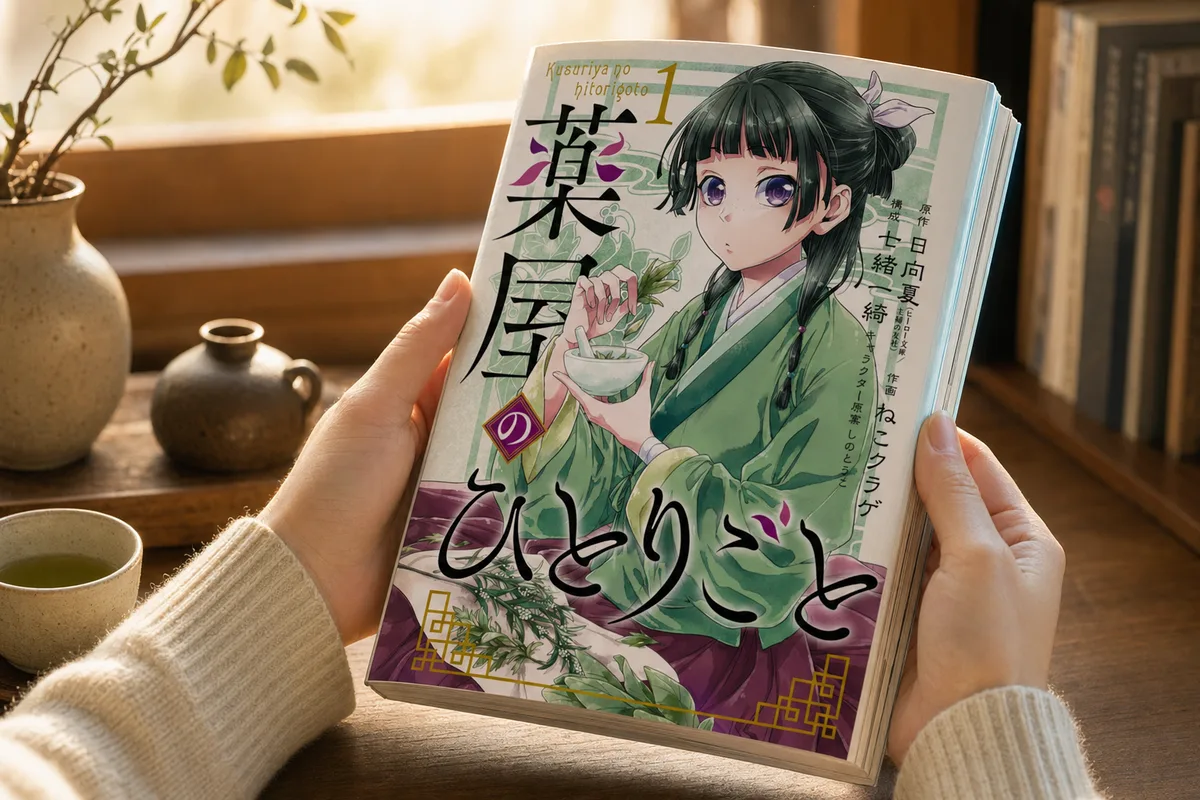
Volume 1 of The Apothecary Diaries (薬屋のひとりごと, Kusuriya no Hitorigoto) contains 1,263 unique vocabulary items across 4 chapters, 163 pages, 579 panels, and 911 textboxes. The script uses 756 unique kanji on the page, of which 51 are non-joyo.
That last number is the lead. JJK volume 1 has 41 non-joyo kanji. FMA volume 1 has 22. Apothecary has 51, and most of them come from a single domain: imperial-court life in a Heian-influenced fantasy China. 後宮 (rear palace), 妃 (consort), 宦官 (eunuch), 妓女 (courtesan), 寵妃 (favored consort), 武官 (military officer). This is a vocabulary book before it is anything else.
Every number in this article comes from Ashiba's production corpus, measured against the official N5 to N1 JLPT vocabulary lists and the 2,136-character joyo kanji set. Last measured 2026-04-26.
Is The Apothecary Diaries volume 1 hard to read in Japanese?
Advanced. Harder than JJK. Harder than FMA. The kanji density is higher, the per-page text load is heavier, and the historical-court vocabulary lives almost entirely outside what Genki teaches. If you have not read mystery or historical fiction in Japanese before, expect to be in the dictionary on every page for the first chapter.
People mis-rate this book in both directions. Here is the actual shape.
What makes it easier than you think
Kanji is not a blocker. Furigana, the small phonetic companion written above every kanji, is provided everywhere in this manga: every kanji, every appearance, every chapter. Across the actual surface forms in volume 1 the manga uses 756 unique kanji, and 705 of them (93.3%) are joyo.
Maomao's analytical voice is also surprisingly clean. When she narrates her deductions, the grammar is straightforward declarative Japanese: short clauses, plain verb endings, modern register. Her thought-bubble panels often use 普通形 (plain form) and read like a textbook example sentence with court-specific nouns swapped in.
What makes it harder than it looks
The vocabulary domain is unfamiliar. 後宮 (rear palace), 宦官 (eunuch), 妃 (consort), 寵妃 (favored consort), 妓女 (courtesan), 帝 (emperor), 武官 (military officer). These appear repeatedly and they are not on the JLPT N5 to N3 lists you studied from. Most appear in the manga's top-20 most-frequent content words. You will recognize them by chapter 2 if you pre-study them.
The long tail is brutal. 864 unique words appear exactly once in the entire volume. That is 68% of the unique vocabulary. Most of those are traditional medicine names, court rituals, palace architecture, and Tang-dynasty-style clothing. They will recur across the series, but in volume 1 alone you do not get the in-volume spaced-repetition benefit on those words.
Vocabulary acquisition is iterative. A word does not stick the first time. Each word takes multiple painful encounters before recognition becomes automatic, and every encounter breaks the story flow. The tipping point where the manga starts reading easily is further out than most learners expect, and Apothecary's tipping point is further out than JJK's or FMA's because the vocabulary domain has so little overlap with everyday modern Japanese.
There is one way to lower the pain without lowering the reps. Pre-study the chapter vocabulary before you open the chapter. That moves the lookups out of the story and into focused study time. Same words, different context. The story stays intact.
The non-joyo kanji are also concentrated in the rare court / medical vocabulary domain. The top non-joyo characters in volume 1: 妓 (in 妓女, courtesan, 15 times), 媚 (in 媚薬, aphrodisiac, 9 times), 宦 (in 宦官, eunuch, 7 times), 寵 (in 寵妃, favored consort, 5 times). Each one is series-relevant, each one comes with furigana every time, and each one appears often enough in volume 1 to start sticking.
You don't need permission. Just go for it.
The real question is not whether this book is at your level. The real question is whether the pain is tolerable for the reward. If you actually want this story, the level mismatch is just a tax on time, not a wall. You pay it in lookups and re-reads and slow chapters until the cost goes down. Always read above your level. Attack the stories that motivate you. Permission is something other people give themselves and then complain about. Just go for it.
What the data says about volume 1
Every number below was calculated from the approved vocabulary set for The Apothecary Diaries volume 1 in Ashiba's production database. JLPT level was assigned by matching against the official N5 to N1 lists. Words not on any list were classified by Gemini 3 Pro against context.
A note on terminology. Running vocabulary means every word token as it occurs in the text, counting every repeat. Unique vocabulary means the distinct words themselves, counted once each.
Volume 1 at a glance
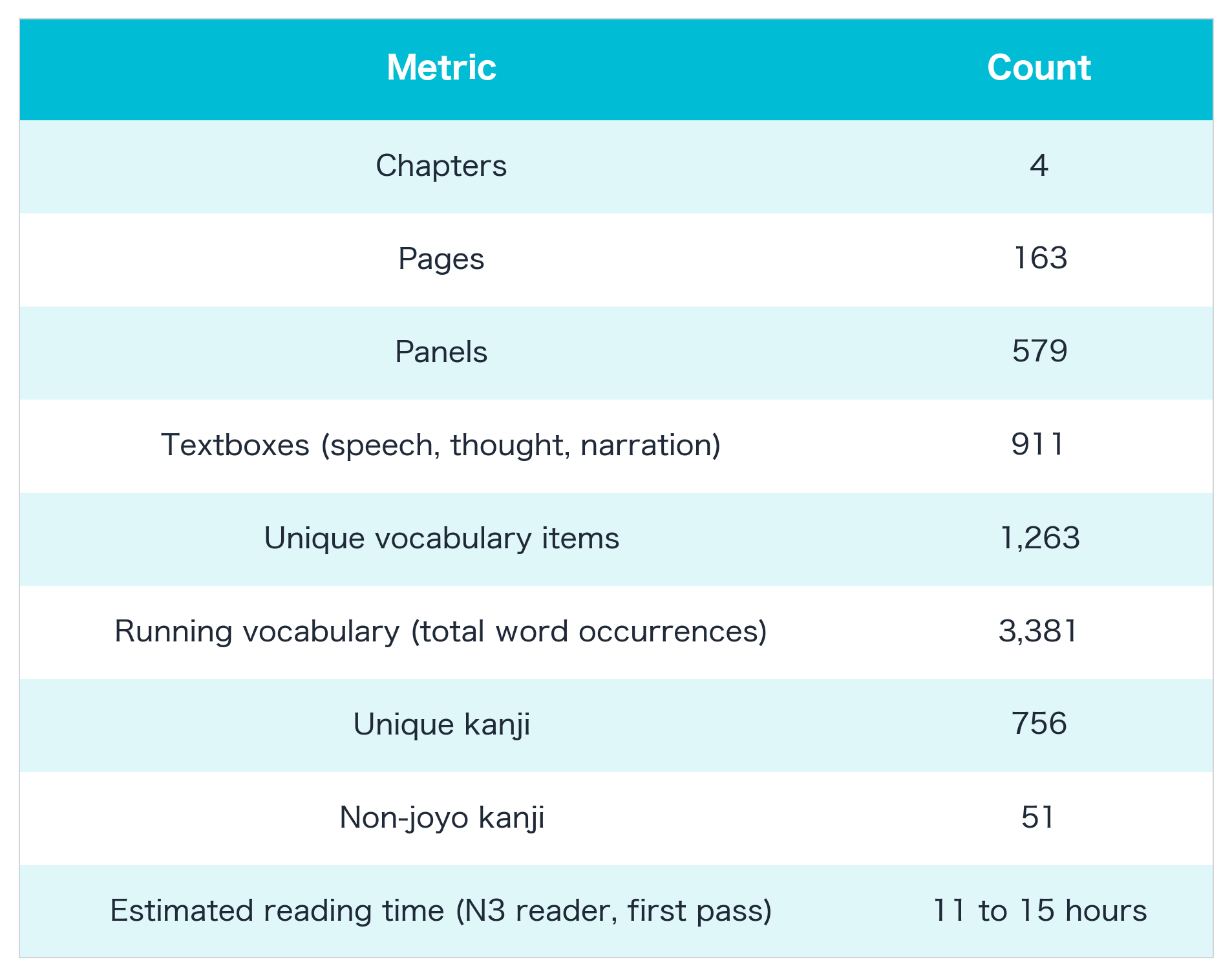
| Metric | Count |
|---|---|
| Chapters | 4 |
| Pages | 163 |
| Panels | 579 |
| Textboxes (speech, thought, narration) | 911 |
| Unique vocabulary items | 1,263 |
| Running vocabulary (total word occurrences) | 3,381 |
| Unique kanji | 756 |
| Non-joyo kanji | 51 |
| Estimated reading time (N3 reader, first pass) | 11 to 15 hours |
JLPT coverage
The 1,263 unique vocabulary items in volume 1 break down like this:
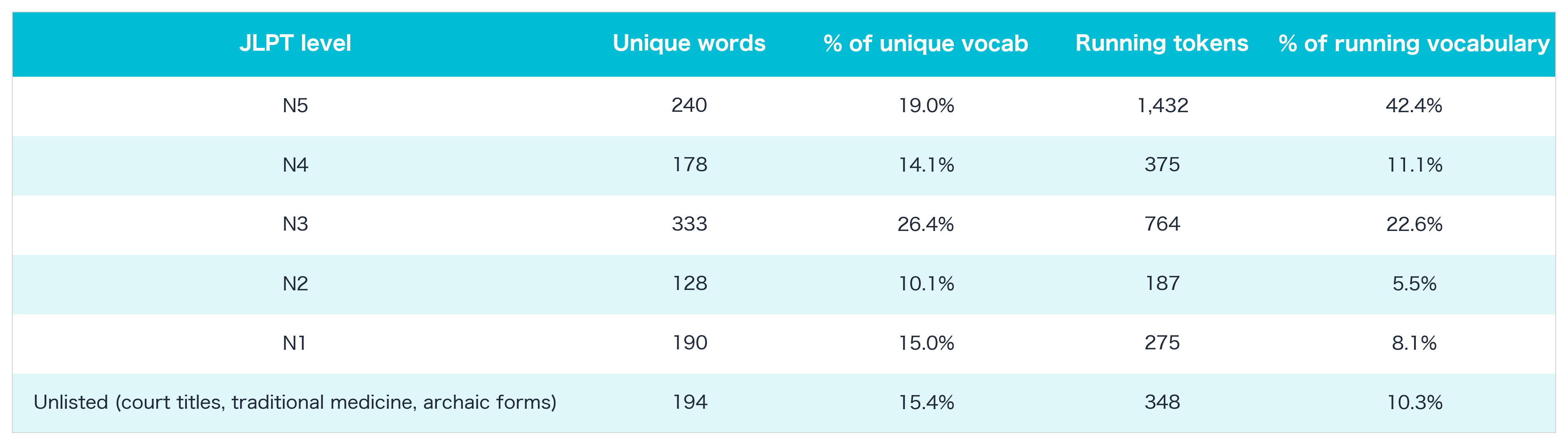
| JLPT level | Unique words | % of unique vocab | Running tokens | % of running vocabulary |
|---|---|---|---|---|
| N5 | 240 | 19.0% | 1,432 | 42.4% |
| N4 | 178 | 14.1% | 375 | 11.1% |
| N3 | 333 | 26.4% | 764 | 22.6% |
| N2 | 128 | 10.1% | 187 | 5.5% |
| N1 | 190 | 15.0% | 275 | 8.1% |
| Unlisted (court titles, traditional medicine, archaic forms) | 194 | 15.4% | 348 | 10.3% |
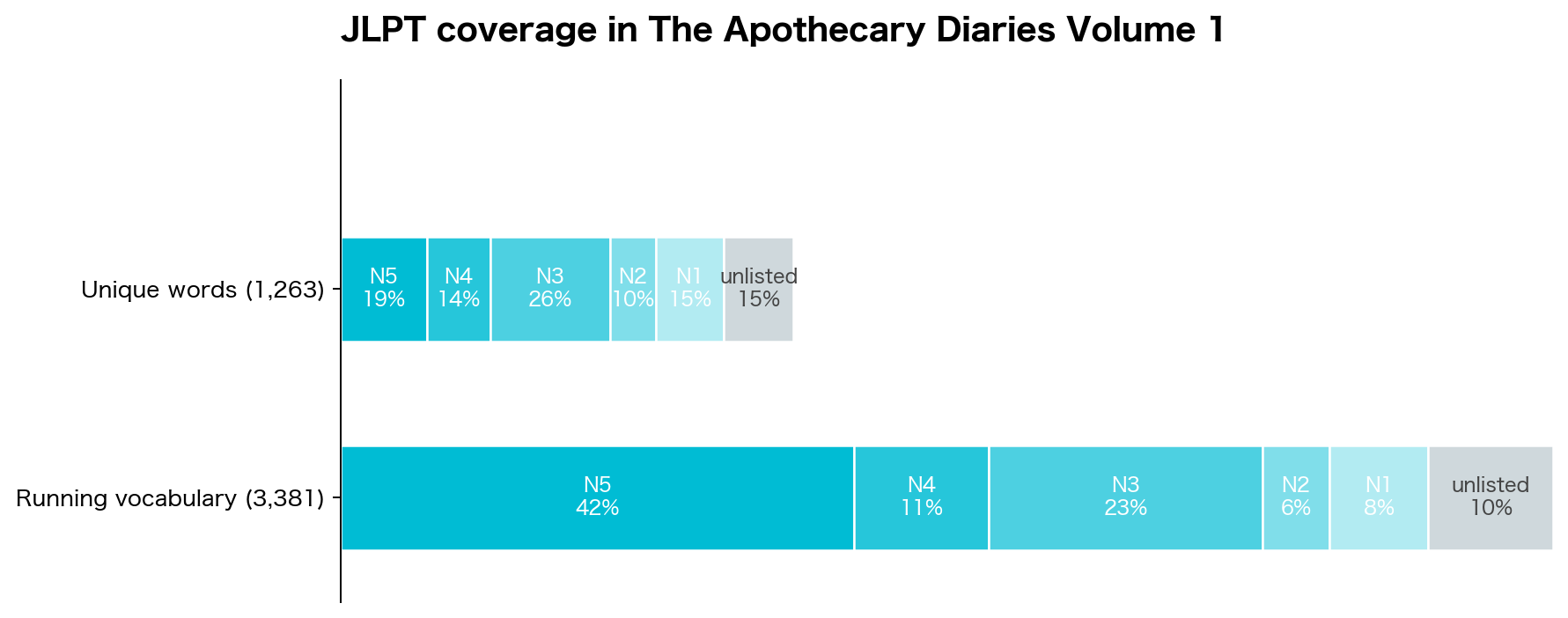
N5+N4 covers 53.5% of running tokens. Add N3 and you reach 76%. The unlisted bucket here is bigger than for JJK or FMA, and that is the story: Apothecary's court vocabulary lives outside the JLPT framework because the JLPT does not test palace politics or traditional Chinese medicine.
Reader guidance by level
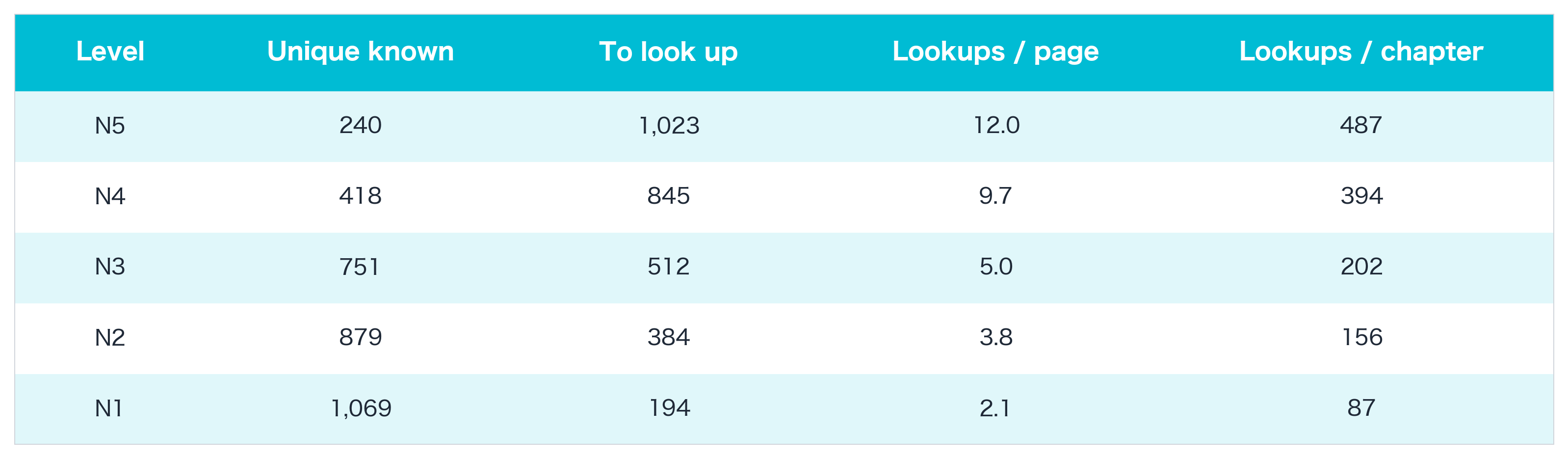
| Level | Unique known | To look up | Lookups per page | Lookups per chapter |
|---|---|---|---|---|
| N5 | 240 | 1,023 | 12.0 | 487 |
| N4 | 418 | 845 | 9.7 | 394 |
| N3 | 751 | 512 | 5.0 | 203 |
| N2 | 879 | 384 | 3.9 | 156 |
| N1 | 1,069 | 194 | 2.7 | 109 |
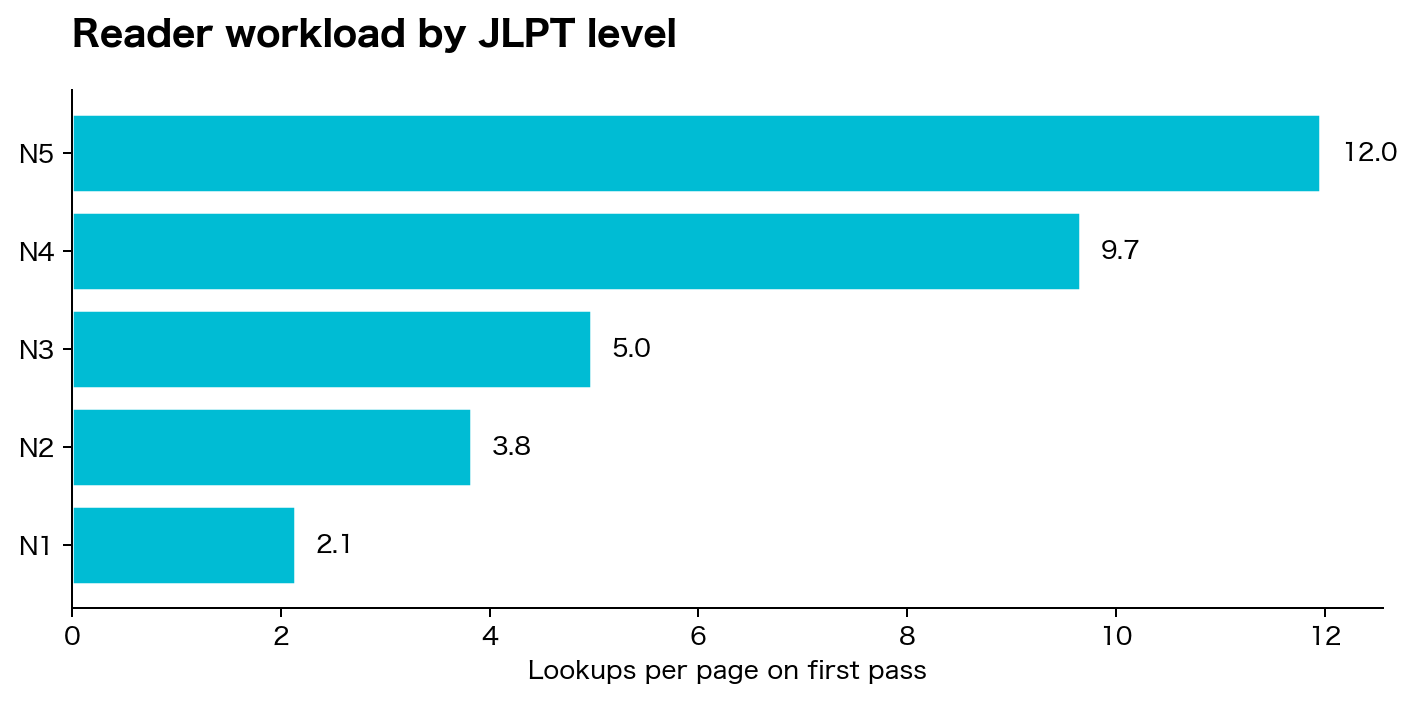
Lookups are unavoidable and painful, but you can lower the pain by completing the grammar foundation guide first. If you do not have kana yet, start there. That is table stakes.
N1 ≠ mastery
N1 means you passed a test. Real Japanese is not the test. Even N1 readers reading Apothecary for the first time will look things up. The unlisted bucket holds 194 unique words you will not have seen on any JLPT list. Plus first-encounter recognition for vocabulary you know from study but have not seen in flowing prose. Expect to look up roughly two to three words per page on a first pass through volume 1, even with N1 grammar locked in. The best way to learn real Japanese is to read real Japanese. Then you can pass any test.
Kanji
Apothecary volume 1 has 756 unique kanji on the page (counted from actual surface forms, not lemma headwords; words written in pure hiragana do not count). 705 are joyo. 51 are non-joyo. That non-joyo count is high relative to JJK (41) and FMA (22), and it skews toward court vocabulary that the joyo list simply does not include.
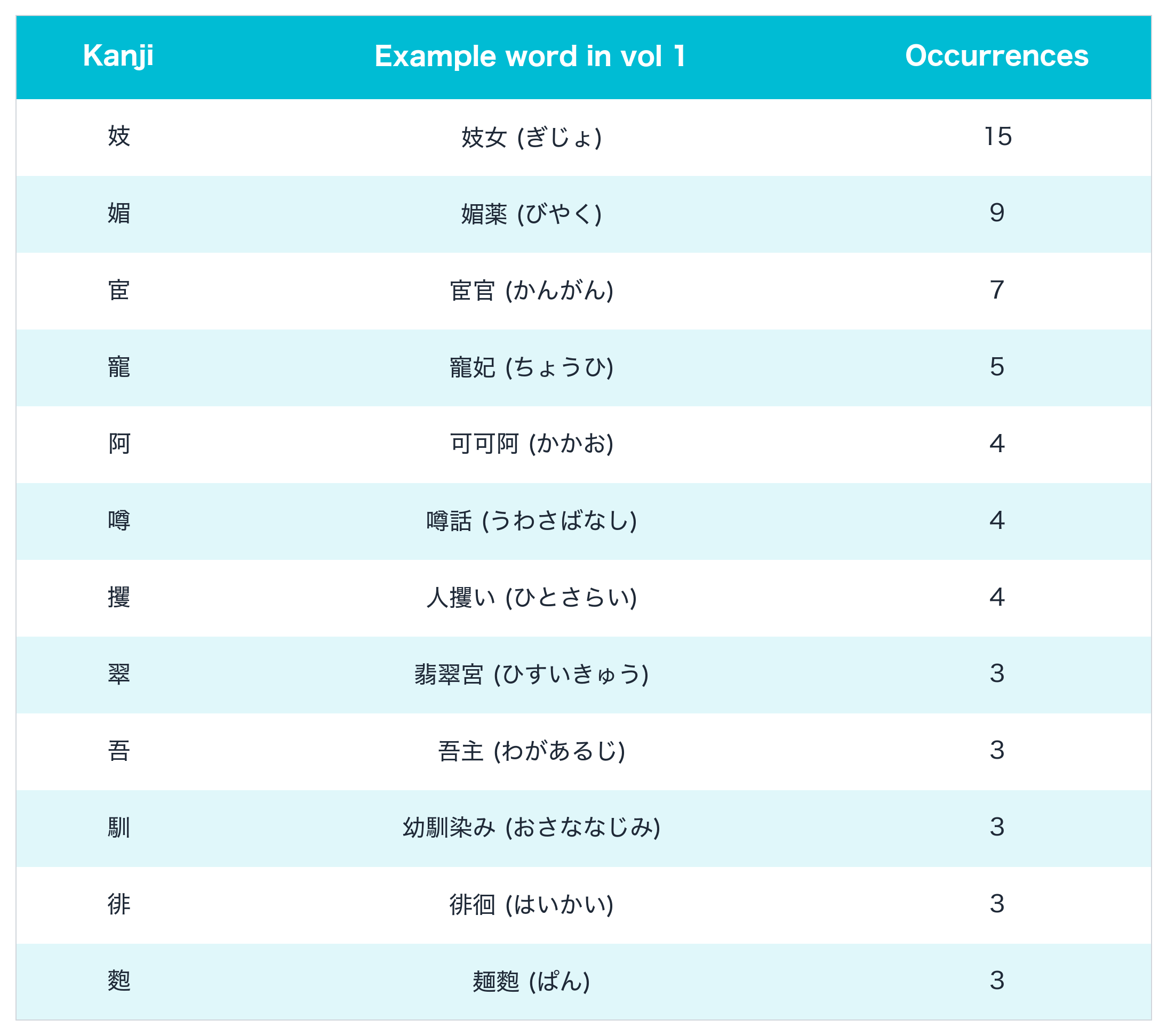
| Kanji | Example surface form in vol 1 | Occurrences |
|---|---|---|
| 妓 | 妓女 (ぎじょ, courtesan) | 15 |
| 媚 | 媚薬 (びやく, aphrodisiac) | 9 |
| 宦 | 宦官 (かんがん, eunuch) | 7 |
| 寵 | 寵妃 (ちょうひ, favored consort) | 5 |
| 阿 | 可可阿 (かかお, cocoa) | 4 |
| 噂 | 噂話 (うわさばなし, gossip) | 4 |
| 攫 | 人攫い (ひとさらい, kidnapper) | 4 |
| 翠 | 翡翠宮 (ひすいきゅう, Jade Palace) | 3 |
| 吾 | 吾主 (わがあるじ, my lord) | 3 |
| 馴 | 幼馴染み (おさななじみ, childhood friend) | 3 |
| 徘 | 徘徊 (はいかい, to wander) | 3 |
| 麭 | 麺麭 (ぱん, bread) | 3 |
Note 麺麭. The Apothecary author writes "bread" with the rare historical kanji compound to keep the period feel, even though every Japanese reader today writes the word in katakana as パン. This is the kind of typographic flourish you only get in historical-fiction manga, and it doubles the look-up cost on a word you already knew.
Frequency
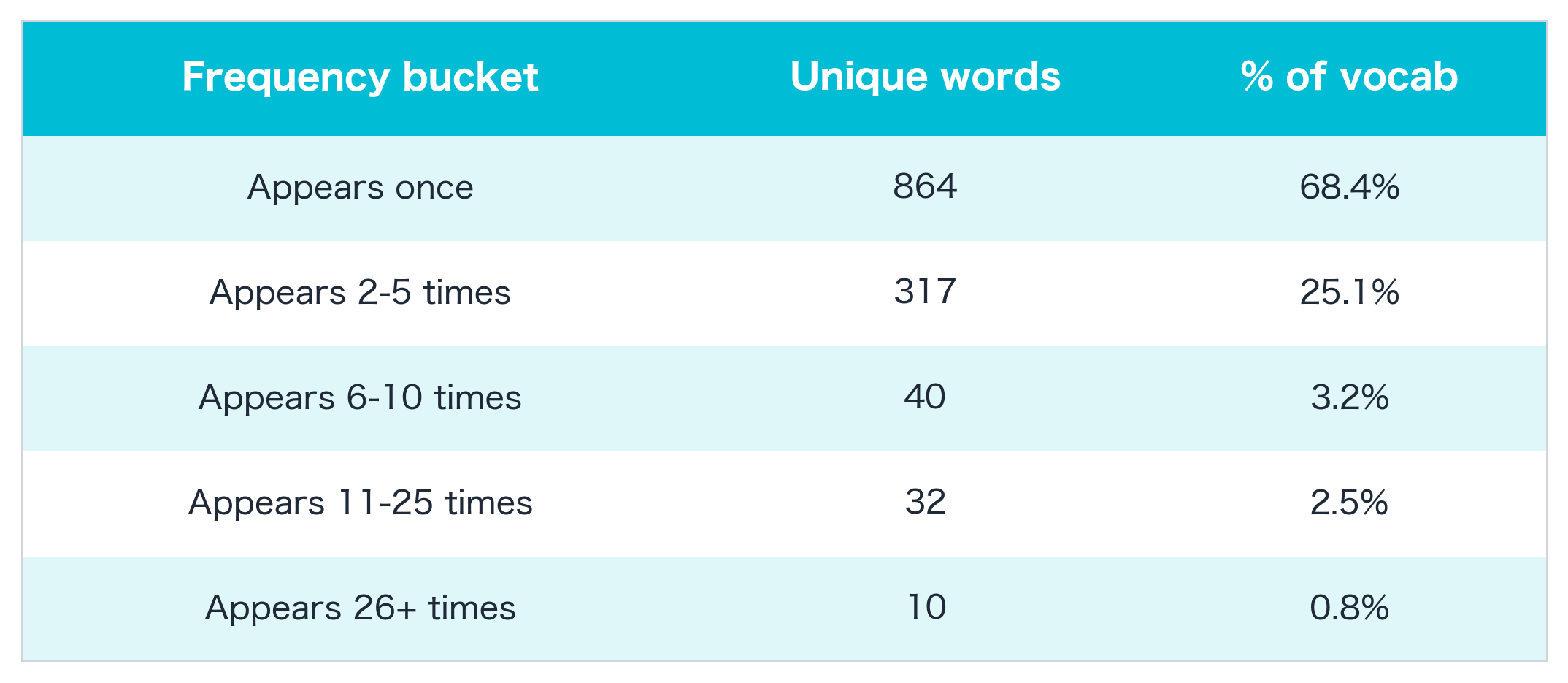
| Frequency bucket | Unique words | % of vocab |
|---|---|---|
| Appears once | 864 | 68.4% |
| Appears 2-5 times | 317 | 25.1% |
| Appears 6-10 times | 40 | 3.2% |
| Appears 11-25 times | 32 | 2.5% |
| Appears 26+ times | 10 | 0.8% |
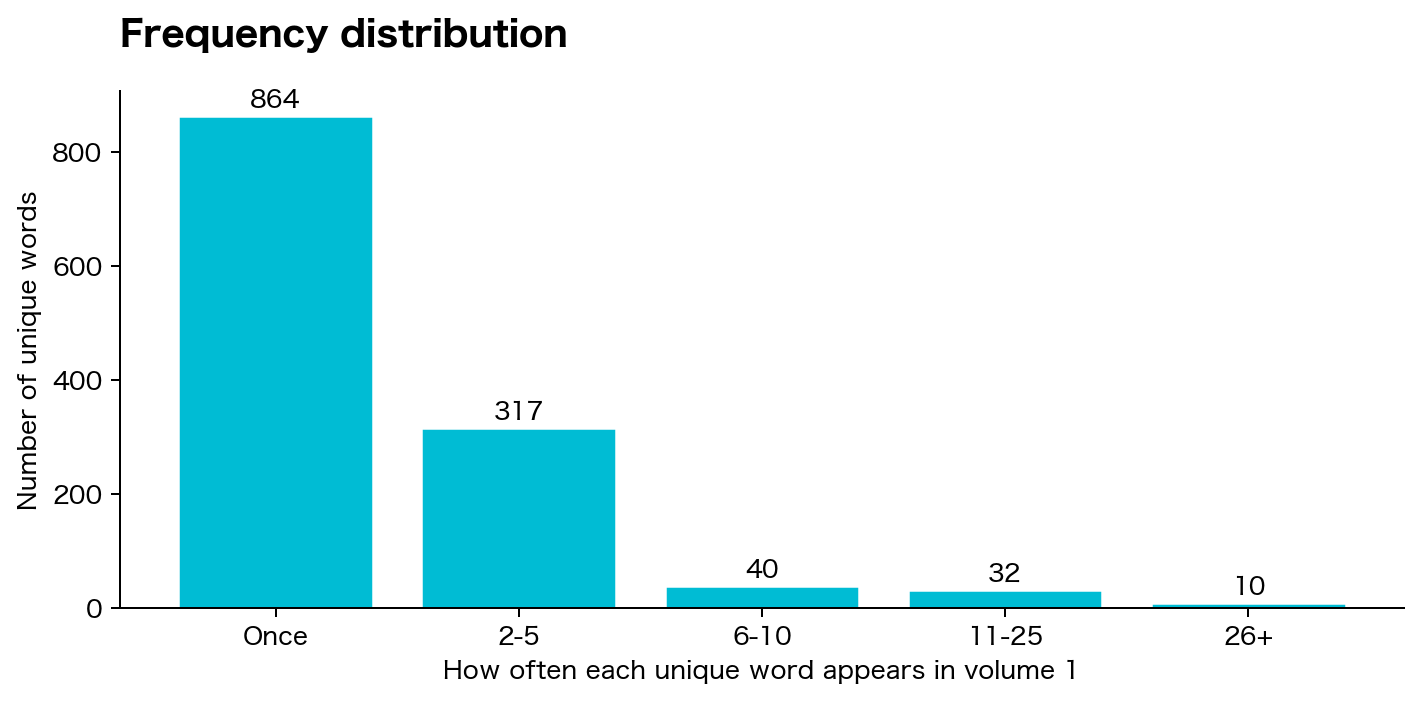
68% of the unique vocabulary appears exactly once. Higher long-tail share than JJK (66%) or FMA (67%). Many recur across the series. Volume 1 alone will not give you the spaced-repetition benefit on those words. The 10 words at the head of the curve carry the panels.
The 20 most frequent content words
Pre-study these 20 and you have learned the most common content words on almost every page. By the time you finish volume 1, all 20 are locked into your memory just from how often they appear, if they were not already.
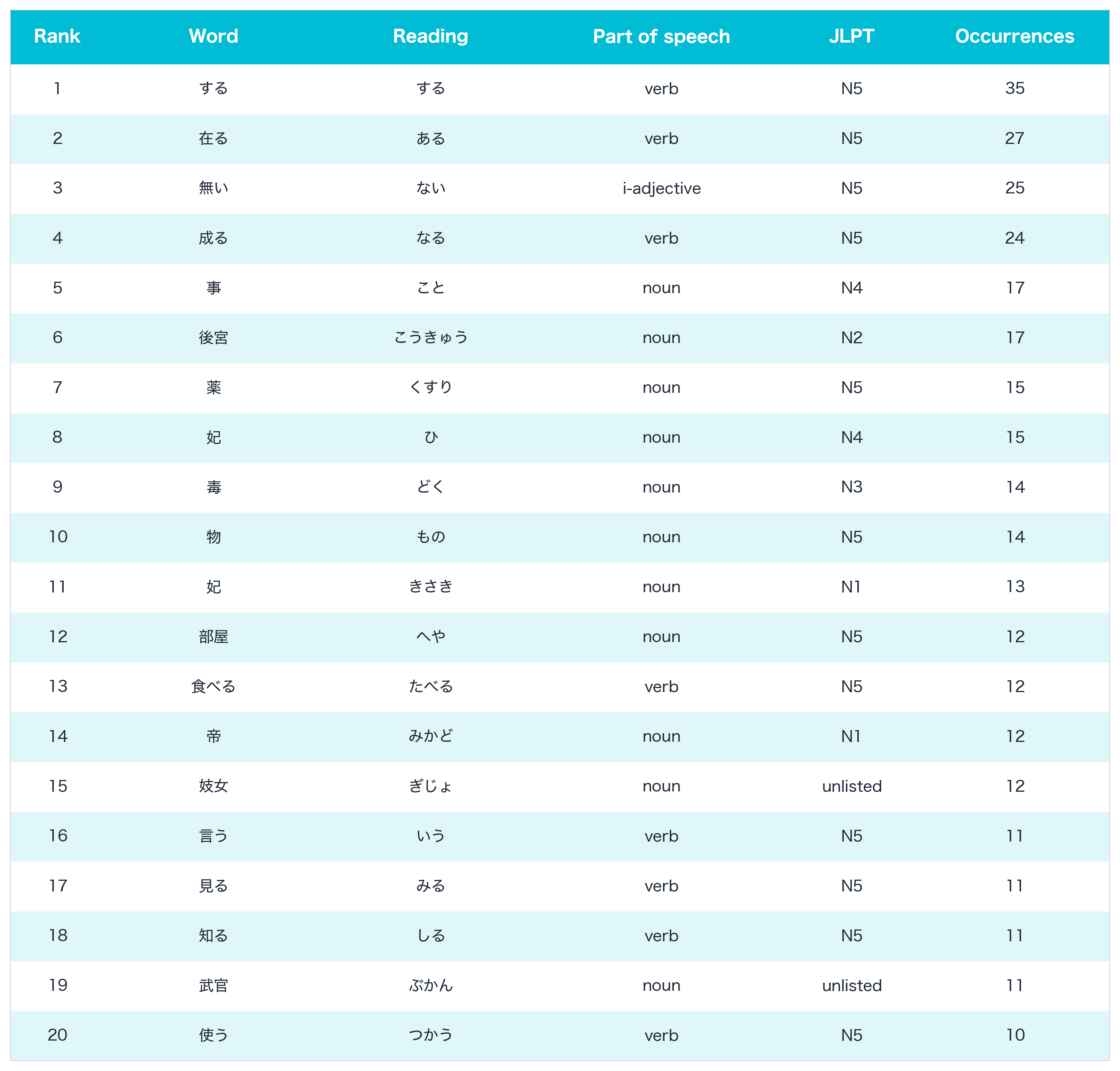
| Rank | Word | Reading | Part of speech | JLPT | Occurrences |
|---|---|---|---|---|---|
| 1 | する | する | verb | N5 | 35 |
| 2 | 在る | ある | verb | N5 | 27 |
| 3 | 無い | ない | i-adjective | N5 | 25 |
| 4 | 成る | なる | verb | N5 | 24 |
| 5 | 事 | こと | noun | N4 | 17 |
| 6 | 後宮 | こうきゅう | noun | N2 | 17 |
| 7 | 薬 | くすり | noun | N5 | 15 |
| 8 | 妃 | ひ | noun | N4 | 15 |
| 9 | 毒 | どく | noun | N3 | 14 |
| 10 | 物 | もの | noun | N5 | 14 |
| 11 | 妃 | きさき | noun | N1 | 13 |
| 12 | 部屋 | へや | noun | N5 | 12 |
| 13 | 食べる | たべる | verb | N5 | 12 |
| 14 | 帝 | みかど | noun | N1 | 12 |
| 15 | 妓女 | ぎじょ | noun | unlisted | 12 |
| 16 | 言う | いう | verb | N5 | 11 |
| 17 | 見る | みる | verb | N5 | 11 |
| 18 | 知る | しる | verb | N5 | 11 |
| 19 | 武官 | ぶかん | noun | unlisted | 11 |
| 20 | 使う | つかう | verb | N5 | 10 |
Particles, auxiliary verbs, pronouns, conjunctions, proper nouns, and adnominals are excluded so the list surfaces meaningful content words.
Note 妃 appearing twice. The same kanji has two readings used in volume 1: ひ (the formal Japanese reading, used in titles like 玉葉妃, Gyokuyou-hi) and きさき (the older on-yomi-adjacent reading used in narrative voice). The manga uses both. Furigana tells you which is which on every appearance.
How each main character speaks
猫猫 (Maomao)
The protagonist apothecary, a teenage girl from the pleasure district who ends up working in the rear palace. Her thought-bubble narration is plain-form Japanese with deliberate clinical word choices: 致死量 (lethal dose), 毒物 (poison), 分類する (classify), 効く (take effect). Her spoken dialogue is more casual, often clipped, with a flat affect that the manga uses for comedy. She codes between informal and analytical mid-paragraph.
壬氏 (Jinshi)
The handsome eunuch who keeps pulling Maomao into investigations. His spoken Japanese is smooth, courtly, and indirect. He uses elevated polite forms in court, drops them when alone with Maomao, and frequently uses 一人称 (first-person pronoun) 私 (わたし) instead of the more masculine 俺 (おれ). The contrast between his spoken register and his actual position is part of his character.
玉葉妃 (Gyokuyou-hi)
A high-ranking consort who becomes Maomao's patron. Speaks in keigo (敬語) with a gentle, teasing edge. Uses imperial-court honorifics around Maomao, including ~なさい forms and ~でしょう that read as soft commands. Her speech is the cleanest example of formal court Japanese in volume 1.
The narrator
Anonymous third-person narration sets the historical-court tone. The narrator uses literary forms: ~である copula instead of ~です, classical-leaning vocabulary, and occasional archaic nominal phrases. This is where the unlisted vocabulary cluster sits heaviest. If you are coming straight from Genki, these passages will feel like a different language. Read them slowly the first time, then again with the translation in hand to confirm parsing.
Expressions with depth
後宮 (こうきゅう, the rear palace)
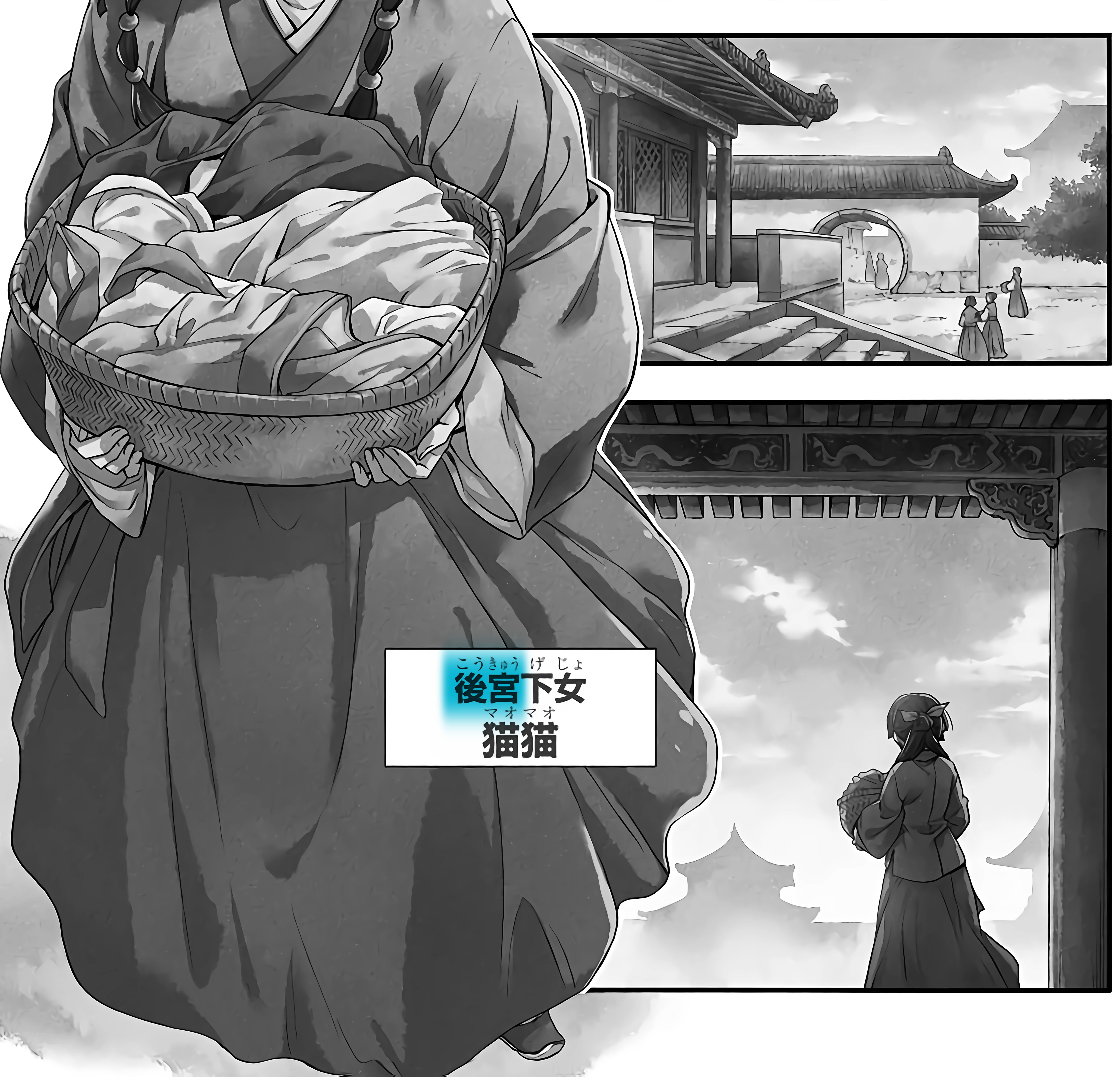
The rear palace is the institution at the center of Apothecary. The word combines 後 (back, rear) and 宮 (palace, shrine). Historically the rear palace housed the emperor's consorts and their retinue, separated from the front court of state business. The manga treats it as an enclosed political world with its own hierarchy, factions, and unwritten rules. Every Maomao mystery in volume 1 is a 後宮 mystery.
宦官 (かんがん, eunuch)
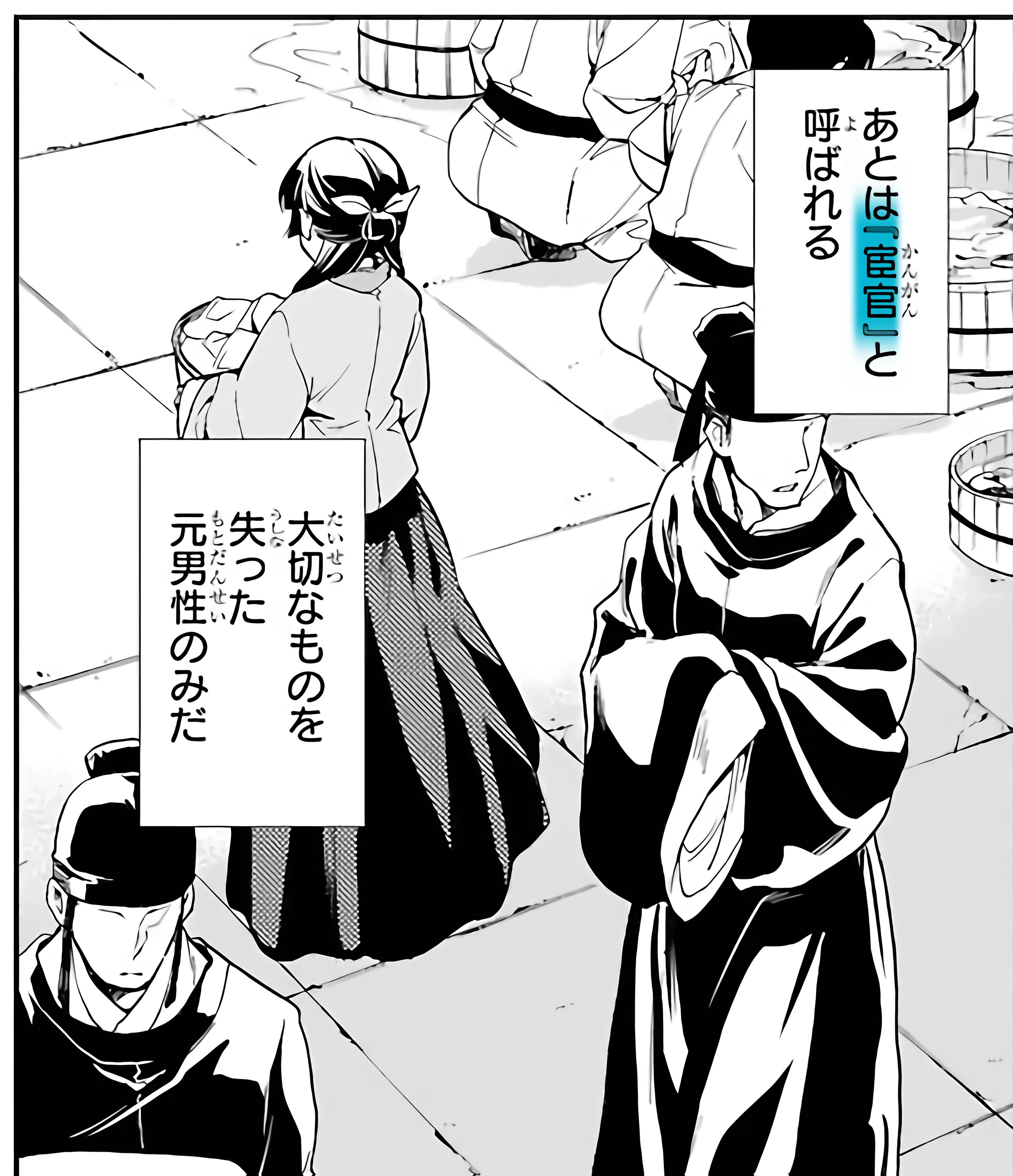
A castrated male court official, historically employed in Chinese imperial palaces because they could safely move between the emperor's consorts without political risk. The kanji 宦 is non-joyo. The status is ambiguous and dramatic: not fully man, not woman, fully powerful in palace logistics. Jinshi's entire arc hinges on the word.
妓女 (ぎじょ, courtesan)
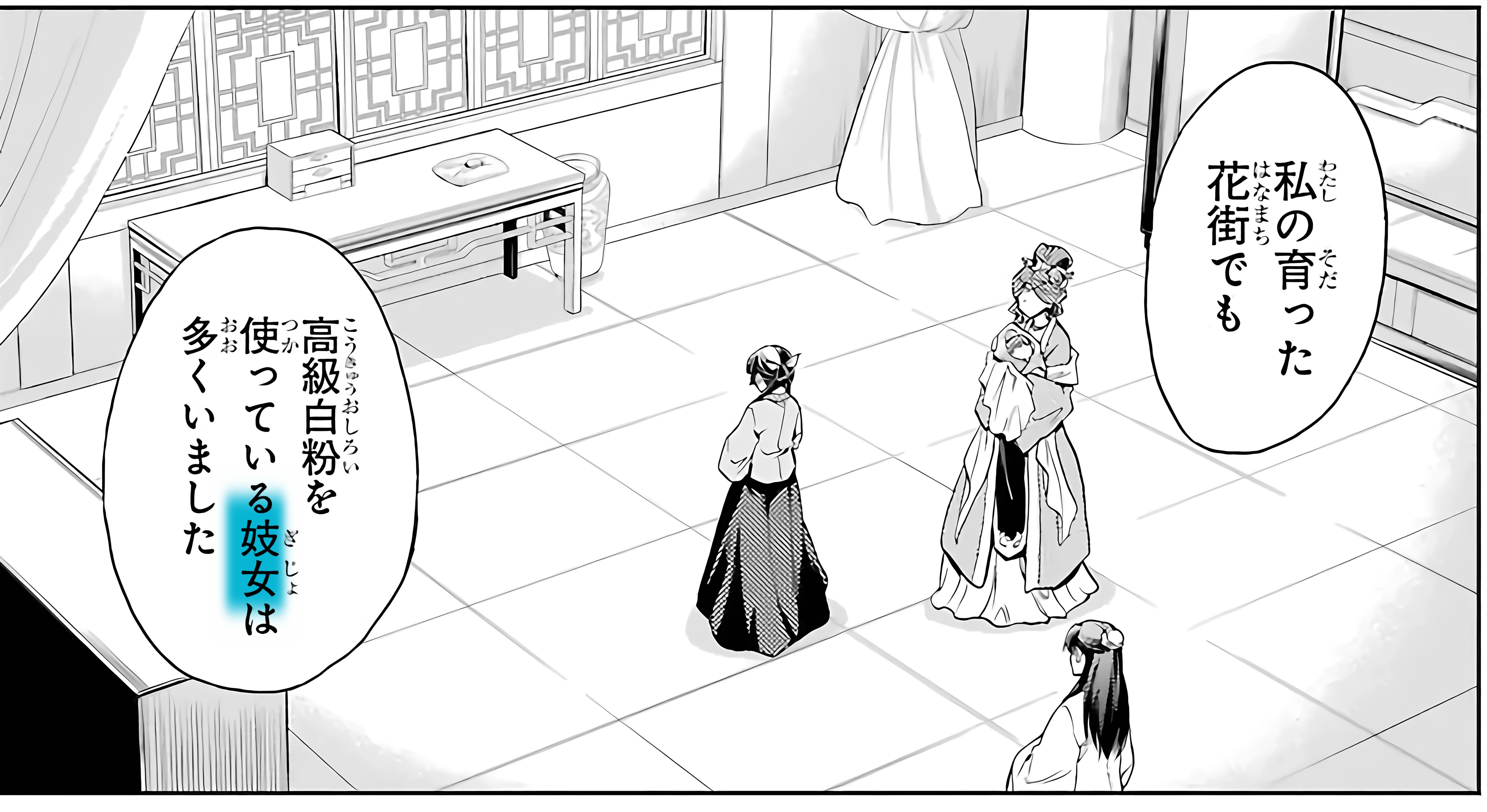
Maomao's pre-palace world. A 妓女 is a high-class entertainer-courtesan, trained in music, conversation, and (in this manga) traditional medicine. Both characters 妓 and 女 appear together specifically for this profession; 妓 is non-joyo and only shows up in related compounds like 妓楼 (ぎろう, courtesan's quarters). When Maomao narrates her upbringing, this word does the work.
寵妃 (ちょうひ, favored consort)
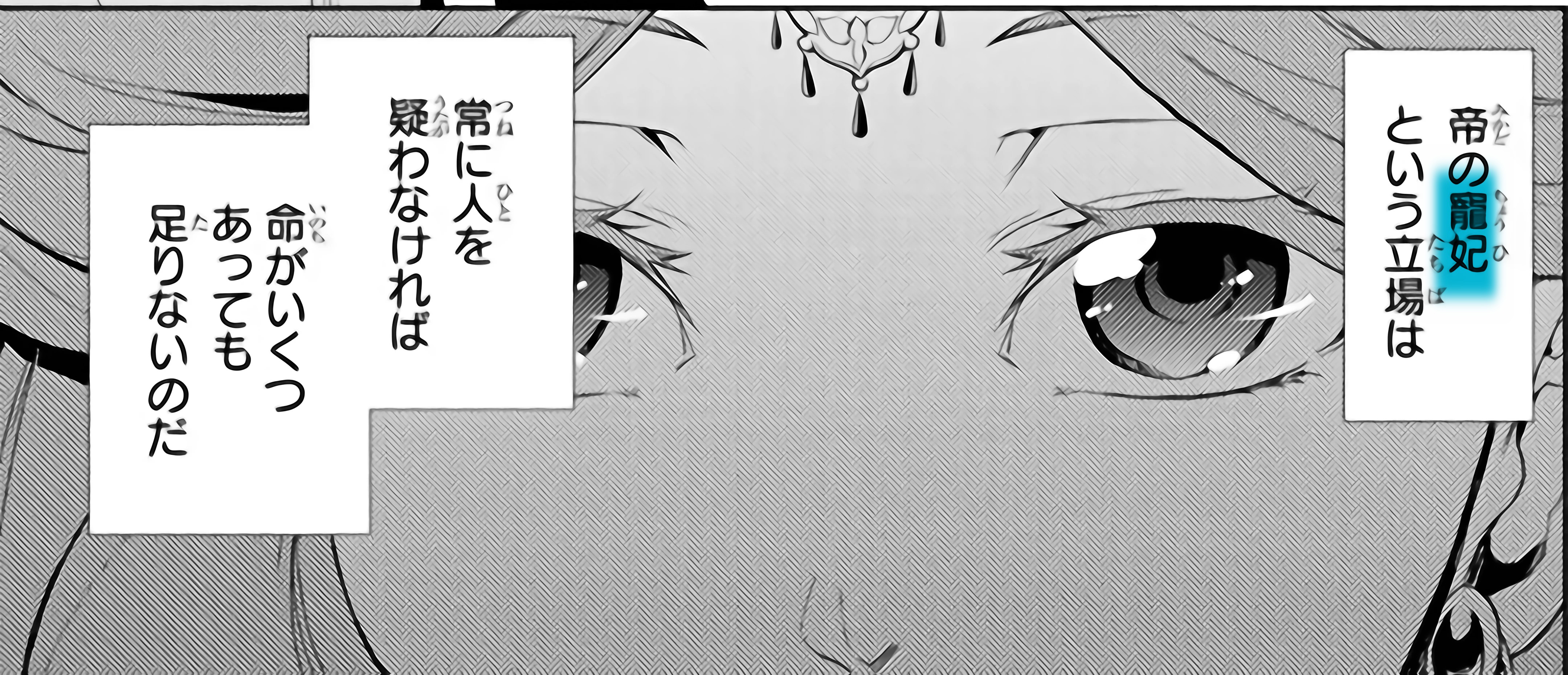
A consort who currently has the emperor's favor. 寵 (favor, affection) is non-joyo. Apothecary uses the word matter-of-factly, as a job title. The consort hierarchy in volume 1 runs from 妃 (consort) up through 貴妃 (high consort) to 皇后 (empress), and where a character sits on that ladder determines the politics of every chapter.
下賜 (かし, bestowed by a superior)
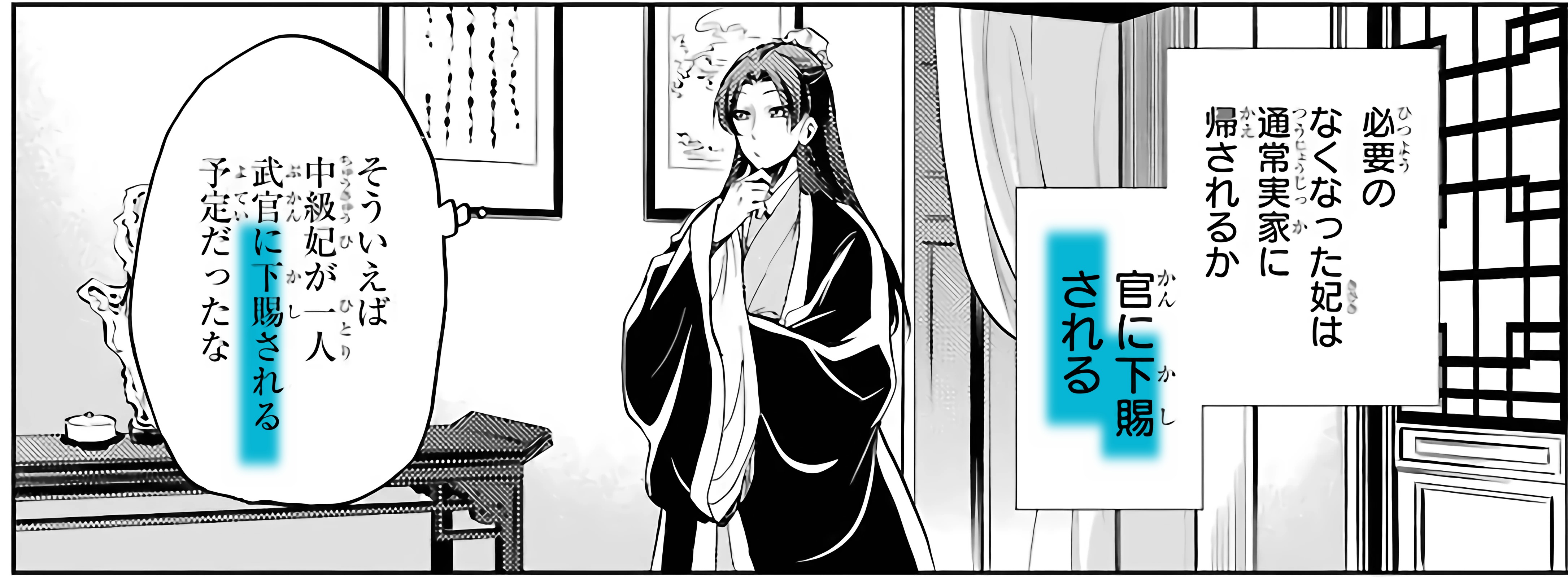
A formal verb meaning to bestow or grant from a superior to an inferior, often used for the emperor handing down gifts, titles, or in volume 1, consorts to military officers. The opposite verb is 献上 (けんじょう, to present upward). Both come up in court Japanese and are essentially never used in modern speech. The manga treats them as ordinary palace vocabulary.
Pop culture and context in volume 1
The setting is fictionalized Tang-dynasty China filtered through Heian-court Japanese sensibility. The names are pseudo-Chinese (玉葉, 梨花, 壬氏) but the court structure, vocabulary, and aesthetic match Heian Japan as closely as they match historical China. The manga is comfortable with that ambiguity. So is the anime.
Traditional Chinese medicine vocabulary. 生薬 (raw medicines), 薬種 (drug types), 媚薬 (aphrodisiac), 毒消し (antidote). Maomao is fluent in this domain because she was raised by an apothecary in the pleasure district. Her vocabulary is your vocabulary challenge for volume 1. If you have read other historical period manga or medicine manga, you already have a head start.
Court hierarchy and titles. 上級妃, 中級妃, 下級妃 (upper / middle / lower consorts), 貴妃 (high consort), 武官 (military officer), 文官 (civil official), 帝 (emperor). These appear constantly in the political plot and almost never in modern Japanese. Pre-studying the title hierarchy pays for itself in chapter 1.
Maomao's freckles. She covers them on purpose to look plainer in the rear palace. The word is そばかす, written in hiragana in the manga. It is not a hard word but it is the running joke / character marker of volume 1.
Inside the app: one panel, fully broken down
Reading manga in Japanese is, at the bottom of it, a vocabulary-acquisition problem. Let me get you one word: 媚薬. All the context around it is broken down here the same way The Ashiba App provides it, so you finish this section actually understanding the word, not just having seen it.
Chapter 3, page 33: alcohol as medicine

Scroll the image sideways to read the Japanese in full size.
Summary. Maomao explains, in her clinical thought-bubble voice, why the unfamiliar foreign 麺麭 (bread) is functioning as an aphrodisiac for the consorts: medicine works on the people most sensitive to it, and a region's unfamiliar food is, by definition, a stimulant.
Textbox 1
JP: 酒は薬の一つだと分類する
EN: Alcohol is classified as a type of medicine.
Overview: Maomao opens with the clinical premise that frames the rest of her deduction.
Breakdown:
- 酒 (さけ): alcohol; sake
- 薬 (くすり): medicine
- 一つ (ひとつ): one (counter)
- 分類する (ぶんるいする): to classify
Textbox 2
JP: 薬とは刺激に弱い人間ほどよく効く
EN: As for medicine, it is more effective on people who are sensitive to stimulation.
Overview: The general principle. Sensitivity to stimulation is the lever.
Breakdown:
- 薬とは: as for medicine; topic-marker introduction
- 刺激 (しげき): stimulation, stimulus
- 弱い (よわい): weak; sensitive
- 人間 (にんげん): person, human
- 〜ほどよく: the more X, the more...; comparative pattern
- 効く (きく): to take effect, work
Textbox 3
JP: この場では媚薬になるこの麺麭も
EN: Even this bread, which acts as an aphrodisiac in this setting...
Overview: Apply the principle to the specific weird foreign food.
Breakdown:
- この場 (このば): this place, this setting
- 媚薬 (びやく): aphrodisiac
- 麺麭 (ぱん): bread, written in archaic kanji for period flavor
- も: even, also
Textbox 4
JP: 原産地域では効かないだろう
EN: ...likely wouldn't have any effect in its region of origin.
Overview: The conclusion. Familiarity neutralizes the stimulant effect.
Breakdown:
- 原産 (げんさん): origin (of a product)
- 地域 (ちいき): region, area
- 効かない (きかない): does not take effect; negative form of 効く
- だろう: probably; speculative copula
Key points
- 媚薬 (びやく): aphrodisiac. The word stacks 媚 (to flirt, to flatter) with 薬 (medicine). Specific to traditional medicine vocabulary; you will see it again across the series.
- 〜ほどよく: a comparative pattern meaning "the more X, the more Y." Common in clinical / explanatory prose.
- 麺麭: an archaic kanji compound for "bread." Modern Japanese uses パン (from Portuguese pão). The manga uses the archaic compound to keep the period feel.
How to actually read volume 1
- Get a foundation. How much you need depends on how much discomfort you can sit with. Genki I and II is the polished path. At a minimum, lock in N5. Apothecary will be brutal at N5 but readable; without N5 it is a wall.
- Start with chapter 1. Take your time. Not a week. Not a day. This is the first chapter of historical-court manga you have ever read in Japanese. Set a timer for 15 minutes. Early on, you crack one to three sentences in that window. Later, you crack a full chapter. Consistency compounds. Rack up the reps.
- When you get stuck, reference the translation. Looking things up is not failure. It is learning. The fastest way to get unstuck is to see the answer and understand why the sentence means what it means. Goal: parse the sentence. Match the English to the Japanese, identify the word or grammar that blocked you, and move on. You will hurdle (probably in chapter 1 when the rear-palace exposition starts, or chapter 3 when the medical reasoning gets dense). Those panels are loaded. The answer is not to grind harder. The answer is what I wrote about in Why You Will Quit Learning Japanese: put the book down and come back tomorrow.
The Takeaway
The main reason reading manga in Japanese is hard is the sheer amount of vocabulary you do not know.
Most readers never get past this. The pain is too great. The effort-to-reward ratio collapses, and the book gets shelved.
The easiest way out is to pre-study the words you do not know that will appear in the chapter you are about to read. The Ashiba App does this for every chapter of every series I cover. It surfaces the vocabulary, shows readings and POS, and includes grammar breakdowns so you see how each word is being used. Nothing is studied in isolation. Every flashcard carries its full panel context. You see the word in the sentence in the panel where it lives.
Frequently asked questions
Should I watch the anime before reading The Apothecary Diaries in Japanese?
Yes. The 2023 anime is one of the best-translated palace dramas ever produced and the early episodes track volume 1 closely. Watch the first arc, then read volume 1, then watch again. The dialogue patterns repeat across both formats and seeing the visual context for unfamiliar court vocabulary helps it stick.
Do I need to know all the kanji before starting?
No. You need kana. That is the hard prerequisite. Furigana is provided everywhere. The non-joyo kanji come with their reading every time they appear, including 妓, 媚, 宦, 寵. Pick them up by repetition. If you have not finished kana yet, start there.
How long does it take to read Apothecary volume 1 in Japanese?
For an N3 reader on a first pass, plan for 11 to 15 hours of focused reading time spread across a few weeks. An N4 reader will spend more time in the dictionary; budget closer to 20 hours. An N1 reader will read it in 5 to 7 hours but still pause on court vocabulary. This volume is denser per page than JJK or FMA.
Do I need to read volume 1 first or can I start anywhere?
Follow the fun. If a different volume or arc is pulling you harder, start there. The reasons to pick volume 1 anyway: the rear-palace setup and core vocabulary (後宮, 妃, 宦官, 妓女, 武官) are introduced here, and almost every later mystery references the chapter-1 cast.
Where can I buy Apothecary Diaries volume 1 in Japanese?
Free preview: read chapter 1 in Japanese on Manga UP!, Square Enix's official reader (chapter previews in the browser; full chapters via the Manga UP! mobile app). For the English translation, chapter 1 is free in your browser on Manga UP! Global. Digital recommendation: the Kindle store on Amazon Japan, or BookWalker, both carry the full series. Physical paperback also via Amazon Japan or BookWalker. Note there are two manga adaptations: the one in this article's corpus is the original 薬屋のひとりごと (drawn by ねこクラゲ, published by 月刊ビッグガンガン). The alternate adaptation, 薬屋のひとりごと~猫猫の後宮謎解き手帳~ (published in 月刊サンデーGX), tells the same story with different art and a different chapter cadence. Either is excellent.